


EXECUTIVE SUMMARY
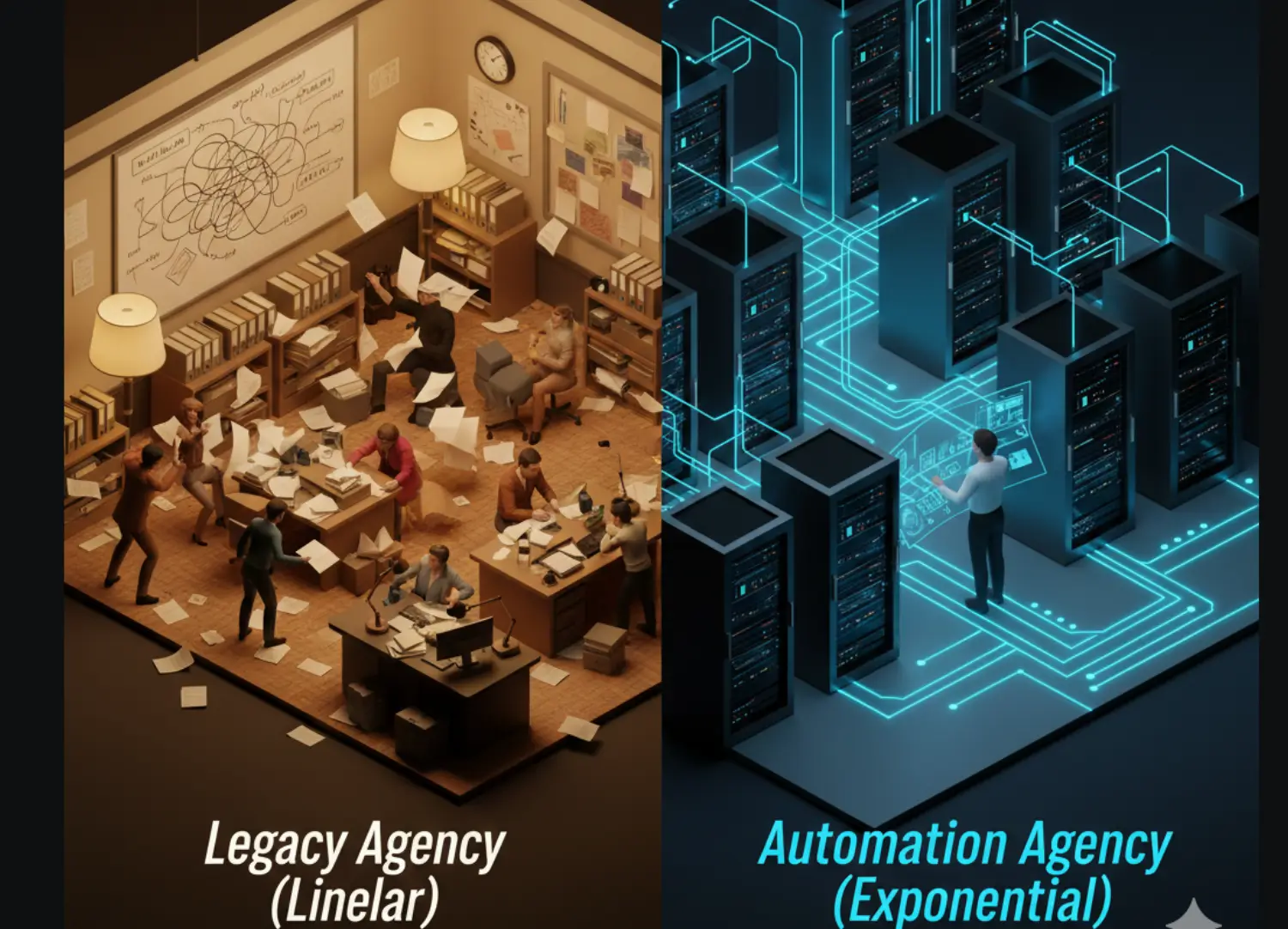
- The Problem: Traditional agencies trade time for money. To make more revenue, you must hire more humans. This creates a low margin, high stress trap known as the Headcount Ceiling.
- The Shift: The automation agency model breaks this link. You do not sell hours; you sell deployed logic. You build a solution once and license/install it for multiple clients.
- The Imperative: Stop building a service business. Start building a systems integrator.
INTRODUCTION
The Agency world is currently divided into two eras:
- Legacy Agencies 2010 to 2024: They sell management. e.g., Social Media Management, Ad Management. They are bloated with account managers and suffer from 30% margins.
- Sovereign Agencies 2026+: They sell infrastructure.
The automation agency model is superior because it is deflationary. Your cost to service the 10th client is lower than the 1st because you are reusing code blocks, scenarios, and architecture. You are not doing the work; you are installing the robot that does the work.
At RankSquire, we argue that if you cannot scale revenue without scaling headcount, you do not have a business; you have a nursery for adults.
Table of Contents
THE FAILURE MODE (THE PEOPLE TRAP)
The Old Way relies on Linear Scaling.
- The Margin Squeeze: In a traditional agency, labor is 50-60% of revenue. In an automation agency, labor is <20%. The workers are servers running n8n workflows.
- The Churn Reality: Clients fire traditional agencies because performance dipped. Clients never fire an automation agency because removing the software breaks their business. You become utility grade infrastructure.
- The Valuation Gap: Service agencies sell for 1x revenue (if lucky). Agencies using the automation agency model trade closer to SaaS multiples (4x–6x) because the revenue is sticky and tech enabled.
The Metric of Failure:
Legacy agencies track Billable Hours. Automation agencies track Asset Utilization. If you are still tracking hours in 2026, you are already obsolete.
Automation Engineering Services
THE ARCHITECTURE (THE 3-TIER STACK)

We structure the automation agency model around three distinct revenue layers.
1. The Build Fee (High Ticket)
- What it is: The setup cost to architect and deploy the system.
- Pricing: $5,000 – $25,000 one-time.
- Logic: This covers the discovery, the mapping, and the initial configuration. It filters out non-serious clients.
- Cash Flow Role: This funds your growth and acquisition.
2. The Maintenance Retainer (Recurring)
- What it is: The Insurance Policy to keep the automation running.
- Pricing: $500 – $2,000 / month.
- Logic: APIs change. Tokens expire. Clients need tweaks. You charge for Availability, not Activity.
- Cash Flow Role: This covers your OpEx and base salaries.
3. The Licensing Fee (Pure Profit)
- What it is: Access to your proprietary IP (e.g., a custom AI Agent or a proprietary database).
- Pricing: Variable / Usage-based.
- Logic: If you built a Real Estate Recruitment Bot, you can license it to 50 brokerages. You build it once, sell it infinitely.
- Cash Flow Role: This is where wealth is generated.
THE ECONOMICS (SAAS MARGINS, SERVICE PRICES)
The automation agency model allows you to charge like a consultant but operate like a software company.
| Metric | Marketing Agency | Automation Agency |
| Primary Cost | Humans (Account Managers) | Compute (Servers/APIs) |
| Client Onboarding | 30 Days (Meetings) | 48 Hours (Configuration) |
| Revenue/Employee | $150,000 | $450,000+ |
| Client Retention | 6–12 Months | 3–5 Years |
| Moat | Relationship-based | Infrastructure-based |
The Asset Reality:
When a client tries to leave a Marketing Agency, they just change passwords. When they try to leave an Automation Agency, they have to rip out their entire operational nervous system. High switching costs equal high retention.
([Automation Agency Retainer])
THE TECHNICAL STACK
To run this model, you need a Fleet Management mentality.
- The Blueprint Library: You need a repo of pre-built n8n workflows. You should never start from a blank canvas.
- The Documentation Hub: Tools like GitBook or Notion. You must document the system so the client feels they own an asset, not a mystery box.
- The Monitoring System: Tools like Sentry or n8n execution logs. You must know an automation failed before the client does.
CONCLUSION
The golden age of Social Media Marketing Agencies (SMMA) is over. The market is saturated, and AI is eating the content creation tasks.
The automation agency model is the next frontier. It targets the boring back office problems invoicing, data entry, lead routing that AI solves perfectly.
You have two choices:
- Manage people who manage problems.
- Build robots that solve them.
Stop selling services. Start selling sovereignty.
FAQ: OBJECTIONS & RISKS
1. Is this just SaaS?
No. SaaS is Do It Yourself software. This is Done For You infrastructure. Clients don’t want to learn n8n; they want the result. You bridge the gap between complex tools and business outcomes.
2. How do I hire for this?
Do not hire Marketers. Hire Systems Thinkers or Junior Engineers. You need people who understand logic, If This, Then That, not people who understand hashtags.
3. Is the market big enough?
Every business with over $1M in revenue has at least one Excel Sheet process that is slowing them down. That is your market. It is virtually infinite.
FROM THE ARCHITECT’S DESK
I consulted for an agency owner doing $80k/mo with 12 staff. His profit was $8k/mo. He was miserable.
We pivoted him to the automation agency model. He fired 8 staff members, stopped offering Social Media, and focused purely on Sales Operation Automation.
Result: Revenue dropped to $60k/mo, but profit jumped to $45k/mo. He works 20 hours a week.
THE ARCHITECT’S CTA
If you are an agency owner tired of the Headcount Trap, or an engineer looking to commercialize your skills, this is the blueprint.
If you are ready to pivot to the automation agency model and build high-margin infrastructure. Stop being a Hustler. Become the Architect.
Every automation I build is bespoke, real, and ready to scale your business. No demos, no templates just results.
Apply to work with me today → Application Form




Comments 1