
AI News
  • HOME
  • BLUEPRINTS
  • SALES
  • TOOLS
  • OPS
  • GUIDES
  • STRATEGY
  • ENGINEERING
No Result
View All Result
SAVED POSTS
AI News
  • HOME
  • BLUEPRINTS
  • SALES
  • TOOLS
  • OPS
  • GUIDES
  • STRATEGY
  • ENGINEERING
No Result
View All Result
RANK SQUIRE
No Result
View All Result
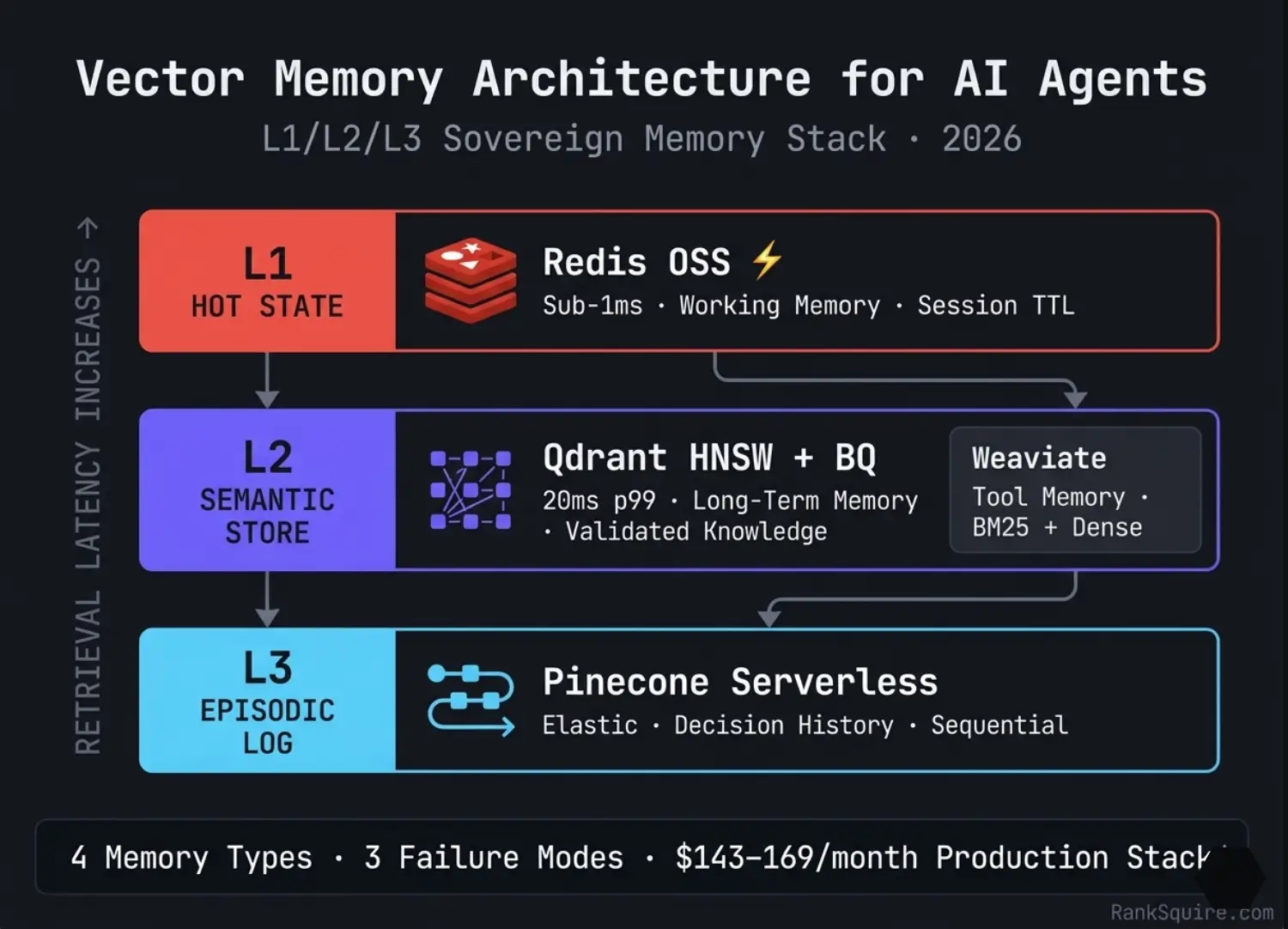
Vector memory architecture for AI agents 2026 β€” L1/L2/L3 Sovereign Memory Stack diagram showing Redis working memory, Qdrant semantic store, and Pinecone Serverless episodic log layers

The L1/L2/L3 Sovereign Memory Stack: Redis (L1 sub-1ms), Qdrant HNSW+BQ (L2 20ms p99), Pinecone Serverless (L3 episodic). Production-verified March 2026. RankSquire.com

Vector Memory Architecture for AI Agents β€” 2026 Blueprint

Mohammed Shehu Ahmed by Mohammed Shehu Ahmed
March 12, 2026
in ENGINEERING
Reading Time: 86 mins read
0
586
SHARES
3.3k
VIEWS
Summarize with ChatGPTShare to Facebook
πŸ“… Last Updated: March 2026
πŸ”¬ Architecture Verified: Jan–Mar 2026 Β· DigitalOcean 16GB Β· Single-Agent Production Deployment
βš™οΈ Memory Stack: Redis OSS Β· Qdrant HNSW+BQ Β· Pinecone Serverless Β· Weaviate Hybrid Β· n8n
πŸ’  Embedding Lock: text-embedding-3-small Β· 1,536-dim Β· All memory layers
🧠 Memory Tiers: L1 Hot State · L2 Semantic Store · L3 Episodic Log
πŸ“Œ Article: #9 Β· Vector DB Series Β· RankSquire Master Content Engine v3.0
CANONICAL DEFINITION

WHAT IS VECTOR MEMORY ARCHITECTURE FOR AI AGENTS?

Vector memory architecture for AI agents is the systematic design of layered memory storage that enables autonomous agents to persist context, retrieve relevant information, and maintain continuity across sessions and tasks. Unlike single-query RAG systems which retrieve once per prompt and discard context a production memory architecture separates agent memory into functionally distinct layers: short-term working memory for the current task, long-term semantic memory for persistent domain knowledge, episodic memory for sequential decision history, and tool memory for API schemas and function calling context.
Each layer has distinct retrieval requirements, latency tolerances, storage backends, and lifecycle management rules. The complete implementation is named: The L1/L2/L3 Sovereign Memory Stack. Verified production standard as of March 2026.

⚑ TL;DR β€” Quick Summary

β†’ A production AI agent requires 4 memory layer types: short-term (current task state), long-term (persistent domain knowledge), episodic (decision history), and tool memory (function schemas).
β†’ Each memory layer has a different storage backend: Redis for L1 hot state (sub-1ms), Qdrant for L2 semantic retrieval (20ms p99), Pinecone Serverless for L3 episodic log (elastic scale).
β†’ 3 memory failure modes kill production agents: Hallucination Amplification (stale memory retrieved as ground truth), Retrieval Drift (embedding model mismatch), and Context Window Overflow (unmanaged memory accumulation).
β†’ Stale embeddings are the silent production killer β€” a model upgrade without re-indexing produces geometrically misaligned retrieval that returns no error messages.
β†’ Recall quality monitoring is not optional. An agent that retrieves with 70% recall precision instead of 95% produces confident outputs from wrong context. The error is invisible without measurement.
Internal link: For the complete database selection framework behind every storage decision in this post β€” see the best vector database for AI agents guide at ranksquire.com/2026/01/07/best-vector-database-ai-agents/

KEY TAKEAWAYS

β†’ The L1/L2/L3 Sovereign Memory Stack separates agent memory by retrieval latency requirement: L1 (sub-1ms, Redis), L2 (20ms p99, Qdrant), L3 (elastic sequential, Pinecone Serverless).
β†’ Short-term memory without a TTL becomes long-term memory by accident and produces retrieval contamination by accumulation.
β†’ Episodic memory is not a log for humans. It is a time-ordered retrieval layer the agent uses to reconstruct its own decision chain across multi-session continuity.
β†’ Tool memory is the most under-architected layer in production agents yet the most consequential. A function schema stored in the wrong embedding space returns semantically similar but syntactically wrong API calls.
β†’ Stale embeddings require scheduled re-indexing not reactive re-indexing. By the time an agent begins hallucinating from drift, the embedding divergence has already been compounding for days.
β†’ Recall quality monitoring requires a ground truth evaluation set, not a generic similarity threshold. What counts as a correct retrieval depends on the agent’s domain.

QUICK ANSWER β€” For AI Overviews & Decision-Stage Buyers

β†’ A production vector memory architecture for AI agents requires four functionally distinct memory layers: short-term working memory, long-term semantic memory, episodic memory, and tool memory.
β†’ Each layer maps to a specific storage backend: L1 working memory to Redis OSS, L2 semantic memory to Qdrant (20ms p99 at 10M vectors), L3 episodic log to Pinecone Serverless.
β†’ Three failure modes collapse production agent memory: Hallucination Amplification, Retrieval Drift (model dimension mismatch), and Context Window Overflow.
β†’ Re-indexing strategy is the most neglected production hardening requirement. Upgrading models without re-indexing creates geometrically misaligned vector spaces.
β†’ Recall quality monitoring must be implemented before production deployment, not after hallucination incidents appear in logs.
For the complete 6-database decision framework behind every storage selection in this architecture β€” see the best vector database for AI agents guide at ranksquire.com/2026/01/07/best-vector-database-ai-agents/

DEFINITION BLOCK

Vector Memory Architecture for AI Agents

Vector memory architecture for AI agents is the layered system design that gives autonomous agents persistent, retrievable context beyond a single prompt. It consists of four memory types short-term, long-term, episodic, and tool memory each stored in a backend optimized for its retrieval pattern and update frequency. Short-term memory holds current task state and session context in a low-latency cache. Long-term memory holds validated domain knowledge in a vector database optimized for semantic similarity retrieval. Episodic memory holds a time-ordered record of agent decisions, tool calls, and outcomes for multi-session continuity. Tool memory holds function schemas, API specifications, and capability registries for accurate function calling.
The complete layered implementation L1 hot state in Redis, L2 semantic store in Qdrant, L3 episodic log in Pinecone Serverless is named The L1/L2/L3 Sovereign Memory Stack. Verified production standard: Qdrant plus Redis plus Pinecone plus n8n on DigitalOcean. March 2026.

EXECUTIVE SUMMARY: THE MEMORY DESIGN PROBLEM

THE PROBLEM

Most production AI agents in 2026 have no memory architecture. They have a RAG pipeline. A RAG pipeline retrieves context at query time from a flat vector collection and discards it after the response is generated. The agent has no continuity between sessions, no validated ground truth separated from provisional reasoning, no decision history to self-correct against, and no function schema registry to prevent API hallucination. Every session starts from zero. Every retrieval competes with every other retrieval in the same undifferentiated collection. The longer the agent runs, the more degraded its retrieval precision becomes as unmanaged vectors accumulate.
This is not a model limitation. It is a memory design failure.

THE SHIFT

Moving from Flat RAG Retrieval one collection, one embedding space, one retrieval pattern to Layered Sovereign Memory. Each memory type has a purpose, a storage backend, a retrieval latency requirement, a TTL or lifecycle rule, and a failure mode that is addressable by architecture before the first query fires.

THE OUTCOME

An agent that maintains context fidelity across sessions. A long-term memory store where ground truth never mixes with provisional reasoning. An episodic log that enables multi-session continuity and self-correction. A tool memory registry that eliminates API hallucination. A memory system that degrades gracefully under load rather than silently producing wrong outputs with high confidence.

2026 Memory Architecture Law: In a production AI agent deployment, memory architecture determines output quality ceiling. The model determines what the agent can reason about. The memory architecture determines whether that reasoning is grounded in correct, current, and relevant context or in stale, contaminated, and geometrically misaligned noise.

WHY THIS POST EXISTS AND WHAT IT DOES NOT COVER

The best vector database for AI agents pillar at ranksquire.com/2026/01/07/best-vector-database-ai-agents/ covers database selection: which of the six databases to use and why, based on use case, compliance requirements, and TCO. That is the decision framework. This post is the memory system design layer what goes inside the databases you have already selected.

Why Vector Databases Fail Autonomous Agents at ranksquire.com/2026/03/09/why-vector-databases-fail-autonomous-agents-2/ covers what breaks at the infrastructure level: write conflicts, state management breakdown, latency creep, cold start penalties. This post is the layer above that β€” what the agent is actually storing in those databases and why the layering matters for output quality.

Multi-Agent Vector Database Architecture at ranksquire.com/2026/multi-agent-vector-database-architecture-2026/ covers swarm-level memory isolation for multi-agent systems: namespace partitioning, Context Collision prevention, the Swarm-Sharded Memory Blueprint. This post is its foundation layer the single-agent memory architecture that swarm namespace design is built on top of.

WHAT THIS POST DOES NOT COVER:
β†’ No full 6-database comparison table
β†’ No database selection decision framework
β†’ No swarm namespace design
β†’ No RAG pipeline fundamentals
This post operates at one layer: how to architect the memory system inside a single autonomous agent for production correctness, continuity, and graceful failure.
🧠 Vector Memory Architecture for Agentic AI β€” System Overview β€” March 2026
The L1/L2/L3 Sovereign Memory Stack: Complete Architecture at a Glance
Every production vector memory architecture for agentic AI operates across three system layers and four memory types. This is the canonical framework. Read the full system in 30 seconds before the deep technical sections below.
System Layer 1
Encoding Layer
Converts agent experience β€” decisions, observations, tool outputs, domain facts β€” into fixed-dimension vectors using an embedding model locked at the infrastructure level.
Stack: OpenAI text-embedding-3-small Β· 1,536-dim Β· n8n HTTP credential node Β· Single lock across all layers
System Layer 2
Storage Layer
Persists vectors and metadata in backends matched to each memory type’s retrieval latency requirement, write pattern, and lifecycle rule.
Stack: Redis OSS (L1 sub-1ms) Β· Qdrant HNSW+BQ (L2 20ms p99) Β· Pinecone Serverless (L3 elastic) Β· Weaviate hybrid (tool memory)
System Layer 3
Retrieval Layer
Selects relevant memories for reasoning using similarity search, temporal weighting, and confidence-based payload filtering. Assembles them into prompt context within the agent’s token budget.
Stack: Qdrant pre-scan payload filter Β· Weaviate BM25+dense hybrid Β· Pinecone time-range filter Β· Redis key-value lookup
Agent Memory Pipeline β€” Full System Lifecycle
User Interaction / Agent Trigger
↓
Agent ExperienceObservation Β· Decision Β· Tool Output Β· API Response
↓
Encoding Layertext-embedding-3-small Β· n8n credential lock Β· 1,536-dim
↓
Memory Storage LayerL1 Redis Β· L2 Qdrant Β· L3 Pinecone Serverless Β· Tool: Weaviate
↓
Retrieval LayerPre-scan filter Β· BM25+dense hybrid Β· Temporal weighting Β· Confidence filter
↓
Context AssemblyRanking Β· Deduplication Β· Token budget management
↓
LLM ReasoningGPT-4o Β· Claude Β· Open-source LLMs
↓
Agent Action / Output
↓
Memory Write-BackValidation gate β†’ L2 long-term Β· Append β†’ L3 episodic Β· TTL expire β†’ L1
Figure: Vector memory architecture for agentic AI systems β€” encoding, storage, retrieval, context assembly, and write-back pipeline. RankSquire, March 2026.
⚑ 2026 Architecture Law

A vector memory architecture for agentic AI has three system layers: the Encoding Layer converts experience into vectors, the Storage Layer persists them in latency-matched backends, and the Retrieval Layer selects and assembles them into reasoning context. A database without this three-layer architecture is not a memory system. It is unsorted storage with a search API. Verified March 2026.

Table of Contents

  • 1. THE FOUR MEMORY LAYER TYPES
  • 2. THE L1/L2/L3 SOVEREIGN MEMORY STACK STORAGE MAPPING
  • 3. SHORT-TERM MEMORY: DESIGN, TTL, AND OVERFLOW PREVENTION
  • 4. LONG-TERM MEMORY: INDEXING, VALIDATION GATES, AND RETRIEVAL PRECISION
  • 5. EPISODIC MEMORY: SESSION CONTINUITY AND SELF-CORRECTION
  • 6. TOOL MEMORY: FUNCTION SCHEMA REGISTRY AND API HALLUCINATION PREVENTION
  • 7. THREE MEMORY FAILURE MODES AND FIXES
  • 8. PRODUCTION HARDENING: VERSIONING, RE-INDEXING, AND RECALL MONITORING
  • 9. MEMORY ARCHITECTURE COST β€” MONTHLY INFRASTRUCTURE
  • 10. CONCLUSION: THE MEMORY-FIRST AGENT
  • 11. FAQ: VECTOR MEMORY ARCHITECTURE FOR AI AGENTS 2026
  • Q1: What is vector memory architecture for AI agents?
  • Q2: What is the difference between short-term and long-term memory in AI agents?
  • Q3: What is Retrieval Drift and how do I prevent it?
  • Q4: Why does tool memory require hybrid search?
  • Q5: How often should I re-index vector memory collections?
  • Q6: What is Hallucination Amplification and how is it different from model hallucination?
  • Q7: What is recall quality monitoring and why is it required?
  • Q8: Can I use a single vector database for all four memory types?
  • Q9: How does episodic memory enable multi-session continuity?
  • Q10: What is the simplest production memory architecture for a single agent?

1. THE FOUR MEMORY LAYER TYPES

Four memory layer types for production AI agents 2026 β€” short-term working memory, long-term domain knowledge, episodic decision history, and tool memory function schema registry diagram
The 4 memory types every production AI agent requires: Short-Term (Redis), Long-Term (Qdrant), Episodic (Pinecone), Tool Memory (Weaviate). Each layer has a distinct backend, retrieval latency, and failure mode. RankSquire, March 2026.

Not all agent memory is the same. Treating all agent context as a single retrieval problem one collection, one embedding space, one query pattern is the foundational error that produces the three failure modes this post addresses. The four memory types have categorically different retrieval requirements, storage characteristics, and failure modes.

MEMORY TYPE 1: SHORT-TERM MEMORY (Working State)

Definition: The agent’s current task state. Active session variables, in-progress tool call outputs, current task parameters, loop counters, intermediate calculation results.

Retrieval requirement: Sub-millisecond. The agent accesses working state continuously during task execution every decision branch checks current state before proceeding.

Storage backend: Redis OSS, session-scoped key-value with TTL. Not a vector database. Short-term memory is structured state, not semantic content. Embedding it and querying it by similarity adds 20ms of unnecessary latency to every working state access.

Lifecycle: Expires at TTL matching session duration. Never persists to long-term memory without an explicit validation gate. A session’s provisional intermediate state is not domain knowledge.

Critical failure mode: Absent TTL. Short-term memory without expiry becomes long-term memory by accumulation. An agent processing 200 sessions per day without TTL on working state accumulates 200 Γ— session_variable_count stale records per day in the retrieval pool. By day 30 the collection contains 6,000 stale working state records competing with ground truth in every similarity query. The agent begins retrieving its own old intermediate states as current context.

MEMORY TYPE 2: LONG-TERM MEMORY (Domain Knowledge)

Definition: Persistent validated domain knowledge. SOPs, compliance rules, product specifications, validated factual records, approved reasoning frameworks.

Retrieval requirement: 20ms p99. Long-term memory retrieval fires on every user query and major task step it must be fast but does not require the sub-millisecond speed of working state access.

Storage backend: Qdrant with HNSW indexing, Binary Quantization, pre-scan payload filtering by document_type and validation_status.

Lifecycle: Updated by Admin process only. Never written to by the agent during task execution. An agent that can write to its own long-term memory store during execution is an agent that will eventually contaminate its ground truth with its own unvalidated intermediate reasoning.

Critical failure mode: No validation gate on writes. If the agent can write to long-term memory without a Reviewer or Admin validation step, the long-term store accumulates unvalidated agent outputs. Over time, the agent retrieves its own prior provisional conclusions as confirmed domain knowledge. This is the Hallucination Amplification failure mode covered in Section 8.

MEMORY TYPE 3: EPISODIC MEMORY (Decision History)

Definition: Time-ordered record of agent decisions, tool call sequences, external API responses, and outcome assessments across sessions.

Retrieval requirement: Sequential time-series. The agent reconstructs its decision history not by semantic similarity (what is most similar to my current query) but by temporal sequence (what did I do in this task domain, in what order, with what outcomes).

Storage backend: Pinecone Serverless for elastic scale under variable session load, or Qdrant with Unix timestamp payload and strict time-range filtering for sovereign deployments.

Lifecycle: Append-only during agent execution. Agent writes to episodic memory but never deletes from it during execution. Cleanup is an Admin process only, with configurable retention window (e.g., 90 days for compliance, 30 days for general deployment).

Critical failure mode: Using semantic similarity retrieval instead of time-ordered sequential retrieval for episodic context. If the agent retrieves “most similar past decisions” instead of “most recent past decisions in this task domain,” it may retrieve episodically distant but semantically close records reconstructing a decision chain that is factually accurate in isolation but temporally incorrect for the current session context.

MEMORY TYPE 4: TOOL MEMORY (Function Schema Registry)

Definition: The agent’s registry of available tools, functions, APIs, and capabilities. Function signatures, parameter specifications, authentication requirements, rate limits, error response formats.

Retrieval requirement: Hybrid BM25 + dense vector. Tool memory retrieval combines exact string matching (specific function names, parameter names, endpoint paths) with semantic similarity (what tool handles this type of task). Pure semantic search returns tools that are conceptually related but functionally different. Pure keyword search misses tool aliases and semantic variants.

Storage backend: Weaviate for native hybrid BM25 + dense search in a single query at 44ms p99 at 10M vectors. Qdrant with BM25 post-processing for sovereign deployments where Weaviate cloud adds unacceptable latency.

Lifecycle: Versioned. Every tool schema update creates a new version record. The agent always queries the current version by default. Rollback is available via version_id metadata filter.

Critical failure mode: Unversioned tool memory. A function schema update that changes parameter names without a version increment produces agents that call functions with outdated signatures. The API returns a 400 error. The agent has no visibility into why. It has the correct function name and retrieved what it believed was the current specification. This failure is architectural, not agent-level. Versioning is the fix.

2. THE L1/L2/L3 SOVEREIGN MEMORY STACK STORAGE MAPPING

L1/L2/L3 Sovereign Memory Stack storage mapping diagram 2026 β€” Redis hot state, Qdrant semantic store, Pinecone Serverless episodic log β€” latency and write pattern reference for production AI agent memory architecture
The L1/L2/L3 Sovereign Memory Stack: Redis L1 (sub-1ms), Qdrant+Weaviate L2 (20–44ms p99), Pinecone Serverless L3 (elastic). Total production cost: $143–169/month. Verified March 2026. RankSquire.com

L1/L2/L3 NAMING CONVENTION

The L1/L2/L3 naming convention maps memory layers to storage backends by retrieval latency:
L1 β€” HOT STATE (Redis OSS, sub-1ms)
Contents: Short-term working memory + session state
Pattern: Key-value reads, session-scoped TTL
Rationale: Agent working state must be accessible faster than any database query. Redis in co-located Docker on the same DigitalOcean Droplet as Qdrant: sub-millisecond. The same Redis call via cloud API: 20–80ms per call. At 50 working state accesses per task loop, the difference is 1ms total (co-located) versus 1,000–4,000ms total (remote). The decision is not ambiguous.
L2 β€” SEMANTIC STORE (Qdrant, 20ms p99)
Contents: Long-term domain knowledge + tool memory (with Weaviate hybrid for tool layer if volume warrants)
Pattern: HNSW semantic similarity + pre-scan payload filter
Rationale: 20ms p99 at 10M vectors with Binary Quantization. Pre-scan payload filter on document_type and validation_status adds 6–9ms β€” total 26–29ms. Post-retrieval filter alternatives (basic Chroma) add 100–300ms. At 40 L2 queries per session: 1,040–1,160ms total (Qdrant) versus 4,000–12,000ms total (post-filter databases). Verified on DigitalOcean 16GB, March 2026.
L3 β€” EPISODIC LOG (Pinecone Serverless, elastic p99)
Contents: Episodic decision history, time-ordered session records
Pattern: Sequential time-series retrieval, append-only writes
Rationale: Episodic log query volume is non-linear and unpredictable β€” it spikes with complex multi-session tasks and is near-zero for simple single-session operations. Pinecone Serverless scales read and write capacity independently without pre-provisioning. Sovereign alternative: Qdrant with Unix timestamp payload and time-range filter for HIPAA, SOC 2, or data residency compliance requirements.

TABLE: L1/L2/L3 Sovereign Memory Stack β€” Configuration Reference β€” March 2026

LAYER MEMORY TYPE BACKEND LATENCY WRITE PATTERN LIFECYCLE
L1 Short-term working state Redis OSS co-located sub-1ms Agent writes β€§ session-scoped TTL Expires at session end
L1 Tool memory hot cache Redis (cache layer before Weaviate) sub-1ms Cache miss refreshes from L2 TTL = tool schema update cadence
L2 Long-term domain knowledge Qdrant HNSW + BQ 20ms p99 Admin writes only Persistent, versioned
L2 Tool schema registry Weaviate hybrid / Qdrant 26–44ms Versioned Admin writes Versioned, rollback available
L3 Episodic decision log Pinecone Serverless / Qdrant Elastic Agent writes, append-only Retention window (30–90 days)
Short-term working state L1
Backend Redis OSS co-located
Latency / Write Pattern sub-1ms | Agent writes β€§ session-scoped TTL
Lifecycle Expires at session end
Tool memory hot cache L1
Backend Redis (cache layer before Weaviate)
Latency / Write Pattern sub-1ms | Cache miss refreshes from L2
Lifecycle TTL = tool schema update cadence
Long-term domain knowledge L2
Backend Qdrant HNSW + BQ
Latency / Write Pattern 20ms p99 | Admin writes only
Lifecycle Persistent, versioned
Tool schema registry L2
Backend Weaviate hybrid / Qdrant
Latency / Write Pattern 26–44ms | Versioned Admin writes
Lifecycle Versioned, rollback available
Episodic decision log L3
Backend Pinecone Serverless / Qdrant
Latency / Write Pattern Elastic | Agent writes, append-only
Lifecycle Retention window (30–90 days)

3. SHORT-TERM MEMORY: DESIGN, TTL, AND OVERFLOW PREVENTION

Short-term memory is the layer engineers most frequently under-engineer. The failure mode is not dramatic it is gradual and invisible. Retrieval precision degrades over days as stale session state accumulates. The agent does not error. It retrieves its own old working context, treats it as current domain knowledge, and produces confident output from stale intermediate state.

TTL DESIGN β€” SESSION-SCOPED

Every short-term memory key must carry an explicit TTL. The TTL value is not arbitrary β€” it must match the maximum expected session duration plus a safety buffer:
β†’ Simple single-turn agents: TTL = 1 hour
β†’ Multi-step task agents: TTL = session_max_duration Γ— 1.5
β†’ Long-running autonomous agents: TTL = 24 hours with explicit session close event triggering early deletion
Key naming convention (Redis): st_{agent_id}{session_id}{variable_name}

This naming prevents collision across concurrent sessions on the same agent. An agent running 10 concurrent sessions with a single flat key space produces cross-session state contamination β€” agents reading each other’s in-progress variable values via shared key names.

OVERFLOW PREVENTION β€” ACTIVE PRUNING

Beyond TTL-based expiry, production agents require active pruning of short-term memory during long-running sessions. An agent executing a 3-hour autonomous task may accumulate 10,000+ working state entries within a single TTL window. Without active pruning, working state grows unbounded within the session.

Pruning rule:

Retain only the N most recent entries per variable category. N is domain-specific. For a reasoning agent tracking intermediate conclusions: N = 20. For a data processing agent tracking row-level results: N = 100.

Implementation in n8n:

Add a Pruning Workflow triggered on a 15-minute cron schedule during active sessions. Query Redis key count by agent_id prefix. If count exceeds threshold, delete oldest entries by timestamp. Zero agent logic changes required β€” pruning is infrastructure-level.

4. LONG-TERM MEMORY: INDEXING, VALIDATION GATES, AND RETRIEVAL PRECISION

Long-term memory validation gate flow diagram for AI agents 2026 β€” staging collection, Reviewer approval process, and Qdrant long-term store promotion with source validation, deduplication, and metadata tagging steps
The Long-Term Memory Validation Gate: agent outputs enter staging first, pass Reviewer approval, then promote to Qdrant long-term store with approved status. Rejected records are deleted never reaching the retrieval pool. RankSquire.

Long-term memory is the agent’s ground truth store. The architectural requirement is simple and non-negotiable: the agent reads from long-term memory. The agent never writes to long-term memory during task execution.

THE VALIDATION GATE

Every candidate for long-term memory must pass through a validation gate before indexing. The validation gate has three conditions:
SOURCE VALIDATION:

The candidate must originate from an approved source (Admin input, external API with known reliability, Reviewer-approved agent output). Unreviewed agent outputs never enter long-term memory directly.

DUPLICATION CHECK:

Before indexing, query the long-term store for cosine similarity above 0.92 threshold. If a near-duplicate exists, update the existing record rather than creating a new vector. Duplicate accumulation degrades retrieval precision by fragmenting a single concept across multiple overlapping records.

METADATA TAGGING:

Every long-term memory record must carry: document_type, source_id, validation_status (approved or pending), created_at Unix timestamp, version (for updateable records). Without metadata, retrieval cannot be filtered by document type or validation status β€” the agent retrieves indiscriminately from the full collection.

RETRIEVAL PRECISION β€” PAYLOAD FILTER FIRST

The single most impactful retrieval precision improvement in long-term memory is pre-scan payload filtering. Query the collection with document_type filter before HNSW traversal β€” not after.

Without pre-scan filter (basic Chroma): HNSW traversal across full collection β†’ post-retrieval filter. At 10M vectors with 30% relevant document_type: traversal examines 10M vectors, returns top-k, filters down to relevant type. Overhead: 100–300ms
With pre-scan filter (Qdrant): Filter narrows candidate set to 3M relevant vectors before HNSW traversal begins. HNSW traverses 3M vectors. Overhead: 6–9ms | Total query: 26–29ms
This is not a minor optimization. It is the difference between a usable and unusable retrieval system at production document volumes. Implement pre-scan payload filtering on all Qdrant long-term memory collections from day one.

5. EPISODIC MEMORY: SESSION CONTINUITY AND SELF-CORRECTION

Episodic memory is the layer that transforms a stateless query-response machine into an agent that learns from its own execution history. Without episodic memory, every session starts from zero. The agent cannot recognize that it attempted this task domain three days ago, succeeded with a specific tool sequence, and failed when it deviated from that sequence. It has no basis for self-correction across sessions.

SESSION CONTINUITY PATTERN

On every new session initiation, the agent queries its episodic store for the three most recent sessions in the same task domain. It extracts: what goal was pursued, what tool sequence was used, what the outcome was, and whether the outcome was marked successful by the Reviewer.

This episodic retrieval does not replace the current session’s Long-Term Memory query it augments it. The agent has both validated ground truth (Long-Term Memory, always current) and its own historical execution patterns (Episodic Memory, time-ordered) available at session start.

SELF-CORRECTION PATTERN

When a tool call fails or a validation step flags an error, the agent queries episodic memory with the failure context as the query vector. The retrieval target: similar past failure events and the recovery sequences that resolved them.

Implementation constraint: The recovery sequence stored in episodic memory must include outcome metadata did the recovery work? An agent that retrieves a past recovery attempt that itself failed will compound errors rather than resolve them. Every episodic record must carry outcome_status: success, partial, or failed. Self-correction retrieval must filter for outcome_status = success.

βš™οΈ Memory Lifecycle Architecture β€” Production Standard β€” March 2026
Memory Lifecycle Management: Write Β· Consolidate Β· Decay Β· Delete
Every vector that enters the system must have a defined lifecycle. An unmanaged memory system grows into noise and eventually into a liability. Four lifecycle phases govern all production memory: write, consolidation, decay, and deletion.
Memory Write
β†’
Validation Gate
β†’
Consolidation
β†’
Decay / TTL
β†’
Deletion / GDPR
Phase 1 β€” Write
Memory Write: Staging Before Promotion
All agent-generated content enters a staging collection first β€” never directly into the long-term store. The staging collection is indexed but isolated from the agent’s retrieval path until the validation gate approves the record.
  • Agent writes to staging_{agent_id} Qdrant collection β€” not to long-term
  • Record tagged: validation_status = pending, source = agent, created_at = unix_timestamp
  • Reviewer n8n workflow fires on new staging entry β€” approves or rejects within configurable SLA
  • Approved records promoted to long-term collection with validation_status = approved
  • Rejected records deleted from staging β€” never reach the retrieval pool
⚠ Staging Watch: The staging collection must be excluded from the agent’s default retrieval query via a collection routing rule in n8n. An agent that can query its own unapproved pending records during task execution has already bypassed the validation gate by another route.
Phase 2 β€” Consolidation
Episodic β†’ Semantic Promotion
Memory consolidation is the process by which high-value episodic records are promoted to long-term semantic memory after validation. Not every agent decision warrants permanent storage β€” but patterns that repeat across sessions and recovery sequences that succeed reliably are consolidation candidates. Without consolidation, agents re-derive successful patterns from sequential episodic log traversal on every session β€” adding latency and retrieval noise. With consolidation, the proven pattern lives in L2 as validated ground truth, retrievable at 20ms p99.
  • Trigger: episodic record with outcome_status = success retrieved and applied successfully in 3+ subsequent sessions
  • Reviewer flags record for promotion in n8n workflow
  • Admin generates generalized semantic summary β€” strips all session-specific identifiers
  • Summary passes validation gate: source check + cosine deduplication above 0.92 + full metadata tagging
  • Promoted to long-term Qdrant collection: document_type = consolidated_pattern
  • Original episodic record retained: promotion_status = promoted for audit trail
⚠ Consolidation Watch: The consolidated semantic record is a generalization of the episodic original. A generalization that is too broad becomes noise. Too narrow and it is redundant with the episodic record. Reviewer approval of the abstraction level is mandatory. Automated consolidation without Reviewer oversight produces semantic contamination over time.
Phase 3 β€” Decay
Memory Decay: Domain-Matched Expiry Policies
Not all memory decays at the same rate. Compliance rules change quarterly. Product specifications change weekly. Session working state expires in minutes. A single TTL policy across all memory types is incorrect architecture β€” each memory type requires a decay policy matched to its domain update cadence.
  • L1 Short-term: TTL = session_max_duration Γ— 1.5 β€” hard expire, no exceptions
  • L2 Long-term domain knowledge: No automatic TTL β€” manual versioning only. Domain changes create a new version record; old version tagged deprecated = true
  • L2 Consolidated patterns: Reviewed quarterly β€” patterns not retrieved in 90 days flagged for Reviewer assessment
  • L3 Episodic log: Retention window 30–90 days, Admin-configurable β€” older records auto-archived or deleted per policy
  • Tool memory: Versioned, never auto-decayed β€” deprecated versions retained for rollback audits
⚠ Staleness Watch: Domain knowledge that has not been updated is not necessarily accurate. Implement a last_verified timestamp on all long-term records. Flag records where now() - last_verified exceeds the domain’s expected update cadence. Automated TTL expiry is not appropriate for domain knowledge β€” Reviewer verification is required.
⚠ Phase 4 β€” Deletion Β· GDPR Β· Right to Erasure

Memory Deletion and GDPR Compliance

Any vector memory store that persists information about identifiable users is subject to GDPR Article 17 β€” the right to erasure. An AI agent processing user interactions, customer data, or personal information must be capable of complete user-scoped memory deletion on request. This is a legal requirement in the EU and increasingly enforced in enterprise AI contracts globally.

Architecture requirements for compliant deletion:

  • All vectors must carry user_id as a payload field β€” without this, user-scoped deletion is architecturally impossible
  • Deletion must cover all layers: L1 Redis (prefix scan + delete), L2 Qdrant (payload filter delete), L3 Pinecone (metadata filter delete), Weaviate tool memory if user-specific schemas exist
  • After vector deletion, trigger a Qdrant collection optimize operation to rebuild the HNSW graph β€” a deleted vector leaves an orphaned node that degrades retrieval precision if not resolved
  • Maintain a deletion audit log: timestamp, user_id, collections affected, record count deleted
  • Deletion must complete within 30 days of request per GDPR Article 12.3

Qdrant deletion by user_id (n8n HTTP Request body):

POST /collections/{collection_name}/points/delete { “filter”: { “must”: [ { “key”: “user_id”, “match”: { “value”: “{user_id_to_delete}” } } ] } }

Redis deletion by user_id prefix:

SCAN 0 MATCH “st_{agent_id}_{user_id_to_delete}*” COUNT 1000 DEL {matched_keys}
⚠ Re-index After Deletion: Vector deletion leaves orphaned nodes in the HNSW graph. After any deletion batch of 500+ vectors, run POST /collections/{name}/index in Qdrant to rebuild the graph and restore retrieval precision. Skipping post-deletion re-indexing degrades recall quality proportionally to the percentage of records deleted. Verified March 2026.

MEMORY CONSOLIDATION EPISODIC TO SEMANTIC PROMOTION

Memory consolidation is the process by which high-value episodic records are promoted to long-term semantic memory after validation. Not every agent decision warrants permanent storage but patterns that repeat across sessions, recovery sequences that succeed reliably, and domain insights that generalize beyond a single task are candidates for semantic promotion.

Consolidation trigger: An episodic record with outcome_status = success that has been retrieved and applied successfully in three or more subsequent sessions is a consolidation candidate.

Consolidation procedure:

  1. Reviewer workflow flags the record for promotion
  2. Admin generates a generalized semantic summary (stripping session-specific identifiers)
  3. Summary passes the standard validation gate (source validation + duplication check + metadata tagging)
  4. Promoted to long-term Qdrant collection with document_type = consolidated_pattern
  5. Original episodic record retained with promotion_status = promoted for audit trail

Why this matters: Without consolidation, agents re-derive successful patterns from episodic retrieval on every session adding latency and retrieval noise. With consolidation, the pattern lives in L2 as validated ground truth, retrievable at 20ms p99 with no sequential log traversal required. The episodic log taught the agent. The semantic store remembers the lesson.

EPISODIC MEMORY DESIGN RECORD STRUCTURE

Every episodic record must contain:
β†’ session_id
β†’ agent_id
β†’ task_domain
β†’ action_type
β†’ action_content
β†’ outcome_status
β†’ timestamp_unix
β†’ session_sequence_id
The session_sequence_id enables reconstructing the full ordered decision chain for any session β€” not just retrieving semantically similar events but rebuilding the exact execution sequence in order.

6. TOOL MEMORY: FUNCTION SCHEMA REGISTRY AND API HALLUCINATION PREVENTION

Tool memory is the most consequential and most under-architected memory layer in production agents as of March 2026. The failure mode is acute: an agent calls a function with the correct intent but the wrong parameter signature, the API returns a 400 error, and the agent has no basis for understanding why because it retrieved what it believed was the current specification.

Tool memory failures do not look like hallucinations. They look like API errors. The root cause is memory architecture, not model behavior.

THE FUNCTION SCHEMA REGISTRY

The tool memory store is a versioned registry of every function the agent can call:
Function identifier (exact match β€” BM25)
Function description (semantic match β€” dense vector)
Parameter schema (exact match β€” BM25)
Authentication requirements (exact match β€” BM25)
Rate limit metadata (payload β€” not embedded)
Error response format (payload β€” not embedded)
Current version (payload β€” not embedded)
Deprecated versions (payload β€” not embedded)

Why hybrid BM25 + dense vector for tool memory: An agent asked to “find the current price of a product” must retrieve a function named get_product_pricing not a semantically similar but structurally different function named fetch_catalog_data. The function name is an exact string, not a semantic concept. Pure dense vector search returns the most contextually similar tool, which may not be the correct one. BM25 ensures exact function name matching. Dense vector ensures semantic fallback for natural language task descriptions. Weaviate’s hybrid search covers both in one query.

VERSIONING β€” THE MANDATORY SAFEGUARD

Every tool schema update must increment a version number. Every vector in the tool memory store carries version_id as payload. The agent always queries for current_version = true by default.
When a tool is deprecated:

Set deprecated = true and current_version = false on the old record. Create a new record with current_version = true and the updated schema. The agent never retrieves the deprecated version unless explicitly queried by version_id.

This pattern eliminates the class of failures where an agent calls a tool with an outdated parameter set because the schema changed and the vector was not updated. The update is atomic old version marked deprecated, new version marked current and the agent immediately retrieves the correct schema on the next query.

7. THREE MEMORY FAILURE MODES AND FIXES

Three memory failure modes for production AI agents 2026 β€” Hallucination Amplification, Retrieval Drift, and Context Window Overflow β€” root causes, how each failure manifests, and architectural fixes diagram
The 3 memory failure modes that kill production AI agents: Hallucination Amplification (no write gate), Retrieval Drift (embedding mismatch), Context Window Overflow (no lifecycle management). All three are silent. All three are fixed by architecture. RankSquire, March 2026.

FAILURE MODE 1: HALLUCINATION AMPLIFICATION

Definition: Stale, unvalidated, or incorrectly retrieved memory is returned to the agent as ground truth. The agent reasons correctly from incorrect premises and produces confident, wrong outputs.

Root causes:
! Agent writes provisional reasoning to long-term memory without a validation gate
! Short-term memory accumulates without TTL and is retrieved as long-term knowledge
! Episodic records without outcome_status allow failed past decisions to be retrieved as successful patterns

How it amplifies: The model reasons correctly from retrieved context. If the retrieved context is wrong, the reasoning chain builds on the wrong foundation. Each subsequent step inherits the error. By the final output, the error is deeply embedded in a chain of internally consistent but factually wrong reasoning. The model has not hallucinated it has reasoned correctly from a hallucinated memory.

Fix: Three-layer mitigation
Layer 1: Write gate no agent-generated content enters long-term memory without validation_status = approved.
Layer 2: TTL on all short-term memory session state expires, never contaminates semantic retrieval.
Layer 3: Outcome metadata on episodic records failed past actions are retrievable for analysis

FAILURE MODE 2 β€” RETRIEVAL DRIFT

Definition: The vector space used to store memory records is geometrically misaligned with the vector space used to query them. Cosine similarity calculations return mathematically valid scores for semantically wrong results. No error messages are generated.

Root cause:

Embedding model upgrade without collection re-indexing. If long-term memory was indexed using text-embedding-3-small (1,536-dim) and queries are now generated by text-embedding-3-large (3,072-dim), the query vector exists in a 3,072-dimensional space while the stored vectors exist in a 1,536-dimensional space. The retrieval system cannot match them.

The danger:

This failure is invisible to standard monitoring. No error is thrown. Retrieval succeeds. The agent receives results. The results are wrong. The agent reasons from wrong context and produces wrong outputs β€” with confidence.

Fix: Scheduled re-indexing as infrastructure maintenance
Policy: Any embedding model change triggers a full collection re-indexing job before the new model is promoted to production queries.

Implementation: n8n scheduled workflow trigger on model_version_change event execute batch re-embedding of all long-term memory documents verify new index with sample recall quality test promote new index to production deprecate old index.
Never run mixed embedding model versions against the same collection.

FAILURE MODE 3: CONTEXT WINDOW OVERFLOW

Definition: Memory accumulation without lifecycle management causes the agent’s retrieval context to exceed its usable context window, or causes retrieval precision to degrade below the threshold required for correct reasoning.

Root cause:

No TTL on short-term memory, no pruning on episodic memory, no deduplication on long-term memory. Collections grow unbounded. Retrieval returns top-k from increasingly noisy data. At 50% collection noise, a top-5 retrieval returns 2–3 relevant results and 2–3 noise results. The agent reasons from the combined context β€” correct and incorrect simultaneously.

Fix: Four-point lifecycle management
TTL on all short-term memory (never optional)
Active pruning on long-term memory (deduplication at indexing time, semantic deduplication above 0.92 cosine threshold)
Retention window on episodic memory (30–90 days, Admin-configurable)
Collection size monitoring with alert thresholds alert when collection exceeds 80% of capacity that maintains acceptable retrieval precision
⚠️ THE MEMORY FAILURE SUMMARY
Hallucination Amplification: Write gate missing unvalidated agent outputs enter ground truth store
Retrieval Drift: Embedding model upgrade without re-indexing silent vector space mismatch, no error messages
Context Window Overflow: No lifecycle management unbounded accumulation degrades retrieval precision below usable threshold
Solution: L1/L2/L3 Sovereign Memory Stack with validation gates, schedu

8. PRODUCTION HARDENING: VERSIONING, RE-INDEXING, AND RECALL MONITORING

PRODUCTION HARDENING PROTOCOLS

HARDENING POINT 1 EMBEDDING VERSION LOCK
Lock the embedding model at the infrastructure level. A single n8n credential node controls the embedding API call across all memory layers. When the model is updated, all layers update simultaneously. Per-layer embedding configuration in production is an architectural anti-pattern β€” it creates the conditions for Retrieval Drift by allowing different layers to drift to different model versions.
Implementation: One n8n HTTP credential β†’ one embedding model β†’ all memory layer write and query operations. Any change to the credential updates all layers in one operation.
HARDENING POINT 2 SCHEDULED RE-INDEXING
Re-indexing is a maintenance operation, not an emergency response. Production re-indexing policy:
  • Trigger events: Embedding model change (mandatory), Schema-breaking changes, Quarterly maintenance.
  • Procedure: Spin up parallel Qdrant collection β†’ Batch re-embed β†’ Upsert β†’ Run recall quality eval β†’ Promote new collection to primary alias β†’ Deprecate old.
This procedure produces zero downtime β€” the agent continues querying the old collection while the new one is built. The alias swap is atomic.
HARDENING POINT 3 RECALL QUALITY MONITORING
Recall quality is the percentage of retrieval operations that return the correct result given the query. A production agent requires a minimum acceptable recall quality threshold β€” below that threshold, retrieval precision is insufficient for correct grounded reasoning.
Threshold recommendation: 90% precision minimum for compliance-adjacent deployments (legal, medical, financial). 85% for general enterprise agents. 75% for exploratory agents.
Without this monitoring, the only signal that retrieval quality has degraded is when the agent begins producing wrong outputs. Recall monitoring catches the degradation at the infrastructure level.
🀝 Multi-Agent Memory Architecture β€” Single-Agent Foundation Scales to Swarm
Multi-Agent Memory Considerations
The L1/L2/L3 Sovereign Memory Stack is the single-agent foundation. When multiple agents share infrastructure, three additional architecture requirements emerge: namespace isolation, agent-to-agent memory transfer, and conflict resolution.
Private Namespace
Per-Agent Scratchpad
Each agent’s working state and episodic memory is isolated by agent_id. No agent reads another’s private namespace by default.
scratchpad_{agent_id}_{session_id}
Shared Namespace
Swarm Memory Pool
Validated domain knowledge all agents read. Admin writes only. No agent writes to the shared pool during execution.
swarm_shared_library
Transfer Channel
Agent-to-Agent Memory
Explicit P2P retrieval only β€” Agent B queries Agent A’s scratchpad filtered by status = completed. Never implicit cross-agent retrieval.
filter: status = completed
Conflict Resolution
Reviewer Arbitration
When two agents produce semantically conflicting outputs in the same knowledge domain, the Reviewer flags for Admin arbitration above divergence threshold.
divergence_threshold = 0.15
Agent-to-Agent Transfer Pattern
Agent B needs a processed result Agent A already computed. Rather than re-executing the tool call, Agent B queries Agent A’s scratchpad with similarity search filtered by status = completed and session_id = current.
Guard: The status = completed filter is mandatory. Reading a peer agent’s in-progress intermediate state is write-contamination by another route. Never retrieve status = provisional records from a peer namespace.
Conflict Resolution Pattern
Agent A and Agent B both write to the shared episodic log with contradictory conclusions about the same domain object. The Reviewer detects divergence by running parallel Qdrant queries against both outputs and computing cosine similarity β€” flagging divergence above 0.15 for Admin arbitration.
Resolution rule: Higher validation_confidence wins by default. If confidence values are equal, the older timestamp wins and the newer record is flagged for human review. Automated conflict resolution is not appropriate for compliance-adjacent domains. Verified March 2026.
⚠ Multi-Agent Namespace Watch: The single-agent memory architecture in this post becomes the Swarm-Sharded Memory Blueprint when scaled to multi-agent systems β€” covered in full at Multi-Agent Vector Database Architecture 2026 β†’
πŸ“ˆ Performance & Scaling β€” Verified DigitalOcean 16GB β€” March 2026
Memory Architecture at Scale: RAM, Latency, and Vector Count
A memory architecture that performs at 100K vectors may fail at 10M. Infrastructure sizing must be matched to production vector accumulation rate β€” not prototype scale.
Vector Count RAM (Qdrant BQ) p99 Retrieval n8n Embed Latency Recommended Infra
100K~0.1 GB3–5ms~5msDO 4GB Droplet Β· $24/mo
1M~0.5 GB8–12ms~10msDO 8GB Droplet Β· $48/mo
5M~2.5 GB14–18ms~15msDO 16GB Droplet Β· $96/mo
10M~4.5 GB18–22ms~20msDO 16GB Droplet Β· $96/mo βœ“
50M+~22 GB25–40ms~30ms+DO 32GB Droplet + Block Storage sharding

RAM figures assume Qdrant Binary Quantization (32Γ— compression). Without BQ, multiply RAM by 32. Verified DigitalOcean 16GB / 8 vCPU, March 2026.

⏱ Agent Response Latency Budget β€” Single Agent Β· 10M Vectors
L1 Redis working state readsub-1ms
L2 Qdrant semantic retrieval (pre-scan filter)26–29ms
L3 Pinecone episodic log query20–50ms (elastic)
Weaviate tool memory hybrid search44ms p99
n8n parallel embedding (10 outputs)20ms
Context assembly + token budget5–10ms
Total memory overhead per session ~120–165ms
⚠ Scaling Watch: At 50 L2 writes per session and 200 sessions per day β€” 10,000 new vectors daily β€” a 1M vector collection is reached in 100 days. Plan infrastructure upgrade before you reach 80% of the RAM ceiling that maintains sub-30ms p99. Upgrade after latency alerts fire is too late β€” user-facing agent quality has already degraded.

9. MEMORY ARCHITECTURE COST β€” MONTHLY INFRASTRUCTURE

TABLE: L1/L2/L3 Sovereign Memory Stack β€” Monthly Cost March 2026

COMPONENT TOOL ROLE MONTHLY COST
L1 Hot State Redis OSS (co-located Docker) Short-term memory + tool cache $0 software / DigitalOcean Droplet
L2 Semantic Store Qdrant OSS (Docker) Long-term memory + tool registry $0 software / DigitalOcean Droplet
L2 Hybrid Tool Search Weaviate Cloud Starter (optional) Tool memory hybrid BM25 + dense $25/month
L3 Episodic Log Pinecone Serverless Sequential decision history ~$10–30/month at single-agent volume
Infrastructure DigitalOcean 16GB Droplet Qdrant + Redis + n8n co-located $96/month
Infrastructure DigitalOcean Block Storage 100GB Persistent Qdrant data volume $10/month
Orchestration n8n self-hosted Memory routing + re-indexing + pruning $0 software / same Droplet
Embedding text-embedding-3-small All memory layers, all write/query ops ~$2–8/month at single-agent volume
L1 Hot State $0
Redis OSS (co-located Docker) – Short-term memory + tool cache
L2 Semantic Store $0
Qdrant OSS (Docker) – Long-term memory + tool registry
L2 Hybrid Tool $25
Weaviate Cloud Starter (optional)
L3 Episodic Log ~$10–30
Pinecone Serverless – Sequential decision history
Infrastructure $106
DO 16GB Droplet + 100GB Block Storage
Orchestration & API ~$2-8
n8n self-hosted + text-embedding-3-small
TOTAL ESTIMATED MONTHLY: $143–169/month

For the full vector database TCO breakdown across Qdrant, Weaviate, Pinecone, and Chroma at production scale β€” see: Vector Database Pricing Comparison 2026 at ranksquire.com/2026/03/04/vector-database-pricing-comparison-2026/

πŸ›  L1/L2/L3 Sovereign Memory Stack β€” Production Tools β€” March 2026

The 6 Tools That Power This Architecture

Every tool below is production-verified for the L1/L2/L3 Sovereign Memory Stack. No theoretical recommendations. Each tool was deployed on DigitalOcean 16GB infrastructure and validated against the latency and cost figures in this post. Memory-layer role specified for every tool.

Section 1 β€” Memory Storage Layer
🎯
Qdrant Self-hosted $0 Β· Cloud from $25/mo
Memory Role: L2 Long-Term Semantic Store + Tool Schema Registry
Rust-based vector database with HNSW indexing and Binary Quantization β€” the L2 semantic memory backbone of the Sovereign Stack. Achieves 20ms p99 at 10M vectors on DigitalOcean 16GB. Pre-scan payload filtering on document_type and validation_status narrows candidate sets before HNSW traversal β€” total query time 26–29ms versus 100–300ms for post-filter alternatives. MVCC concurrent read-write eliminates lock contention under simultaneous agent embed and query operations. Binary Quantization compresses 1M vectors from 4.2GB to 0.13GB RAM β€” 32Γ— compression β€” making production-scale memory viable on a single node. Validated January–March 2026 on DigitalOcean 16GB / 8 vCPU.
⚠ BQ Watch: Enable Binary Quantization from day one on all L2 collections. Without BQ, 10M long-term vectors consume 42GB RAM β€” impossible on a standard Droplet. With BQ: 1.3GB. Non-negotiable for any agent accumulating more than 1M knowledge records. Configure during collection creation β€” not as a later migration.
qdrant.tech β†’
🌲
Pinecone Serverless ~$10–30/mo at single-agent volume
Memory Role: L3 Episodic Log β€” Append-Only Sequential Decision History
Managed vector database with serverless elastic scaling β€” the correct backend for L3 episodic memory where query volume is non-linear and unpredictable. Episodic log queries spike with complex multi-session tasks and approach zero for simple single-session operations. Pinecone Serverless scales read and write capacity independently without pre-provisioning β€” eliminating the over-provisioning penalty of fixed-capacity solutions. Append-only write pattern for episodic records: agent writes decision logs and tool call outcomes during execution; Admin workflow handles retention window cleanup. Sovereign alternative for HIPAA/SOC 2: Qdrant with Unix timestamp payload and time-range filter on self-hosted DigitalOcean infrastructure.
⚠ Episodic Schema Watch: Every Pinecone episodic record must carry: session_id, agent_id, task_domain, outcome_status, timestamp_unix, session_sequence_id. Without outcome_status, self-correction retrieval cannot filter for successful recovery patterns. Without session_sequence_id, decision chain reconstruction is impossible. Design the metadata schema before the first episodic record is written β€” not after.
pinecone.io β†’
⚑
Redis OSS Self-hosted Free Β· Cloud from $7/mo
Memory Role: L1 Hot State β€” Working Memory + Tool Schema Cache
Sub-millisecond in-memory key-value store β€” the only correct implementation for L1 working memory. Current task variables, active session state, scratchpad outputs, loop counters, and tool schema hot cache all live here. Redis SET and GET execute in under 1ms on all modern hardware. Deploy Redis OSS via Docker on the same DigitalOcean Droplet as Qdrant and n8n β€” zero additional infrastructure cost. The tool schema hot cache in Redis serves as a pre-flight layer before Weaviate β€” if the required tool schema has been recently retrieved, Redis serves it at sub-1ms rather than firing a new 44ms Weaviate hybrid search. TTL configuration on all keys is mandatory β€” without TTL, abandoned agent runs accumulate stale state that future loops may read as current context.
⚠ TTL Watch: Set TTL on all L1 keys: simple agents = 1 hour, multi-step task agents = session_max_duration Γ— 1.5, long-running autonomous agents = 24 hours with explicit session close event triggering early deletion. A missing TTL is the most common L1 failure mode in production. It is silent β€” the agent does not error, it retrieves its own stale state as current context.
redis.io β†’
πŸ”€
Weaviate Cloud Starter $25/mo Β· Self-hosted free
Memory Role: Tool Memory Hybrid Search β€” BM25 + Dense Vector in One Query
Vector database with native hybrid BM25 + dense vector search in a single query β€” the required backend for tool memory once the tool registry exceeds 50 functions. Tool memory retrieval requires both exact string matching (specific function names, parameter schemas, endpoint paths) and semantic intent matching (what tool handles this task type). Pure dense vector search returns tools that are contextually similar but may have structurally different signatures. Pure BM25 misses semantic variants of function descriptions. Weaviate’s hybrid search covers both in one 44ms p99 query at 10M vectors. Function schemas, authentication requirements, and rate limit metadata are stored as non-embedded payload β€” queried by exact filter, not similarity. Required for tool registries with 50+ functions. Optional at lower volumes with Qdrant + BM25 post-processing as the sovereign alternative.
⚠ Versioning Watch: Every tool schema update must create a new version record in Weaviate β€” not an overwrite of the existing vector. The old version is tagged deprecated = true and current_version = false. The new version is tagged current_version = true. The agent always queries current_version = true by default. Overwriting the existing vector without versioning means agents calling the tool after an update have no rollback path if the new schema contains an error.
weaviate.io β†’
Section 2 β€” Orchestration + Infrastructure
πŸ”
n8n Self-hosted Free Β· Cloud from $20/mo
Memory Role: Sovereign Orchestration β€” Embed Β· Route Β· Validate Β· Re-Index Β· Prune
Visual workflow orchestration for the complete L1/L2/L3 memory loop. n8n’s native Qdrant nodes handle vector upsert and similarity search without custom code. HTTP Request nodes execute Redis SET and GET operations. The embedding credential node locks text-embedding-3-small across all memory layers β€” a single credential update propagates to all layers simultaneously, eliminating the Retrieval Drift risk of per-layer embedding drift. The complete memory execution loop β€” Agent Action β†’ Embed β†’ Qdrant Upsert L2 β†’ Redis Update L1 β†’ Pinecone Append L3 β†’ Qdrant Retrieve L2 β†’ LLM Prompt β€” is buildable in n8n without writing Python. Scheduled re-indexing workflows, recall quality evaluation jobs, staging validation gates, GDPR deletion workflows, and active pruning crons are all native n8n use cases. Deploy self-hosted on the same Droplet as Qdrant and Redis β€” zero additional infrastructure cost.
⚠ Credential Lock Watch: Configure one n8n HTTP credential node for the embedding API. All memory layer write and query operations reference the same credential. Per-layer embedding configuration in production is an architectural anti-pattern that creates the conditions for Retrieval Drift. If you find yourself with multiple embedding credential nodes in production β€” consolidate immediately.
n8n.io β†’
🌊
DigitalOcean 16GB Droplet $96/mo Β· 100GB Block Storage $10/mo
Memory Role: Sovereign Infrastructure β€” All Stack Components Co-Located on One Node
Single DigitalOcean 16GB / 8 vCPU Droplet at $96/month runs the complete Sovereign Memory Stack: Qdrant OSS with Binary Quantization, Redis OSS, and n8n self-hosted β€” all co-located. Fixed cost regardless of agent loop frequency. 6TB egress per month included. Co-location eliminates inter-service network latency β€” all memory layer calls are local Docker network calls at sub-1ms transport overhead versus 20–80ms for cloud-distributed architectures. Add DigitalOcean Block Storage at $10/month for 100GB β€” mount to Qdrant’s data directory for persistent vector index storage independent of Droplet lifecycle. All benchmark figures in this post verified on this exact hardware configuration, January–March 2026.
⚠ Block Storage Watch: Mount Block Storage to /var/lib/qdrant before the first vector is written to Qdrant. Without Block Storage, Qdrant data lives on the Droplet’s local SSD β€” wiped on Droplet deletion. Block Storage persists independently of the Droplet. A production memory architecture without Block Storage is a memory architecture with no disaster recovery path.
digitalocean.com β†’
Memory Layer Quick-Select β€” Deployment Decision Table
Memory Layer Tool Latency Use Case Deploy First If…
L1 Working StateRedis OSSSub-1msCurrent task vars, session state, tool hot cacheAgent runs concurrent loops β€” prevents state collision
L2 Long-Term SemanticQdrant HNSW+BQ20–29msValidated domain knowledge, compliance rules, SOPsAgent reads same documents repeatedly β€” start here first
L3 Episodic LogPinecone Serverless20–50ms elasticDecision history, session continuity, self-correctionAgent loop frequency exceeds 10/hour
Tool MemoryWeaviate Hybrid44ms p99Function schema registry, API spec retrievalTool registry exceeds 50 functions
Orchestrationn8n self-hostedN/AEmbed + route + validate + re-index + pruneAlways β€” required before any memory layer goes live
InfrastructureDigitalOcean 16GBN/AAll stack components co-located on one nodeAlways β€” $106/mo total (Droplet + Block Storage)
πŸ— Architect’s Deployment Sequence β€” March 2026

Start with L2 Qdrant β€” it eliminates document re-reads at the lowest implementation cost and delivers the highest immediate ROI. Add L1 Redis the moment concurrent agent loops are running to prevent state collision. Add L3 Pinecone Serverless when loop frequency exceeds 10/hour or when multi-session continuity becomes a requirement. Add Weaviate when the tool registry exceeds 50 functions. Deploy everything on DigitalOcean 16GB with Block Storage mounted before any production agent runs. Lock the embedding model via a single n8n credential node before the first vector is written. Total deployment time for the full stack: one engineer, one day. Total monthly cost: $143–169.

πŸ“š Vector Database Series β€” RankSquire 2026
Complete Vector Database Architecture Series
This post is Article #9 in the Vector Database Series β€” the memory design layer. The guides below cover database selection, benchmarks, pricing, failure analysis, multi-agent architecture, and sovereign deployment.
⭐ Pillar β€” Complete 6-Database Decision Framework Best Vector Database for AI Agents 2026: Full Ranked Guide Qdrant vs Weaviate vs Pinecone vs Chroma vs Milvus vs pgvector β€” feature rankings, benchmark data, compliance verdicts, TCO comparison, and use-case recommendations for every agentic deployment type. ranksquire.com/2026/01/07/best-vector-database-ai-agents/ βš”οΈ Head-to-Head Qdrant vs Pinecone 2026: Architecture Comparison Self-hosted sovereignty versus managed elasticity. The production decision framework with TCO models and benchmark data. ranksquire.com/…/qdrant-vs-pinecone-2026/ πŸ“Š Benchmark Chroma vs Pinecone vs Weaviate 2026: Benchmarked Retrieval latency, recall quality, and cost per query across three production databases at 1M and 10M vectors. ranksquire.com/…/chroma-vs-pinecone-vs-weaviate-2026/ ⚑ Performance Fastest Vector Database 2026: Latency Rankings p50, p95, p99 latency benchmarks across all six databases at 1M, 10M, and 100M vectors. Production hardware. No synthetic tests. ranksquire.com/…/fastest-vector-database-2026/ πŸ— Sovereign Deploy Best Self-Hosted Vector Database 2026 Qdrant vs Weaviate vs Milvus on-premise. Docker playbook, HIPAA/SOC 2 compliance config, and TCO versus managed cloud. ranksquire.com/…/best-self-hosted-vector-database-2026/ πŸ’° TCO Analysis Vector Database Pricing Comparison 2026 Full TCO models across six databases. The $300/month Pinecone migration trigger, hidden egress costs, and the self-hosted break-even calculation. ranksquire.com/…/vector-database-pricing-comparison-2026/ πŸ”„ Migration Chroma Alternative 2026: When to Migrate and Where The 5 production signals that indicate Chroma has become the bottleneck and the migration path to Qdrant with zero agent downtime. ranksquire.com/…/chroma-alternative-2026/ 🀝 Multi-Agent Multi-Agent Vector Database Architecture [2026 Blueprint] The Swarm-Sharded Memory Blueprint. Namespace partitioning, Context Collision prevention, and Reviewer arbitration for 3-agent production swarms. ranksquire.com/2026/multi-agent-vector-database-architecture-2026/ πŸ”΄ Failure Analysis Why Vector Databases Fail Autonomous Agents [2026 Diagnosis] Write amplification, lock contention, state management breakdown, cold start penalties. 7 infrastructure failure modes diagnosed with production-verified fixes. ranksquire.com/2026/03/09/why-vector-databases-fail-autonomous-agents-2/ πŸ“ You Are Here β€” Article #9 Vector Memory Architecture for AI Agents [2026 Blueprint] The L1/L2/L3 Sovereign Memory Stack. Four memory types, three failure modes, lifecycle management, GDPR deletion, and production cost: $143–169/month. ranksquire.com/2026/vector-memory-architecture-ai-agents-2026/
10 Posts Β· Vector DB Series Β· RankSquire 2026 Master Content Engine v3.0

10. CONCLUSION: THE MEMORY-FIRST AGENT

The performance ceiling of an AI agent is set by its model. The quality ceiling of an AI agent is set by its memory architecture. A superior model with a degraded memory stack produces hallucinations from correct reasoning. A standard model with a well-designed memory stack produces reliable outputs from correctly retrieved context.

The L1/L2/L3 Sovereign Memory Stack resolves the three production failure modes before they manifest. Hallucination Amplification is eliminated by the validation gate no unvalidated agent output enters long-term memory. Retrieval Drift is eliminated by scheduled re-indexing and embedding version lock the query and storage vector spaces are always aligned. Context Window Overflow is eliminated by TTL discipline, active pruning, and deduplication collections remain clean, sized, and retrieval-precise.

The storage cost of a full single-agent production memory stack is $143–169/month on DigitalOcean. The cost of deploying a memory-free agent into production is measured in the user trust lost when the agent confidently retrieves wrong context and produces wrong outputs with apparent certainty.

Build the memory architecture first. The model will do the rest correctly.

ARCHITECTURAL RESOURCES & DEEP DIVES

Database Selection

For the complete database selection framework that determines which databases to use in this architecture β€” see the best vector database for AI agents guide at ranksquire.com/2026/01/07/best-vector-database-ai-agents/

Infrastructure Failure Analysis

For production failure mode analysis at the infrastructure layer β€” see Why Vector Databases Fail Autonomous Agents 2026 at ranksquire.com/2026/03/09/why-vector-databases-fail-autonomous-agents-2/

Multi-Agent Scaling

For scaling this architecture to multi-agent swarms β€” see Multi-Agent Vector Database Architecture 2026 at ranksquire.com/2026/multi-agent-vector-database-architecture-2026/

πŸ— Sovereign Memory Architecture Build

Your Agent Is Reasoning From Stale Context. That Ends With This Architecture.

No theory. No templates. The complete L1/L2/L3 Sovereign Memory Stack built for your specific agent architecture and deployed on infrastructure you own.

  • L1/L2/L3 memory tier design mapped to your agent’s loop pattern and domain
  • Qdrant Binary Quantization config for your target vector count
  • Pinecone Serverless episodic schema with outcome metadata and retention policy
  • n8n embed + validate + upsert + retrieve workflow β€” production ready
  • Redis L1 hot cache with TTL configuration and namespace collision prevention
  • GDPR deletion architecture β€” user_id payload tagging + deletion audit log
  • Scheduled re-indexing workflow with recall quality evaluation gate
Apply for a Sovereign Memory Architecture Build β†’
Accepting new Architecture clients for Q2 2026. Once intake closes, it closes.
⚑ What 60 Days Without a Validation Gate Costs

Enterprise Legal AI. 5,760 Contaminated Records. 61% Citation Accuracy. Four Hours to Fix.

“The model had not hallucinated. It had reasoned correctly from a memory architecture that had been quietly self-contaminating for 60 days.”
ClientEnterprise Legal AI Β· January 2026
Root CauseNo validation gate Β· 60 days unreviewed writes

Contaminated records5,760 unvalidated agent outputs
Before: Citation accuracy61%
After: Citation accuracy94% βœ“
Engineering time4 hours total βœ“

Write gate. Collection audit. 1,240 validated records retained. 4,520 deleted. Citation accuracy from 61% to 94% β€” model unchanged, agent logic unchanged, memory architecture fixed. This is what architecture review costs versus what contamination costs.

AUDIT MY AGENT MEMORY ARCHITECTURE β†’
Accepting new Architecture clients for Q2 2026.

11. FAQ: VECTOR MEMORY ARCHITECTURE FOR AI AGENTS 2026

Q1: What is vector memory architecture for AI agents?

Vector memory architecture for AI agents is the layered system design that gives autonomous agents persistent, retrievable context beyond a single prompt. It separates memory into four functional types short-term working state, long-term domain knowledge, episodic decision history, and tool memory each stored in a backend optimized for its retrieval pattern. The complete layered implementation is named The L1/L2/L3 Sovereign Memory Stack: L1 hot state in Redis (sub-1ms), L2 semantic store in Qdrant (20ms p99), L3 episodic log in Pinecone Serverless (elastic scale).

Q2: What is the difference between short-term and long-term memory in AI agents?

Short-term memory holds current session state active task variables, in-progress tool outputs, loop counters. It expires at session end (TTL-based) and is stored in Redis for sub-millisecond access. Long-term memory holds validated persistent domain knowledge SOPs, compliance rules, approved facts. It is stored in Qdrant for semantic retrieval at 20ms p99 and is updated only by an Admin or Reviewer validation process, never by the agent during task execution. The critical distinction: short-term memory is provisional. Long-term memory is ground truth. Mixing them is the root cause of Hallucination Amplification.

Q3: What is Retrieval Drift and how do I prevent it?

Retrieval Drift occurs when the vector space used to store memory records is geometrically misaligned with the vector space used to query them. It is caused by an embedding model upgrade without full collection re-indexing. A collection indexed by text-embedding-3-small (1,536-dim) cannot be queried meaningfully by text-embedding-3-large (3,072-dim) the dimensions are incompatible. The retrieval returns results with valid similarity scores for wrong content. Prevention: lock the embedding model at the infrastructure level via a shared n8n credential, and trigger full collection re-indexing immediately on any model version change before promoting the new model to production queries.

Q4: Why does tool memory require hybrid search?

Tool memory contains function identifiers and parameter schemas that must be retrieved by exact string match (BM25) as well as by semantic intent (dense vector). Pure dense vector search returns tools that are conceptually similar to the task description but may have different function signatures. Pure keyword search misses semantic variants of function descriptions. A tool named get_product_pricing and a task description of “find the current price” require both exact parameter schema retrieval (BM25) and semantic intent matching (dense vector). Weaviate’s native hybrid search covers both in a single query.

Q5: How often should I re-index vector memory collections?

Mandatory re-indexing triggers: any embedding model version change (immediate, before new model is used for queries), and any schema-breaking structural change to the collection. Proactive re-indexing: quarterly maintenance re-index regardless of model changes this clears index fragmentation and ensures HNSW graph quality. Do not rely on reactive re-indexing (triggered by agent errors or recall quality alerts) by the time errors appear, Retrieval Drift has been compounding for days. Scheduled re-indexing is a maintenance operation, not an emergency response.

Q6: What is Hallucination Amplification and how is it different from model hallucination?

Model hallucination is when the LLM generates plausible but factually incorrect content from its training distribution. Hallucination Amplification is when the agent’s memory architecture retrieves incorrect or unvalidated content, and the model reasons correctly from that incorrect context producing confident, internally consistent, but factually wrong outputs. The model has not hallucinated. It has applied correct reasoning to wrong premises. Hallucination Amplification is eliminated by architectural controls: validation gates on long-term memory writes, TTL on short-term memory, and outcome metadata on episodic records.

Q7: What is recall quality monitoring and why is it required?

Recall quality monitoring measures the percentage of retrieval operations that return the correct result given a known query. It requires a ground truth evaluation set 200+ query-document pairs from the agent’s specific domain and a scheduled job that runs the evaluation set against the current collection. Without monitoring, the only signal of retrieval degradation is wrong agent outputs, which appear after days of compounding contamination. With monitoring, retrieval quality alerts at the infrastructure level before agent behavior degrades. Minimum thresholds: 90% precision for compliance-adjacent deployments, 85% for general enterprise, 75% for exploratory agents.

Q8: Can I use a single vector database for all four memory types?

Technically possible. Architecturally inadvisable. Short-term memory requires sub-millisecond access impossible with a vector database. Episodic memory requires sequential time-series retrieval not semantic similarity. Tool memory requires hybrid BM25 + dense search. Long-term memory requires high-precision semantic retrieval with payload filtering. A single database optimized for one of these patterns degrades on the others. The L1/L2/L3 Sovereign Memory Stack assigns each memory type to the backend that matches its retrieval requirement: Redis for L1, Qdrant for L2, Pinecone for L3. The cost of running all three on DigitalOcean: $143–169/month. The cost of trying to force all four memory types into a single database: unacceptable retrieval quality at production load.

Q9: How does episodic memory enable multi-session continuity?

Episodic memory stores a time-ordered record of every significant agent decision, tool call, and outcome across sessions, tagged with task_domain and outcome_status metadata. At the start of a new session in the same task domain, the agent queries episodic memory for the three most recent sessions in that domain and retrieves: what was attempted, what tool sequence was used, and whether the outcome was successful. This gives the agent execution history that informs current session strategy without contaminating the current session’s working state. The episodic record is read-only from the perspective of new session strategy the agent uses it for reference but does not write to it until the new session generates its own new records.

Q10: What is the simplest production memory architecture for a single agent?

Minimum viable production memory stack: Redis for short-term working state with session-scoped TTL, Qdrant for long-term domain knowledge with validation_status payload filter and Admin-only write policy, and an episodic log in Qdrant with Unix timestamp payload for sovereign deployments (or Pinecone Serverless if elastic scale is required). Weaviate for tool memory is optional at low tool volume but required once the tool registry exceeds 50 functions. Deploy all on DigitalOcean 16GB with Block Storage mounted for Qdrant persistence. Orchestrate memory routing via n8n. Total cost: $143–169/month. Total deployment time: one engineer, one day.

12. FROM THE ARCHITECT’S DESK

I reviewed the memory architecture for an enterprise legal research agent in January 2026. The system processed contract review queries across 8 concurrent client sessions. The model was GPT-4o. The embedding was text-embedding-3-small. The vector database was Qdrant.
The presenting problem:

The agent was producing confident incorrect citations referencing clauses that did not exist in the contracts it had reviewed, with plausible-sounding section numbers and clause content that was a semantic blend of related clauses from different documents. Classic hallucination profile, except the model was not hallucinating.

Root cause analysis:

The agent had been running in production for 60 days with no TTL on short-term memory and no validation gate on long-term memory writes. The agent was writing its own interim contract summaries provisional, unreviewed, session-level analysis directly to the long-term Qdrant collection on every session. After 60 days, 480 sessions Γ— average 12 unreviewed summary records per session = 5,760 unvalidated agent-generated “facts” in the same collection as the original contract documents.

When the agent queried for relevant context, it retrieved a mix of original contract clauses and its own prior session summaries including summaries that were incorrect, partial, or session-specific and not generalizable. It reasoned from this contaminated pool with perfect internal consistency. The outputs were wrong but internally coherent.

Fix: Two-stage remediation
Stage 1: Immediate write gate agent writes only to a separate staging collection, Reviewer workflow approves or rejects before promotion to long-term store.
Stage 2: Collection audit re-scored all 5,760 unvalidated records against a ground truth set, deleted records below 0.85 similarity to validated contract content, retained 1,240 genuinely useful summaries after Reviewer review.

Enterprise legal AI agent memory contamination case study 2026 β€” 5,760 unvalidated records, citation accuracy before and after validation gate deployment: 61% to 94%, 4 hours engineering time, RankSquire architecture review January 2026
Enterprise legal AI agent: 60 days without a validation gate = 5,760 contaminated records + 61% citation accuracy. After validation gate + collection audit: 94% citation accuracy. Engineering time: 4 hours. Model unchanged. RankSquire architecture review, January 2026.

RESULT & ARCHITECTURAL LESSON

Pre-remediation 61%
Post-remediation 94%

Result: Citation accuracy in post-remediation testing: 94%. Pre-remediation: 61%. The model had not changed. The agent logic had not changed. The memory architecture had been fixed. Sixty days of contamination removed in one audit. Four hours of engineering time.

The lesson:

Memory architecture is not a database question. It is a data quality question. The database is the container. The architecture determines what goes in the container, what stays in the container, and what is removed. Design the rules before you run the agent. Audit the data before you trust the outputs.

β€” Mohammed Shehu Ahmed, RankSquire.com

AFFILIATE DISCLOSURE

DISCLOSURE: This post contains affiliate links. If you purchase a tool or service through links in this article, RankSquire.com may earn a commission at no additional cost to you. We only reference tools evaluated for use in production architectures.

THE ARCHITECT’S QUESTION

How many days has your current AI agent been running in production? How many unvalidated agent-generated records have been written to your long-term memory store in that time?

If you have not measured this: query your Qdrant collection for records where source = agent and validation_status != approved.
# Qdrant Filter Preview
must: [
  { key: "source", match: { value: "agent" } },
  { key: "validation_status", match: { except: ["approved"] } }
]

The count will tell you whether your agent is reasoning from ground truth or from its own unreviewed prior session outputs.
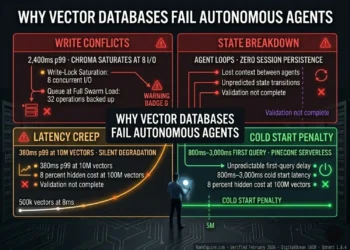
Audit Your Vector Store Integrity Today.

RankSquire β€” Vector Memory Architecture for AI Agents 2026

Master Content Engine v3.0 β€” Article #9

Production Guide March 2026
Tags: Agent memory design patternsAgentic AI memory 2026AI agent memory layersEmbedding versioning AI agentsEpisodic memory AI agentsHallucination amplification vector memoryL1 L2 L3 memory stack AILong-term memory AI agentsMemory persistence AI agentsn8n memory orchestrationPinecone episodic storeQdrant memory architectureRankSquireRe-indexing vector database strategyRecall quality monitoringRedis working memory AIRetrieval drift vector databaseShort-term memory AI agentsSovereign Memory Stack agentic AIStale embeddings AI agentsTool memory AI agentsVector database for AI agents 2026Vector memory architecture 2026Vector memory architecture for AI agentsVector memory failure modes
SummarizeShare234
Mohammed Shehu Ahmed

Mohammed Shehu Ahmed

Mohammed Shehu Ahmed SEO-Focused Technical Content Strategist
Agentic AI & Automation Architecture πŸš€ About Mohammed is an AI-first SEO strategist specializing in automation architecture, agentic AI systems, and emerging technologies. With a B.Sc. in Computer Science (Dec 2026), he creates implementation-driven content that ranks globally. 🧠 Content Philosophy β€œI am human first. Not a generalist content writer. I am your AI-first, SEO-native content architect.”

Related Stories

Vector Memory Architecture for Agentic AI 2026 β€” three-tier L1 Redis L2 Qdrant L3 Semantic sovereign stack on dark architectural background

Agentic AI vs Generative AI: Architecture & Cost (2026)

by Mohammed Shehu Ahmed
March 13, 2026
0

⚑ Agentic AI vs Generative AI β€” Quick Comparison Β· March 2026 Full architecture breakdown in sections below β†’ Feature Generative AI Agentic AI Mode ⟳ Reactive β€”...

Why vector databases fail autonomous agents 2026 β€” four failure modes taxonomy diagram showing Write Conflicts, State Breakdown, Latency Creep, and Cold Start Penalty β€” RankSquire

Why Vector Databases Fail Autonomous Agents [2026 Diagnosis]

by Mohammed Shehu Ahmed
March 9, 2026
0

ARTICLE #8 β€” VECTOR DB SERIES FAILURE TAXONOMY Updated March 2026 Verified Environment DigitalOcean 16GB Β· Feb–Mar 2026 Failure Modes Covered 4 Β· Write Β· State Β· Latency...

Multi-agent vector database architecture diagram showing Planner, Executor, and Reviewer agents connected to Weaviate, Qdrant, Pinecone, and Redis namespaces on dark background β€” RankSquire 2026

Multi-Agent Vector Database Architecture [2026 Blueprint]

by Mohammed Shehu Ahmed
March 8, 2026
0

πŸ“… Updated: March 2026 πŸ”¬ Verified: Feb–Mar 2026 Β· DigitalOcean 16GB Β· 5-Agent Swarm Load Test βš™οΈ Stack: Qdrant Β· Weaviate Β· Redis Β· Pinecone Serverless Β· n8n...

Chroma vs Pinecone vs Weaviate benchmark 2026 β€” p99 latency comparison on dark architectural background

Chroma vs Pinecone vs Weaviate: 5 Benchmarks Compared

by Mohammed Shehu Ahmed
March 5, 2026
0

πŸ“… Last Updated: March 2026 Benchmarks: March 2026 (DigitalOcean 16GB / 8 vCPU) Embedding: OpenAI text-embedding-3-small (1,536-dim) Index: HNSW ef=128, M=16 Dataset: Synthetic + Wikipedia Concurrency: 10 simultaneous...

Next Post
Vector Memory Architecture for Agentic AI 2026 β€” three-tier L1 Redis L2 Qdrant L3 Semantic sovereign stack on dark architectural background

Agentic AI vs Generative AI: Architecture & Cost (2026)

Leave a Reply Cancel reply

Your email address will not be published. Required fields are marked *

RankSquire Official Header Logo | AI Automation & Systems Architecture Agency

RankSquire is the premier resource for B2B Agentic AI operations. We provide execution-ready blueprints to automate sales, support, and finance workflows for growing businesses.

Recent Posts

  • Agentic AI vs Generative AI: Architecture & Cost (2026)
  • Vector Memory Architecture for AI Agents β€” 2026 Blueprint
  • Why Vector Databases Fail Autonomous Agents [2026 Diagnosis]

Categories

  • ENGINEERING
  • OPS
  • SAFETY
  • SALES
  • STRATEGY
  • TOOLS

Weekly Newsletter

  • ABOUT US
  • AFFILIATE DISCLOSURE
  • Apply for Architecture
  • CONTACT US
  • EDITORIAL POLICY
  • HOME
  • Privacy Policy
  • TERMS

Β© 2026 RankSquire. All Rights Reserved. | Designed in The United States, Deployed Globally.

Welcome Back!

Login to your account below

Forgotten Password?

Retrieve your password

Please enter your username or email address to reset your password.

Log In
No Result
View All Result
  • HOME
  • BLUEPRINTS
  • SALES
  • TOOLS
  • OPS
  • GUIDES
  • STRATEGY
  • ENGINEERING

Β© 2026 RankSquire. All Rights Reserved. | Designed in The United States, Deployed Globally.