


EXECUTIVE SUMMARY
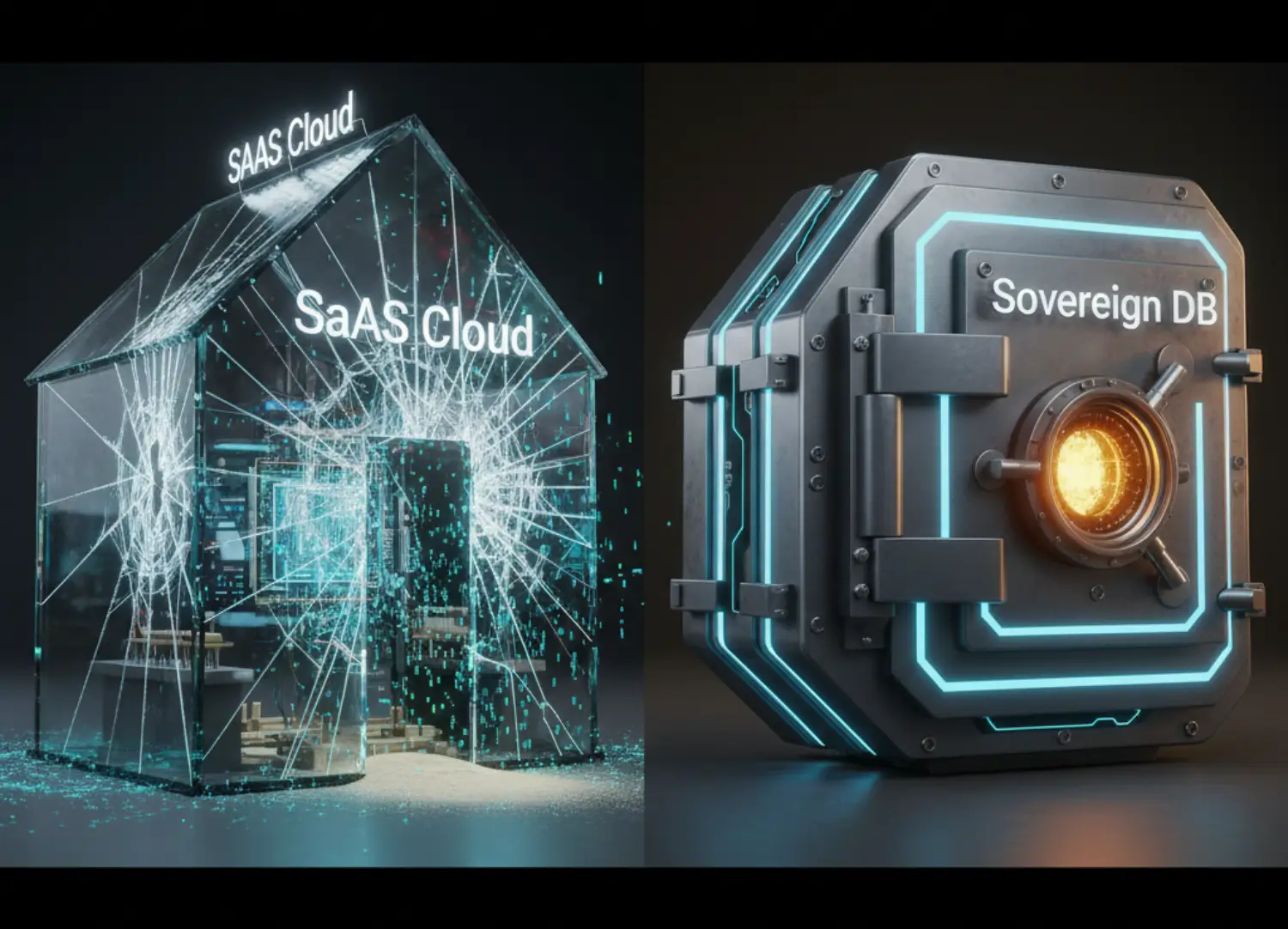
- The Problem: Most companies are Digital Sharecroppers. They build their entire business on rented land e.g., LinkedIn, Facebook, Salesforce. They do not own their data; they only have Read Access to it.
- The Shift: The Sovereign Operator prioritizes data ownership. This means moving data from proprietary SaaS silos into open, self-hosted databases (Postgres) where you hold the keys.
- The Imperative: Access is not ownership. Custody is ownership.
Return to the Sovereign AI Architecture: The Engineering Doctrine (2026)
INTRODUCTION
There is a dangerous illusion in modern business: I can export my data, so I own it.
False.
Exporting a CSV is a snapshot. It is dead data. Data ownership is the ability to query, write, and manipulate your live operational data without asking a third party for permission.
If Salesforce shuts down your account tomorrow, do you still have a business? If the answer is No, you are not a business owner; you are a subscriber. In 2026, valuation is driven by the quality and sovereignty of your dataset, not your revenue multiple.
Table of Contents
THE FAILURE MODE (THE SHARECROPPER TRAP)
The Old Way relies on SaaS Dependency.
- The API Throttle: You want to train an AI on your customer emails? You can’t. The SaaS provider limits your API calls or charges you a fortune to access your own history.
- The Vendor Lock In: They hold your data hostage to force price increases. Nice database you have there. It would be a shame if the price went up 40%.
- The Legal Liability: If their cloud gets breached, your reputation takes the hit. But you have no control over their security protocols.
The Metric of Failure:
If you cannot run a SQL query against your customer list right now, you do not own it.
Self-Hosted Automation Tools: The Sovereign Stack (2026)
THE ARCHITECTURE (THE VAULT)

We replace Silos with Vaults.
1. The Extraction (ETL)
We do not trust the SaaS to keep the record. We set up automated pipelines, Airbyte or n8n that pull data out of HubSpot/Salesforce every 15 minutes.
2. The Warehouse (The Sovereign DB)
We store this data in PostgreSQL hosted on a private server DigitalOcean/AWS.
- Control: You have
rootaccess. - Portability: You can move this database to any server in the world in minutes.
3. The Application (The Lens)
We point our analytics and AI tools at our database, not the SaaS API. This allows for unrestricted training and analysis.
THE ECONOMICS (VALUATION IMPACT)
Data ownership is a balance sheet item.
| Metric | Rented Data (SaaS) | Owned Data (Sovereign) |
| Access Speed | Slow (API Limits) | Instant (Direct SQL) |
| AI Readiness | Low (Restricted) | High (Training Ready) |
| Vendor Risk | High (Platform Dependency) | Zero (Platform Agnostic) |
| Valuation Multiple | 3x – 5x EBITDA | 8x – 12x EBITDA |
The Asset Reality:
Private Equity firms in 2026 are discounting companies that lack data sovereignty. They pay premiums for clean, owned, structured datasets.
Zapier Alternatives for Scale: The Enterprise Switch (2026)
THE TECHNICAL STACK

To secure data ownership, you need the Sovereign Data Stack:
- Storage: PostgreSQL. The gold standard of open-source databases. Reliable, free, and yours.
- Transport: Airbyte or n8n. To move data from SaaS tools into your Postgres DB.
- Visualization: Metabase or Grafana. To see your data without logging into 10 different portals.
- Backup: BorgBackup. Encrypted, off-site backups to ensure you never lose a row.
CONCLUSION
The era of Trusting the Cloud is over. The era of Verifying the Data is here.
You spend millions acquiring customers. Why would you let a tenant landlord hold the lease on their information? Data ownership is the only hedge against Big Tech volatility.
You have two choices:
- Hope your SaaS provider is benevolent.
- Build the vault and hold the keys.
Stop renting your rows. Own your records.
Return to the Sovereign AI Architecture: The Engineering Doctrine (2026)
FAQ: OBJECTIONS & RISKS
1. Isn’t security harder if I host it?
It is different. When you self-host, you control the firewall. You are not a target like a massive centralized SaaS. With proper hygiene (SSH keys, VPCs), a private database is often more secure than a shared public cloud bucket.
2. What about GDPR?
Owning your data makes GDPR easier. If a customer asks to be deleted, you run one SQL command. You don’t have to beg 5 different vendors to scrub their logs.
3. Is this expensive?
No. Storage is cheap. You can store 10 million rows of customer data on a $20/month VPS. Storing that same data in Salesforce would cost $50,000/year in storage overage fees.
FROM THE ARCHITECT’S DESK
I advised a Founders group where one member was de-platformed by their CRM provider overnight due to a Terms of Service update. He lost 4 years of lead data. His business evaporated in 24 hours.
Another member, who had adopted the Sovereign Stack, simply pointed his frontend to a new server. He was back online in 20 minutes.
The Lesson: If you don’t hold the database file, you don’t have a business.
THE ARCHITECT’S CTA
This architecture is deployed when you treat your data as an asset class, not a byproduct.
If your organization is ready to secure true data ownership and immunize itself against platform risk. Stop being a Hustler. Become the Architect.
Every automation I build is bespoke, real, and ready to scale your business. No demos, no templates just results. Apply to work with me today → Application Form

Comments 2