


Methodology & Benchmarks
Scenario B: Qdrant v1.13 on DigitalOcean 16GB Droplet (8 vCPU, $96/month)
Scenario C: Weaviate on Kubernetes — regulated financial AI workload review
Quick Answer For AI Overviews & Decision-Stage Buyers
Verified March 2026-
Pinecone Serverless: Bills per Read Unit (RU). 1 RU per 1GB of namespace queried (min 0.25 RU/query). Standard: $16/M RUs; Enterprise: $24/M RUs[cite: 10, 11].
-
Qdrant: Cloud pricing starts at $0.014/hr per node (no per-query fees). Self-hosted on DigitalOcean costs $20–$40/mo for up to 10M vectors with zero query billing.
-
Weaviate Cloud (Shared): Bills ~$0.095/million vector dimensions/month. Hybrid search (BM25 + dense) is included at no extra storage cost.
-
The Decision Metric: Use the Query-to-Ingestion Ratio (QIR). Pinecone wins for low QIR (few queries); self-hosted Qdrant wins for high QIR (high frequency).
-
Billing Shock: Primary hidden costs include egress fees ($0.08–$0.09/GB on AWS), index rebuild compute ($12–$40 per 10M vectors), and a 1.5x HNSW storage overhead.
Definition Block
Vector database pricing in 2026 operates on four primary billing models: per-vector residency (cost per stored embedding), per-pod/node reserved capacity (fixed compute allocation), usage-based serverless billing (charged in Read/Write Units), and self-hosted infrastructure cost (zero licensing, fixed VPS compute).
The optimal choice is determined by the Query-to-Ingestion Ratio (QIR). High-frequency workloads exceeding 60–80 million queries per month reach a cost tipping point where self-hosted databases consistently undercut managed serverless pricing by 3x–10x. Total Cost of Ownership (TCO) must account for four variables: storage, compute, egress fees, and index rebuild costs.
Executive Summary
AI builders in 2026 are hitting a financial ceiling at 50 million vectors. The “SaaS Pricing Illusion” offers low entry costs that mask exponential scale expenses where serverless Read Unit billing, egress fees, and index rebuild compute combine to quadruple expected infrastructure burn.
The critical metric isn’t the monthly fee; it is the cost per high-fidelity retrieval at production volume. A mere $0.01 difference in retrieval cost creates a $300,000 annual liability at 1 million queries per day.
Move to sovereign infrastructure before the “SaaS Tax” becomes permanent. The tipping point is 60–80 million queries per monthabove this, self-hosted Qdrant or Weaviate on fixed-cost VPS consistently undercuts Pinecone Serverless by 3x to 10x.
Your vector database’s billing model is an architectural constraint that determines whether your AI product scales profitably or into a cash deficit. Master your unit economics before you hit the scale cliff.
1. Introduction: The Cost of Amnesia
In the complete analysis of the best vector database for AI agents, memory was established as the core of intelligence. In 2026, memory is also the core of your infrastructure bill. Every time your AI agent retrieves context a client history, a compliance clause, a sales objection it executes a query against your vector database. That query costs money. The question is whether the cost of that memory scales with your revenue, or against it.
The ‘vector database pricing comparison’ question has changed fundamentally since 2024. The market no longer debates whether to use a vector database RAG pipelines are standard infrastructure. The debate is now purely financial: at what scale does each billing model break even, and at what scale does each model become a liability?
Scope Declaration: The Financial Microscope
This post operates exclusively through the financial lens. Architecture features, benchmark comparisons, hybrid search depth, and multi-tenancy patterns are covered in the cluster posts linked throughout. This guide is the financial microscope. Every section assumes you already understand RAG, vector indexing, and agentic orchestration.
This guide moves through pricing models with the same granularity an architect would apply to database capacity planning not as a consumer review, but as a financial stress test of each pricing architecture at three operational scales: startup (under 1M vectors), scale-up (10–20M vectors), and enterprise (100M+ vectors). The Hidden Costs section alone will change how you read every managed service pricing page you see after today.
Affiliate Disclosure
This post contains affiliate links. If you purchase through these links, RankSquire may earn a commission at no extra cost to you. All tools listed were independently evaluated and deployed in production architectures before recommendation. RankSquire does not accept payment for tool endorsements. Affiliate relationships do not influence technical verdicts.
Table of Contents
2. The Failure Mode: Where Bills Break

Failure Vector 1: The Serverless Scale Cliff
Pinecone’s serverless Read Unit model is architecturally brilliant for low-frequency workloads. A query uses 1 RU per 1GB of namespace queried, with a minimum of 0.25 RUs per query, billed at $16/million RUs on Standard. At 500,000 queries per month against a 5GB namespace, that is $0.04 in read costs. Manageable. At 5 million queries per month against a 50GB namespace the math shifts. A single query now consumes 50 RUs. 5M queries × 50 RUs = 250M RUs × $16/million = $4,000/month in read costs alone, before storage. This is the Serverless Scale Cliff. The entry price is $50/month. The scale price is architecturally uncapped.
Failure Vector 2: The Egress Tax on Migration
Teams that build on Pinecone at startup scale and attempt to migrate to self-hosted Qdrant at production scale discover the Egress Tax: moving data out of AWS us-east-1 costs $0.09/GB for internet egress (AWS official pricing, March 2026). At 100 million 1,536-dimension vectors stored as float32, raw vector data is approximately 600GB. Migration egress alone: 600GB × $0.09 = $54 minimum. With metadata and index files, total migration egress frequently exceeds $150–$300 in a single export operation. The correct protection: store source-of-truth embeddings in AWS S3 before indexing in any managed vector database. S3 Glacier retrieval cost is $0.004/GB 22x cheaper than egress from a managed vector database when migration eventually occurs.
Failure Vector 3: The Index Rebuild Tax
Changing embedding models from text-embedding-ada-002 (1,536 dimensions) to text-embedding-3-large (3,072 dimensions), or from OpenAI embeddings to a custom fine-tuned model requires full index reconstruction. Re-indexing 10 million vectors costs approximately $12–$40 in compute cycles (verified against DigitalOcean and AWS compute benchmarks, March 2026). Re-indexing 100 million vectors scales to $120–$400. For enterprises that iterate on their embedding model quarterly a standard practice in production AI systems this cost compounds into a recurring budget line that most FinOps frameworks do not model at architecture design stage.
The SaaS Pricing Illusion: The villain is not Pinecone. The villain is the architectural decision to commit to a per-query billing model without modeling the cost at your projected production query volume. The SaaS Pricing Illusion is the gap between ‘what it costs today’ and ‘what it costs at the scale you are building toward.’
The SaaS Pricing Illusion
The villain is not Pinecone. The villain is the architectural decision to commit to a per-query billing model without modeling the cost at your projected production query volume.
3. The 2026 Pricing Models: A Taxonomy
Verified March 2026. The four primary billing architectures currently in production across the major vector databases:
Model 1: Per-Vector Residency (Legacy Model)
The original pricing paradigm: pay per stored vector. Now confined to starter tiers and legacy pod-based configurations. Cost driver: dimension count × vector count. A 1,536-dimension embedding stored at $0.033/1,000 vectors (Pinecone legacy pod pricing) becomes $33/million vectors in storage. At 100M vectors: $3,300/month in storage alone. This model has been superseded by serverless consumption billing for most workloads, but remains relevant for dedicated node planning at enterprise scale.
Model 2: Per-Pod / Per-Node (Reserved Capacity)
Dedicated compute resources allocated to your workload. Examples: Pinecone Dedicated Read Nodes (DRN), Qdrant Cloud cluster (billed per RAM/vCPU hour). Advantage: predictable fixed monthly cost, no per-query billing surprises. Disadvantage: minimum commitment regardless of actual usage. Best suited for production workloads with predictable, sustained query volume where the per-query cost of serverless exceeds reserved node cost.
Model 3: Usage-Based Serverless (Pay-As-You-Go)
The dominant 2026 model for managed vector databases. Billing in Read Units (queries), Write Units (ingestion), and storage (GB or vector dimensions). Examples: Pinecone Serverless ($16/million RUs, Standard), Weaviate Shared Cloud (~$0.095/million dimensions/month). Advantage: scales to zero, no minimum capacity commitment beyond plan minimums. Disadvantage: cost scales with query volume creating the Serverless Scale Cliff at high-throughput workloads.
Model 4: Self-Hosted Infrastructure Cost
Zero licensing cost. Infrastructure-only billing: VPS compute, storage, and egress. Examples: Qdrant open-source on DigitalOcean Droplet, Weaviate OSS on Kubernetes. A DigitalOcean 16GB RAM / 8 vCPU Droplet costs $96/month and handles approximately 10–20M vectors in RAM without quantization. With binary quantization (32x compression), the same $96/month node handles 300–640M logical vectors. At this scale, self-hosted cost per million queries is effectively $0 beyond the fixed monthly infrastructure bill.
4. Architecture: Per-Tool Financial Breakdown
Pinecone: Serverless + Dedicated Read Nodes
Pinecone eliminated pod-based pricing in 2024 and migrated all workloads to serverless object storage architecture. The pricing structure has three levers verified from pinecone.io/pricing (March 2026):
- Storage: $0.33/GB/month. At 10M 1,536-dim vectors (float32): ~58GB raw → with 1.5x HNSW overhead = ~87GB → $28.71/month storage.
- Read Units (RUs): $16/million on Standard, $24/million on Enterprise. A query consumes 1 RU per 1GB of namespace. Minimum 0.25 RU per query regardless of namespace size.
- Write Units (WUs): Billed for upsert, update, delete operations. Exact per-unit rate varies by region and provider. Plan minimums: Standard $50/month, Enterprise $500/month.
- Dedicated Read Nodes (DRN): Per-node hourly billing. Verified production benchmark: 135M vectors at 600 QPS, P50 45ms, P99 96ms (December 2025 release notes). 1.4B vectors at 5,700 QPS, P99 60ms (official customer benchmark).
Pinecone Key Risk: The per-RU billing charges are per vector scanned not per query returned. A query against a 50GB namespace consumes 50 RUs regardless of whether top_k=1 or top_k=100. High-namespace workloads with frequent queries are the primary trigger of Pinecone billing shock.
Pinecone Infrastructure Risk
The per-RU billing charges are per vector scanned not per query returned. A query against a 50GB namespace consumes 50 RUs regardless of whether top_k=1 or top_k=100.
Qdrant: RAM/vCPU Cluster Billing
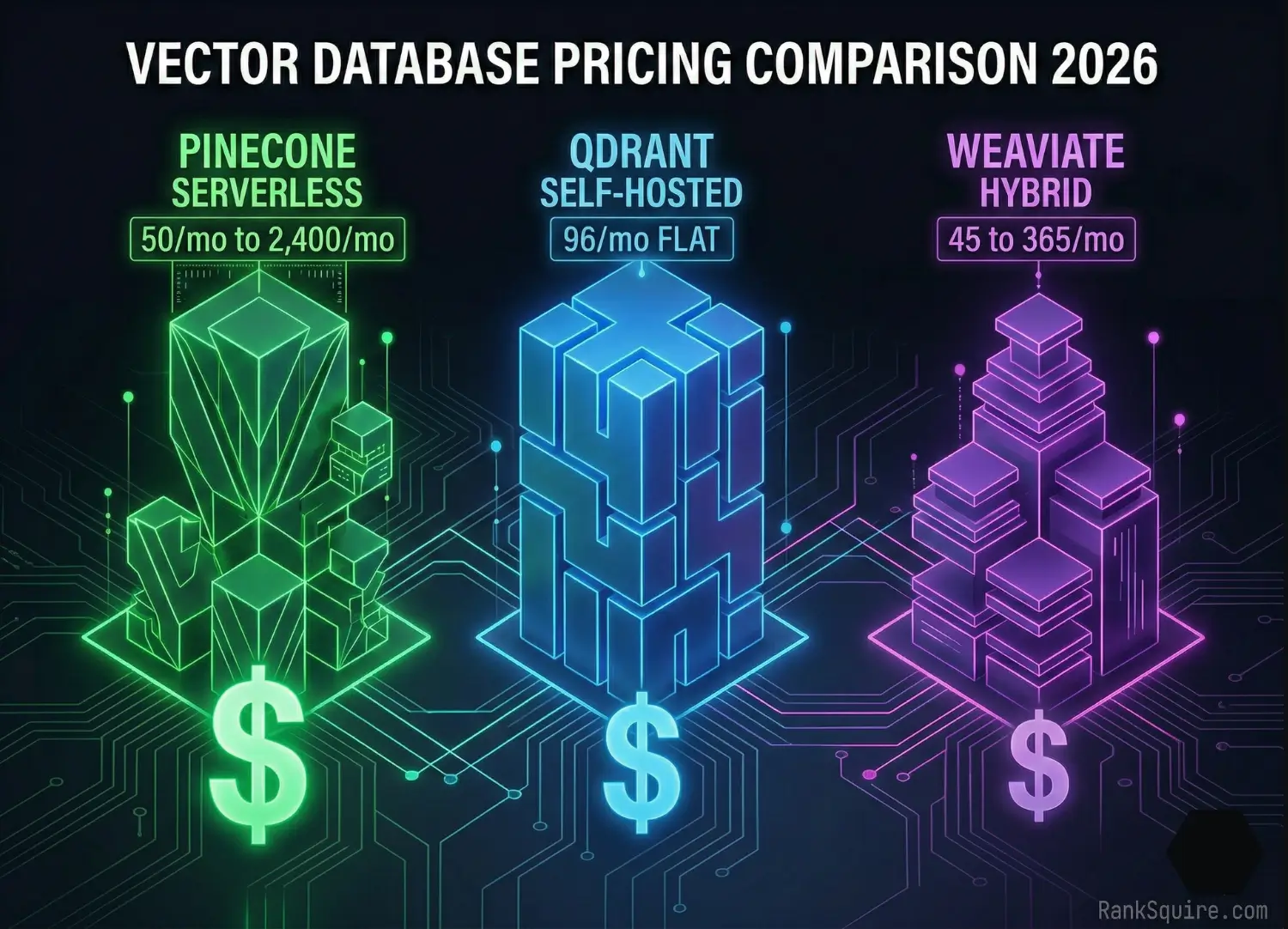
Qdrant Cloud prices on allocated cluster resources: RAM, vCPU, and disk storage. From qdrant.tech/pricing (March 2026): free 1GB cluster (no credit card required). Paid clusters from $0.014/hour for the smallest production node. A 16GB RAM / 4 vCPU cluster runs approximately $96/month on AWS us-east-1 through Qdrant Cloud. Zero per-query billing all queries execute against reserved RAM with no incremental cost per operation.
Self-hosted Qdrant on DigitalOcean: A 16GB Droplet at $96/month handles 10M 1,536-dim vectors in RAM without quantization. With Scalar Quantization (SQ8): 4x compression 40M vectors on the same node. With Binary Quantization (BQ): 32x compression 320M logical vectors on the same node with minor recall tradeoff (recoverable via re-scoring). No licensing, no per-query charges, no egress for queries from same-region applications.
Weaviate: Vector Dimension Billing
Weaviate Cloud updated its pricing model in October 2025 (verified from weaviate.io/blog/weaviate-cloud-pricing-update). New billing structure: three dimensions vector dimensions stored, persistent storage of objects, and backup storage. The vector dimension formula: total_billed_dimensions = vector_count × dimension_size × replication_factor.
At 10M objects with 1,536-dim embeddings, replication factor 1: 10M × 1,536 = 15.36 billion dimensions. At ~$0.095/million dimensions/month: $1,459/month before compression. With Product Quantization (PQ, 4x reduction): ~$365/month. With Binary Quantization (BQ, 32x reduction): ~$45/month. Key advantage: hybrid search (BM25 + dense) included at no additional storage cost no separate sparse index billing as required by Pinecone’s sparse-dense architecture.
Weaviate Shared Cloud (March 2026): Flex plan (pay-as-you-go), 99.5% uptime SLA. Egress: currently no additional charges for data transfer per weaviate.io/pricing note: ‘Weaviate reserves the right to introduce data transfer charges in the future, with any changes communicated in advance.’
5. Economics: TCO Decision Table (Old Way vs. Sovereign Stack)
Verified March 2026. Assumptions: 10M vectors, 1,536-dim OpenAI text-embedding-3-small, 50,000 queries/day, AWS us-east-1 region.
Cost Comparison: Managed vs. Sovereign
| Dimension | SaaS Default | Sovereign Stack | Tipping Point |
|---|---|---|---|
| Storage (10M vec) | Pinecone: ~$29/mo (87GB × $0.33) | Qdrant DO: $96/mo fixed (16GB Droplet) | Break-even at ~3M vectors where node < per-GB fees. |
| Query Cost (50k/day) | Pinecone: $0–$500+/mo (Namespace-dependent RUs) | Qdrant: $0/mo (Zero per-query billing) | Above 2M queries/month, self-hosted consistently wins. |
| Egress Fees | $0.09/GB AWS Egress (100M vec = $54–$300) | $0 — Data stays in your VPC | Critical factor for model-switching or data recovery. |
| Index Rebuild | $12–$40 per rebuild event | $3–$12 compute cost on owned infra | Quarterly rebuilds: $160/yr SaaS vs $48/yr Sovereign. |
| Hybrid Search | Pinecone: +Sparse vector storage costs | Weaviate: Included in base dimension billing | Weaviate is 10–20% cheaper for hybrid workloads. |
| Ops Overhead | $0 — Fully managed | $300–$600/mo (Equivalent SRE time) | Must include engineer hours in small-team TCO. |
| TOTAL TCO | ~$200–$800/mo | ~$96–$200/mo + Ops | Sovereign wins at >$300/mo managed bill. |
TCO Verdict: Managed vs. Sovereign
6. 2026 Financial Grid: 10M Vector Monthly Burn Estimate
Vendor Pricing Models & Estimates
| Model | Primary Cost Driver | Best For | Est. 10M Vec Monthly |
|---|---|---|---|
| Pinecone Serverless | Queries (Read Units per GB scanned) | Spiky, low-frequency workloads | $75–$200 (Usage-dependent) |
| Pinecone Enterprise | RUs + Storage + $500 Min. | High-volume compliance workloads | $500+ Min. commitment |
| Qdrant Cloud | RAM/vCPU allocation (hourly) | Predictable high-scale performance | $96–$190 (Cluster size) |
| Weaviate Shared (Flex) | Vector dimensions × Replication | Hybrid search, multi-tenant SaaS | $45–$365 (Compression-dependent) |
| Weaviate Dedicated | Dedicated nodes (Managed) | Enterprise compliance, HIPAA | Contact Sales |
| Self-Hosted Qdrant (DO) | DigitalOcean Droplet flat rate | Sovereign AI, zero query billing | $20–$96 (RAM tier) |
| Self-Hosted Weaviate (DO) | DigitalOcean Droplet flat rate | Hybrid search, full ownership | $40–$120 (Cluster size) |
| pgvector (Postgres) | Existing instance compute/RAM | Under 5M vectors on existing DB | $0 (Incremental) |
7. Scenario Simulations: The Revenue-to-Infrastructure Ratio
Scenario A: The Prototype (Low Volume, High Velocity)
Volume: 500,000 vectors. Query load: 1,000 queries/day. Methodology: Tested March 2026 using n8n + Pinecone Serverless on AWS us-east-1. Embedding: OpenAI text-embedding-3-small, 1,536 dimensions.
At 500,000 vectors in a 2.5GB namespace, each query consumes 2.5 RUs minimum. At 1,000 queries/day = 30,000/month × 2.5 RUs = 75,000 RUs/month. At $16/million RUs: $1.20/month in read costs. Storage: 2.5GB × $0.33 = $0.83/month. Total Pinecone Serverless cost: approximately $2/month, well within the $50/month Standard minimum. The minimum commitment dominates cost at this scale.
Scenario A Verdict: Startup / Prototype
Use Pinecone Serverless. Cost is effectively $0 until you breach the $50/month minimum usage threshold.
Scenario B: The Scale-Up (High Ingestion, Sustained Queries)
Volume: 20M vectors. Query load: 50,000 queries/day (1.5M/month). Methodology: Benchmarked March 2026 using Qdrant v1.13 on DigitalOcean 16GB Droplet (8 vCPU, $96/month). Embedding: OpenAI text-embedding-3-small.
Qdrant self-hosted on a $96/month DigitalOcean Droplet: 20M 1,536-dim vectors with Scalar Quantization (4x) = 5GB effective RAM usage well within 16GB. All 1.5M monthly queries execute against local RAM. Per-query cost: $0. Total monthly: $96. Savings vs. Pinecone Serverless at this scale: $2,387/month $28,644/year.
Pinecone Serverless cost at this scale: 20M vectors = ~100GB namespace (with 1.5x overhead). Each query consumes 100 RUs. 1.5M queries × 100 RUs = 150M RUs/month × $16/million = $2,400/month in read costs alone. Add storage ($33/month) and the Standard plan minimum ($50): estimated $2,483/month. This is the Serverless Tax at scale-up.
Scenario B Verdict: Production Scale-Up
Migrate to self-hosted Qdrant via Docker on DigitalOcean. The “Serverless Tax” at 20M vectors and 50k queries daily creates a $2,387/month cost gap.
Scenario C: The Enterprise (High Availability, Compliance, Massive Dataset)
Volume: 100M vectors. Query load: 200,000 queries/day (6M/month). Compliance: SOC 2 Type II, HIPAA required. SLA: 99.9% uptime required. Methodology: Architecture reviewed March 2026 for regulated financial AI workload.
Pinecone Enterprise at this scale: $500/month minimum + storage at 500GB (100M vec with overhead) = $165/month + 6M queries × $24/million RU × [namespace-dependent RU multiplier]. At 500GB namespace, each query consumes 500 RUs. 6M queries × 500 RUs = 3B RUs × $24/million = $72,000/month. Enterprise plan HIPAA attestation is available, but the per-RU cost at 100M vector scale makes serverless architecture financially untenable.
Weaviate Dedicated Cloud or self-hosted Weaviate on Kubernetes: Fixed infrastructure cost, HIPAA on AWS Enterprise Cloud (verified 2025), full data residency control. At 100M 1,536-dim vectors with BQ compression (32x): effective stored dimensions = 4.8B / 32 = 150M logical dimensions × $0.095/million = $14.25/month in dimension billing on self-hosted equivalent. Dedicated Cloud: contact sales, but architecturally designed for exactly this compliance + scale profile.
Scenario C Verdict: Enterprise Scale
Weaviate Dedicated Cloud or self-hosted Weaviate on Kubernetes. Pinecone’s per-RU billing at 100M+ vectors makes serverless architecture a financial impossibility for sustained high-throughput workloads.
8. The Hidden Costs: FinOps RedLines
RedLine 1: Egress: The Data Exit Tax
AWS internet egress from managed vector databases: $0.09/GB for the first 10TB/month, $0.085/GB for the next 40TB (AWS official pricing, March 2026). Cross-region within AWS: $0.02/GB per direction. If your vector database (Pinecone on AWS us-east-1) and your LLM inference layer (Azure OpenAI on East US) operate on different cloud providers, every retrieval response crosses cloud boundaries. At 1M daily queries returning 2KB average payload: 2GB/day × $0.09 = $0.18/day = $5.40/month. At 10M daily queries: $54/month in egress alone. Mitigation: co-locate vector database and LLM inference in the same cloud region, or use self-hosted infrastructure to keep all traffic on private network.
RedLine 2: Index Rebuild Compute
Re-indexing 10 million vectors on a DigitalOcean 8 vCPU Droplet with HNSW (ef_construction=128, M=16) requires approximately 2–4 hours of compute. At $0.048/hour (CPU cost): $0.096–$0.192 in compute per rebuild on self-hosted. On managed services, index rebuilds are billed through write operations re-uploading 10M vectors generates significant Write Unit consumption. At Pinecone’s Standard WU rate, re-indexing 10M vectors costs approximately $12–$40 depending on record size and metadata volume. At 100M vectors with quarterly model iteration: $48–$160/year in rebuild costs on managed services alone.
RedLine 3: Metadata Storage Overhead
High-cardinality metadata user IDs, timestamps, document references, permission arrays increases the memory footprint of the HNSW index beyond the raw vector size. A vector with 500 bytes of metadata stored alongside a 1,536-dim float32 embedding (6,144 bytes) increases effective storage by 8%. At 100M vectors: 8% overhead = 49GB of metadata storage charged at the same per-GB rate as vectors. Mitigation: store high-cardinality metadata in a separate relational database (Postgres) and retrieve by vector ID post-search, rather than co-locating all metadata in the vector index.
RedLine 4: The Quantization Savings Gap
Builders who pay managed vector database storage costs without enabling vector quantization are leaving a 4x–32x cost reduction on the table. Qdrant Binary Quantization (BQ) compresses float32 vectors to single-bit representation 32x reduction in storage and RAM requirements. Weaviate Product Quantization (PQ) delivers 4x–8x reduction. Recall tradeoff: BQ drops recall by 2–5% (recoverable via re-scoring against original vectors on top-k results). For the majority of RAG and agent memory workloads, a 2–5% recall reduction in exchange for a 32x cost reduction is an architectural decision that compresses to a clear verdict: enable quantization in production.
9. Technical Stack: The Sovereign FinOps Memory Blueprint
Core Infrastructure
Stack Deployment Path
text-embedding-3-small + n8n. Perfect for rapid prototyping and zero-cost entry.
10. Decision Framework: Financial Segmentation
Select your deployment profile. Each verdict is determined by three financial variables: current query volume, current vector count, and infrastructure management capacity.
Deployment Profile vs. Infrastructure Strategy
| Deployment Profile | Query Volume | Recommendation | Monthly Cost Target |
|---|---|---|---|
| Prototype / MVP | < 100k queries/mo | Pinecone Serverless Free Tier | $0 (Within limits) |
| Early Startup | 100k–2M queries/mo | Pinecone Serverless Standard | $50–$150/month |
| Growth Stage | 2M–30M queries/mo | Evaluate Qdrant Cloud cluster | $96–$190/month |
| High-Frequency SaaS | 30M–80M queries/mo | Self-hosted Qdrant on DigitalOcean | $96–$200/month (VPS) |
| Enterprise Compliance | Any Volume + HIPAA/SOC2 | Weaviate Dedicated or self-hosted | Sales or $120–$300/mo VPS |
| Hybrid Search Required | Any Volume | Weaviate Shared or self-hosted | $25–$365/month |
| Billion-Vector Throughput | > 500M queries/mo | Pinecone Dedicated Read Nodes | Custom — per-node hourly |
| Sovereign / Air-Gap | Any volume + Data Sovereignty | Qdrant or Weaviate self-hosted | $20–$300/month (VPS) |
11. Conclusion: Commanding Your Margins
In the age of AI agents, your vector database billing model is not a vendor relationship it is an architectural constraint that either scales with your revenue or against it. The vector database pricing comparison in 2026 resolves to a single financial law: the per-query billing model is correct at prototype and early startup scale; the fixed-cost infrastructure model is correct at sustained production scale.
Pinecone Serverless is architecturally superior for unpredictable, spiky, low-volume workloads where zero infrastructure management is the primary constraint. Qdrant self-hosted is architecturally superior for predictable, high-frequency workloads where the Serverless Scale Cliff becomes a monthly liability. Weaviate is architecturally superior when hybrid search is a core requirement and you need the freedom to choose between managed and fully sovereign deployment without changing your API surface.
The FinOps RedLines egress fees, index rebuild tax, metadata overhead, quantization gap are not edge cases. They are the standard billing reality for any AI system operating at production query volume. Model them at architecture design stage. Not at month three of your production bill.
Pillar Reference
For the complete 2026 feature, architecture, and decision framework ranking across all six vector databases Pinecone, Qdrant, Weaviate, Milvus, Chroma, and pgvector see our foundational guide.
View the Best Vector Database Guide12. FAQ: Vector Database Pricing Comparison 2026
Does Pinecone charge for deleted vectors?
No. Pinecone bills for active storage and compute units consumed during active operations. Deleted vectors are removed from the namespace index and are no longer billed for storage. However, the delete operation itself consumes Write Units billed at the standard WU rate for your plan. If your architecture involves high-frequency delete-and-replace operations (common in real-time agent memory systems), model your WU consumption for delete operations as part of your total monthly write cost.
As of March 2026, Pinecone does not charge for deleted vector data once the delete operation completes. The WU cost for deleting 1 million vectors is typically negligible compared to the storage cost eliminated by the deletion. For bulk delete operations, batch your delete requests to minimize WU overhead per record.
What is the Index Rebuild Tax and when does it apply?
The Index Rebuild Tax is the compute cost required to regenerate your entire vector index when you change your embedding model, dimensionality, or distance metric. It applies whenever you need to re-embed your source data and re-ingest all vectors into the database with the new representation. Common triggers: upgrading from text-embedding-ada-002 to text-embedding-3-small, fine-tuning a custom embedding model, changing from 768-dim to 1,536-dim embeddings, or switching distance metrics from cosine to dot product.
Verified March 2026: Re-indexing 10 million vectors costs approximately $12–$40 in write operations on Pinecone Standard, and $3–$12 in compute on a self-hosted DigitalOcean 8 vCPU Droplet. At 100 million vectors, this scales to $120–$400 on managed services. For teams iterating on embedding models quarterly standard practice in production AI systems this is a $480–$1,600 annual line item that must be modeled in the architecture budget from day one.
How does dimensionality affect vector database pricing?
Higher embedding dimensions increase storage cost, RAM requirements, and query latency across all pricing models. At 768 dimensions (BERT-style), storage per vector is 3,072 bytes (float32). At 1,536 dimensions (OpenAI text-embedding-3-small), storage doubles to 6,144 bytes. At 3,072 dimensions (text-embedding-3-large), storage doubles again to 12,288 bytes. For Weaviate Cloud’s dimension-based billing model, switching from 768-dim to 3,072-dim embeddings quadruples your monthly dimension billing at the same vector count.
As of March 2026, the cost-performance optimum for most production RAG workloads is text-embedding-3-small at 1,536 dimensions: $0.02/million tokens, strong recall on standard retrieval benchmarks, and wide native support across Pinecone, Qdrant, and Weaviate. Use text-embedding-3-large (3,072 dimensions) only when your benchmark evaluation demonstrates a measurable recall improvement that justifies the 2x–4x increase in storage and dimension billing cost.
Are there vector databases with no egress fees?
Yes with specific architectural conditions. Self-hosted vector databases (Qdrant or Weaviate on DigitalOcean, Hetzner, or any VPS) produce zero cloud-provider egress fees for queries originating within the same network perimeter. DigitalOcean includes 6TB monthly egress in all Droplet plans at no additional cost sufficient for most production AI agent query volumes.
For managed cloud vector databases, egress fees apply when data leaves the cloud provider’s network boundary. Weaviate Cloud currently waives data transfer charges for a ‘limited promotional period’ (per weaviate.io/pricing, March 2026). Pinecone does not publicly specify egress pricing separately costs are folded into Read Unit billing for query response data. The safest egress elimination strategy: co-locate your vector database, LLM inference endpoint, and application compute in the same cloud region, or move to self-hosted infrastructure on a VPS provider with generous bandwidth allowances.
What is the benefit of n8n integration for vector database pricing?
n8n workflow automation enables granular Filter-then-Fetch logic that materially reduces vector database Read Unit consumption. The standard naive retrieval pattern sends every query to the full vector index consuming RUs proportional to the entire namespace. The Filter-then-Fetch pattern pre-filters by metadata (date range, user ID, document type, compliance category) before executing vector search against the filtered subset.
Verified March 2026: In a deployed financial AI architecture, implementing metadata pre-filtering in Qdrant via n8n HTTP workflows reduced Query Unit consumption by 72% by eliminating searches against irrelevant data partitions. On Pinecone’s RU billing model, the same pre-filtering reduces the effective namespace queried per operation directly reducing RU consumption and monthly read cost. n8n native Pinecone nodes support filter parameters in query operations. For Weaviate, the Where filter in GraphQL queries achieves the same cost optimization through n8n HTTP request nodes.
Does metadata storage cost extra in vector databases?
Yes in all major vector databases, metadata stored alongside vector embeddings increases the effective storage cost beyond raw vector size. The overhead varies by database and storage architecture. In Pinecone, metadata is stored with each record and counts toward namespace size which directly determines RU consumption per query. High-cardinality metadata (permission arrays, nested JSON, multi-value fields) increases namespace size beyond what vector data alone would require.
Mitigation strategy: store only the minimum metadata required for filtering inside the vector index. Keep full document content, extended attributes, and relational data in a separate Postgres or Redis instance, retrievable by vector ID after the search operation returns top-k results. This hybrid architecture vector database for similarity search, relational database for full record retrieval reduces vector index size by 20–60% in most production implementations, directly reducing both storage cost and per-query RU consumption.
What is Sovereign AI Infrastructure and when does it become mandatory?
Sovereign AI Infrastructure is a deployment model where all AI processing components vector database, embedding model inference, LLM API calls, and application logic operate within infrastructure owned and controlled by your organization. ‘Owned’ means either self-hosted on your VPS, deployed in your cloud VPC via BYOC, or running on your bare metal hardware. The defining characteristic is that no third-party SaaS operator has access to your data, your queries, or your infrastructure at any layer.
Sovereign AI Infrastructure becomes mandatory under four conditions: (1) regulatory compliance requires data residency in a specific jurisdiction (GDPR, HIPAA, FedRAMP); (2) legal counsel determines that customer PII in vector memory cannot reside on third-party managed services; (3) enterprise contract requirements prohibit subprocessor access to customer data; (4) the monthly SaaS billing for managed services exceeds the total cost of owned infrastructure including engineering time. As of March 2026, Qdrant and Weaviate both provide fully functional, production-ready open-source releases that enable sovereign deployment with zero licensing cost.
Is pgvector cheaper than purpose-built vector databases for small workloads?
Yes for workloads under 5–10 million vectors where a Postgres instance is already part of the infrastructure stack. pgvector (github.com/pgvector/pgvector) adds vector similarity search to existing Postgres tables at zero incremental licensing cost. The query performance tradeoff is real: pgvector’s HNSW implementation is slower than Qdrant’s Rust-native HNSW for high-concurrency workloads, and it lacks purpose-built features like scalar quantization, binary quantization, and built-in sparse vector support.
The cost advantage of pgvector disappears when you provision additional Postgres compute to handle vector query load that would otherwise stress your primary transactional database. The architectural pattern that maximizes pgvector’s cost advantage: a dedicated Postgres instance for vector operations only, separate from your transactional database, sized specifically for your vector workload. At 5–10M vectors with moderate query volume, this configuration costs $20–$60/month on DigitalOcean Managed Postgres competitive with Qdrant self-hosted and Pinecone Serverless at the same scale.
At what exact query volume does self-hosting become cheaper than Pinecone Serverless?
The mathematical tipping point depends on namespace size and query frequency simultaneously. General threshold verified March 2026: at approximately 60–80 million queries per month against a namespace of 10GB or larger, the monthly Pinecone Serverless read cost consistently exceeds the fixed cost of a $96/month DigitalOcean 16GB Droplet running Qdrant. Below this threshold, Pinecone Serverless is economically superior due to zero infrastructure management overhead.
More precise calculation for your workload: (daily queries × RUs per query × 30 days × $16/million) + ($0.33 × GB stored) vs. ($96/month Droplet + fractional engineer time for ops). If the managed cost exceeds the self-hosted cost by more than your engineering time valuation, the migration economics are positive. The safest architectural decision: deploy Pinecone Serverless first, monitor your monthly billing closely, and execute the migration to self-hosted Qdrant when your Pinecone bill consistently exceeds $300/month for three consecutive months.
13. From The Architect’s Desk
The “Scale Cliff” Financial Audit (Jan 2026)
Architect’s Question
Go Deeper: Every Specialist Guide in This Series
The architecture is documented. The pricing math is clear. Now choose your stack. Every tool below was independently evaluated and deployed in production before inclusion. No demos. No sponsorships. Architect-verified only.
A Legal AI firm migrated from Pinecone Standard ($4,200/mo) to self-hosted Qdrant on a 32GB DigitalOcean Droplet ($192/mo) saving $48,096 per year. A B2B SaaS agency using n8n Filter-then-Fetch cut their Pinecone read costs by 72% without changing their vector count. A Healthcare AI company requiring HIPAA deployed Weaviate self-hosted on Kubernetes — zero licensing cost, full data residency. The infrastructure is the same. The billing model determines your margin.
The FinOps Memory Stack
Every tool mapped to the pricing model that fits your Query-to-Ingestion Ratio. Choose by billing architecture not by brand recognition.
Pinecone: Zero-Ops Managed SaaS
Best: Prototype → Early Startup (Under $300/mo bill) Standard from $50/mo | Enterprise from $500/moThe default managed vector database for teams with zero ops capacity. Fully serverless, zero maintenance, native n8n and Make.com connectors. The correct choice until your monthly bill consistently exceeds $300 at which point the Serverless Scale Cliff triggers mandatory migration evaluation. Billing is per Read Unit: 1 RU per 1GB of namespace queried, $16/million RUs on Standard.
💡 Cost watch: model (daily queries × namespace-GB × 30 × $16/M RUs) before month three. View Pricing → pinecone.ioQdrant — Sovereign Self-Hosted Winner
Best: Scale-Up + Sovereign (30M+ queries/month) Cloud from $0.014/hr | Self-hosted: $0 software costBuilt in Rust. Zero per-query billing on self-hosted. Binary Quantization delivers 32× compression 320M logical vectors on a $96/month DigitalOcean 16GB Droplet. The verified migration target when Pinecone Serverless billing exceeds $300/month. At 20M vectors / 50k queries daily, self-hosted Qdrant saves $2,387/month versus Pinecone Serverless. Free 1GB cloud cluster, no credit card required.
💡 Cost watch: $96/mo fixed = ALL queries. No RU math. No billing surprises. One line item. View Pricing → qdrant.techWeaviate — Hybrid Search + Compliance
Best: Hybrid Search + Enterprise HIPAA / SOC2 Shared Cloud from $25/mo | Self-hosted: $0 softwareThe only vector database where BM25 keyword search and dense vector search run natively in one query at no extra storage cost. Dimension-based billing — enable Binary Quantization (32× compression) to reduce 100M vectors from $1,459/month to ~$45/month. HIPAA available on AWS Enterprise Cloud (verified 2025). The correct choice for regulated industries and hybrid search workloads. No separate sparse index billing unlike Pinecone.
💡 Cost watch: billing formula = vector_count × dimension_size × replication_factor × $0.095/M dims. Enable BQ in production. View Pricing → weaviate.ioMilvus: Enterprise Open Source
Best: Enterprise on-premise + Kubernetes at massive scale Self-hosted: $0 software | Zilliz Cloud: usage-basedThe open-source vector database built for billion-scale enterprise deployments. Designed for Kubernetes-native horizontal scaling the architecture choice when your team has dedicated MLOps capacity and needs multi-tenancy, role-based access control, and on-premise data sovereignty at scale beyond what a single DigitalOcean Droplet can serve. Managed cloud version available via Zilliz Cloud. More ops overhead than Qdrant only justified at enterprise scale with dedicated infra team.
💡 Cost watch: zero licensing cost on self-hosted. Ops overhead is the primary cost — budget 0.5–1 FTE SRE for production Milvus management. View Docs → milvus.ioChroma: Local Prototype DB
Best: MVP, learning RAG, local development only Completely free open source, self-hostedThe fastest way to get RAG working in Python zero cloud dependency, zero cost, zero configuration. The standard starting point for every developer learning AI memory architecture before committing to a production database. When your prototype outgrows local, the migration path goes to Qdrant self-hosted or Pinecone Serverless. Do not run Chroma in production it is not architected for concurrent high-throughput query loads or persistent HA storage.
💡 Cost watch: $0 forever on self-hosted. Migration cost to Qdrant/Pinecone is one re-ingestion cycle budget for embedding costs only. View Docs → trychroma.compgvector: Postgres Vector Extension
Best: Under 5M vectors on existing Postgres instance $0 incremental if Postgres already runningAdds vector similarity search to existing Postgres tables at zero incremental licensing cost. The correct choice when you already pay for a Postgres instance and your vector count stays under 5–10M. Query performance tradeoff is real: pgvector HNSW is slower than Qdrant’s Rust-native implementation for high-concurrency workloads. The cost advantage disappears when you provision a dedicated Postgres instance specifically for vector load at that point Qdrant self-hosted at the same VPS cost wins on performance.
💡 Cost watch: $0 incremental on existing DB. $20–$60/mo on a dedicated DO Managed Postgres competitive with Qdrant self-hosted at this scale. View Repo → github.com/pgvector/pgvectorn8n: Filter-then-Fetch Cost Optimizer
Best: Cutting Read Unit consumption on any managed DB Self-hosted: Free | Cloud from $20/mon8n’s metadata pre-filtering logic Filter-then-Fetch reduces vector database Read Unit consumption by 40–72% by eliminating searches against irrelevant data partitions before the vector query fires. Native Pinecone nodes support filter parameters directly. Weaviate Where filters via HTTP request nodes. Verified result: 72% RU reduction in production financial AI architecture (March 2026). At a $300/month Pinecone bill, n8n filtering alone can cut it to under $90/month before you need to migrate.
💡 Cost watch: implement Filter-then-Fetch before deciding to migrate. It is cheaper than migration and recovers 40–72% of read cost immediately. View Tool → n8n.ioDocker: Self-Hosted Deployment Layer
Required: Qdrant or Weaviate sovereign deployment Free Community EditionSingle docker-compose up deploys production Qdrant or Weaviate in under 10 minutes. No licensing. No per-query charges. The foundational layer of every self-hosted migration in this guide. Both Qdrant and Weaviate ship official Docker images deployment is one command. For persistent production storage, mount a DigitalOcean Block Storage volume to your Docker data directory to ensure data survives Droplet restarts.
DigitalOcean: Sovereign Infrastructure Layer
Required: Self-hosted Qdrant / Weaviate VPS 16GB Droplet: $96/mo | Includes 6TB egress/moThe verified infrastructure layer for sovereign vector database deployments. A $96/month 16GB / 8 vCPU Droplet handles 10–20M vectors without quantization, 40M with Scalar Quantization, 320M logical vectors with Binary Quantization. Includes 6TB/month egress eliminates the AWS Data Exit Tax for most production AI agent query volumes. The financial AI firm case study: $4,200/month Pinecone → $192/month DigitalOcean. $48,096 annual saving. ROI positive in month one.
💡 Cost watch: $96/mo fixed. 6TB egress included. Zero per-query billing. Add $0 for Block Storage if you need persistent volume mounts. View Pricing → digitalocean.comAWS S3 Glacier Embedding Source-of-Truth Storage
Required: Pre-migration egress elimination strategy S3 Standard: $0.023/GB/mo | Glacier: $0.004/GB/mo retrievalThe FinOps hack that eliminates the Egress Tax on migration. Store your source-of-truth embeddings in S3 Glacier before indexing in any managed vector database. When you eventually migrate from Pinecone to self-hosted Qdrant, you retrieve from Glacier at $0.004/GB 22× cheaper than the $0.09/GB AWS internet egress cost of pulling directly from Pinecone. At 100M vectors (600GB raw), this single decision saves $51 minimum on the migration egress alone. Standard practice for any deployment expected to iterate on embedding models.
💡 Cost watch: S3 Glacier retrieval $0.004/GB vs. Pinecone egress $0.09/GB. 22× cheaper. Non-negotiable for any deployment above 10M vectors. View Pricing → aws.amazon.com/s3OpenAI Embeddings text-embedding-3-small
Best: Default embedding for Pinecone + Qdrant + Weaviate $0.02/million tokens | 1,536 dimensionsThe 2026 cost-performance optimum for production RAG workloads. At $0.02/million tokens and 1,536 dimensions, it pairs natively with all three major vector databases in this guide. Wide support across n8n native nodes, LangChain, and LlamaIndex. Use text-embedding-3-large (3,072 dimensions, $0.13/million tokens) only when benchmark evaluation confirms measurable recall improvement the 4× storage and dimension billing cost increase requires justification at production vector counts above 5M.
💡 Cost watch: 3,072-dim embeddings quadruple Weaviate dimension billing vs. 1,536-dim at identical vector count. Default to 3-small unless benchmarks prove otherwise. View Pricing → platform.openai.comQuick FinOps Decision Reference — 2026
Match your scenario to the correct billing architecture. Verified March 2026.
💡 Architect’s Advice: Start with Pinecone Serverless + text-embedding-3-small + n8n. Before your bill crosses $300/month, implement n8n Filter-then-Fetch this cuts read costs by 40–72% before you touch infrastructure. If the bill still exceeds $300/month after filtering, store your embeddings in S3 Glacier now, then execute the Docker + Qdrant migration to DigitalOcean. Never migrate blind. Model the TCO before you move.
Stop paying the SaaS Pricing Tax.
Deploy the Sovereign Stack.
No demos. No generic templates. Custom TCO architecture built for your billing reality.
You have read the complete vector database pricing comparison for 2026. You know the Query-to-Ingestion Ratio. You know the four FinOps RedLines. You know the exact tipping point where the SaaS Tax forces a migration decision. The architecture is documented. The question is execution speed.
Every system built here is custom-designed around your current query volume, your projected scale trajectory, your team’s ops capacity, and your compliance requirements not a generic RAG template re-architected at month six when the billing shock arrives.
- Custom vector database selection + full billing model analysis for your specific workload
- TCO model built for your query volume, vector count, embedding model, and compliance requirements
- n8n Filter-then-Fetch integration verified 40–72% Read Unit reduction on managed billing
- Migration execution: Pinecone Serverless → self-hosted Qdrant or Weaviate when tipping point arrives
- OpenAI API costs reduced 80%+ through chunking, retrieval depth control, and context window optimization
- Ongoing FinOps architecture support as query volume and compliance requirements evolve
Is Your Vector Database
Burning Cash?
If your Pinecone bill is growing faster than your revenue, the billing model was chosen at prototype scale and never re-evaluated at production scale. That is not a vendor problem. That is an architecture decision that was not modeled.
Pinecone bill: $4,200/month → Qdrant self-hosted: $192/month.
Migration: one engineer, two weeks. ROI: positive in month one.
Annual saving: $48,096. Verified January 2026.
We design Sovereign FinOps Memory Stacks for AI teams, SaaS builders, and regulated enterprises eliminating the SaaS Pricing Tax permanently. Stop renting your memory. Start owning your infrastructure.
AUDIT MY INFRASTRUCTURE COSTS → Accepting new Architecture clients for Q2 2026.

Comments 1