


EXECUTIVE SUMMARY
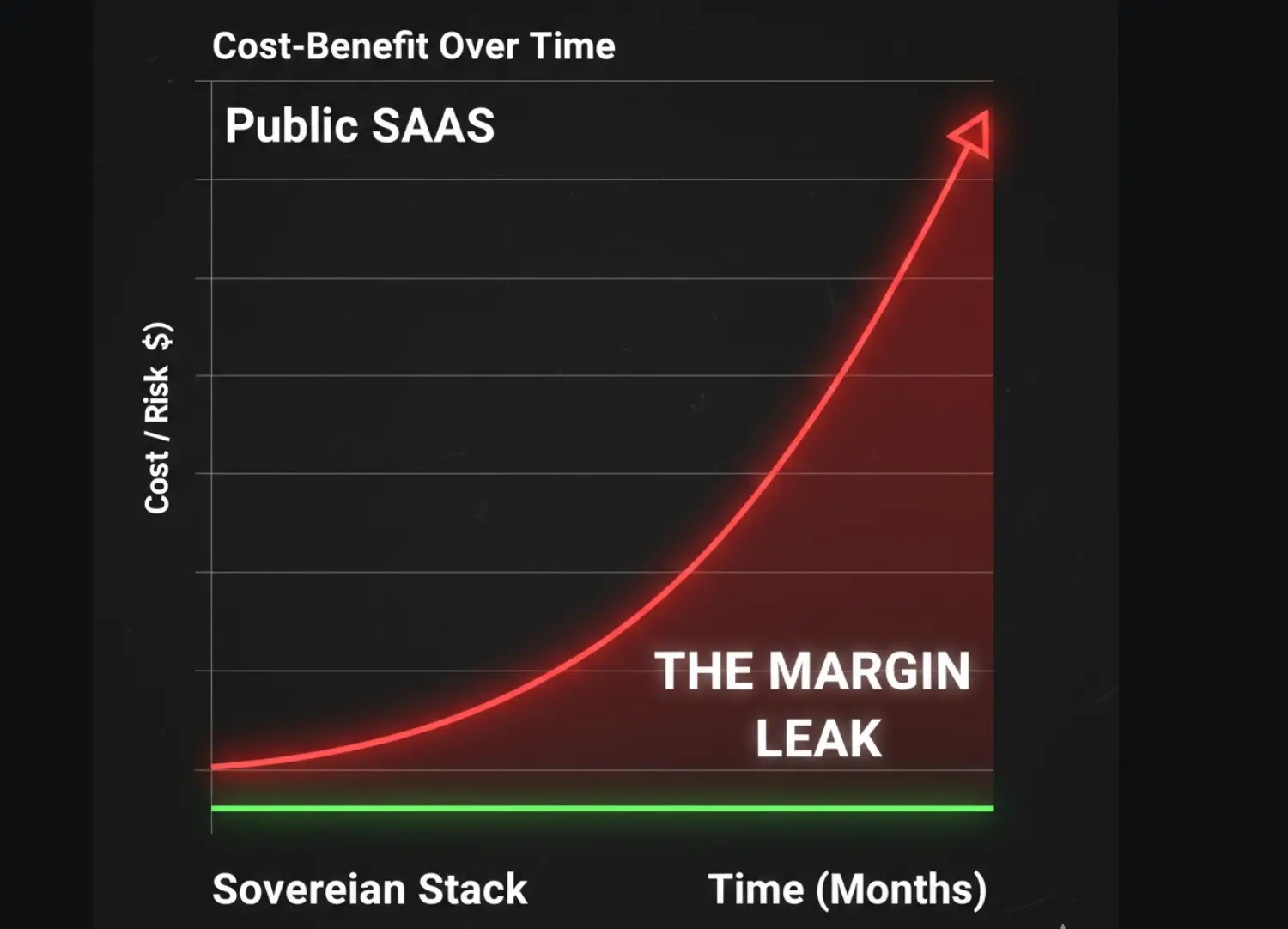
- The Problem: Public SaaS automation (Zapier, Make) charges you per task. As you scale, you are punished with exponential costs. Worse, your sensitive data passes through their black-box servers.
- The Shift: The Sovereign Architect moves to self-hosted automation tools. We deploy open-source logic on our own private servers (VPS).
- The Imperative: Own the pipe. Own the data. Own the uptime.
Return to the Engineering Pillar
INTRODUCTION
In the early stages of business, convenience is king. You use Zapier because it is easy.
In the mature stages of business, control is king.
Relying on public SaaS for your core operations introduces two fatal risks:
- The Zapier Tax: Scaling to 100,000 tasks/month on Zapier costs ~$600/month. On a self-hosted server, it costs ~$20/month.
- The Data Leak: When you send customer data through public aggregators, you are trusting their security.
Self-hosted automation tools allow you to run enterprise grade workflows behind your own firewall. You trade convenience for sovereignty. In 2026, with data privacy laws tightening, this is not just a technical choice; it is a legal survival strategy.
Table of Contents
THE FAILURE MODE (THE SAAS RENT-SEEKER)
The Old Way relies on Rented Infrastructure.
- Variable Costs: Your bill fluctuates based on traffic. If your marketing campaign goes viral, your automation bill bankrupts you. Self-hosted automation tools have fixed costs (Server CPU/RAM).
- Throttle Limits: Public SaaS platforms impose rate limits. If you try to process 10,000 leads in an hour, they block you. Your own server never says no to you.
- Vendor Lock-In: If the SaaS platform changes its pricing or removes an integration, your business breaks.
The Metric of Failure:
If you are paying more than $0.0001 per task, you are being exploited. Self-hosted stacks drive this cost effectively to zero.
Zapier Alternatives for Scale: The Enterprise Switch (2026)
THE ARCHITECTURE (THE SOVEREIGN CLOUD)

We do not just install software. We build a Private Operations Cloud.
The Core Components:
1. The Orchestrator (n8n)
- Role: The brain.
- Why Self-Hosted: The cloud version of n8n is great, but the self-hosted version is unrestricted. You can run Python scripts, access local files, and install custom npm packages without permission.
- Deployment: Docker Compose.
2. The Database (Supabase / Postgres)
- Role: The memory.
- Why Self-Hosted: Never store long-term data in a Google Sheet. Spin up a Postgres container. It handles millions of rows and costs nothing extra.
- Security: Your data never leaves your virtual private cloud (VPC).
3. The AI Interface (Flowise / LangFlow)
- Role: The intelligence.
- Why Self-Hosted: Running LLM chains (RAG) requires massive token processing. Self-hosting these tools allows you to swap models (Llama 3, Mistral) locally without API fees if you have the GPU compute.
THE ECONOMICS (THE $50 VS. $2,000 GAP)
Self-hosted automation tools flatten your expense curve.
| Metric | Public SaaS (Zapier/Make) | Self-Hosted (n8n on DigitalOcean) |
| Cost Model | Per Task (Variable) | Per Server (Fixed) |
| Monthly Cost (1M Tasks) | ~$3,000+ | ~$50 (VPS Cost) |
| Data Privacy | Shared Infrastructure | Single Tenant (Private) |
| Execution Time | Shared Queues (Latency) | Dedicated CPU (Instant) |
| Customization | Restricted | Unlimited (Root Access) |
The Asset Reality:
A business running on self-hosted infrastructure has lower OpEx and higher margins. This increases enterprise value. You are selling a machine, not a subscription liability.
Data Ownership: The Ultimate Business Asset Guide (2026)
THE GOVERNANCE MOAT (COMPLIANCE IS CAPITAL)
Data sovereignty is not just about cost; it is about liability.
When you use public SaaS, you are often legally the Data Controller while they are the Data Processor. If they breach, you bleed. Self-hosted automation tools allow you to achieve GDPR, HIPAA, and SOC2 compliance by ensuring sensitive payloads (PII, Financial Data) never leave your encrypted VPC.
You do not just own the software; you own the audit trail.
THE TECHNICAL STACK
To deploy self-hosted automation tools, you need a Linux Literacy baseline.
CONCLUSION
The era of No-Code is maturing into Low-Code Engineering.
No-Code was about avoiding code to gain speed.
Self-hosted automation tools are about embracing code to gain power.
You have two choices:
- Pay the rent (SaaS).
- Buy the building (Self-Hosted).
Stop renting your logic.
Return to the Engineering Pillar
FAQ: OBJECTIONS & RISKS
1. Is self-hosting hard to maintain?
It requires maintenance, yes. You need to handle updates and server security. If you are non-technical, hire an Automation Engineer to set it up. The cost savings usually pay for the engineer in 3 months.
2. What happens if the server crashes?
You need redundancy. We recommend running a Health Check monitor (like Uptime Kuma) that alerts you if the server goes down. For mission-critical ops, we run a backup server.
3. Can I still connect to Gmail/Slack?
Yes. Self-hosted n8n connects to all public APIs just like Zapier does. You just have to set up your own Google Cloud Console credentials which is free and more secure.
FROM THE ARCHITECT’S DESK
I audited a Lead Gen Agency spending $4,500/month on Zapier. They were terrified to touch the server.
We migrated them to a self-hosted n8n instance on a $40/month Hetzner server.
Result: They saved $53,000/year. The migration took 3 days. They used the savings to hire a full-time developer.
THE ARCHITECT’S CTA
If you are bleeding margin on task-based billing, it is time to go sovereign.
If you are ready to deploy self-hosted automation tools and secure your data infrastructure. Stop being a Hustler. Become the Architect.
Every automation I build is bespoke, real, and ready to scale your business. No demos, no templates just results. Apply to work with me today → Application Form




Comments 2