


EXECUTIVE SUMMARY
- The Problem: Traditional AI (ChatGPT) is passive. It waits for a prompt. It is a stateless reasoning engine that cannot interact with the world unless a human drives it.
- The Shift: We are moving to agentic AI systems. These are loops of software that possess Agency the ability to perceive a goal, plan a sequence of actions, and execute them without human hand holding.
- The Imperative: Stop building Assistants. Start building Employees.
Return to the Automation Engineering Services: Implementation Guide (2026)
INTRODUCTION
There is a fundamental misunderstanding in the C-Suite about what AI is. They think AI is a Super Search Engine or a Copywriter. That is Generation 1 (Generative AI).
Generation 2 is Agentic AI.
Agentic AI systems are not defined by what they know, but by what they can do. A chatbot can write an email for you. An agentic system can:
- Login to your CRM.
- Find the lead.
- Draft the email.
- Send it.
- Update the status to Contacted.
This shift from Text Generation to Action Execution is the single biggest value driver of the next decade. We are no longer querying databases; we are deploying workers.
Table of Contents
THE ARCHITECTURE (THE LOOP)
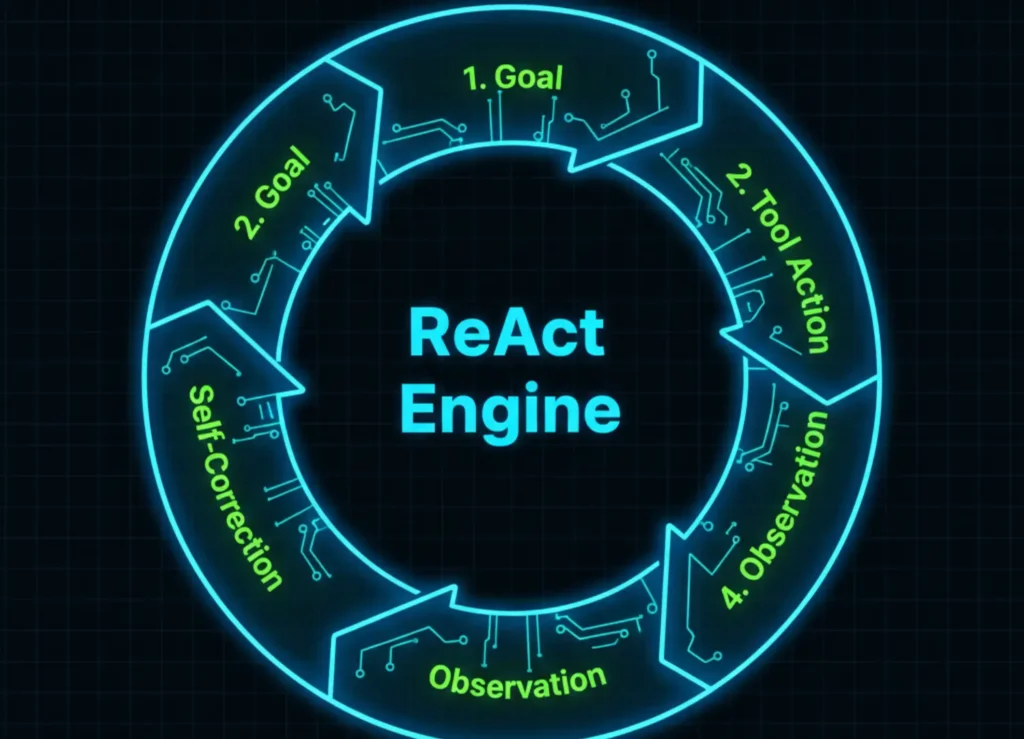
How does an LLM become an Agent? It requires a cognitive architecture known as the ReAct (Reason + Act) Loop.
- Goal: The user sets a broad objective e.g., Research this competitor and summarize their pricing.
- Plan: The Agent breaks this down: First, I need to Google them. Then, I need to browse their pricing page.
- Tool Use: The Agent selects the Web Browser tool.
- Observation: It reads the site. If the site is blocked, it self-corrects and tries a different source.
- Completion: It returns the final report.
Agentic AI systems are defined by this Self-Correction. A script crashes when it hits an error. An agent tries a different path.
THE FAILURE MODE (THE HALLUCINATION TRAP)
The Old Way relies on Blind Automation.
- Infinite Loops: Poorly architected agents can get stuck in a loop, burning through API credits while trying to solve a problem they cannot solve.
- Tool Hallucination: The AI might try to use a tool it doesn’t have e.g., I will now email the CEO when it has no email access.
- Cost Spikes: Unlike a chatbot (1 input = 1 output), agentic AI systems might run 50 internal steps to solve one user query. The cost is variable and unpredictable.
The Metric of Failure: If your agent spends $10 in compute to solve a $5 task, it is not an asset; it is a novelty.
Zapier Alternatives for Scale: The Enterprise Switch (2026)
THE USE CASES (BEYOND THE HYPE)

Where are agentic AI systems actually driving ROI in 2026?
1. The SDR Agent (Sales)
- Role: Autonomous prospecting.
- Action: It scrapes LinkedIn, verifies emails, and sends personalized outreach. It only pings a human when a lead replies “Interested.”
2. The Support Agent (Tier 1)
- Role: Autonomous resolution.
- Action: It doesn’t just answer “How do I refund?”; it actually logs into Stripe and processes the refund if the policy criteria are met.
3. The Analyst Agent (Operations)
- Role: Autonomous reporting.
- Action: Every Monday at 8 AM, it pulls data from Facebook Ads and Shopify, calculates ROAS, formats a PDF, and Slacks it to the CMO.
THE TECHNICAL STACK

Building agentic AI systems requires a new set of tools (The Agent Stack).
- The Framework: LangChain or LangGraph. These are the libraries that allow you to chain LLM calls together into a workflow.
- The Brain: GPT-4o or Claude 3.5 Sonnet. You need high-intelligence models for planning. Smaller models (Llama 3 8B) are often too “dumb” for complex reasoning.
- The Memory: Pinecone or Weaviate. Agents need Long Term Memory (Vector Database) to remember what they did yesterday.
- The Tools: Custom APIs. You must give the agent tools (Search, Calculator, Gmail API) via function calling.
CONCLUSION
The difference between a Script and an Agent is adaptability. A script follows a track. An agent drives a car.
Agentic AI systems are the workforce of the future. They do not sleep, they do not complain, and they scale infinitely with server capacity. But they require a Sovereign Architect to design their boundaries, their tools, and their mission.
You have two choices:
- Hire more humans to click buttons.
- Build agents to push the buttons for you.
Return to the Automation Engineering Services: Implementation Guide (2026)
FAQ: OBJECTIONS & RISKS
1. Will agents go rogue? Not if you sandbox them. We never give agents Delete permissions or access to bank transfers without a “Human in the Loop” approval step.
2. Are they expensive to run? Yes, compared to simple scripts. An agent might make 20 API calls to answer one question. But compared to a human salary ($50/hour), an agent ($0.50/task) is cheap.
3. Can I buy an agent off the shelf? Mostly no. You buy the framework, but you must engineer the logic. An agent is only as good as the tools you give it access to.
FROM THE ARCHITECT’S DESK
We deployed an “Invoice Agent” for a logistics firm. Previously, 3 staff members manually read PDFs and typed data into SAP. We built an agent that:
- Monitors the email inbox.
- OCRs the PDF.
- Validates the Vendor ID in SQL.
- Enters the invoice into SAP.
Result: It processes 400 invoices/day. Error rate dropped from 4% (Human) to 0.1% (Agent).
THE ARCHITECT’S CTA
If you are tired of managing tasks and want to start managing outcomes, you are ready for agency.
If you are ready to deploy agentic AI systems and automate complex cognition. Stop being a Hustler. Become the Architect.
Every automation I build is bespoke, real, and ready to scale your business. No demos, no templates just results. Apply to work with me today → Application Form.