

Vector Database News May 2026: Every Release, Every Pricing Change, Every Production Action
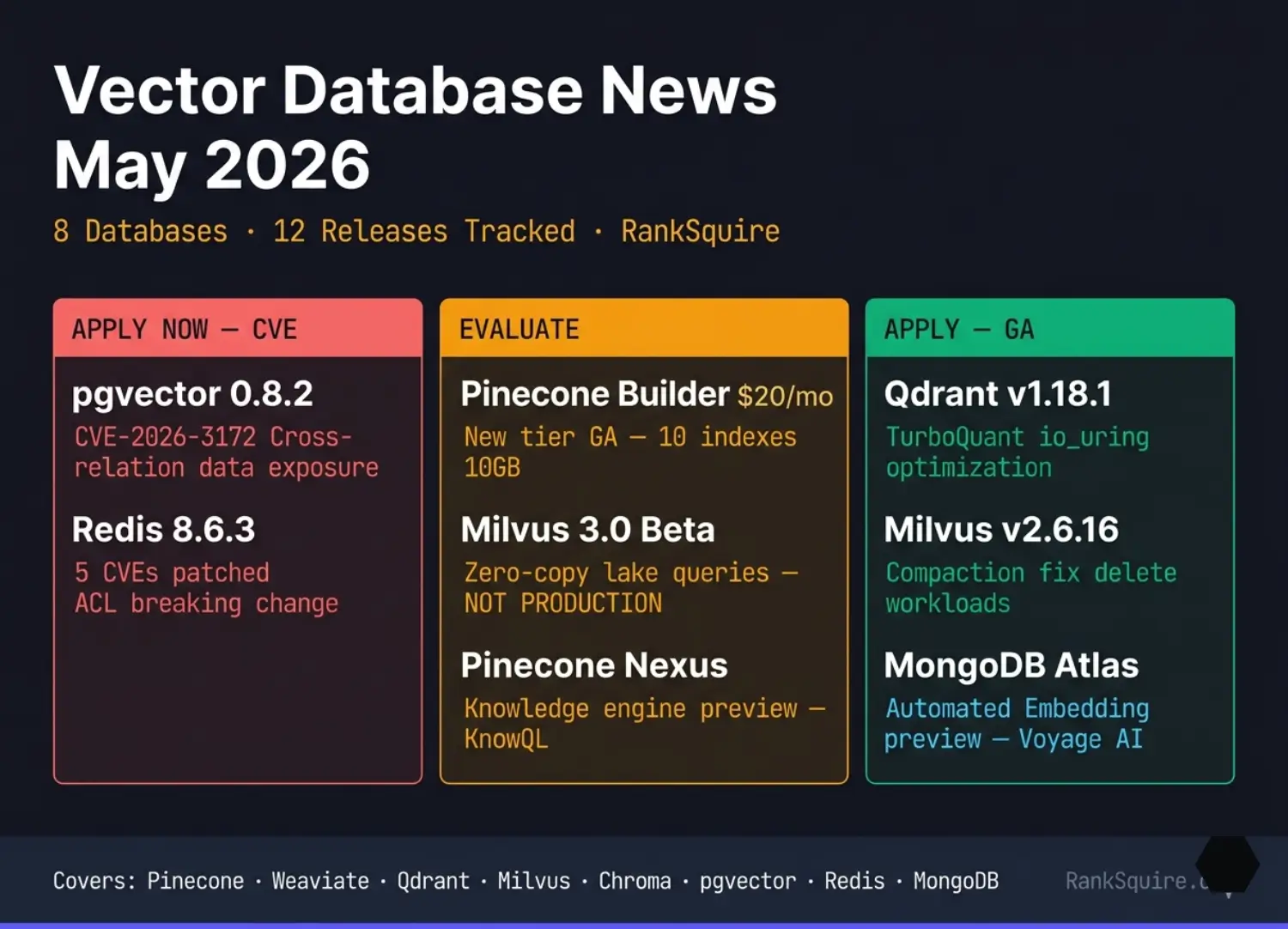
Vector database news May 2026 lands across eight databases in a single month — Pinecone restructures its pricing model with a new $20/month Builder tier, Milvus ships its 3.0 beta with zero-copy data lake queries, Qdrant releases v1.18 with a new quantization engine, and pgvector pushes a critical security patch that production teams running PostgreSQL need to apply within seven days. Here is the full breakdown, verified from primary sources, with a production action for every release that matters.
This is the May 2026 edition of RankSquire’s monthly vector database intelligence series. Each edition covers all confirmed releases from the prior calendar month, cross-verified against official changelogs, GitHub release tags, and documentation. The April 2026 Vector Database News covered Weaviate v1.37’s MCP Server launch. May 2026 expands to eight databases.
| Database | Version / Update | Date | Type | Action Priority |
|---|---|---|---|---|
| pgvector | 0.8.2 | May 18, 2026 | Security Patch | APPLY NOW — CVE |
| Redis | 8.6.3 | May 5, 2026 | Security Patch | APPLY NOW — CVE |
| Milvus | v2.6.16 | May 13, 2026 | GA Minor | APPLY — DELETE WORKLOADS |
| Qdrant | v1.18.1 | May 22, 2026 | GA Minor | APPLY — MULTI-VECTOR |
| Pinecone | Builder Tier GA | May 4, 2026 | Pricing + Cloud | UPGRADE IF ON STARTER |
| Pinecone | Nexus / Marketplace | May 5, 2026 | Preview | EVALUATE — NOT PROD |
| Milvus | v3.0.0-beta | May 9, 2026 | Beta | EVALUATE Q4 PLANNING |
| MongoDB Atlas | Automated Embedding | May 7-14, 2026 | Preview | POC ON NEW WORKLOADS |
| Qdrant | v1.18.0 | May 11, 2026 | GA Minor | APPLY — QUANT GAINS |
| Weaviate | v1.37.4 + v1.35.19 | May 4 + May 14 | Patch | NORMAL CADENCE |
| Chroma | v1.5.9 | May 5, 2026 | Minor | NORMAL CADENCE |
| Redis | Vector Set (beta) | Ongoing (8.0+) | Beta | EVALUATE — NOT PROD |
May 2026 Vector Database News: The Monthly Verdict
Two developments in May 2026 carry architectural weight beyond their individual release notes.Pinecone’s Launch Week repositions the platform from a vector search index to an application layer. Nexus, Marketplace, and the Builder tier together represent a fundamental product direction change, not a feature addition. Milvus 3.0 beta, shipping the same week, signals the same shift from a different direction: treating the vector database as a compute engine over a data lake rather than a standalone index. Both changes affect long-term architecture decisions more than they require immediate production upgrades.
| Rank | Database | Development | Impact Area | Window to Act |
|---|---|---|---|---|
| 1 | pgvector | CVE-2026-3172 — cross-relation data exposure | Security / Data integrity | Within 7 days |
| 2 | Redis | 8.6.3 — 5 CVEs patched + ACL change | Security | Standard patch timeline |
| 3 | Pinecone | Builder tier $20/month GA | Cost / Operations | Before next billing cycle |
| 4 | Milvus | v2.6.16 — compaction fix for delete workloads | Reliability / Performance | This sprint if delete-heavy |
| 5 | Qdrant | v1.18.1 — TurboQuant + io_uring optimization | Performance / Compression | This sprint if multi-vector |
| 6 | Pinecone | Nexus + Marketplace — agent knowledge engine | Architecture / Agents | Evaluate in Q3 |
| 7 | Milvus | v3.0.0-beta — zero-copy data lake queries | Architecture / Data lake | Evaluate Q3, plan for Q4 |
| 8 | MongoDB Atlas | Automated Embedding preview | RAG pipeline simplification | POC on new workloads |
The one update requiring immediate action regardless of which database you run is pgvector 0.8.2. The CVE-2026-3172 buffer overflow in the parallel HNSW build path carries a cross-relation data exposure risk, not just a crash risk. Any production
PostgreSQL deployment with pgvector installed checks its current extension version before anything else this month. For the June 2026 edition, subscribe below.
Pinecone — May 2026 Update (Launch Week, May 4-8, 2026)
Pinecone’s vector database news May 2026 is a company-level direction change bundled as a week of feature releases. Nexus
positions the database as a knowledge orchestration engine for agents. The Marketplace ships pre-built AI application templates.
The Builder tier ends the gap between a Starter plan with hard limits and a Standard plan billed by usage.
The Builder tier is the most immediately useful release from Launch Week. At $20/month flat, it sits between the free Starter plan and usage-based Standard. It covers 10 serverless indexes, 10GB storage, 100 namespaces per index, and adds native monitoring exports to Prometheus and Datadog, a significant operational improvement over Starter. Hard quotas apply: no overages, no surprise bills. Teams on Starter with predictable usage have a clear, low-friction upgrade path. See the full cost breakdown in the Pinecone pricing 2026 analysis.
Pinecone Nexus (public preview) introduces KnowQL, a declarative query language for knowledge retrieval. Pinecone claims up to 90% token reduction and over 90% task completion rates versus standard RAG approaches these numbers are from Pinecone’s own benchmarks, not independent testing, and warrant evaluation in your specific workload before architectural decisions. The Marketplace ships over 90 application templates and multi-domain routing. Both are preview, not GA. Do not build production agent systems on either until GA.
Full-text search (public preview) adds BM25 alongside vector search a native hybrid search path without a separate keyword
layer. New serverless regions launched in AWS Singapore (first APAC region for Pinecone serverless) and AWS Frankfurt (EU compliance). Both are GA. Teams with APAC or EU data residency requirements can move workloads from workarounds to supported infrastructure now.
One breaking change ships quietly inside Launch Week: metadata filters using $in or $nin operators now have a hard ceiling of 10,000 values. Requests above that limit return 400-BAD_REQUEST immediately. Any multi-tenant RAG system passing user permission arrays as metadata filters must audit whether those arrays can exceed 10,000 elements. Refactor before upgrading to avoid silent production failures.
Pricing: Builder plan $20/month GA · Standard/Enterprise unchanged
Assistant: Fully usage-based (from April) · Starter: monthly resets
Dedicated Read Nodes: GA (from April) · Fetch by metadata: GA (from April)
Regions: Singapore GA · Frankfurt GA (new in May)
Performance: Dedicated Read Nodes benchmark: 1.4B vectors / 5,700 QPS / p99 60ms (Pinecone internal)
Free tier: Starter promotional — 1M input tokens/month through June 30, 2026
Official: docs.pinecone.io/release-notes/2026
See also: Pinecone pricing 2026 — full cost analysis
Milvus — May 2026 Update (v3.0.0-beta, May 9 + v2.6.16, May 13)
Milvus 3.0-beta ships May 9 and changes what the database is, not just what it does. External Collections let Milvus query Parquet and Apache Iceberg files on object storage directly. No data ingestion, no ETL, no copy. The data lives in S3 or GCS. Milvus reads it in place. Snapshot Isolation adds point-in-time reads that separate batch analytics from concurrent real-time upsert streams. Both features mark the beginning of Milvus positioning itself as compute infrastructure over a data lake, not a standalone index. This is a beta. No production deployment. Evaluate in a non-production environment against your Q4 roadmap.
The production-safe release from Milvus in May is v2.6.16, GA on May 13. It raises the Level 0 compaction deltalog threshold from
30 to 1,000 — a change that directly eliminates compaction backlogs in clusters running high-volume real-time delete operations alongside upsert spikes. If your Milvus deployment has experienced disk starvation during delete-heavy workflows, 2.6.16 fixes the root cause. Apply it. Streaming node resource group isolation also ships in 2.6.16, preventing noisy-neighbor compute starvation in multi-tenant deployments.
Production: v2.6.16 GA (May 13, 2026) — apply for delete-heavy workloads
Preview: v3.0.0-beta (May 9, 2026) — non-production evaluation only
Key fix in 2.6.16: L0 compaction max deltalog 30 → 1,000
Pricing: NO CHANGE (open-source core unchanged)
Official: milvus.io/docs/release_notes.md
GitHub: github.com/milvus-io/milvus/releases

beta is NOT production-ready. Evaluate in non-production for
Q4 2026 planning only.
Qdrant — May 2026 Update (v1.18.0, May 11 + v1.18.1, May 22)
Qdrant ships two production releases in May — v1.18.0 on May 11 and a follow-up patch v1.18.1 on May 22. The headline feature
in v1.18.0 is TurboQuant, a quantization engine based on fast Hadamard rotations from Google Research. TurboQuant redistributes coordinate values uniformly before bit-packing, which counteracts the skewed distributions that most embedding models produce. The practical result is higher recall at equivalent compression rates compared to standard scalar quantization. Engineers running multi-vector collections on Linux bare metal or GPU instances gain the most — v1.18.1 specifically optimizes quantized multi-vector scoring for Linux io_uring.
Dynamic named vector alterations land in v1.18.0 as GA. Engineers can now add or drop named vector segments from a live collection via API without rebuilding the index or executing a cluster migration. This matters most for teams switching embedding models the new model’s vectors load into the same collection alongside the existing ones while backfilling completes, with zero downtime. For the full Qdrant Cloud pricing reference, see Qdrant Cloud pricing 2026.
v1.18.1 introduces strict pre-WAL dimension validation for asynchronous upsert streams. Any async payload with a mismatched
vector dimension now gets rejected before writing to the Write-Ahead Log. Previously, misaligned payloads failed silently downstream during replication sync. Teams using async upsert pipelines must verify their dimension consistency before upgrading
the fix catches real errors that were previously invisible. This fix surfaces real dimension mismatches before they corrupt downstream replication errors that previously failed silently and only appeared during sync.
Production: v1.18.1 GA (May 22, 2026) — current recommended version
v1.18.0 GA (May 11, 2026) — TurboQuant, dynamic named vectors
Pricing: NO CHANGE · Free: 1GB RAM / 0.5 vCPU / 4GB disk / permanent
See: March 2026 Vector Database News for v1.17 feature context
Qdrant Cloud pricing: Qdrant Cloud pricing 2026
Official: qdrant.tech/blog/qdrant-1.18.x/
GitHub: github.com/qdrant/qdrant/releases
MongoDB Atlas Vector Search — May 2026 Update
MongoDB Atlas ships two public preview features in May that reduce the pipeline complexity of production RAG systems for teams already on Atlas. Automated Embedding connects Voyage AI models directly to collection fields and re-embeds only when those specific fields change. There is no external sync worker, no custom orchestration, no manual re-indexing trigger. Nested Embedding support adds indexing of vectors inside arrays of subdocuments it retrieves the parent document with max or average scoring rollup across child matches, eliminating the data flattening that most teams build workarounds for.
Both features are public preview. Do not replace existing vector pipelines until GA. For teams building new agent memory systems
on Atlas, the LangGraph.js long-term memory integration reaches GA in May it structures documents as persistent state and conversation history stores for multi-turn agent workflows without a separate memory layer.
Automated Embedding: Public Preview — POC on new workloads only
Nested Embedding: Public Preview — eliminates data flattening for hierarchical models
LangGraph.js memory store: GA — multi-agent state persistence
MongoDB 8.3: GA — 45% more read throughput vs prior version
Pricing: NO CHANGE — Inference Flex Tier for Automated Embedding (token-based)
Official: MongoDB release announcement
pgvector — May 2026 Security Patch (v0.8.2, May 18, 2026)
pgvector 0.8.2 fixes CVE-2026-3172, a buffer overflow in the parallel HNSW build path. The risk is not just a backend crash. The documented outcome includes cross-relation data exposure meaning one tenant’s data potentially visible to another during a concurrent parallel index build. For any production PostgreSQL deployment with pgvector installed, check the installed version
immediately: SELECT extversion FROM pg_extension WHERE extname = ‘vector’; PostgreSQL’s own minor release process does not include pgvector. You must upgrade the extension separately. The upgrade is non-breaking. There is no valid reason to defer.
v0.8.2: May 18, 2026 — Security patch only. No new features.
v0.9.0: NOT SHIPPED as of May 31, 2026
Pricing: N/A (open-source PostgreSQL extension)
Official: github.com/pgvector/pgvector/releases
Redis — May 2026 Update (v8.6.3 Security + Vector Set Beta)
Redis ships two separate stories in May. The first is practical and urgent: Redis 8.6.3 patches multiple CVEs (CVE-2026-23479,
CVE-2026-25243, CVE-2026-23631, CVE-2026-25588, CVE-2026-25589) and teams running Redis in production apply it on the same timeline as any security patch. The second is architectural and early-stage: Vector Set, a new native Redis data type for
high-dimensional vector similarity search, ships as beta in Redis 8.0+. It supports automatic dimensionality reduction via Random Projection and eliminates the RediSearch module dependency for basic vector operations.
The ACL breaking change matters for teams using +@all -@write ACL policies. Commands from included modules (JSON.SET and others) now fall under standard ACL categories rather than custom ones. Any policy denying write access must be reviewed and updated before upgrading to 8.6.3. The upgrade otherwise is a straightforward security maintenance operation.
Vector Set is too early for production. The native Redis data type removes the module dependency but beta stability means API
contract is not final. Evaluate it for workloads where Redis is already the primary data store and co-location of vectors eliminates a network hop. Do not migrate production vector workloads from a dedicated vector database to Vector Set beta.
8.6.3: May 5, 2026 — Security patch — 5 CVEs patched
Vector Set: Beta (Redis 8.0+) — do not use in production
BFLOAT16 / FLOAT16 vector types: GA — memory optimization
Performance: Up to 87% faster command execution in Redis 8.0 vs prior major — 35% memory savings on replicas
Pricing: NO CHANGE
Official: redis.io/docs/latest/develop/whats-new/8-0/
Chroma — May 2026 Update (v1.5.9, May 5, 2026)
Chroma v1.5.9 releases May 5 with GROUP BY support for sharded collections and sharded collection rebuild capability both operational improvements for Chroma Cloud users. Open-source self-hosted users are largely unaffected by this release. Independent security researchers (third-party, not confirmed by Chroma) reported a pre-authentication vulnerability in older open-source Chroma instances exposed to public networks.Running v1.5.9 and restricting Chroma to private network access closes the documented exposure. No public Chroma CVE number confirmed from official sources as of May 31, 2026.
v1.5.9: May 5, 2026 — Routine minor release
Pricing: $5 free credits on signup · $2.50/GiB write · $0.33/GiB storage
Official: github.com/chroma-core/chroma/releases
Changelog: trychroma.com/changelog
Weaviate — May 2026 Update (v1.37.4, May 14 + v1.35.19, May 4)
Weaviate ships two patch releases in May. v1.37.4 (May 14) adds server-side guardrails for objects, collections, tenants, and
shards — a multi-tenancy quota enforcement feature relevant for cloud providers and large-scale multi-tenant applications. It also improves async replication with CompareDigests implementation and frequency handling fixes. v1.35.19 (May 4) patches a recursive RAFT command edge case in schema management. Both are non-breaking patches. The architectural flagship from Weaviate this year remains the MCP Server from v1.37 in April there is no equivalent magnitude update in May. Apply v1.37.4 and continue normal operations. See Weaviate Cloud pricing for the full current cost structure.
v1.37.4: May 14, 2026 — Usage limits, async replication improvements
v1.35.19: May 4, 2026 — Recursive RAFT command edge case fix
Pricing: NO CHANGE
Note: DigitalOcean Managed Weaviate private preview (TOR1 region) — not GA
Weaviate pricing: Weaviate Cloud pricing 2026
Official: github.com/weaviate/weaviate/releases
What May 2026 Vector Database News Means for Your Production Stack
Three things happened simultaneously in May 2026 that matter beyond any single release note. Pinecone and Milvus both moved
in the same direction from pure vector search components to application and compute layers. pgvector shipped a security patch that carries actual data exposure risk. And Redis introduced a native vector data type that, when it reaches GA, will make the dedicated-vector-database decision more complex than it has been. These are not isolated vendor updates. They show the market consolidating around two futures: managed knowledge platforms and sovereign compute over data lakes.
If you are building agent systems and evaluating Pinecone Nexus — the claimed 90% token reduction is from Pinecone’s own benchmarks, not independent testing. Test KnowQL against your specific workload before changing architecture. The Builder tier at $20/month is the genuinely useful immediate decision. It caps cost, adds Prometheus/Datadog monitoring, and gives teams a proper staging environment that Starter’s hard limits prevent. That is a procurement decision, not an architecture decision.
Milvus 3.0’s zero-copy data lake queries shift the right question from “which vector database should we use?” to “where should our vector compute live relative to our existing data stores?” If your data already lives in Parquet files on S3, Milvus 3.0 (when it reaches GA) potentially eliminates an entire ingestion pipeline. Do the evaluation now in staging. The GA date is not confirmed build your timeline around Q4 2026.
For teams not yet using a dedicated vector database, MongoDB Atlas’s Automated Embedding preview changes the calculus. A single database with automated embedding, vector search, and operational storage in one system reduces infrastructure surface area and eliminates the embedding sync problem. It is still preview. The right action is a proof of concept, not a migration. Compare it against the best vector database for AI agents analysis before deciding.
The security summary for May 2026 is short and clear. pgvector 0.8.2 — apply it. Redis 8.6.3 — apply it. Chroma v1.5.9 on private network — verify it. Those three checks should complete before you evaluate any other item in this month’s release notes. Everything else in May 2026 is optional evaluation. Those three are mandatory operations.
Related production intelligence for deeper context on this month’s releases.
What are the most important vector database releases in May 2026?
Vector database news May 2026 spans eight databases. The highest-impact releases by production priority: pgvector 0.8.2 (CVE patch — apply immediately), Redis 8.6.3 (5 CVEs — apply now), Pinecone Builder tier $20/month GA, Milvus v2.6.16 GA (compaction fix), Qdrant v1.18.1 (TurboQuant + io_uring), Milvus 3.0.0-beta (zero-copy lake queries — preview only), MongoDB Atlas Automated Embedding (preview). Weaviate and Chroma ship routine patches with no urgent production action.
Did Pinecone change pricing in May 2026?
Yes. Pinecone introduced the Builder tier at $20/month flat during Launch Week (May 4-8, 2026). It sits between the free Starter plan and the usage-based Standard plan. Builder covers 10 serverless indexes, 10GB storage, 100 namespaces per index, and adds Prometheus/Datadog monitoring export. Hard quotas apply — no overages. Teams on Starter with predictable usage have a clear, low-friction upgrade path. No other pricing changed in May 2026.
Is Milvus 3.0 production-ready in May 2026?
No. Milvus 3.0.0-beta shipped May 9, 2026 and is explicitly beta — the API contract may change before GA. Production teams stay on Milvus v2.6.16 (GA, May 13). Use 3.0 beta only for architecture evaluation in non-production environments. The GA date is unconfirmed as of May 31, 2026. Plan evaluation in Q3 2026 and production readiness in Q4 or later. The zero-copy data lake query feature is architecturally significant but not safe for production yet.
What is CVE-2026-3172 in pgvector and how urgent is the patch?
CVE-2026-3172 is a buffer overflow in pgvector’s parallel HNSW build path, fixed in v0.8.2 (May 18, 2026). The risk includes cross-relation data exposure — not just a crash. Any production PostgreSQL deployment with pgvector must upgrade within 7 days. Check current version with SELECT extversion FROM pg_extension WHERE extname = 'vector'; PostgreSQL’s minor releases do NOT include pgvector updates — upgrade the extension separately. The upgrade is non-breaking.
What is Qdrant TurboQuant and should I upgrade for it?
TurboQuant is Qdrant’s quantization engine using fast Hadamard rotations, first shipped in v1.18.0 (May 11, 2026). It redistributes coordinate values before bit-packing to counteract the skewed distributions that embedding models produce, resulting in higher recall at equivalent compression rates. v1.18.1 (May 22) adds io_uring optimization for multi-vector quantized scoring on Linux. If you run multi-vector collections on Linux instances with io_uring support, upgrade to v1.18.1. No breaking changes — standard upgrade cadence applies.
Should I upgrade to Redis 8.6.3 and what does the ACL change affect?
Yes — apply Redis 8.6.3 on your standard security patch timeline. It patches 5 CVEs. Before upgrading, audit ACL policies: commands from included modules (JSON.SET and similar) now fall under standard ACL categories. If you use +@all -@write policies, update them before upgrading or those commands will be blocked post-upgrade. Once ACL policies are verified, the upgrade is straightforward.
What does MongoDB Atlas Automated Embedding mean for RAG architecture?
MongoDB Atlas Automated Embedding (public preview, May 2026) connects Voyage AI embedding models directly to Atlas collection fields. When an indexed field changes in a document, the embedding re-generates automatically — no external sync worker, no custom pipeline, no manual re-indexing. It is preview — do not replace existing production pipelines until GA. Use it for proof of concept on new workloads where you want to eliminate the embedding orchestration layer.
Which vector database should I use for AI agents after the May 2026 updates?
For agent systems where MCP integration is a priority, Weaviate v1.37 (April 2026) remains the only database with a native MCP Server — no change in May. For agent memory requiring cost-optimal sovereign infrastructure, self-hosted Qdrant stays the production standard. For managed infrastructure with predictable low-latency reads, Pinecone with Dedicated Read Nodes GA (April) now includes the Builder tier for staging. For teams wanting to consolidate embedding and retrieval in one database, MongoDB Atlas Automated Embedding is worth a proof of concept once it reaches GA. See the best vector database for AI agents guide for the full decision framework.

2026. All action items cross-verified across 6 AI research agents.
DIRECTLY VERIFIED for all CVE and pricing items.
After reviewing May 2026 — are you treating Milvus 3.0’s data lake direction as a planning signal for your Q4 roadmap, or does the beta status push it into 2027? And have Pinecone’s Nexus claims held up in your own testing? Leave what you found
in the comments.