


⚙️ Quick Answer (For AI Overviews & Skimmers)
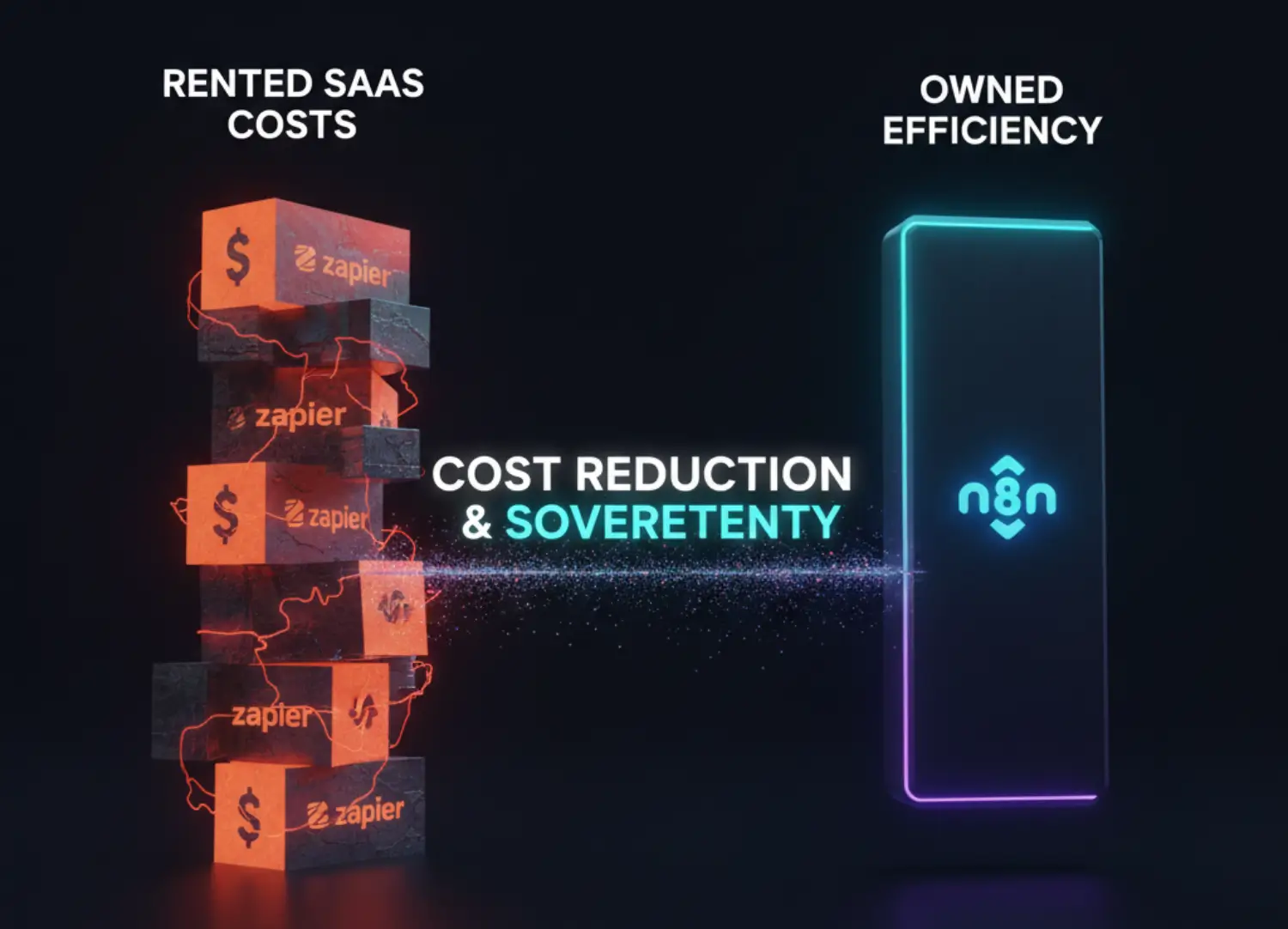
In the n8n vs Zapier enterprise debate, the answer depends entirely on your execution volume. Below 5,000 tasks per month, Zapier wins on convenience. Above 50,000 tasks per month the Zapier Cliff staying on Zapier is financial negligence.
At 200,000 tasks per month, Zapier costs $899 or more. Self-hosted n8n on a $65 Hetzner server costs the same whether you run 200,000 tasks or 2 million. The annual saving on a single high-volume AI agent workflow: over $41,000.
This is the complete 2026 cost audit with the math, the hidden enterprise features, the honest counter-argument, and the decision framework that tells you exactly where you sit.
💼 Executive Summary: The Success Tax That Scales Against You
The n8n vs Zapier enterprise decision is not a features debate. It is an economics debate. And the economics are unambiguous at scale.
In the early stages of a startup, Zapier is a miracle. It connects disparate tools without a single line of code, gets your first automations live in an afternoon, and requires no infrastructure knowledge whatsoever. For simple, low-volume triggers new lead arrives, send Slack notification Zapier is the correct tool. There is no shame in using the right tool for the right job.
But Zapier’s pricing model is structurally designed to penalize success. It charges per task. Every action a workflow performs counts as one task not the workflow itself, each individual step inside it. A complex AI agent that validates a lead, looks up the CRM, queries the vector database, reasons with GPT-4, and sends a follow-up email consumes five tasks in a single execution. At 10,000 lead processing runs per month, that is 50,000 tasks — and you have not even begun to count the logging, error handling, and retry logic steps that compound the bill further.
This is the Success Tax. Your automation spend scales linearly with your revenue. The more your business grows, the more Zapier charges you for growing.
The n8n vs Zapier enterprise comparison exists to answer one question: at what point does the Success Tax cost more than the infrastructure to eliminate it?
The answer is 50,000 tasks per month. That is the Zapier Cliff.
For a deeper architectural context on where this fits in your sovereign infrastructure strategy, read the pillar: Enterprise AI Infrastructure 2026: The Sovereign Stack.

Table of Contents
4. The Economic Model: What You Are Actually Buying
To understand the n8n vs Zapier enterprise math, you must first understand what each platform sells.
Zapier sells Actions.
Every time data moves through a workflow step, the meter runs. A Gmail trigger fires one task consumed. A filter checks a condition one task consumed. A CRM lookup runs one task consumed. A Slack notification sends one task consumed. A four-step workflow that handles one lead consumes four tasks. Process 10,000 leads and you have consumed 40,000 tasks before your AI reasoning step has even started.
The cost driver is the volume of activity not the complexity of logic, not the compute required, not the value delivered. Pure volume.
n8n sells Capabilities.
n8n bills based on workflow execution, not individual steps. This means that no matter how complex or branched your workflow is, each run counts as a single execution. 1 A workflow with 200 nodes that validates, enriches, reasons, and acts on a lead counts as one execution. A workflow with 3 nodes that sends a Slack message also counts as one execution. The pricing model does not punish you for building sophisticated logic.
When you self-host n8n, you pay for the server compute and RAM not for the software. You can scale from ten thousand executions to ten million, and the software cost from n8n remains zero. 2
The cost driver is infrastructure capacity a fixed monthly cost that does not move regardless of execution volume until you hit the hardware ceiling.
The Break-Even Point: The Zapier Cliff
Based on current 2026 pricing and verified execution data, the Zapier Cliff the point at which self-hosted n8n becomes financially superior even including infrastructure and setup costs occurs at approximately 50,000 tasks per month for the average enterprise AI workflow.
Below 50,000 tasks: Zapier convenience wins over n8n setup investment. Above 50,000 tasks: Every month you stay on Zapier is money transferred from your operating budget to Zapier’s revenue line.
5. The 2026 Cost Breakdown: The Math That Ends the Debate
This simulation models a real-world scenario used in enterprise AI infrastructure deployments: an AI Sales Agent processing 10,000 leads per month, where each lead triggers a 20-step workflow lead validation, CRM lookup, vector database query, LLM reasoning, email draft, send, log, update CRM, tag lead, trigger follow-up sequence.
Total monthly task volume: 200,000 tasks.
| Feature | Zapier Enterprise | n8n Self-Hosted |
|---|---|---|
| Pricing Model | Per task — volume based | Per server — compute based |
| 200k tasks/month | ~$899/month (Team Plan) | $65/month (Hetzner AX102) |
| 1M tasks/month | ~$3,500/month (Company Plan) | $65/month (same server) |
| 10M tasks/month | Custom enterprise pricing | $65/month (same server) |
| Execution timeout | ~30 seconds hard limit | Unlimited — long-polling supported |
| Data retention | 30 days standard | Unlimited — you own the logs |
| User seats | Per seat cost on higher plans | Unlimited users on self-hosted |
| Annual cost at 1M tasks | ~$42,000/year | ~$780/year |
The annual saving on this single workload: $41,220.
For an e-commerce company processing thousands of orders daily to update inventory, generate reports, and synchronize customer data, n8n maintains a stable cost regardless of volume, while the Zapier bill increases proportionally to the number of transactions. 3
That $41,220 is not a projection. It is the salary of a junior developer. It is a marketing budget. It is six months of Hetzner servers. It is the entire infrastructure cost of the Sovereign Stack for over four years. Staying on Zapier above the Cliff is not a technology decision it is a capital allocation failure.
6. The Honest Counter-Argument: What Zapier’s Defenders Will Tell You
Any serious n8n vs Zapier enterprise audit must address the opposition’s best argument. Zapier’s own analysis claims that a properly maintained enterprise n8n deployment with one full-time engineer to manage scaling, upgrades, and deployment could represent significant total cost of ownership beyond the server cost alone. 4
This argument has surface credibility. It deserves a direct response.
The claim inflates the maintenance burden by assuming a full-time dedicated engineer for a single n8n instance a staffing model no rational organization would deploy. The reality of n8n maintenance in production, verified across real deployments, is this: approximately two hours per month for updates, backups, and monitoring when running on Coolify as the management layer. Coolify handles SSL renewals, deployment pipelines, resource monitoring, and container restarts automatically.
At a fully-loaded engineer rate of $150 per hour, the honest n8n vs Zapier enterprise maintenance cost is $300 per month in labor not $25,000.
The revised n8n vs Zapier enterprise equation at 1 million tasks per month:
Zapier: $3,500 per month, no setup required, no maintenance overhead.
n8n self-hosted: $65 server plus $300 in engineer time equals $365 per month total.
Organizations need not choose exclusively. Consider deploying Zapier for business team workflows while running n8n for technical team automation. 5 Even including full labor costs, the n8n vs Zapier enterprise math yields a 10x ROI in favor of n8n at scale. The only scenario where Zapier wins on pure economics above the Cliff is if your organization has zero engineers and no plan to hire one in which case, n8n is also not the right choice.
6. The Hidden Enterprise Features: Where n8n Wins Beyond Economics
Cost is not the only dimension of the n8n vs Zapier enterprise decision. For CTOs evaluating these platforms seriously, three hidden capability gaps matter as much as the price differential.
1: Source Control and SDLC Compliance
n8n workflows are JSON files that can be committed to Git, allowing for proper Software Development Life Cycle practices dev, staging, and production environments with pull request reviews. 6 You can roll back a broken workflow to yesterday’s commit in under 60 seconds. You can review changes to business logic in a code review before they reach production.
Zapier has no native version control. If a Zap is broken in production, your rollback strategy is memory and screenshots.
For any organization pursuing SOC 2 Type II compliance, the ability to produce a complete Git history of every change to business logic automation is not a convenience it is a compliance requirement.
2: Data Sovereignty and GDPR
All workflow data in Zapier is processed through Zapier’s infrastructure, including data stored in logs, histories, and payloads remaining within Zapier’s cloud, outside your direct control. For teams handling PII, financial records, healthcare data, or sensitive IP, this is often a blocker. 10
In the n8n vs Zapier enterprise comparison, this is not a preference it is a legal requirement for organizations operating under GDPR, the EU AI Act, or DORA. You install n8n on a Hetzner server in Frankfurt. The data never leaves the EU. You can point to the physical disk. A regulator can audit the logs. Zapier’s Data Processing Agreement is a contractual promise, not a physical guarantee.
3: Complex Logic and AI Agent Compatibility
Zapier is designed for linear A-to-Z workflows with simple branching. Complex nested loops, recursive workflows, and long-running execution cycles are either impossible or require expensive workarounds. 7
n8n supports full Python and JavaScript code nodes, complex branching, recursive loops, parallel execution threads, and long-polling webhooks without execution timeouts. For enterprise AI infrastructure where a single agentic loop may run for minutes checking memory, reasoning, retrying failed API calls, logging outcomes Zapier’s 30-second execution timeout is a hard architectural limit, not a configuration option.
7. The Setup Tax: The Honest Cost of Switching
If you value yIntellectual honesty requires accounting for the Setup Tax of the n8n vs Zapier enterprise migration.
Zapier is zero setup. You create an account, connect your apps, build your first Zap in twenty minutes, and you are live.
n8n self-hosted requires infrastructure provisioning. Based on real deployment timelines using Coolify on Hetzner, the one-time setup cost breaks down as follows:
Server provisioning and Coolify installation: 2 hours. DNS configuration and SMTP setup for email sending: 1 hour. n8n installation, configuration, and first workflow migration: 2 hours. Total one-time setup investment: approximately 5 hours at $150 per hour equals $750.
Ongoing monthly maintenance running Coolify-managed n8n in production: approximately 2 hours per month equals $300 per month in engineer time.
The payback period on the setup investment at 1 million tasks per month:
Monthly saving versus Zapier: $3,500 minus $365 equals $3,135 per month. One-time setup cost recovery: $750 divided by $3,135 equals 8 days.
The Setup Tax pays for itself in the first week of the first month. Every month after that is pure margin recovery.
8. When to Stay on Zapier: The Honest Answer
The n8n vs Zapier enterprise comparison is not a crusade against Zapier. Zapier is the correct tool in specific circumstances, and pretending otherwise is advocacy, not analysis.
Stay on Zapier if:
Your task volume is under 5,000 per month. At this volume the economics of n8n infrastructure setup do not justify the investment. Zapier’s convenience premium is worth paying.
You have no technical resources and no plans to hire. n8n requires at minimum one engineer who understands Docker and Linux fundamentals. Without this, the setup cost is not $750 it is a failed project.
You need a specific proprietary integration that n8n does not natively support. Zapier offers a library of over 8,000 app integrations. n8n provides roughly 500 community-maintained nodes. 8 If your stack includes obscure legacy SaaS tools with no public API, Zapier’s pre-built connector library may be the only viable path.
Your team is non-technical and builds their own automations. Zapier’s no-code builder is genuinely superior for marketing and sales teams who need to move fast without engineering support.
Switch to n8n if:
Your task volume exceeds 50,000 per month and is growing. You are past the Zapier Cliff. Every month you delay is money leaving your operating budget.
You are building AI agents with complex multi-step reasoning loops. Zapier’s execution timeout and task-based billing make it architecturally incompatible with production-grade agentic AI workflows.
You handle PII, financial data, or any information subject to GDPR, EU AI Act, or DORA. n8n self-hosted in your chosen jurisdiction is frequently the only legally compliant option.
You need Git-based version control over business logic automation for SOC 2 or internal engineering standards.
9. The Hybrid Model: The Smartest n8n vs Zapier Enterprise Strategy
You don’t have to choose 100%. The smThe most sophisticated organizations do not frame the n8n vs Zapier enterprise decision as binary. They deploy a two-tier hybrid model.
Tier 1: Sovereign Core (n8n self-hosted): All high-volume, mission-critical, AI-agent workflows. Order processing at scale. Lead qualification agents. Vector database retrieval workflows. Compliance document processing. Financial operations automation. Everything that touches sensitive data, runs at volume, or requires execution beyond 30 seconds lives on n8n.
Tier 2: Convenience Layer (Zapier): Simple, low-volume, non-critical notifications for non-technical teams. Marketing team Slack alerts. Calendar event triggers. Simple CRM-to-email bridges used by sales staff. Workflows that run fewer than 200 times per month and involve no sensitive data.
This hybrid n8n vs Zapier enterprise strategy keeps the self-serve culture alive for non-technical teams who genuinely benefit from Zapier’s no-code simplicity while protecting the engineering organization and the CFO from the Success Tax at scale.
10. Real-World Application: The n8n vs Zapier Enterprise Decision by Vertical
Real Estate: The Lead Processing Volume Test
A Real Estate brokerage processing 10,000 leads per month through a 20-step AI qualification workflow generates 200,000 tasks per month. On Zapier’s Team plan, this costs approximately $899 per month $10,788 annually for a workflow that could run on a $65 Hetzner server. The ISA agent that runs this workflow has no execution timeout concerns, processes leads in parallel across multiple n8n worker instances, and stores every interaction in a self-hosted Qdrant vector database that Zapier cannot natively connect to at the required depth.
B2B Agencies: The Compliance Trigger
A B2B Agency handling client data under GDPR cannot legally process client PII through Zapier’s US-based servers without a carefully managed DPA and even then cannot guarantee physical data residency. The n8n vs Zapier enterprise decision for this agency is not primarily economic. It is legal. Self-hosted n8n in an EU data center is the only architecture that satisfies the data residency requirement by design rather than by contractual promise.
Financial Firms: The Audit Trail Requirement
A Financial Firm running compliance automation on Zapier retains workflow execution logs for 30 days on standard plans. Regulatory requirements under DORA require audit trail retention for a minimum of five years. n8n self-hosted with MinIO backup retains logs indefinitely at storage cost only. The n8n vs Zapier enterprise choice for a regulated Financial Firm is settled by the first compliance audit.
11. Conclusion: The Architect’s Choice
Build the factory. Own the process.
The n8n vs Zapier enterprise decision comes down to your trajectory. A lemonade stand or a factory?
Zapier is the finest lemonade stand builder in the world. Fast. Accessible. Elegant for simple use cases. And structurally designed to charge you more as your lemonade stand grows.
n8n is the factory. It requires a blueprint and a foundation. It requires one engineer who understands Docker. It requires an afternoon of setup and two hours of maintenance per month. But once it is running, it processes 10 workflows or 10 million at the same fixed cost. It retains every log forever. It stores every execution in a Git repository. It never times out on a complex AI reasoning loop.
If you are serious about enterprise AI infrastructure, you cannot rent your assembly line forever. The question is not whether to make the switch. The question is how many months of the Success Tax you are willing to pay before you do.
Frequently Asked Questions: n8n vs Zapier Enterprise
What is the main difference between n8n and Zapier for enterprise use?
The fundamental difference in the n8n vs Zapier enterprise comparison is the pricing model and deployment architecture. Zapier charges per task every step in every workflow execution is billed individually, making costs scale linearly with volume. n8n self-hosted charges per server a fixed infrastructure cost that stays flat regardless of how many workflow executions you run. At high volumes, this difference produces a 90% or greater cost reduction in favor of n8n.
At what point does n8n become cheaper than Zapier for enterprise workflows?
The Zapier Cliff the break-even point in the n8n vs Zapier enterprise comparison occurs at approximately 50,000 tasks per month for typical enterprise AI workflows. Below this threshold, Zapier’s convenience justifies the cost premium. Above it, the economics shift decisively toward self-hosted n8n. At 200,000 tasks per month, the annual saving on a single workload exceeds $41,000.
Is n8n really free for enterprise use?
n8n operates under a fair-code license. Self-hosted n8n can be used and modified for internal business purposes without an open-source license fee. 12 You pay only for the server infrastructure it runs on. For internal enterprise automation the core n8n vs Zapier enterprise use case there is no software licensing cost. Enterprise features like SAML SSO and advanced RBAC require an enterprise license agreement.
Does n8n have enough integrations for enterprise use?
n8n has over 500 native integration nodes plus the ability to connect to any service with a public API via its HTTP node and custom code nodes. For the majority of enterprise AI infrastructure workflows CRMs, email services, vector databases, LLM APIs, webhooks, and internal business tools n8n’s integration coverage is sufficient. If your stack includes highly obscure legacy SaaS tools with no public API, Zapier’s 8,000-app library may be the only option.
How does n8n handle GDPR compliance compared to Zapier?
In the n8n vs Zapier enterprise compliance comparison, n8n self-hosted provides physical data residency you choose the server location, your data stays there, you can point an auditor to the physical disk. Zapier processes all data on US-based AWS infrastructure. A Data Processing Agreement is available, but it is a contractual guarantee, not a physical one. For organizations under GDPR, the EU AI Act, or DORA, self-hosted n8n is frequently the only architecturally compliant option.
What is the real maintenance cost of self-hosted n8n?
Running self-hosted n8n on Coolify which manages SSL, deployments, and monitoring automatically requires approximately two hours per month of engineer time for updates, backups, and performance checks. At a $150 per hour fully-loaded rate, this is $300 per month in labor cost. Adding the $65 server cost, total monthly n8n infrastructure cost at any execution volume is approximately $365 compared to $3,500 or more on Zapier’s Company Plan at equivalent high-volume enterprise workloads.
Can we use both n8n and Zapier at the same time?
Yes. The hybrid model is the most strategically sound n8n vs Zapier enterprise approach for organizations with mixed technical maturity. Run high-volume, AI-agent, and compliance-sensitive workflows on self-hosted n8n. Allow non-technical marketing and operations teams to build simple, low-volume notifications and triggers on Zapier. This protects your infrastructure economics at scale while preserving the self-serve culture that Zapier enables for non-engineers.
What happens to our existing Zapier workflows when we migrate to n8n?
The migration process is additive, not disruptive. The recommended approach is to build new workflows in n8n in parallel with existing Zapier zaps, validate output parity over two weeks, then cut over the traffic. Zapier zaps export as configurations that can be manually reconstructed as n8n JSON workflows. Complex multi-step AI agent workflows that were hitting Zapier’s execution limits or task billing ceiling often perform significantly better in n8n after migration, with no timeout constraints and parallel worker execution available for high-volume processing.
From the Architect’s Desk
I ran a Zapier account for eighteen months before I hit the Cliff. I remember the exact moment I opened the billing dashboard, saw the monthly task count at 340,000, and the invoice was $1,200 for that month alone. I had not changed a single workflow. My business had just grown.
That is the design of the Success Tax. It is invisible when you start. It is painful when you scale. And by the time you feel it, you have normalized it as a cost of doing business.
Migrating that same workload to self-hosted n8n on a Hetzner AX41 took one Saturday afternoon. The following month’s automation infrastructure bill: $39.
The n8n vs Zapier enterprise decision is not complicated once you run the numbers. The complication is that most people never run the numbers until the invoice makes them.
Run the numbers now.
The Migration Toolkit
The exact infrastructure we use to replace $3,500 per month Zapier bills with $65 per month servers — deployed in one Saturday afternoon, running in production the following Monday.
This is the server that runs everything. AMD Ryzen 9 processor, 128GB ECC RAM, NVMe storage — for $65 per month flat. Not per task. Not per execution. Not per workflow. Flat. Whether you run 10,000 n8n executions this month or 10 million, this bill does not move. That is the economic foundation of the entire migration. Hetzner operates data centers in Germany, Finland, and the US — you choose the jurisdiction your data lives in. EU teams choose Frankfurt or Helsinki and satisfy GDPR data residency in the same decision.
💰 Saves: Up to $1,135/month vs Vercel Enterprise for equivalent compute Best for: Any organization past the Zapier Cliff that needs a fixed-cost compute foundation for self-hosted n8n. View Server →Coolify is why you do not need a DevOps engineer to run this migration. It gives you a Vercel-style deployment dashboard on your own Hetzner server — one-click n8n deployment, automatic SSL certificate renewal via Traefik, real-time resource monitoring, Git-based deployments, and container management without touching a command line beyond the initial installation. The engineers who told you self-hosting was too complex had not used Coolify. One competent developer. One afternoon. Your entire n8n stack live in production.
💰 Saves: $0 license cost — open source, runs on the server you already paid for Best for: Technical teams who want Vercel-level deployment simplicity on Hetzner-level infrastructure cost. View Tool →This is the tool the entire article is about — and the reason it earns its own card is that most people who have only used Zapier have never seen what n8n can actually do. Full Python and JavaScript code nodes. Complex nested loops. Parallel execution threads. No 30-second execution timeout — an AI agent reasoning loop that takes four minutes runs to completion. Every workflow is a JSON file you commit to Git, branch in staging, review in a pull request, and roll back in 60 seconds if something breaks in production. Zapier cannot do any of this. At any price.
💰 Saves: $41,220/year vs Zapier Company Plan at 1 million tasks per month Best for: Every organization past the Zapier Cliff running AI agent workflows, compliance-sensitive automation, or complex multi-step business logic. View Tool →Most people run n8n in standard mode and wonder why it struggles at high volume. The answer is Queue Mode — and Queue Mode requires Redis as the message broker. Redis separates the webhook receiver from the execution workers, allowing you to spin up as many worker containers as your Hetzner hardware supports. Need to process one million webhooks in an hour? Add worker containers. The queue absorbs the spike. Zapier would be timing out, throwing errors, and billing you for every failed retry. Redis-powered n8n processes the backlog and catches up without losing a single execution.
💰 Saves: Zero additional cost — runs as a Docker container on the same Hetzner server Best for: Any n8n deployment processing more than 100,000 executions per month or handling unpredictable volume spikes from webhook-driven AI agents. View Tool →Every n8n workflow exports as a JSON file. That JSON file goes into a GitHub repository. This one decision transforms your automation from a black box into a version-controlled, auditable, branch-tested engineering asset. Your compliance team can review every change to business logic before it reaches production. Your CTO can see a complete history of what was changed, when, by whom, and why. Your SOC 2 auditor can pull the Git log and tick the checkbox. Zapier will never offer you this. It is architecturally impossible in a hosted SaaS model where your workflows live on their servers, not yours.
💰 Cost: Free for private repositories on standard plans Best for: Any organization pursuing SOC 2, ISO 27001, or internal SDLC standards that require version control over business logic automation. View Tool →The honest recommendation from someone who has run both in production: Zapier is not dead. It has a specific role in the hybrid model. For non-technical marketing and operations teams building simple, low-volume notifications — new lead to Slack, form submission to CRM, calendar event to email — Zapier’s no-code builder genuinely cannot be matched for speed and accessibility. The mistake is using it for everything. Keep Zapier for the long tail of simple team automations under 5,000 tasks per month. Move everything else to n8n. This is the Hybrid Model that the smartest CTOs run in 2026.
Best for: Simple, low-volume, non-critical workflows built by non-technical team members who need to move fast without engineering support. View Tool →Stop being a Hustler.
Become the Architect.
You have run the numbers. Now run the migration — without the risk of doing it wrong.
You have just seen the n8n vs Zapier enterprise math. You know the Zapier Cliff. You know the $41,000 annual saving. You know the hybrid model. The question is not whether the migration is worth doing. The question is whether you have the time and the engineering bandwidth to do it correctly — or whether one misconfigured Docker container is going to cost you more in downtime than you save in the first year.
Whether you are running a Real Estate operation processing thousands of leads, a B2B Agency with GDPR obligations on client data, or a Financial Firm that needs SOC 2 audit trails on every automation — I will architect, migrate, and hand over your sovereign n8n infrastructure in 30 days. Not a template. A bespoke migration built around your specific Zapier workflows, your data residency requirements, and your execution volume.
- Complete Zapier workflow audit — every zap mapped, categorized, and prioritized for migration
- Hetzner server provisioned, hardened, and Coolify-deployed in your chosen jurisdiction
- n8n in Queue Mode with Redis — all high-volume workflows migrated and validated
- GitHub repository configured — all workflows committed, branched, and version-controlled
- Hybrid model configured — Zapier long-tail preserved where it belongs
- Full handover documentation and 30 days post-migration support
Calculate Your Success Tax.
Then Eliminate It.
You are not paying $899 a month for software.
You are paying $899 a month for the privilege of having a growing business
while Zapier’s billing model treats your success as a revenue opportunity.
Here is what that decision costs at scale — in real numbers, not projections.
We migrate Real Estate operations, B2B Agencies, and Financial Firms from Zapier to sovereign self-hosted n8n infrastructure. We handle the server setup, the security hardening, the workflow migration, the Queue Mode configuration, and the Git repository. You get a fully operational sovereign stack — handed over, documented, and supported. You keep the $41,000.
- Full Zapier workflow audit before a single line of infrastructure is touched
- Hetzner + Coolify + n8n + Redis deployed in your jurisdiction in 30 days
- All high-volume workflows migrated, tested, and running in parallel before cutover
- GitHub version control configured — your business logic in Git from day one
- 85% average reduction in automation infrastructure cost within first 30 days



Comments 1