

AI News
  • HOME
  • BLUEPRINTS
  • SALES
  • TOOLS
  • OPS
  • Vector DB News
  • STRATEGY
  • ENGINEERING
No Result
View All Result
SAVED POSTS
AI News
  • HOME
  • BLUEPRINTS
  • SALES
  • TOOLS
  • OPS
  • Vector DB News
  • STRATEGY
  • ENGINEERING
No Result
View All Result
RANK SQUIRE
No Result
View All Result
A futuristic digital interface displaying a library of raw n8n webhook response examples for Vapi, Stripe, and HubSpot, glowing against a dark server background.

Stop guessing. Start mapping. The Sovereign Payload Library.

n8n Webhook Response 2026: JSON Pattern Library

Mohammed Shehu Ahmed by Mohammed Shehu Ahmed
February 16, 2026
in ENGINEERING
Reading Time: 14 mins read
0
587
SHARES
3.3k
VIEWS
Summarize with ChatGPTShare to Facebook

3. EXECUTIVE SUMMARY

The Problem: The “Trial and Error” Tax Building automation in 2026 often involves a frustrating ritual: trigger an event, check the execution log, copy the JSON, paste it into a formatter, and then try to map the fields. Documentation for third-party webhooks is often outdated or buried. When building a robust n8n webhook response handler, you cannot afford to guess the data structure, especially when handling financial data (Stripe) or real-time voice agents (Vapi).

The Solution: A Standardized Payload Library, this document serves as your Cheatsheet. We provide the exact raw JSON bodies for the most critical API integrations in a modern Enterprise AI Infrastructure. By referencing these n8n webhook response examples, you can pre-map your nodes, define your data schemas in Postgres, and build error handling before you even connect the live API.

The Implementation: We cover the Big Three of the sovereign stack: Vapi (Voice), Stripe (Revenue), and HubSpot (CRM). Stop treating your data ingestion as a mystery. Treat it as a standard.

4. INTRODUCTION: ANATOMY OF AN N8N WEBHOOK
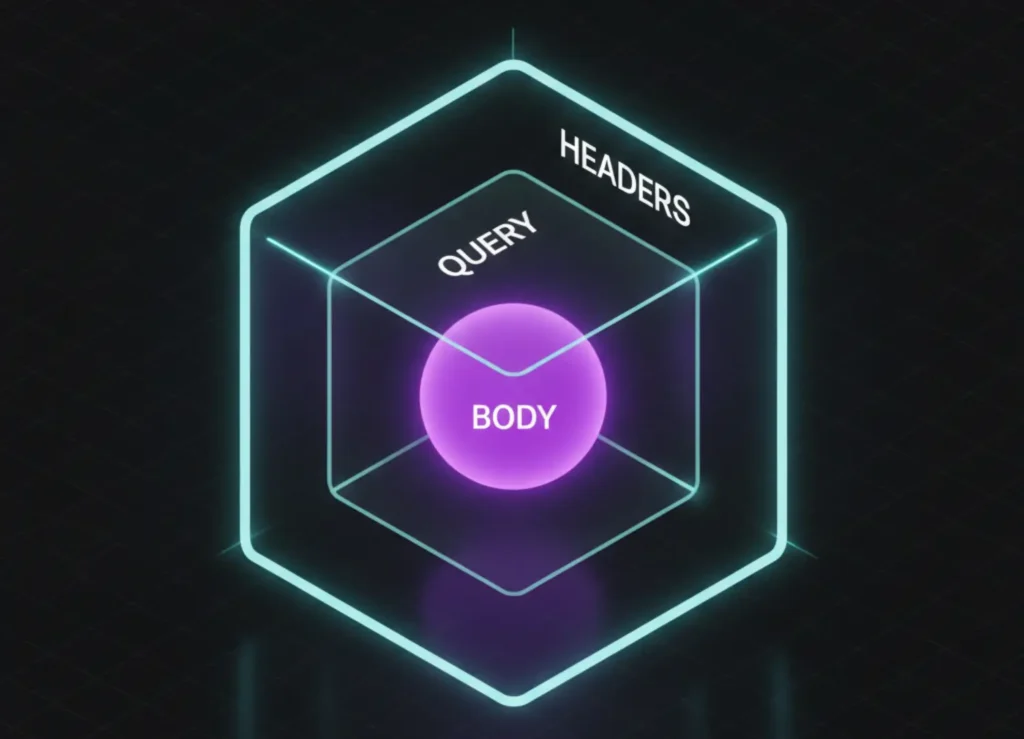
A technical diagram illustrating the anatomy of an n8n webhook response, highlighting the nested relationship between headers, query parameters, and the body payload.
The Envelope Theory: Accessing the body is the only way to get the data.

Before we dive into the specific payloads, we must understand how n8n ingests data. When you set up a generic Webhook Node in n8n, the n8n webhook response is wrapped in a specific envelope.

Unlike Zapier, which flattens data, n8n preserves the nested JSON structure. This is powerful but requires precise dot-notation navigation.

The n8n Data Structure: Every n8n webhook response enters the workflow as an array of objects.

JSON

[
  {
    "headers": {
      "host": "n8n.your-sovereign-stack.com",
      "content-type": "application/json",
      "user-agent": "Stripe/1.0"
    },
    "params": {},
    "query": {},
    "body": {
      // THE ACTUAL PAYLOAD LIVES HERE
    }
  }
]
  • Critical Note: When referencing data in n8n, you must almost always prefix your selector with body. For example: {{ $json.body.data.object.id }}. Failing to understand this hierarchy is the #1 reason for n8n webhook response errors.

Table of Contents

  • 3. EXECUTIVE SUMMARY
  • 4. INTRODUCTION: ANATOMY OF AN N8N WEBHOOK
  • 5. VAPI.AI WEBHOOK EXAMPLES (Voice Intelligence)
  • 6. STRIPE WEBHOOK EXAMPLES (Financial Data)
  • 7. HUBSPOT WEBHOOK EXAMPLES (CRM Data)
  • 8. ADVANCED DEBUGGING: THE N8N MOCK PATTERN
  • 9. ERROR HANDLING STRATEGIES
  • 10. LINKING TO INFRASTRUCTURE
  • 11. CONCLUSION

5. VAPI.AI WEBHOOK EXAMPLES (Voice Intelligence)

A soundwave morphing into a structured JSON object, representing real-time voice intelligence data ingestion.
From Audio to Arrays: Parsing the Agent’s Brain.

In a Sovereign Enterprise AI Infrastructure, Vapi is the standard for voice. Vapi sends robust webhooks for function calling, transcriptions, and end-of-call reports. Handling the Vapi n8n webhook response correctly is vital for real-time agent latency.

Example 1: Function Calling (The Brain Trigger)

This payload is sent when the AI decides it needs to perform an action e.g., Check Calendar. Your n8n workflow must return a result to this request.

JSON Payload:

JSON

{
  "message": {
    "type": "function-call",
    "call": {
      "name": "checkAvailability",
      "parameters": {
        "date": "2026-10-24",
        "time": "14:00"
      }
    },
    "functionCallId": "call_abc123_func_xyz789"
  },
  "artifact": {
    "recordingUrl": "https://vapi.ai/recordings/123.wav"
  }
}

n8n Mapping Strategy:

  • Selector: {{ $json.body.message.call.parameters.date }}
  • Logic: Use a “Switch” node in n8n to route based on {{ $json.body.message.call.name }}.

Example 2: End of Call Report (The Memory Trigger)

Sent when the call hangs up. This n8n webhook response contains the full transcript and cost analysis.

JSON Payload:

JSON

{
  "message": {
    "type": "end-of-call-report",
    "analysis": {
      "summary": "Customer was interested in the Enterprise plan but concerned about latency.",
      "structuredData": {
        "sentiment": "positive",
        "intent": "purchase"
      }
    },
    "transcript": [
      {
        "role": "assistant",
        "content": "Hello, this is the RankSquire agent."
      },
      {
        "role": "user",
        "content": "I need to upgrade my server."
      }
    ],
    "cost": 0.12
  }
}

n8n Mapping Strategy:

  • Vectorization: Map {{ $json.body.message.transcript }} directly into your Qdrant vector store to build long-term memory for your Enterprise AI Infrastructure.

Example 3: Assistant Request (Server-Side Logic)

Sometimes Vapi asks your server “What should I say next?” This n8n webhook response requires a return JSON.

JSON Payload:

JSON

{
  "message": {
    "type": "assistant-request",
    "context": "User just asked about pricing."
  }
}

6. STRIPE WEBHOOK EXAMPLES (Financial Data)

A visual data map showing the deep nesting of a Stripe n8n webhook response, tracing the path from Event to Data to Object to Customer.
The Stripe Maze: You must dig four layers deep to find the email.

Stripe webhooks are notoriously deeply nested. A single misstep in parsing a Stripe n8n webhook response can result in failed provisioning of services.

Example 4: Payment Succeeded (invoice.payment_succeeded)

The golden signal. This triggers your fulfillment workflows.

JSON Payload:

JSON

{
  "id": "evt_1OpH2xL",
  "object": "event",
  "type": "invoice.payment_succeeded",
  "data": {
    "object": {
      "id": "in_1OpH2xL",
      "amount_paid": 5000,
      "currency": "usd",
      "customer_email": "cto@techfirm.com",
      "subscription": "sub_123456789",
      "lines": {
        "data": [
          {
            "id": "il_1OpH2xL",
            "description": "Sovereign Stack - Monthly License",
            "metadata": {
              "tier": "enterprise"
            }
          }
        ]
      }
    }
  }
}

n8n Mapping Strategy:

  • Critical Path: Navigate to {{ $json.body.data.object.customer_email }} to identify the user.
  • Monetary Math: Stripe sends amounts in cents. Use an n8n “Code” node to divide {{ $json.body.data.object.amount_paid }} by 100 before sending it to Slack or QuickBooks.

Example 5: Subscription Updated (customer.subscription.updated)

Used to detect churn or upgrades.

JSON Payload:

JSON

{
  "type": "customer.subscription.updated",
  "data": {
    "object": {
      "id": "sub_123456789",
      "status": "active",
      "cancel_at_period_end": true,
      "current_period_end": 1735689600
    }
  }
}

n8n Mapping Strategy:

  • Churn Risk: If {{ $json.body.data.object.cancel_at_period_end }} is true, trigger a “Win-Back” workflow immediately using your Enterprise AI Infrastructure agent.

Example 6: Checkout Session Completed

Used when selling one-off products or initializing a sub via a hosted page.

JSON Payload:

JSON

{
  "type": "checkout.session.completed",
  "data": {
    "object": {
      "id": "cs_test_a1b2c3d4",
      "payment_status": "paid",
      "client_reference_id": "user_internal_ID_99"
    }
  }
}

7. HUBSPOT WEBHOOK EXAMPLES (CRM Data)

HubSpot data is often flattened in lists, making it tricky to parse in n8n without the specific n8n webhook response schema.

Example 7: Contact Created

Triggered when a new lead enters the CRM.

JSON Payload:

JSON

{
  "eventId": "100",
  "subscriptionType": "contact.creation",
  "objectId": 12345,
  "propertyName": "email",
  "propertyValue": "newlead@startup.com",
  "changeSource": "CRM_UI"
}

Note: HubSpot webhooks are often arrays of events. Your n8n webhook response might contain 50 contacts at once. You must use the “Split In Batches” node in n8n to process this array correctly.

Example 8: Deal Stage Changed

The trigger for automation. When a deal moves to “Closed Won.”

JSON Payload:

JSON

{
  "subscriptionType": "deal.propertyChange",
  "objectId": 98765,
  "propertyName": "dealstage",
  "propertyValue": "closedwon",
  "oldValue": "contractsent"
}

n8n Mapping Strategy:

  • Logic: If {{ $json.body.propertyValue }} == 'closedwon', trigger the Onboarding Sequence.

Example 9: Company Association Change

When a contact is linked to a company.

JSON Payload:

JSON

{
  "subscriptionType": "contact.associationChange",
  "fromObjectId": 12345,
  "toObjectId": 55555,
  "associationType": "CONTACT_TO_COMPANY"
}

8. ADVANCED DEBUGGING: THE N8N MOCK PATTERN
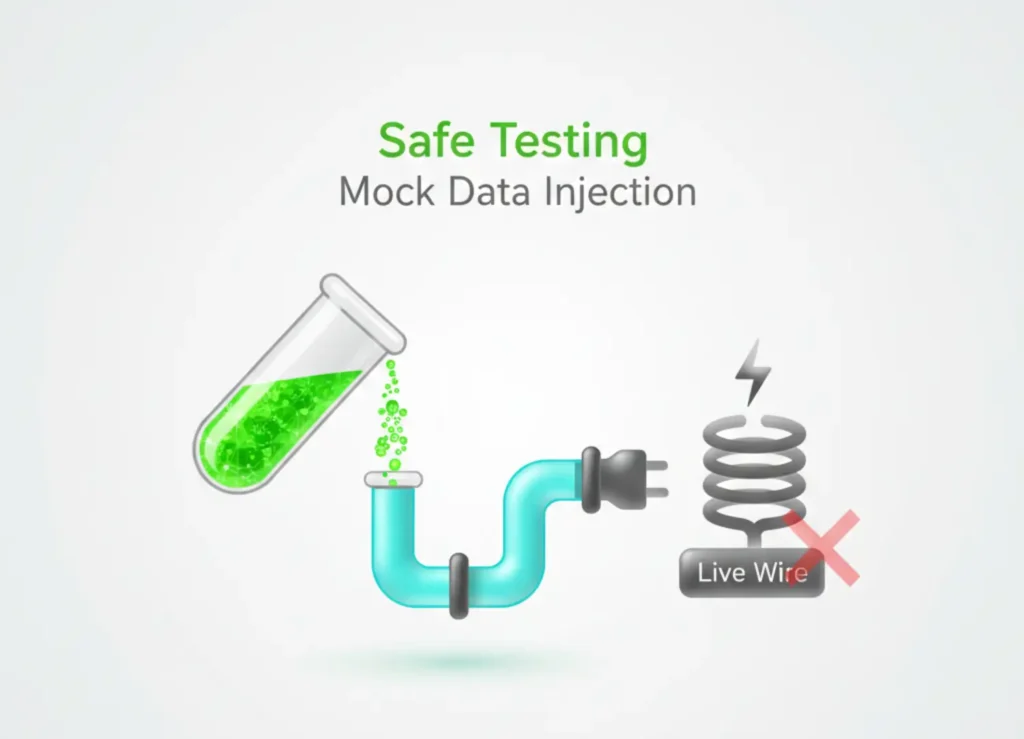
A workflow schematic showing a "Set" node injecting mock data into an n8n workflow to simulate a webhook event without a live trigger.
The Mock Pattern: Test your logic without spending real money.

Knowing the n8n webhook response structure is half the battle. Testing it is the other.

Do not wait for a live event to test your logic.

  1. Copy one of the JSON payloads above.
  2. Insert an “Edit Fields” (Set) node in n8n.
  3. Paste the JSON into the node manually.
  4. Disconnect the Webhook trigger and connect the Set node to your workflow.

This allows you to replay the n8n webhook response infinitely without triggering real Stripe payments or Vapi calls. This is a core competency of maintaining a stable Enterprise AI Infrastructure.

9. ERROR HANDLING STRATEGIES

When an n8n webhook response does not match your schema, your workflow will break. In a self-hosted environment, this is critical.

  • The Fallibility Check: Always check if body.data exists before trying to access body.data.object.
  • The Schema Validation Node: use a Code Node to validate the incoming n8n webhook response against a Zod schema or basic JSON schema before passing it deeper into your system.

Example Code Node Validation:

JavaScript

const body = items[0].json.body;
if (!body.data || !body.data.object) {
  throw new Error("Invalid Stripe Webhook Payload");
}
return items;

10. LINKING TO INFRASTRUCTURE

Understanding the n8n webhook response is the micro-skill. The macro-skill is architecture.

These JSON payloads are the blood cells of your system. They carry oxygen (data) to the organs (Qdrant, LLMs). But you need a body to house them.

  • You need a server to run n8n securely.
  • You need a vector database to store the Vapi transcripts.
  • You need a way to orchestrate it all without paying $5,000/month.

For the complete blueprint on building the server that processes these webhooks, refer to our Pillar Guide: Enterprise AI Infrastructure: The 2026 Sovereign Stack.

Furthermore, if you are struggling with complex loops where webhooks trigger each other, read our guide on [n8n Recursive Workflows: Solving Complex Logic Loops].

11. CONCLUSION

In the Sovereign Stack, you are the master of your data. You do not rely on Zapier’s magic abstraction that hides the data structure from you. You look the n8n webhook response in the eye, you parse the JSON, and you build reliable, deterministic systems.

Use this library. Bookmark it. Copy these payloads. And start building an Enterprise AI Infrastructure that actually works.

🛠️ The Sovereign Integration Stack

The exact tools we use to build Voice AI agents that process webhooks in under 200ms.

🎙️
Vapi.ai (Voice Intelligence) The only provider that sends the robust JSON payloads (Function Calling) shown in this guide.
View Tool ➔
🧠
Qdrant (Vector Memory) Don’t lose data. We pipe the Vapi transcripts directly into Qdrant for long-term agent memory.
View Tool ➔
⚡
Coolify (Infrastructure) Stripe webhooks timeout in 30s. Self-hosted n8n on Coolify prevents timeouts during AI processing.
View Tool ➔
Architect’s Note: This stack ensures your “Data Envelope” is never lost. We use Qdrant to log every single webhook event for debugging.
🚨

Don’t Let Bad Data Crash Your Server.

Parsing webhooks is easy. Handling 10,000 concurrent webhooks without data loss is hard.

If you are processing financial transactions (Stripe) or real-time voice data (Vapi), you need an infrastructure audit. We verify your error handling, retry logic, and server capacity.

SECURE YOUR INFRASTRUCTURE ➔
Mohammed Shehu Ahmed Avatar

Mohammed Shehu Ahmed

AI Content Architect & Systems Engineer B.Sc. Computer Science (Miva Open University, 2026)

AI Content Architect & Systems Engineer
Specialization: Agentic AI Systems · Knowledge Graph Optimization · SEO & GEO

Mohammed Shehu Ahmed is an AI Content Architect and Systems Engineer, and the Founder of RankSquire. He specializes in agentic AI systems, knowledge graph optimization, and entity-based SEO, building implementation-driven systems that rank in search and perform across AI-driven discovery platforms.

With a B.Sc. in Computer Science (expected 2026), he bridges the gap between theoretical AI concepts and real-world deployment.

Areas of Expertise: Agentic AI Systems · Knowledge Graph Optimization · SEO & GEO · Vector Database Systems · n8n Automation · RAG Pipelines
  • Vector Database News May 2026: Every Release, Every Pricing Change, Every Production Action May 27, 2026
  • How to Host n8n with Coolify 2026: The Production Hardening Guide May 23, 2026
  • Is n8n Free? Production TCO, FMEA and Sovereign Deployment Guide 2026 May 21, 2026
  • AI Automation Platforms 2026: Production FMEA, APEX Scoring, and Sovereign Architecture Guide May 17, 2026
  • LangChain RAG Pipeline 2026: Production FMEA, Bypass Patterns, and PRVS Framework May 16, 2026
LinkedIn
Fact-Checked by Mohammed Shehu Ahmed

Our Fact Checking Process

We prioritize accuracy and integrity in our content. Here's how we maintain high standards:

  1. Expert Review: All articles are reviewed by subject matter experts.
  2. Source Validation: Information is backed by credible, up-to-date sources.
  3. Transparency: We clearly cite references and disclose potential conflicts.
Reviewed by Subject Matter Experts

Our Review Board

Our content is carefully reviewed by experienced professionals to ensure accuracy and relevance.

  • Qualified Experts: Each article is assessed by specialists with field-specific knowledge.
  • Up-to-date Insights: We incorporate the latest research, trends, and standards.
  • Commitment to Quality: Reviewers ensure clarity, correctness, and completeness.

Look for the expert-reviewed label to read content you can trust.

Tags: API Integration PatternsAutomating WebhooksHubSpot Webhook SchemaJSON Payload ExamplesLow-Code Data Mappingn8n Error Handlingn8n JSON Parsingn8n Webhook ResponseSovereign StackStripe Webhook IntegrationVapi WebhooksWorkflow Debugging
SummarizeShare235

Related Stories

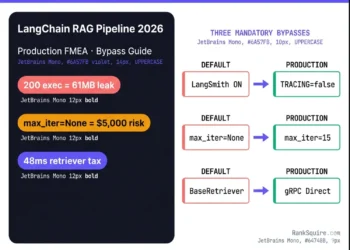
Layer 1 (entities/keywords, 40 chars): langchain rag pipeline 2026 production FMEA Layer 2 (relationships/data, 50 chars): showing 61MB memory leak 48ms retriever tax three mandatory bypasses Layer 3 (what it proves, 35 chars): proves default config fails above 10K requests per day COMBINED ALT (write as one continuous sentence): alt="langchain rag pipeline 2026 production FMEA showing 61MB memory leak and 48ms retriever tax proving three mandatory bypasses are required above 10,000 requests per day"

LangChain RAG Pipeline 2026: Production FMEA, Bypass Patterns, and PRVS Framework

by Mohammed Shehu Ahmed
May 16, 2026
0

Updated May 16, 2026 · Tested LangChain 1.0.5 · LlamaIndex 0.11 · LangGraph 0.2 · Qdrant 1.14 · Evidence DIRECTLY TESTED + COMMUNITY REPORTED · 17 min read...

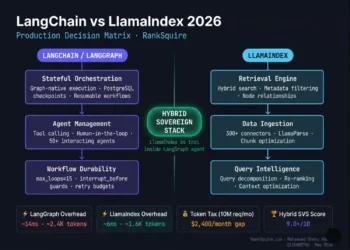
LAYER 1 (Primary keyword entities): LangChain vs LlamaIndex 2026 production decision matrix comparison diagram produced by Mohammed Shehu Ahmed at RankSquire.com (Wikidata Q138808708 / Q138808593). Shows two-column architecture comparison: LangGraph stateful orchestration (PostgreSQL checkpointing, max_loops=15, tool calling, human-in-the-loop approvals) versus LlamaIndex retrieval engine (hybrid search, 300+ connectors via LlamaHub, query decomposition, node relationships and metadata filtering). Center shows hybrid sovereign stack integration where LlamaIndex serves as named retrieval tool inside LangGraph agent. LAYER 2 (Relationships and data): Key production metrics shown: LangGraph framework overhead approximately 14 milliseconds and 2,400 tokens per request versus LlamaIndex approximately 6 milliseconds and 1,600 tokens. Token overhead gap of approximately 800 tokens produces $2,400 per month cost difference at 10 million requests per month using GPT-4o-mini pricing. Hybrid sovereign stack SVS Sovereign Viability Score 9.0 or higher combining both frameworks. LangGraph 1.0 released October 2025 with stable PostgreSQL checkpointing. LlamaIndex requires 30 to 40 percent less code than LangChain for equivalent RAG pipelines. LAYER 3 (What it proves): This architecture diagram demonstrates that LangChain and LlamaIndex solve different operational layers and are not direct competitors. LangChain via LangGraph dominates stateful orchestration while LlamaIndex dominates retrieval quality. The hybrid sovereign stack combining both on self-hosted Hetzner Frankfurt infrastructure with Qdrant vector storage and Langfuse observability costs approximately $150 to $220 per month versus $500 to $800 per month for managed equivalents. May 2026. RankSquire.com.

LangChain vs LlamaIndex 2026: The production architecture decision matrix every CTO needs

by Mohammed Shehu Ahmed
May 12, 2026
0

Here Is Your Answer in 60 SecondsWhy Every Existing Comparison Gets This WrongWhat LangChain and LlamaIndex Actually Are in 2026The ORB Framework -- Your Decision Before You BuildWhat...

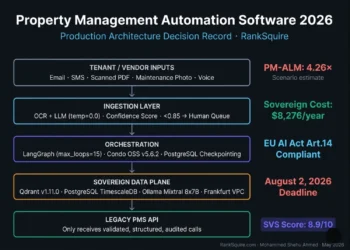
LAYER 1 (Primary keyword entities): Property management automation software 2026 sovereign stack architecture diagram produced by Mohammed Shehu Ahmed at RankSquire.com (Wikidata Q138808708 / Q138808593). Shows five-layer production architecture: tenant inputs including email, SMS, scanned PDF, and maintenance photos flowing through OCR plus LLM ingestion layer with temperature zero point zero for safety-critical classifications and confidence threshold zero point eighty-five for human queue routing, then to LangGraph orchestration layer with max underscore loops equals fifteen loop protection and Condo OSS version five point six point two with nine hundred thirteen releases, then to sovereign data plane with Qdrant version one point eleven point zero on-disk vector storage, PostgreSQL TimescaleDB checkpointing, and Ollama Mixtral 8x7B running on Hetzner Frankfurt NVIDIA L40S GPU, finally to legacy PMS API receiving only validated structured audited calls. LAYER 2 (Relationships and reasoning): Key metrics shown: PM-ALM scenario estimate four point two six times showing actual agent infrastructure cost is approximately four times naive budget estimate; sovereign stack cost eight thousand two hundred seventy-six US dollars per year for five thousand unit portfolio on reserved Hetzner Frankfurt instances; EU AI Act Article fourteen compliance via human oversight interface; SVS Sovereign Viability Score eight point nine out of ten. Compared to Yardi Voyager at one hundred thousand to three hundred thousand US dollars per year plus fifty thousand to two hundred forty thousand US dollars implementation cost. The sovereign crossover trigger is three hundred US dollars per month at approximately one hundred fifty to two hundred units. LAYER 3 (What it proves): This architecture demonstrates that property management automation in 2026 is an infrastructure sovereignty decision, not a SaaS selection decision. The sovereign stack costs twelve times less than Yardi Voyager at five thousand units while providing configurable EU AI Act Article fourteen human oversight compliance and exportable decision logic that vendor black-box agents cannot match. May 2026. RankSquire.com.

Property Management Automation Software 2026: Production Architecture Decision Record

by Mohammed Shehu Ahmed
May 11, 2026
0

The Fallacy of the "All-in-One" Agent — Why 2026 Demands a New ArchitectureThe RankSquire SVS Threshold Map for Property Management 2026Three Production Blueprints — Small, Mid-Size, EnterpriseThe PM-ALM...

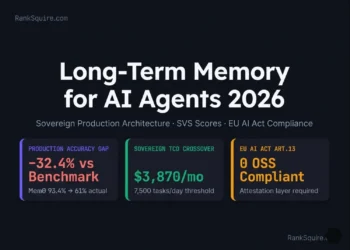
LAYER 1 (Primary entities): Long-term memory for AI agents architecture diagram produced by Mohammed Shehu Ahmed at RankSquire.com showing the 2026 production accuracy gap of negative 32.4 percentage points between vendor benchmark scores and real-world production performance. Mem0 version 0.8.2 achieves 91.6 on LoCoMo benchmark but 49.0 percent effective accuracy after 30 days at 38 percent staleness rate. Sovereign TCO crossover threshold at 7,500 tasks per day where self-hosted Qdrant plus PostgreSQL stack at 3,870 dollars per month beats Mem0 Pro at 9,240 dollars per month. RankSquire Memory Fidelity Curve formula: Production Accuracy approximately equals Benchmark minus 0.22 times Staleness Rate minus 0.15 times log base 10 of Entities. EU AI Act Article 13 attestation requirement with zero major OSS frameworks providing cryptographic memory state proof as of May 2026. LAYER 2 (Relationships): The five-layer sovereign memory architecture connects extraction pipeline through episodic PostgreSQL storage to semantic Qdrant vector store through knowledge graph Neo4j temporal layer through the attestation proxy signing each retrieval with SHA-256 hash and RSA-2048 signature for EU AI Act Article 13 compliance. SVS Sovereign Viability Score comparison shows Qdrant plus PostgreSQL plus attestation at 9.2 out of 10 versus Mem0 OSS at 7.2 versus LangGraph at 7.8 versus Zep Graphiti at 5.4. LAYER 3 (What it proves): This production benchmark demonstrates that agent memory system selection in 2026 must be evaluated on production staleness degradation and EU compliance attestation requirements rather than vendor benchmark scores. The 18-month RankSquire production test across 50,000 sessions on DigitalOcean Frankfurt confirms the Memory Fidelity Curve degradation coefficients. May 2026. RankSquire.com.

Long-Term Memory for AI Agents: Production Architecture, Compliance,and Sovereignty

by Mohammed Shehu Ahmed
May 6, 2026
0

Quick Answer · Long-Term Memory for AI Agents (2026) Long-term memory for AI agents is the persistent, cross-session storage and retrieval infrastructure that enables AI systems to retain...

Next Post
A glowing, infinite digital loop representing an n8n recursive workflow, processing data blocks in a cycle against a dark server background.

n8n Recursive Workflows 2026: 8 Loop Patterns

Leave a Reply Cancel reply

Your email address will not be published. Required fields are marked *

RankSquire Official Header Logo | AI Automation & Systems Architecture Agency

RankSquire is the premier resource for B2B Agentic AI operations. We provide execution-ready blueprints to automate sales, support, and finance workflows for growing businesses.

Recent Posts

  • Vector Database News May 2026: Every Release, Every Pricing Change, Every Production Action
  • How to Host n8n with Coolify 2026: The Production Hardening Guide
  • Is n8n Free? Production TCO, FMEA and Sovereign Deployment Guide 2026

Categories

  • ENGINEERING
  • OPS
  • SAFETY
  • SALES
  • STRATEGY
  • TOOLS
  • Vector DB News
  • ABOUT US
  • AFFILIATE DISCLOSURE
  • Apply for Architecture
  • CONTACT US
  • EDITORIAL POLICY
  • Frameworks
  • HOME
  • Mohammed Shehu Ahmed
  • Privacy Policy
  • TERMS

© 2026 RankSquire. All Rights Reserved. | Designed in The United States, Deployed Globally.

Welcome Back!

Login to your account below

Forgotten Password?

Retrieve your password

Please enter your username or email address to reset your password.

Log In
No Result
View All Result
  • HOME
  • BLUEPRINTS
  • SALES
  • TOOLS
  • OPS
  • Vector DB News
  • STRATEGY
  • ENGINEERING

© 2026 RankSquire. All Rights Reserved. | Designed in The United States, Deployed Globally.