
AI News
  • HOME
  • BLUEPRINTS
  • SALES
  • TOOLS
  • OPS
  • Vector DB News
  • STRATEGY
  • ENGINEERING
No Result
View All Result
SAVED POSTS
AI News
  • HOME
  • BLUEPRINTS
  • SALES
  • TOOLS
  • OPS
  • Vector DB News
  • STRATEGY
  • ENGINEERING
No Result
View All Result
RANK SQUIRE
No Result
View All Result
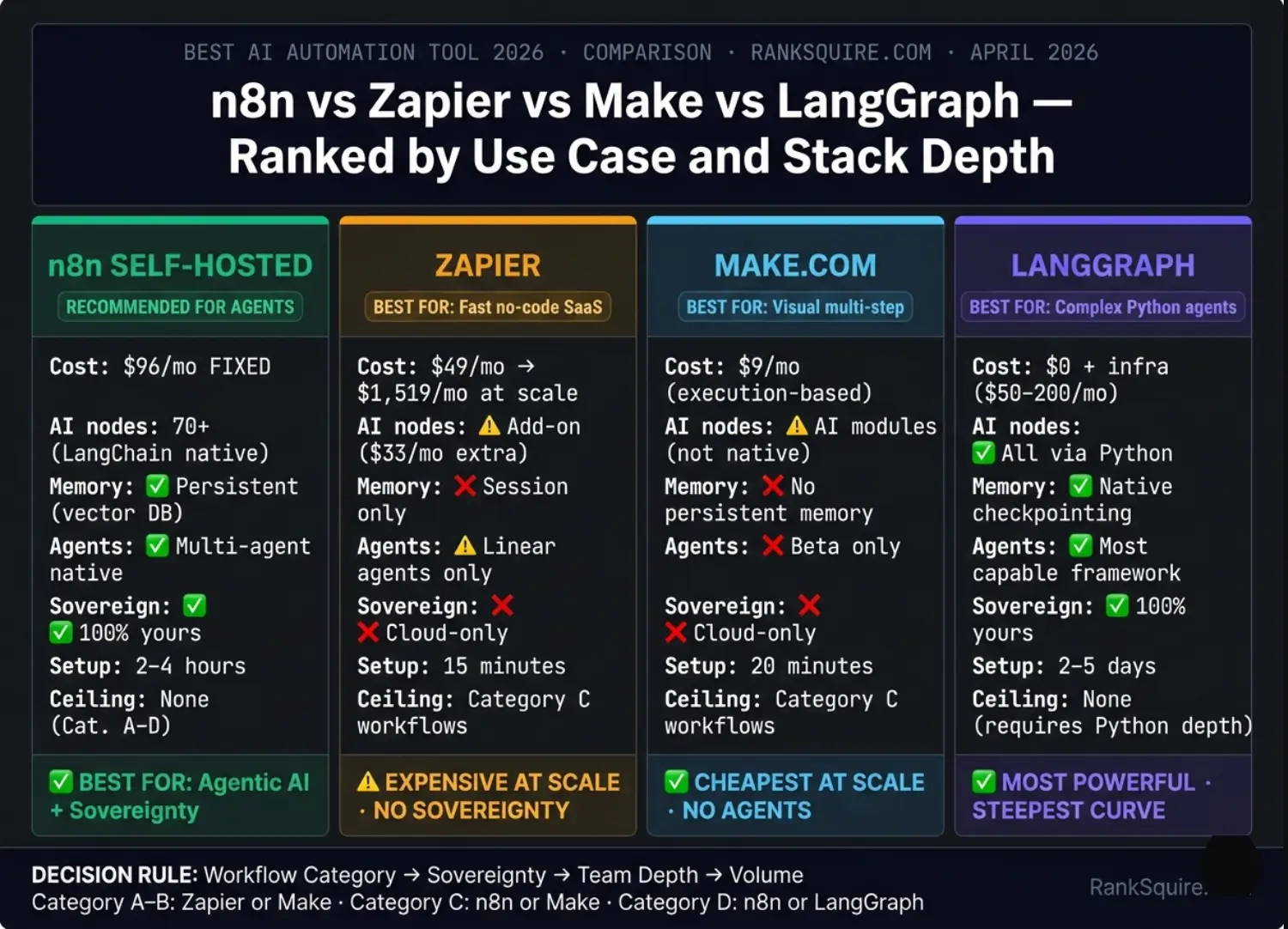
Best AI automation tool 2026 comparison of four tools: n8n self-hosted at $96 per month fixed with 70 plus AI nodes and full sovereignty, Zapier at $1519 per month at scale with 8000 integrations, Make at $9 per month execution-based with 1500 integrations, and LangGraph open source Python-native for complex multi-agent systems

Best AI automation tool 2026: n8n self-hosted ($96/month fixed, 70+ AI nodes, sovereign, LangChain native) vs Zapier ($1,519/month at 10K runs, 8,000+ integrations, cloud-only) vs Make ($9/month execution-based, 1,500+ integrations) vs LangGraph (open source, Python-native, no ceiling). Right tool determined by workflow category not brand. Mohammed Shehu Ahmed · RankSquire.com · April 2026.

Best AI Automation Tool 2026: The Ranked Decision Guide for Engineers

Mohammed Shehu Ahmed by Mohammed Shehu Ahmed
April 9, 2026
in TOOLS
Reading Time: 40 mins read
0
586
SHARES
3.3k
VIEWS
Summarize with ChatGPTShare to Facebook

Best AI Automation Tool 2026: The Ranked Decision Guide for Engineers

The best AI automation tool in 2026 is not a single answer.
It is a function of four variables: your team’s technical depth, the complexity of the workflow you are automating, your data sovereignty requirements, and the scale at which you need to operate without the cost model collapsing.

n8n, Zapier, Make, and LangGraph are not interchangeable. They are four architecturally distinct tools serving four distinct team profiles — and choosing the wrong one costs you either months of rebuild time or thousands per month in avoidable platform fees.

This post ranks all four across six criteria:
→ AI agent depth — can it build systems that reason and remember?
→ Sovereignty — do you own the infrastructure you deploy on?
→ Pricing at scale — what does it actually cost at 10,000 runs/month?
→ Technical ceiling — where does it break down under complexity?
→ Setup time — days to first production workflow
→ The verdict — which tool for which exact use case
Data verified April 2026 from production deployments and official vendor pricing. No affiliate bias in the rankings.

[PASTE METADATA BAR HTML BLOCK HERE]

TL;DR — QUICK SUMMARY

→ The best AI automation tool in 2026 by use case:
n8n (self-hosted) best for technical teams building agentic AI systems, sovereign infrastructure, and complex multi-step orchestration. $96/month fixed. Zero per-execution fees above the base cost.
Zapier best for non-technical teams needing fast deployment with 8,000+ integrations and no DevOps overhead. Expensive at scale — $20/month grows fast when workflows exceed 750 tasks/month.
Make.com best for operations teams needing visual multi-step logic at competitive pricing. 1,500+ integrations, strong data transformation. Cloud-only.
LangGraph best for engineering teams building Python-native multi-agent systems with explicit state management. Not a no-code tool. Requires strong Python depth and custom infrastructure.
→ The decision in one rule: if your workflow requires an AI agent to reason across multiple steps with memory of prior sessions — use n8n or LangGraph. If it requires connecting SaaS tools without complex logic — use Zapier or Make. The distinction is the difference between an agent and an automation.

For the complete n8n vs Zapier cost analysis — see:

n8n vs Zapier Enterprise Cost Analysis at ranksquire.com/2026/02/13/n8n-vs-zapier-enterprise-cost-analysis/

KEY TAKEAWAYS

→ The best AI automation tool is determined by workflow complexity, not brand recognition. Zapier’s 8,000+ integrations are irrelevant if the workflow requires conditional reasoning across 15 steps with persistent agent memory. n8n handles this. Zapier does not.
→ n8n 2.0 (launched January 2026) ships native LangChain integration with 70+ AI nodes, persistent agent memory across executions, and vector database integrations for RAG workflows. This is the largest capability gap between n8n and Zapier in the tool’s history.
→ Zapier’s pricing model is task-based — every action in a workflow counts as one task. A 10-step workflow with 1,000 daily runs = 10,000 tasks/day. At the Professional plan ($49/month for 2,000 tasks), this exhausts your monthly quota in 4.8 hours.
→ Make.com pricing is execution-based, not task-based. One complex 50-step scenario counts as one execution. This makes Make significantly cheaper than Zapier for complex multi-step workflows at medium volume.
→ LangGraph is not a replacement for n8n. It is a Python library for building multi-agent state machines. It has no visual interface, no pre-built integrations, and requires a custom deployment environment. It is the correct choice when workflow logic is too complex for any visual tool.
→ Sovereign deployment is not optional for regulated industries. Zapier and Make are cloud-only. n8n self-hosted on DigitalOcean gives you GDPR Article 44 compliance, zero data leaving your infrastructure, and a fixed $96/month cost regardless of execution volume.
RankSquire.com
Production AI Infrastructure 2026

QUICK ANSWER

What is the best AI automation tool in 2026? The best AI automation tool in 2026 depends on your use case:
For agentic AI workflows with memory and reasoning: n8n self-hosted — $96/month, sovereign, 70+ AI nodes, native LangChain, persistent agent memory.
For fast no-code SaaS integration: Zapier — starts at $20/month, 8,000+ integrations, no DevOps required, expensive above 2,000 tasks/month.
For visual multi-step logic at scale: Make.com — starts at $9/month, 1,500+ integrations, execution-based pricing (not task-based), cloud-only.
For Python-native multi-agent systems: LangGraph — free and open source, requires Python depth and custom infrastructure, no pre-built integrations.
Self-Hosted Deployment Guide For the full self-hosted n8n deployment guide — see ranksquire.com/2026/01/09/self-hosted-n8n-guide/

BEST AI AUTOMATION TOOL 2026 — DEFINED

AI automation tools are software platforms that design, execute, and manage automated workflows using artificial intelligence to handle decisions, data processing, and system orchestration. In 2026, this definition covers a wide spectrum — from Zapier’s visual trigger-action connector to n8n’s full agentic AI orchestration with native LangChain integration, persistent vector memory, and self-hosted sovereign deployment.
The Core Distinction
The distinction that matters for choosing: does your workflow require an AI agent to reason, decide, and remember — or does it require a structured sequence of predictable steps connecting known inputs to known outputs? The former is agentic AI. The latter is workflow automation. The best tool for each is different.

EXECUTIVE SUMMARY: THE AI AUTOMATION TOOL DECISION

THE PROBLEM

The AI automation tool market in 2026 has fragmented into two distinct categories that share the same brand label. Workflow automation tools (Zapier, Make) have added AI features — LLM API calls, AI-generated content, basic decision routing. Agentic AI platforms (n8n 2.0, LangGraph) have shipped native orchestration with persistent memory, multi-agent coordination, and vector database integration.

The problem: they are all called “AI automation tools.” The pricing pages look similar at entry level. The proposals from vendors all claim “AI-powered automation.” The buyer who selects Zapier for an agentic workflow gets a workflow tool sold as an AI platform — and discovers the limitation 90 days into production.

THE SHIFT

From evaluating tools by feature checklist to evaluating them by architectural fit: what is the complexity ceiling of this tool, what is the cost at my production volume, what do I own at the end, and what happens when my workflow needs to reason rather than just execute?

THE OUTCOME

A tool selection that matches the workflow complexity, production volume, technical depth, and sovereignty requirements before the first workflow is built — not after the first month-three billing surprise.

2026 TOOL LAW

The best AI automation tool is the one whose complexity ceiling is above your workflow’s complexity floor, whose pricing model survives your production volume, and whose deployment model aligns with your data residency requirements.

All three criteria must pass. One failure = wrong tool.

Verified RankSquire Architecture Lab — April 2026

Table of Contents

  • 1. The 4 Categories of AI Automation Tools
  • 2. Head-to-Head: n8n vs Zapier vs Make vs LangGraph
  • 3. Pricing at Scale — What It Actually Costs
  • 4. AI Agent Depth — Which Tool Can Actually Build Agents
  • 5. Sovereignty and Compliance — Who Owns Your Data
  • 6. Decision Matrix — Which Tool for Which Use Case
  • 7. Conclusion
  • 8. FAQ: Best AI Automation Tool 2026
  • What is the best AI automation tool in 2026?
  • Is n8n better than Zapier for AI automation in 2026?
  • How much does n8n cost compared to Zapier in 2026?
  • Can Zapier build AI agents in 2026?
  • What is LangGraph and when should I use it?
  • What AI automation tool is best for sovereign deployment?
  • 9. FROM THE ARCHITECT’S DESK
Best AI automation tool 2026 comparison of four tools: n8n self-hosted at $96 per month fixed with 70 plus AI nodes and full sovereignty, Zapier at $1519 per month at scale with 8000 integrations, Make at $9 per month execution-based with 1500 integrations, and LangGraph open source Python-native for complex multi-agent systems
Best AI automation tool 2026: n8n self-hosted ($96/month fixed, 70+ AI nodes, sovereign, LangChain native) vs Zapier ($1,519/month at 10K runs, 8,000+ integrations, cloud-only) vs Make ($9/month execution-based, 1,500+ integrations) vs LangGraph (open source, Python-native, no ceiling). Right tool determined by workflow category not brand. Mohammed Shehu Ahmed · RankSquire.com · April 2026.

1. The 4 Categories of AI Automation Tools

Workflow Logic Mapping — RankSquire 2026

Before comparing tools, map the workflow type. The category determines the correct tool before any feature comparison begins.
Category A SaaS Connector Automation
What it does: connects existing SaaS tools using trigger-action sequences. When X happens in App A, do Y in App B. Predictable inputs. Predictable outputs. No reasoning required. No memory required.
Examples: sync CRM contacts to email list, create Slack notification when form is submitted, log calendar events to spreadsheet.
Correct tools: Zapier, Make.com
Ceiling: fails when conditional logic exceeds 3–4 branches or when inputs are ambiguous.
Category B Data Pipeline Automation
What it does: transforms, routes, and processes data across systems. Multi-step logic with branching, loops, and data transformation. No AI reasoning. Structured data in, structured data out.
Examples: ETL workflows, API data sync with field mapping, automated report generation from multiple data sources.
Correct tools: Make.com, n8n (either hosted)
Ceiling: fails when data requires interpretation rather than transformation.
Category C LLM-Powered Workflow Automation
What it does: incorporates LLM API calls within a workflow. The LLM processes text — summarizes, classifies, generates — and returns a structured output that the workflow routes. The LLM is a step in the workflow, not the orchestrator.
Examples: email classification and routing, document summarization with output to CRM, sentiment analysis on support tickets with auto-tagging.
Correct tools: n8n, Zapier (with AI actions), Make.com
Ceiling: fails when the LLM needs to make decisions about what to do next, not just what to say.
Category D Agentic AI Orchestration
What it does: the LLM is the orchestrator — it decides which tools to call, in what sequence, based on reasoning about the current state. The agent persists state across sessions, retrieves relevant memory, and improves over time.
Examples: autonomous research agent, multi-session sales intelligence agent, customer support agent with memory of prior interactions, AI agent that writes, reviews, and deploys code autonomously.
Correct tools: n8n 2.0 (with LangChain nodes), LangGraph (Python-native)
Ceiling: no ceiling — this is production-grade agentic AI infrastructure.
Best AI automation tool 2026 four workflow categories: Category A SaaS connector automation with Zapier or Make, Category B data pipeline with Make or n8n, Category C LLM-powered workflows with n8n or Zapier, Category D agentic AI orchestration with n8n 2.0 or LangGraph only
Four workflow categories determine the best AI automation tool in 2026: Category A SaaS connectors (Zapier/Make), Category B data pipelines (Make/n8n), Category C LLM-powered workflows (n8n/Zapier/Make), Category D agentic AI orchestration (n8n 2.0 or LangGraph only). Match the tool to the category before evaluating features. Mohammed Shehu Ahmed · RankSquire.com · April 2026.

2. Head-to-Head: n8n vs Zapier vs Make vs LangGraph

Six criteria. Four tools. One verdict per use case.

CRITERION 1: AI AGENT DEPTH
n8n 2.0 ★★★★★
Native LangChain integration with 70+ AI nodes. Persistent agent memory across executions. Vector database integration (Qdrant, Pinecone, Weaviate) for RAG workflows. Multi-agent AI Tool Node for parallel agent orchestration. MCP server creation and management. Self-hosted LLM support via Ollama.
Verdict: the most capable AI agent platform among visual workflow tools in 2026.
Zapier ★★☆☆☆
Zapier Agents for autonomous task execution across 8,000+ apps. AI Copilot builds Zaps from natural language. AI actions available as separate paid add-on (Agents Pro: $33.33/month). Limited to linear agent patterns.
Verdict: AI feature parity at the surface; architectural depth gap of ~18 months behind n8n.
Make.com ★★☆☆☆
Maia AI assistant builds scenarios from natural language. Native AI module integrations. Agent builder in beta — not production-ready. No persistent agent memory. No vector database integration. Cloud-only deployment.
Verdict: strong for LLM-powered workflows (Category C); not suitable for Category D orchestration.
LangGraph ★★★★★
Python-native state machine for multi-agent systems. Explicit state management with checkpointing. Parallel agent execution with conditional routing. Native integration with all Python AI libraries. No complexity ceiling.
Verdict: most powerful framework available — steepest learning curve and zero no-code interface.
CRITERION 2: PRICING AT SCALE (10k/MO)
n8n
Cloud: ~$50/month (Starter plan, per execution)
Self-hosted: $96/month fixed (DigitalOcean 16GB) — zero per-execution cost above the Droplet fee.
Zapier
Pro: $49/month (2,000 tasks) — exhausted in 4.8 hours at 10k executions of 10 steps. Requires Team plan ($69/month, 50,000 tasks) minimum.
Make.com
Core: $9/month (10,000 operations) — competitive because Make prices per scenario execution, not per step.
LangGraph
$0 (open source) + infrastructure — AWS/GCP/DO cost for deployment: $50–200/month depending on compute.
CRITERION 3: SOVEREIGNTY & COMPLIANCE
n8n Self-hosted ✅
Full sovereignty. Your instance. Your data. Zero API calls leaving infrastructure for orchestration. GDPR Article 44 compliant.
Zapier ❌
Cloud-only. SOC 2 Type II. GDPR compliant as processor. But data passes through Zapier infrastructure.
Make.com ❌
Cloud-only. SOC 2 Type II. Limited RBAC compared to Zapier. No self-hosted option.
LangGraph ✅
Full sovereignty. Open source Python library. Deploy on any infrastructure. No data leaves your environment.
CRITERION 4 & 5: SETUP & INTEGRATION
Setup Time
Zapier: 15m | Make: 20m | n8n Cloud: 30m | n8n Self-hosted: 2–4h | LangGraph: 2–5 days.
Integrations
Zapier: 8k+ | Make: 1.5k | n8n: 400+ (plus HTTP) | LangGraph: 0 (all via Python).
CRITERION 6: TECHNICAL CEILING
Zapier & Make: hits ceiling at Category C (LLM-powered workflows with simple routing). Multi-agent hierarchies and persistent memory require workarounds that break under production load.
n8n: no ceiling for Categories A–D. Visual builder handles A–C; LangChain nodes and code handle D. Self-hosted removes infrastructure ceiling.
LangGraph: no ceiling. The ceiling is your engineering team’s depth in Python and distributed systems — not the framework.

3. Pricing at Scale — What It Actually Costs

Best AI automation tool 2026 pricing comparison at 10000 workflow runs per month: Zapier $1519 per month due to per-task billing, n8n self-hosted $96 per month fixed unlimited, Make $9 per month execution-based, LangGraph $50-200 per month infrastructure only
Pricing reality at 10,000 workflow runs/month: Zapier ~$1,519/month (per-task model punishes scale), n8n self-hosted $96/month fixed regardless of volume, Make ~$9/month (execution-based advantage), LangGraph $50–200/month infrastructure only. The pricing model matters more than the entry price. Mohammed Shehu Ahmed · RankSquire.com · April 2026.

Verified April 2026 Production Pricing Analysis

The pricing comparison that matters is not the entry price — it is the cost at your production execution volume. These are verified April 2026 prices.
SCENARIO: 10,000 workflow runs/month | 10-step workflow
Zapier Professional
10,000 runs × 10 steps = 100,000 tasks/month
Additional tasks: 98,000 × $0.015
~$1,519/mo
Make.com Core
10,000 runs × 1 execution = 10,000 operations
Make prices per scenario execution, not per step.
$9/mo
n8n Cloud (Starter)
Per-execution pricing: 10,000 executions total.
~$50/mo
n8n Self-hosted
DigitalOcean 16GB Droplet. Unlimited executions at fixed cost.
$96/mo
LangGraph (OSS)
Infrastructure cost only: compute for agent workloads.
$50–200/mo
THE PRICING VERDICT AT 10,000 RUNS/MONTH
  • Make $9 (Cheapest)
  • LangGraph $50–200
  • n8n Cloud ~$50
  • n8n Self-hosted $96 Fixed
  • Zapier ~$1,519

The Zapier pricing model is correct for low-volume, simple workflows. It becomes the most expensive option at production AI automation scale.

See the complete n8n vs Zapier cost breakdown at ranksquire.com/2026/02/13/n8n-vs-zapier-enterprise-cost-analysis/

4. AI Agent Depth — Which Tool Can Actually Build Agents

Production AI Agent Infrastructure — Scoring & Standards

This section defines the line between “has AI features” and “can build production AI agents.”
Persistent memory The agent must remember information across sessions without you manually injecting context every time.
Tool-use loop The LLM must be able to call external tools, receive results, and use those results to decide the next action.
Multi-agent coordination For complex workflows, multiple specialized agents must hand off tasks to each other with shared state.
Error recovery System must handle tool failures or unexpected agent results gracefully without human intervention.
Observability You must be able to see exactly what the agent decided, which tools it called, and why — at production scale.
n8n 2.0 (self-hosted)
✅ Persistent memory — native via LangChain memory nodes and vector database integration (Qdrant, Pinecone)
✅ Tool-use loop — AI Tool Node supports any API as an agent tool with structured input/output
✅ Multi-agent — AI Tool Node creates agent hierarchies with orchestrator + specialist agent pattern
✅ Error recovery — native error workflow triggers with retry logic and dead-letter queuing
✅ Observability — execution logs with full step-by-step visibility, LangChain trace integration
Verdict: production-ready for Category D agents.
Zapier
❌ Persistent memory — session context only; no vector database integration; no memory across Zaps
⚠️ Tool-use loop — Zapier Agents can call apps but cannot build custom tool schemas or process structured tool results
❌ Multi-agent — no native multi-agent coordination
✅ Error recovery — task history and replay available
⚠️ Observability — execution logs but limited for complex agent debugging
Verdict: Category C LLM workflows only. Agentic patterns require workarounds that break at scale.
Make.com
❌ Persistent memory — none native; requires external database integration with manual state management
❌ Tool-use loop — AI modules exist but no agent tool-use pattern; LLM is a step not an orchestrator
❌ Multi-agent — not supported; agent builder in beta with no production timeline confirmed
✅ Error recovery — scenario error handling available
✅ Observability — scenario execution history available
Verdict: Category B–C only. Not suitable for agents.
LangGraph
✅ Persistent memory — native checkpointing with configurable state backends (Redis, PostgreSQL)
✅ Tool-use loop — first-class concept; tool nodes, tool routing, and result processing are core primitives
✅ Multi-agent — framework designed for this; supervisor, specialist, and swarm patterns are all native
✅ Error recovery — configurable retry logic and fallback graph nodes
✅ Observability — LangSmith integration for full agent trace visibility
Verdict: the most capable framework for Category D — with the highest implementation cost.

5. Sovereignty and Compliance — Who Owns Your Data

Best AI automation tool 2026 decision matrix showing four steps: workflow category determines Category A-B use Zapier or Make, Category D use n8n or LangGraph only, then sovereignty requirement eliminates Zapier and Make for regulated data, then team technical depth determines n8n for technical teams versus LangGraph for Python engineers, then production volume above 10000 executions per month favors n8n self-hosted fixed pricing
The 4-step decision matrix for the best AI automation tool in 2026: (1) workflow category A–D, (2) sovereignty requirement, (3) team technical depth, (4) production volume. Apply in order first criterion that eliminates an option ends the analysis for that tool. Mohammed Shehu Ahmed · RankSquire.com · April 2026.

Data Sovereignty Comparison — RankSquire 2026

For regulated industries and any organization where data cannot leave controlled infrastructure, the tool decision is made by sovereignty first, features second.
n8n Self-hosted Architecture: Sovereign
Data path: trigger → your n8n instance → your tools
Nothing passes through n8n’s servers. Your DigitalOcean Droplet is the only infrastructure between your workflow and your tools. GDPR Article 44: compliant by architecture on DO Frankfurt or Amsterdam. HIPAA: achievable with appropriate Droplet configuration. Recommended deployment: DO 16GB at $96/month.
Zapier Architecture: Cloud
Data path: trigger → Zapier’s cloud → your tools
All workflow data passes through Zapier’s infrastructure. SOC 2 Type II certified. GDPR compliant as a data processor. Enterprise plan offers GDPR DPA execution. Not suitable for: data that cannot leave client infrastructure under any regulatory interpretation.
Make.com Architecture: Cloud
Data path: trigger → Make’s cloud → your tools
Cloud-only. Similar compliance posture to Zapier. SOC 2 Type II certified. GDPR processing agreement available. Limited RBAC compared to Zapier — governance risk for large enterprise deployments.
LangGraph Architecture: Library
Data path: trigger → your deployed environment → your tools
Complete sovereignty by architecture. Open source library. No data passes through any third-party infrastructure for the orchestration layer. Compliance: determined by your deployment infrastructure choice, not the framework itself.
THE SOVEREIGNTY VERDICT

If data residency is a hard requirement: n8n self-hosted or LangGraph. The choice between them is a function of your team’s technical depth, not the sovereignty posture.

If compliance is managed (SOC 2, GDPR processor): Zapier or Make with appropriate DPA execution and enterprise plan.

6. Decision Matrix — Which Tool for Which Use Case

2026 AI Automation Architectural Decision Protocol

The tool is decided by four criteria applied in order. Stop at the first criterion that eliminates an option.
STEP 1 What is the workflow category?
→ Category A (SaaS connector): Zapier or Make
→ Category B (data pipeline): Make or n8n
→ Category C (LLM-powered): n8n, Zapier, or Make
→ Category D (agentic AI): n8n or LangGraph only
STEP 2 What is the sovereignty requirement?
→ Data can leave your infrastructure: any tool
→ Data cannot leave your infrastructure: n8n self-hosted or LangGraph only. Zapier and Make are eliminated.
STEP 3 What is the team’s technical depth?
→ No-code / ops team: Zapier (Category A–C) or Make (B–C)
→ Technical team with some Python: n8n (all categories)
→ Strong Python engineering depth: LangGraph (Category D)
STEP 4 What is the production volume?
→ Under 2,000 tasks/month: Zapier or Make competitive
→ 2,000–10,000 tasks/month: Make or n8n Cloud
→ Above 10,000 tasks/month: n8n self-hosted ($96/month fixed) or LangGraph (infrastructure cost only)
FINAL VERDICTS
Non-technical team, low volume, SaaS connectors: ZAPIER Fast setup, massive integration library, no DevOps. Accept the cost curve at scale.
Ops team, medium volume, visual logic: MAKE.COM Best pricing per execution for complex multi-step workflows. Visual debugging. 1,500+ apps.
Technical team, agentic AI, sovereign deployment: N8N SELF-HOSTED 70+ AI nodes, LangChain native, persistent memory, $96/month fixed, full sovereignty. This is the production standard for AI automation agencies (ranksquire.com/2026/ai-automation-agencies-2026/)
Python engineering team, complex multi-agent systems: LANGGRAPH No ceiling on agent complexity. Full control over state, routing, and memory architecture. Requires custom deployment infrastructure.

7. Conclusion

THE ENGINEERING VERDICT: AI AUTOMATION 2026

The best AI automation tool in 2026 is not a single answer — and any post that gives you one without asking about your workflow category, sovereignty requirements, team depth, and production volume is giving you a marketing ranking, not an engineering verdict.
THE VERDICT
For technical teams building AI agent infrastructure: n8n self-hosted is the correct default. It handles every workflow category (A through D), costs $96/month fixed at any execution volume, provides full data sovereignty, and ships native LangChain integration.
For non-technical teams: Zapier or Make are the correct choices. Accept their cloud dependency and their pricing model’s scale limitations.
For pure engineering teams: LangGraph is the most capable framework available, with full Python control and no architectural ceiling.
The mistake to avoid: using a Category A tool to build a Category D system. That is where deployments fail, three months and $50,000 of agency fees later.
Recommended Architecture Guide See Agentic AI Architecture 2026 at ranksquire.com/2026/01/05/agentic-ai-architecture/ Memory Infrastructure Guide See Best Vector Database for AI Agents 2026 at ranksquire.com/2026/01/07/best-vector-database-ai-agents/

8. FAQ: Best AI Automation Tool 2026

What is the best AI automation tool in 2026?

The best AI automation tool in 2026 depends on the workflow type and team profile. For agentic AI systems with persistent memory and multi-agent orchestration: n8n self-hosted (70+ AI nodes, LangChain native, $96/month fixed on DigitalOcean).

For fast no-code SaaS integration: Zapier (8,000+ integrations, no DevOps, expensive above 2,000 tasks/month). For visual multi-step workflows at competitive pricing: Make.com (execution-based pricing, 1,500+ integrations, cloud-only). For Python-native multi-agent systems with no complexity ceiling: LangGraph (open source, full sovereignty, requires strong Python depth).

Is n8n better than Zapier for AI automation in 2026?

n8n is better than Zapier for AI automation in 2026 for technical teams building agentic workflows. n8n 2.0 (January 2026) ships native LangChain integration with 70+ AI nodes, persistent agent memory across executions, vector database integration for RAG workflows, and full self-hosted deployment at $96/month fixed.

Zapier has added Zapier Agents and an AI Copilot, but its architecture is linear it does not support multi-agent hierarchies, persistent cross-session memory, or self-hosted sovereign deployment. For non-technical teams needing fast deployment across 8,000+ apps for simple automations: Zapier remains faster to start.

How much does n8n cost compared to Zapier in 2026?

At 10,000 workflow runs per month with a 10-step workflow, n8n self-hosted on DigitalOcean costs $96/month fixed with unlimited executions. Zapier Professional costs $49/month for 2,000 tasks the same 10,000 runs at 10 steps generates 100,000 tasks, requiring the Team plan and additional task purchases for a total of approximately $1,519/month.

Make.com processes the same volume for approximately $9/month because it prices per scenario execution rather than per step.
n8n self-hosted is the most cost-effective option for high-volume AI automation workflows above 2,000 executions per month. See the complete cost comparison at ranksquire.com/2026/02/13/n8n-vs-zapier-enterprise-cost-analysis/

Can Zapier build AI agents in 2026?

Zapier can build basic AI agents via Zapier Agents (a paid add-on starting at $33.33/month billed annually) for task execution across its 8,000+ app integrations. Zapier Agents can execute autonomous tasks and use natural language to operate workflows.

What Zapier cannot do in 2026: build multi-agent hierarchies with an orchestrator directing specialist agents, maintain persistent memory across sessions in a vector database, integrate with self-hosted LLMs via Ollama, or deploy on sovereign self-hosted infrastructure. For production agentic AI systems requiring these capabilities, n8n 2.0 or LangGraph are the architecturally correct choices.

What is LangGraph and when should I use it?

LangGraph is an open source Python library from LangChain for building multi-agent AI systems with explicit state
management. It models agent workflows as directed graphs where nodes represent agents or tools and edges represent conditional routing based on agent outputs.

LangGraph is correct when: the workflow requires the most complex multi-agent coordination possible, the team has strong Python engineering depth, custom infrastructure deployment is acceptable, and no visual workflow interface is required. LangGraph is not correct for: non-technical teams, fast deployment requirements, teams that need pre-built SaaS integrations, or workflows where a visual builder would accelerate development without sacrificing capability.

What AI automation tool is best for sovereign deployment?

For sovereign deployment where data cannot leave controlled infrastructure, n8n self-hosted and LangGraph
are the only architecturally correct options in 2026.

n8n self-hosted on a DigitalOcean 16GB Droplet at $96/month gives you complete infrastructure ownership, GDPR Article 44 compliance on EU regions, zero data passing through third-party orchestration infrastructure, and the full n8n AI agent capability set including LangChain integration, vector database connectivity, and persistent agent memory.

Zapier and Make.com are cloud-only platforms all workflow data passes through their infrastructure regardless of enterprise plan tier.

9. FROM THE ARCHITECT’S DESK

Architectural Decision Guidance — April 2026

The question I receive most often about AI automation tools in 2026 is: “Should I use n8n or Zapier?”
The honest answer is that this is the wrong question for most of the people asking it. The right question is: “What category of workflow am I building?”
If the answer is Category A or B — SaaS connector automation or data pipelines — Zapier or Make will get you to production faster. Use them.
If the answer is Category C or D — LLM-powered workflows or full agentic AI orchestration — the question becomes: how much do you want to pay at scale, and do you need to own your infrastructure?
At 10,000 runs per month, Zapier costs 15× more than n8n self-hosted for the same workflow. That is not a nuance — it is a cost model that will force a migration conversation at month three of production.
Build the right architecture for your workflow category. Choose the tool that matches it. The month-three bill reflects the decision you made on day one.
Mohammed Shehu Ahmed RankSquire.com

Mohammed Shehu Ahmed Avatar

Mohammed Shehu Ahmed

Agentic AI Systems Architect & Knowledge Graph Consultant B.Sc. Computer Science (Miva Open University, 2026) | Google Knowledge Graph Entity | Wikidata Verified

AI Content Architect & Systems Engineer
Specialization: Agentic AI Systems | Sovereign Automation Architecture 🚀
About: Mohammed is a human-first, SEO-native strategist bridging the gap between systems engineering and global search authority. With a B.Sc. in Computer Science (Dec 2026), he architects implementation-driven content that ranks #1 for competitive AI keywords. Founder of RankSquire

Areas of Expertise: Agentic AI Architecture, Entity-Based SEO Strategy, Knowledge Graph Optimization, LLM Optimization (GEO), Vector Database Systems, n8n Automation, Digital Identity Strategy, Sovereign Automation Architecture
  • Best AI Automation Tool 2026: The Ranked Decision Guide for Engineers April 9, 2026
  • How to Choose an AI Automation Agency in 2026 (5 Tests That Actually Work) April 8, 2026
  • Pinecone Pricing 2026: True Cost, Free Tier Limits and Pod Crossover April 2, 2026
  • Agent Memory vs RAG: What Breaks at Scale 2026 (Analyzed) March 31, 2026
  • Vector Database News March 2026 March 26, 2026
LinkedIn
Fact-Checked by Mohammed Shehu Ahmed

Our Fact Checking Process

We prioritize accuracy and integrity in our content. Here's how we maintain high standards:

  1. Expert Review: All articles are reviewed by subject matter experts.
  2. Source Validation: Information is backed by credible, up-to-date sources.
  3. Transparency: We clearly cite references and disclose potential conflicts.
Reviewed by Subject Matter Experts

Our Review Board

Our content is carefully reviewed by experienced professionals to ensure accuracy and relevance.

  • Qualified Experts: Each article is assessed by specialists with field-specific knowledge.
  • Up-to-date Insights: We incorporate the latest research, trends, and standards.
  • Commitment to Quality: Reviewers ensure clarity, correctness, and completeness.

Look for the expert-reviewed label to read content you can trust.

Tags: Agentic AIai agentai automation tool 2026ai tool comparisonbest ai automation tool 2026langgraphMake.comMulti-Agent Systemsn8n 2026n8n self-hostedn8n vs ZapierSelf-Hosted Automationsovereign deploymentWorkflow Automationzapier alternative
SummarizeShare234

Related Stories

Vector Database Pricing Comparison 2026 — TCO architecture showing cost tiers for Pinecone Serverless, Qdrant self-hosted, and Weaviate on dark background

Vector Database Pricing Comparison 2026: Real Cost Breakdown

by Mohammed Shehu Ahmed
March 4, 2026
0

⚠️ Most vector database pricing breakdowns are wrong because they ignore query scaling, egress fees, and index rebuild costs. This benchmark isolates the true cost drivers across Pinecone,...

A futuristic digital scale balancing a heavy stack of gold coins against a sleek, glowing cyan server blade, representing the cost efficiency of self-hosted infrastructure.

n8n vs Zapier Enterprise 2026: Full Cost Audit

by Mohammed Shehu Ahmed
February 13, 2026
1

⚙️ Quick Answer (For AI Overviews & Skimmers) In the n8n vs Zapier enterprise debate, the answer depends entirely on your execution volume. Below 5,000 tasks per month,...

Abstract visualization for a self hosted n8n guide, showing a secure private server fortress breaking free from a cloud-based metered billing chain.

Self-Hosted n8n Guide 2026: Stop Paying Per Task

by Mohammed Shehu Ahmed
January 9, 2026
1

The Executive Summary The Conflict: SaaS automation tools like Make and Zapier charge you a success tax. The more you automate, the more you pay. The Solution: Self-Hosted...

AI agent with infinite memory accessing a vast vector database for AI agents — representing perfect recall through RAG architecture and embedding storage

Best Vector Database for AI Agents (2026 Ranked)

by Mohammed Shehu Ahmed
January 7, 2026
2

Quick Answer (For AI Overviews & Skimmers) The best vector database for most AI agents in 2026 is Pinecone for managed simplicity, Qdrant for open-source performance, and Weaviate...

Leave a Reply Cancel reply

Your email address will not be published. Required fields are marked *

RankSquire Official Header Logo | AI Automation & Systems Architecture Agency

RankSquire is the premier resource for B2B Agentic AI operations. We provide execution-ready blueprints to automate sales, support, and finance workflows for growing businesses.

Recent Posts

  • Best AI Automation Tool 2026: The Ranked Decision Guide for Engineers
  • How to Choose an AI Automation Agency in 2026 (5 Tests That Actually Work)
  • Pinecone Pricing 2026: True Cost, Free Tier Limits and Pod Crossover

Categories

  • ENGINEERING
  • OPS
  • SAFETY
  • SALES
  • STRATEGY
  • TOOLS
  • Vector DB News
  • ABOUT US
  • AFFILIATE DISCLOSURE
  • Apply for Architecture
  • CONTACT US
  • EDITORIAL POLICY
  • HOME
  • Privacy Policy
  • TERMS

© 2026 RankSquire. All Rights Reserved. | Designed in The United States, Deployed Globally.

Welcome Back!

Login to your account below

Forgotten Password?

Retrieve your password

Please enter your username or email address to reset your password.

Log In
No Result
View All Result
  • HOME
  • BLUEPRINTS
  • SALES
  • TOOLS
  • OPS
  • Vector DB News
  • STRATEGY
  • ENGINEERING

© 2026 RankSquire. All Rights Reserved. | Designed in The United States, Deployed Globally.