

Best AI Automation Tool 2026: The Ranked Decision Guide for Engineers
n8n, Zapier, Make, and LangGraph are not interchangeable. They are four architecturally distinct tools serving four distinct team profiles — and choosing the wrong one costs you either months of rebuild time or thousands per month in avoidable platform fees.
TL;DR — QUICK SUMMARY
For the complete n8n vs Zapier cost analysis — see:
n8n vs Zapier Enterprise Cost Analysis at ranksquire.com/2026/02/13/n8n-vs-zapier-enterprise-cost-analysis/KEY TAKEAWAYS
QUICK ANSWER
BEST AI AUTOMATION TOOL 2026 — DEFINED
EXECUTIVE SUMMARY: THE AI AUTOMATION TOOL DECISION
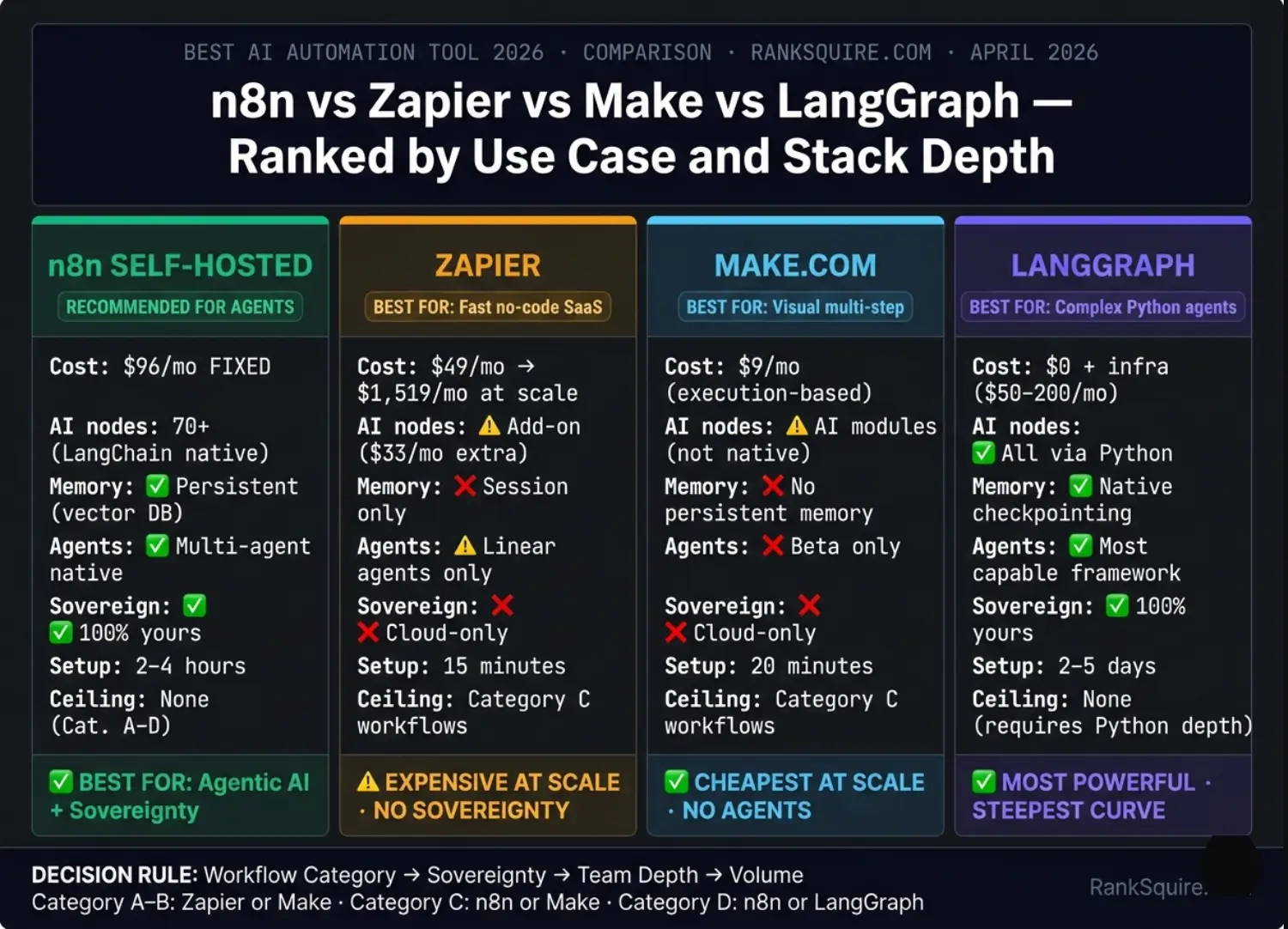
The AI automation tool market in 2026 has fragmented into two distinct categories that share the same brand label. Workflow automation tools (Zapier, Make) have added AI features — LLM API calls, AI-generated content, basic decision routing. Agentic AI platforms (n8n 2.0, LangGraph) have shipped native orchestration with persistent memory, multi-agent coordination, and vector database integration.
The problem: they are all called “AI automation tools.” The pricing pages look similar at entry level. The proposals from vendors all claim “AI-powered automation.” The buyer who selects Zapier for an agentic workflow gets a workflow tool sold as an AI platform — and discovers the limitation 90 days into production.
From evaluating tools by feature checklist to evaluating them by architectural fit: what is the complexity ceiling of this tool, what is the cost at my production volume, what do I own at the end, and what happens when my workflow needs to reason rather than just execute?
A tool selection that matches the workflow complexity, production volume, technical depth, and sovereignty requirements before the first workflow is built — not after the first month-three billing surprise.
Table of Contents

1. The 4 Categories of AI Automation Tools
Workflow Logic Mapping — RankSquire 2026

2. Head-to-Head: n8n vs Zapier vs Make vs LangGraph
Six criteria. Four tools. One verdict per use case.
Self-hosted: $96/month fixed (DigitalOcean 16GB) — zero per-execution cost above the Droplet fee.
3. Pricing at Scale — What It Actually Costs

Verified April 2026 Production Pricing Analysis
Additional tasks: 98,000 × $0.015
Make prices per scenario execution, not per step.
- Make $9 (Cheapest)
- LangGraph $50–200
- n8n Cloud ~$50
- n8n Self-hosted $96 Fixed
- Zapier ~$1,519
The Zapier pricing model is correct for low-volume, simple workflows. It becomes the most expensive option at production AI automation scale.
4. AI Agent Depth — Which Tool Can Actually Build Agents
Production AI Agent Infrastructure — Scoring & Standards
5. Sovereignty and Compliance — Who Owns Your Data

Data Sovereignty Comparison — RankSquire 2026
If data residency is a hard requirement: n8n self-hosted or LangGraph. The choice between them is a function of your team’s technical depth, not the sovereignty posture.
If compliance is managed (SOC 2, GDPR processor): Zapier or Make with appropriate DPA execution and enterprise plan.
6. Decision Matrix — Which Tool for Which Use Case
2026 AI Automation Architectural Decision Protocol
→ Category B (data pipeline): Make or n8n
→ Category C (LLM-powered): n8n, Zapier, or Make
→ Category D (agentic AI): n8n or LangGraph only
→ Data cannot leave your infrastructure: n8n self-hosted or LangGraph only. Zapier and Make are eliminated.
→ Technical team with some Python: n8n (all categories)
→ Strong Python engineering depth: LangGraph (Category D)
→ 2,000–10,000 tasks/month: Make or n8n Cloud
→ Above 10,000 tasks/month: n8n self-hosted ($96/month fixed) or LangGraph (infrastructure cost only)
7. Conclusion
THE ENGINEERING VERDICT: AI AUTOMATION 2026
8. FAQ: Best AI Automation Tool 2026
What is the best AI automation tool in 2026?
The best AI automation tool in 2026 depends on the workflow type and team profile. For agentic AI systems with persistent memory and multi-agent orchestration: n8n self-hosted (70+ AI nodes, LangChain native, $96/month fixed on DigitalOcean).
For fast no-code SaaS integration: Zapier (8,000+ integrations, no DevOps, expensive above 2,000 tasks/month). For visual multi-step workflows at competitive pricing: Make.com (execution-based pricing, 1,500+ integrations, cloud-only). For Python-native multi-agent systems with no complexity ceiling: LangGraph (open source, full sovereignty, requires strong Python depth).
Is n8n better than Zapier for AI automation in 2026?
n8n is better than Zapier for AI automation in 2026 for technical teams building agentic workflows. n8n 2.0 (January 2026) ships native LangChain integration with 70+ AI nodes, persistent agent memory across executions, vector database integration for RAG workflows, and full self-hosted deployment at $96/month fixed.
Zapier has added Zapier Agents and an AI Copilot, but its architecture is linear it does not support multi-agent hierarchies, persistent cross-session memory, or self-hosted sovereign deployment. For non-technical teams needing fast deployment across 8,000+ apps for simple automations: Zapier remains faster to start.
How much does n8n cost compared to Zapier in 2026?
At 10,000 workflow runs per month with a 10-step workflow, n8n self-hosted on DigitalOcean costs $96/month fixed with unlimited executions. Zapier Professional costs $49/month for 2,000 tasks the same 10,000 runs at 10 steps generates 100,000 tasks, requiring the Team plan and additional task purchases for a total of approximately $1,519/month.
Make.com processes the same volume for approximately $9/month because it prices per scenario execution rather than per step.
n8n self-hosted is the most cost-effective option for high-volume AI automation workflows above 2,000 executions per month. See the complete cost comparison at ranksquire.com/2026/02/13/n8n-vs-zapier-enterprise-cost-analysis/
Can Zapier build AI agents in 2026?
Zapier can build basic AI agents via Zapier Agents (a paid add-on starting at $33.33/month billed annually) for task execution across its 8,000+ app integrations. Zapier Agents can execute autonomous tasks and use natural language to operate workflows.
What Zapier cannot do in 2026: build multi-agent hierarchies with an orchestrator directing specialist agents, maintain persistent memory across sessions in a vector database, integrate with self-hosted LLMs via Ollama, or deploy on sovereign self-hosted infrastructure. For production agentic AI systems requiring these capabilities, n8n 2.0 or LangGraph are the architecturally correct choices.
What is LangGraph and when should I use it?
LangGraph is an open source Python library from LangChain for building multi-agent AI systems with explicit state
management. It models agent workflows as directed graphs where nodes represent agents or tools and edges represent conditional routing based on agent outputs.
LangGraph is correct when: the workflow requires the most complex multi-agent coordination possible, the team has strong Python engineering depth, custom infrastructure deployment is acceptable, and no visual workflow interface is required. LangGraph is not correct for: non-technical teams, fast deployment requirements, teams that need pre-built SaaS integrations, or workflows where a visual builder would accelerate development without sacrificing capability.
What AI automation tool is best for sovereign deployment?
For sovereign deployment where data cannot leave controlled infrastructure, n8n self-hosted and LangGraph
are the only architecturally correct options in 2026.
n8n self-hosted on a DigitalOcean 16GB Droplet at $96/month gives you complete infrastructure ownership, GDPR Article 44 compliance on EU regions, zero data passing through third-party orchestration infrastructure, and the full n8n AI agent capability set including LangChain integration, vector database connectivity, and persistent agent memory.
Zapier and Make.com are cloud-only platforms all workflow data passes through their infrastructure regardless of enterprise plan tier.


Comments 1