

EXECUTIVE SUMMARY
- The Problem: Traditional real estate strategy is reactive. You wait for a listing to hit the MLS, or you wait for a lead to fill out a form. By then, you are competing with everyone else.
- The Shift: Sophisticated firms are deploying predictive analytics for real estate. They use historical data and machine learning to identify who will sell before they list, and which neighborhoods will appreciate before prices spike.
- The Imperative: In a zero sum market, the winner is the one who sees the future first. You must move from hindsight reporting to foresight modeling.
Return to the Operations architecture
INTRODUCTION
Most real estate data is an obituary. It tells you what happened last month.
Market Reports are just historical records. While useful for context, they do not give you an edge. An edge comes from knowing what will happen next month.
Predictive analytics for real estate is the discipline of using statistical algorithms and machine learning techniques to identify the likelihood of future outcomes based on historical data. It answers questions like: Which homeowner in this zip code has a >80% probability of selling in the next 90 days?
At RankSquire, we do not guess. We calculate. This guide outlines the architecture of prediction.
Table of Contents
THE FAILURE MODE (THE GUT FEELING)
The Old Way relies on Intuition and Lagging Indicators.
- The Spray and Pray: You farm a neighborhood by mailing postcards to everyone. This is expensive and inefficient because 95% of those people have no intent to sell.
- The Rearview Mirror: You invest in a neighborhood because prices went up last year. But you missed the signal that inventory is now stacking up, indicating a coming crash.
- The Churn Surprise: You lose a top agent to a competitor and are shocked. A predictive model would have flagged their drop in production and engagement 3 months ago.
The Metric of Failure:
Firms without predictive analytics for real estate models waste 60–70% of their marketing budget targeting people who are statistically irrelevant.
( [Real Estate Data Pipeline Automation])
THE ARCHITECTURE (THE PREDICTION ENGINE)
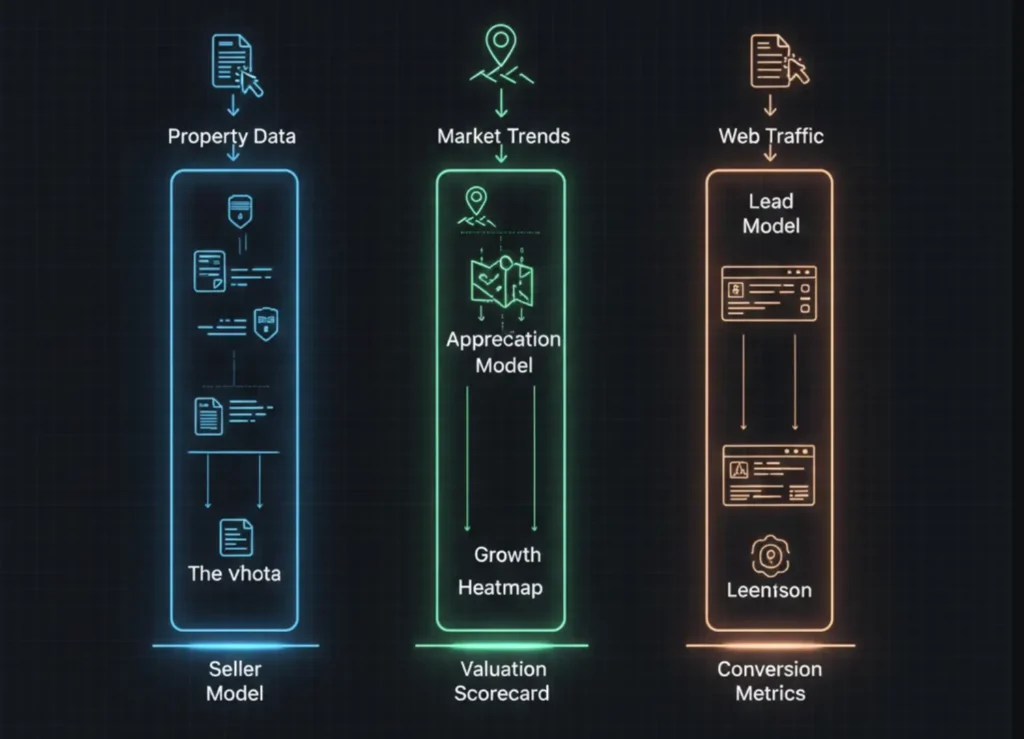
We replace Gut Feeling with Propensity Models.
The 3 Models Every Firm Needs:
1. The Seller Propensity Model (Who)
- Goal: Identify homeowners likely to list.
- Signals: Length of residence (7+ years), sudden increase in mortgage inquiries, divorce filings (public record), change in household size (census data).
- Output: A “Sell Score” (0-100) for every address in your farm. You only market to the top 10%.
2. The Appreciation Model (Where)
- Goal: Identify undervalued neighborhoods.
- Signals: Permit applications renovations, new business licenses, coffee shops opening, crime rate trends, rent-to-price ratios.
- Output: A heat map showing areas with high Alpha potential for above market returns.
3. The Lead Conversion Model (When)
- Goal: Prioritize incoming leads.
- Signals: Speed of response, number of site visits, specific properties viewed (price brackets).
- Output: Lead scoring that tells your ISAs: Call John now; ignore Steve.
THE ECONOMICS (PRECISION VS. VOLUME)

Predictive analytics for real estate changes the economics of customer acquisition by substituting volume with precision.
| Metric | Traditional Farming | Predictive Targeting |
| Audience Size | 10,000 Homes (Entire Zip) | 500 Homes (High Propensity) |
| Cost Per Touch | $0.50 (Postcard) | $5.00 (Handwritten Note/Gift) |
| Total Cost | $5,000 | $2,500 |
| Conversion Rate | 0.1% | 2.0% |
| Deals Generated | 10 | 10 |
| CAC (Cost to Acquire) | $500 | $250 |
The Asset Reality:
The model itself is an asset. As it consumes more data (wins/losses), it gets smarter, creating a Data Moat that competitors cannot replicate without years of history.
([Building Real Estate AI Agents with Python])
THE TECHNICAL STACK

To build a predictive analytics for real estate engine, you need the Data Science Stack:
- The Language: Python. The industry standard for ML.
- The Libraries: Scikit Learn for regression/classification and Pandas for data manipulation.
- The Forecasting Tool: Prophet by Meta. Excellent for predicting time series data like seasonal price trends.
- The Visualization: Tableau or PowerBI. To render the heat maps and scores for your agents.
- The Data Source: Snowflake (Your Warehouse). The model must be fed by the automated pipeline we discussed in the previous guide.
CONCLUSION
The future belongs to the Quant Broker.
While your competitors are reacting to the market news, you are acting on the market math. Predictive analytics for real estate allows you to be there before the decision is made. It allows you to knock on the door the week before the For Sale sign goes up.
You have two choices:
- Wait for the phone to ring.
- Call the person who is about to dial.
Stop guessing. Start modeling.
Return to the Operations architecture
FAQ: OBJECTIONS & RISKS
1. Is predictive analytics for real estate legal?
Yes, as long as you use fair housing compliant data. You cannot use race, religion, or protected classes as variables in your model. We strictly use financial and behavioral signals.
2. How accurate are these models?
No model is 100% accurate. But it doesn’t need to be. It just needs to be better than random. If a model lifts your conversion rate from 1% to 3%, it has tripled your revenue.
3. Do I need a PhD Data Scientist?
For advanced models, yes. But for basic propensity scoring, a sharp Data Analyst using AutoML tools like Google Vertex AI can build a functional prototype in weeks.
FROM THE ARCHITECT’S DESK
I advised a developer looking for land in emerging markets. Instead of driving around, we built an appreciation model using predictive analytics for real estate.
We ingested data on starbucks permits and whole foods permits. The model flagged a specific zip code in Nashville that had high permit activity but low current prices. They bought 20 lots. Two years later, the prices doubled as the retail infrastructure was built. The algorithm saw the gentrification before the market did.
THE ARCHITECT’S CTA
This architecture is deployed when capital allocation must be driven by math, not sentiment.
If your organization is ready to deploy predictive analytics for real estate and gain an unfair information advantage. Stop being a Hustler. Become the Architect.
Every automation I build is bespoke, real, and ready to scale your business. No demos, no templates just results.
Apply to work with me today → Application Form