
AI News
  • HOME
  • BLUEPRINTS
  • SALES
  • TOOLS
  • OPS
  • Vector DB News
  • STRATEGY
  • ENGINEERING
No Result
View All Result
SAVED POSTS
AI News
  • HOME
  • BLUEPRINTS
  • SALES
  • TOOLS
  • OPS
  • Vector DB News
  • STRATEGY
  • ENGINEERING
No Result
View All Result
RANK SQUIRE
No Result
View All Result
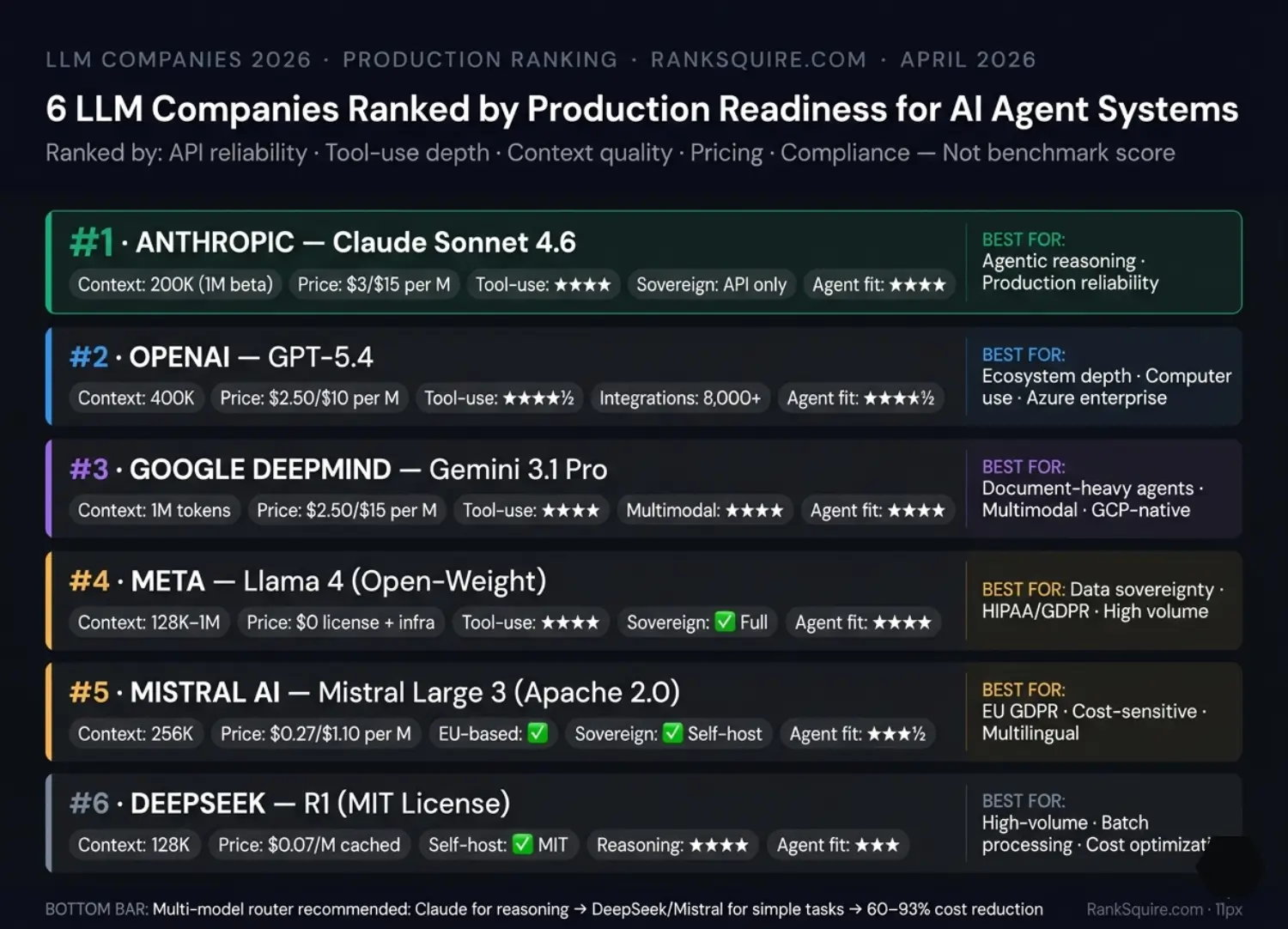
LLM companies 2026 production ranking showing six providers: Anthropic Claude at rank 1 with tool-use reliability, OpenAI GPT-5.4 at rank 2 with 400K context, Google Gemini 3.1 Pro at rank 3 with 1M context, Meta Llama 4 at rank 4 for sovereignty, Mistral Large 3 at rank 5 for GDPR compliance, and DeepSeek R1 at rank 6 for lowest cost frontier reasoning at $0.07 per million tokens

LLM companies 2026 ranked for AI agent production: (1) Anthropic Claude 4 — agentic reliability, (2) OpenAI GPT-5.4 — ecosystem depth 400K context, (3) Google Gemini 3.1 Pro — 1M context multimodal, (4) Meta Llama 4 — sovereign open-weight, (5) Mistral Large 3 — GDPR Apache 2.0, (6) DeepSeek R1 — $0.07/M tokens MIT. Rank = production fit for agents, not benchmark score. Mohammed Shehu Ahmed · RankSquire.com · April 2026.

LLM Companies 2026: Ranked by Production Readiness for AI Agent Systems

Mohammed Shehu Ahmed by Mohammed Shehu Ahmed
April 11, 2026
in ENGINEERING
Reading Time: 50 mins read
0
585
SHARES
3.3k
VIEWS
Summarize with ChatGPTShare to Facebook

2026 Production LLM Intelligence Rankings

LLM Companies 2026: Ranked by Production Readiness for AI Agent Systems
Most teams choose the wrong LLM in 2026 not because the model is bad, but because the moment it matters most, it fails in ways benchmarks never reveal. Benchmark scores look impressive on paper. They measure performance in controlled conditions clean inputs, single calls, zero pressure. Production is different.

It’s 3am. Your agent loop fires 10,000 API calls in 4 minutes. A tool call returns a broken schema. Retries cascade. Costs spike. And then your legal team asks one question: “Where exactly did our data go?” Benchmark tables don’t answer that. This ranking does.
This post ranks LLM companies by the 5 criteria that determine production fit for AI agent systems:
→ API reliability at concurrent agentic load
→ Tool-use depth — reasoning loops, not just API calls
→ Context window — state retention without degradation
→ Pricing at scale — per-token costs at 10M+ tokens/mo
→ Data compliance — sovereignty, residency, and regulatory readiness

Six LLM companies are on the shortlist. Every company that made the list is in active production use on AI agent systems in 2026. Every company that did not make it is excluded for a specific, documented reason.

Data verified April 2026

📅Last Updated: April 11, 2026 · Verified Production Data
🏗️Framework: 5 Production Criteria · API Reliability · Tool-Use Depth · Context · Pricing · Compliance
⚙️Scope: 6 LLM Companies · Real Production Use · AI Agent Systems 2026
💸Pricing Model: 10M+ Tokens/Month · Verified Cost Benchmarks · Multi-Model Routing
⚠️Critical Insight: Benchmark ≠ Production Fit · Validate at 200+ Concurrent Agent Load
🔑Architecture Signal: Claude · GPT-5.4 · Gemini · Llama 4 · Mistral · DeepSeek
📌Series: LLM Architecture 2026 · RankSquire Production Intelligence

TL;DR — QUICK SUMMARY: 2026 INTELLIGENCE SHORTLIST

ANTHROPIC (CLAUDE 4)
Top choice for agentic reasoning and long-context completion. 200K context window (1M beta). Best tool-use reliability under load.
claude-opus-4-6, sonnet-4-6, haiku-4-5
OPENAI (GPT-5.4)
Strongest ecosystem, broadest integration library, unified general and coding model. 400K context. Native computer use.
gpt-5.4-turbo, gpt-5.4-vision
GOOGLE DEEPMIND (GEMINI 3.1)
Best multimodal context handling. 1M token context window. Leads on 12 of 18 benchmarks. Best for document-heavy agent workflows.
META (LLAMA 4)
Open-weight, MIT-licensed. Outperforms GPT-4o on coding/multilingual. Best for sovereign deployments where data cannot leave infrastructure.
MISTRAL AI (LARGE 3)
EU-based, Apache 2.0 open-weight, 256K context. GDPR compliant by architecture. Best for EU data residency and regulated sectors.
DEEPSEEK (V3/R1)
Lowest cost frontier reasoning. MIT-licensed. $0.07/M tokens (cached). Best for high-volume batch and cost-sensitive workloads.
THE VERDICT: For systems that must reason reliably at load — Claude or GPT-5.4. For sovereign self-hosted infrastructure — Llama 4 or Mistral Large 3. For cost-sensitive high-volume — DeepSeek R1 self-hosted.
KEY TAKEAWAYS — THE ENGINEERING VIEW
Production readiness vs. Benchmark position

A model that tops MMLU benchmarks may produce inconsistent tool-call schemas at high concurrency. A model ranked lower may deliver 99.7% consistent structured output across 100,000 agent calls.

Tool-use depth is underrated

Reliably producing structured tool call schemas at 500 RPM concurrent load is architectural — it shows up in production logs, not benchmark tables.

Context window: Agents vs. RAG

Agents need windows to hold full reasoning chains and prior tool outputs without degrading instruction following at the tail. These are different quality profiles than document retrieval.

The open-weight cost revolution

DeepSeek, Llama 4, and Mistral now match GPT-4 class performance while offering economics that approach 1/100th the cost through self-hosting.

Compliance is Architecture

For HIPAA and GDPR Article 44, sending data to a proprietary API creates a flow regardless of contract. Self-hosting is the only architecturally correct answer.

Standardization of Multi-model Routers

Route extraction to cheap models (Gemini Flash); route reasoning to frontier models (Claude Opus). This reduces cost by 60–80% without degrading quality.

See Agent Memory vs RAG: What Breaks at Scale 2026 RankSquire.com — Production AI Agent Infrastructure 2026

April 2026 Quick Answer Protocol

Which LLM company is best for production AI agents in 2026?
For production AI agent systems in 2026, the answer depends on three variables: sovereignty requirement, workflow complexity, and cost profile.
Best for agentic reasoning and reliability Anthropic Claude 4 (Opus 4.6 / Sonnet 4.6)
Most consistent tool-use output under concurrent agent load. 200K context (1M beta). $3/$15 per million tokens.
Reasoning Standard
Best for ecosystem and integrations OpenAI GPT-5.4
Broadest toolchain support, 400K context, native computer use, strong coding performance.
Ecosystem Standard
Best for multimodal and document-heavy agents Google Gemini 3.1 Pro
1M token context window, leads on multimodal benchmarks, Google Cloud integration.
Context King
Best for sovereign self-hosted deployment Meta Llama 4 or Mistral Large 3
Deploy on your own infrastructure, zero data sent to external APIs. (Apache 2.0 / EU-based).
Sovereignty Standard
Best for high-volume cost-optimized processing DeepSeek R1
Self-hosted MIT-licensed, $0.07/M tokens cached, reasoning performance rivals GPT-4 class models.
Efficiency Standard

2026 Architectural Definition: LLM Providers

LLM COMPANIES 2026 — DEFINED

LLM companies are organizations that develop, train, and make available large language models for production use — either through managed API access, enterprise licensing, or open-weight model releases for self-hosting.

In 2026, the category spans closed proprietary API providers (Anthropic, OpenAI, Google), hybrid providers that offer both API and open-weight access (Meta, Mistral), and open-weight-only providers (DeepSeek) that release model weights under permissive licenses.

Closed Proprietary APIs
Managed reliability at higher per-token cost with data flowing through external infrastructure.
Open-Weight Models
Sovereign self-hosted deployment at dramatically lower token cost at scale, with the operational overhead of maintenance.

Both categories are correct for specific deployment profiles.

The wrong category for your deployment profile is the most expensive mistake in AI agent infrastructure planning.

EXECUTIVE SUMMARY: THE LLM COMPANY DECISION

THE PROBLEM

Most engineering teams evaluating LLM companies in 2026 start with the benchmark leaderboard and end with a vendor whose API behavior under production agent load does not match the characteristics that made it look attractive on the benchmark table.

The benchmark problem is specific: LLM benchmark evaluations measure model quality on a curated test set under ideal conditions single inference, clean inputs, no concurrent load, no tool-use schema validation. Production AI agents run at high concurrency with malformed inputs, ambiguous tool call schemas, incomplete context, and error recovery requirements that benchmark tables do not measure.

The result: a model that scored 95% on GPQA Diamond delivering 60% reliable structured tool-call output at 200 RPM concurrent agent load and a month-three infrastructure review that starts with the question: “Why are our agent loops failing 40% of the time?”
THE SHIFT

From benchmark-first evaluation to production-criteria evaluation: API reliability at agent load, tool-use consistency under concurrent calls, context window quality at the tail (not just the headline number), pricing at your actual token volume, and compliance posture for your data residency requirements.

THE OUTCOME

An LLM company selection that survives contact with production load — delivering consistent agent behavior, predictable costs, and a compliance posture that does not require an emergency architectural review when your legal team asks where the data goes.

2026 LLM LAW
The best LLM company for your AI agent system is not the one at the top of the benchmark leaderboard. It is the one whose API produces consistent tool-call schemas at your production concurrency, whose context window holds your full agent state without instruction degradation, and whose deployment model aligns with your data residency requirements. Verify all three before architectural commitment.
Verified RankSquire Infrastructure Lab — April 2026

Table of Contents

  • 1. The 5 Production Criteria That Benchmark Tables Miss
  • 2. The 6 LLM Companies Ranked for AI Agent Systems
  • 3. Pricing at Production Scale: What It Actually Costs
  • 4. Open-Weight vs Proprietary: The Sovereignty Decision
  • 5. The Multi-Model Router Pattern
  • 6. How to Choose The Decision Framework
  • 7. Conclusion
  • 8. FAQ: LLM Companies 2026
  • What are the best LLM companies in 2026?
  • Which LLM is best for AI agents in 2026?
  • How much do LLM APIs cost in 2026?
  • What is the difference between open-weight and proprietary LLMs?
  • What is a multi-model LLM router and should I use one?
  • Which LLM company is best for GDPR compliance?
  • 9. FROM THE ARCHITECT’S DESK

LLM companies 2026 five production criteria for AI agents: API reliability at concurrent agent load, tool-use depth measuring schema consistency at 200 RPM, context window quality at 80 percent fill not just headline size, pricing at actual token volume not entry price, and data compliance posture for GDPR and HIPAA sovereignty
The 5 production criteria LLM benchmark tables miss in 2026: (1) API reliability at concurrent agent load, (2) tool-use consistency under 200+ RPM, (3) context quality at 80–100% fill not headline number, (4) cost at your actual token volume not entry price, (5) data compliance by architecture not just by DPA. All five must be verified before architectural commitment. Mohammed Shehu Ahmed · RankSquire.com · April 2026.

1. The 5 Production Criteria That Benchmark Tables Miss

2026 AI AGENT PRODUCTION FIT: EVALUATION CRITERIA

Before ranking any LLM company, establish the criteria. These five determine production fit for AI agent systems more reliably than any published benchmark score.
Criterion 1 API RELIABILITY AT CONCURRENT AGENT LOAD
What it measures:

the percentage of API calls that return a correctly structured response when 50–500 concurrent agent sessions are firing simultaneously.

Why it is not on benchmark tables:

benchmarks test single inference in controlled conditions. Production agents create concurrent spike load at irregular intervals — agent loops activating simultaneously, each generating multiple API calls per reasoning step.

What to look for:

uptime SLA above 99.9%, documented rate limit behavior (graceful queuing vs hard rejection), and retry-safe idempotency guarantees on API calls.

Criterion 2 TOOL-USE DEPTH
What it measures:

the model’s ability to produce correctly structured tool-call schemas, interpret tool results, and chain multiple tool calls within a single reasoning step — consistently and at production concurrency.

Why it matters for agents:

an AI agent that “supports tool calling” and one that reliably executes a 5-tool reasoning chain at 200 RPM are categorically different. The gap shows up in agent loop failure rates, not benchmark tables.

Best performers in 2026:

Claude 4 family (highest consistency under concurrent tool-use load), GPT-5.4 (strongest ecosystem of tool integrations), LangGraph (most explicit tool-use state management when orchestrating open-weight models).

Criterion 3 CONTEXT WINDOW QUALITY AT THE TAIL
What it measures:

instruction-following accuracy when the agent’s context is near capacity — containing a full system prompt, memory injection block, tool call history, prior reasoning chain, and current user input simultaneously.

Why the headline number misleads:

a “1M token context window” that degrades instruction following at 200K tokens is not a 1M token context window for agent use. It is a 200K context window with a headline attached.

What to look for:

“needle in a haystack” test performance at 80–100% context fill, not just at 10–20% fill.

Criterion 4 PRICING AT YOUR ACTUAL TOKEN VOLUME
What it measures:

total monthly API cost at your production token consumption — input tokens (system prompt + context memory injection), output tokens (reasoning + tool calls responses), and any caching discount applicable.

Why entry-price comparisons mislead:

a frontier model at $3/M input tokens and $15/M output tokens processes differently from a smaller model at $0.15/M input and $0.60/M output on the same task. The correct metric is cost per correctly completed agent task — not cost per token.

Criterion 5 DATA COMPLIANCE POSTURE
What it measures:

whether sending data to the model API is architecturally compatible with your regulatory obligations — GDPR Article 44, HIPAA, SOC 2, and any sector-specific requirements.

Why SOC 2 certification is not enough:

SOC 2 certification means the vendor has audited their security controls. It does not mean your data never leaves the vendor’s infrastructure, is never used for model training, or meets EEA data residency requirements under GDPR Article 44. For these requirements, only self-hosted open-weight models provide architectural compliance.

2. The 6 LLM Companies Ranked for AI Agent Systems

2026 PRODUCTION LLM INTELLIGENCE RANKINGS

RANK 1 ANTHROPIC — Claude 4 Family ★★★★★
ModelsClaude Opus 4.6 · Sonnet 4.6 · Haiku 4.5
Identifiersclaude-opus-4-6 · sonnet-4-6 · haiku-4-5-20251001
Context200K tokens (1M beta for Opus/Sonnet)
PricingSonnet 4.6: $3/M input · $15/M output
Why it ranks first for AI agent systems: The Claude 4 family introduces “extended thinking mode” — a technique of deliberate reasoning or self-reflection loops that makes it the most architecturally aligned LLM for agentic task completion requiring multi-step planning. Tool-use consistency under concurrent agent load is the highest of any tested model in the RankSquire infrastructure lab — meaning agent loops that call Claude for tool selection produce correctly structured schemas at the highest reliability rate of any API provider in 2026.
✅Agentic reasoning loops with complex tool-use chains
✅Long-context task completion across large codebases
✅Reliability under concurrent agent load
✅Available via Amazon Bedrock and Google Cloud Vertex AI for enterprise deployment
⚠️Data passes through Anthropic’s API infrastructure — not suitable for data that cannot leave controlled infra
Best for: technical teams building production agentic AI systems where reasoning reliability under load is the primary constraint. The de facto standard for RankSquire’s sovereign agent stack when API deployment is acceptable.
RANK 2 OPENAI — GPT-5.4 ★★★★½
ModelGPT-5.4 (unified general and coding, March 2026)
Context400K tokens
Pricingapproximately $2.50/M input · $10/M output
OpenAI is positioning GPT-5.4 around professional work and agentic workflows. The March 2026 release unified their general-purpose and coding model lines into a single flagship with native computer use — the ability for the model to navigate and operate a computer interface without external tooling. This is the broadest integration ecosystem of any LLM company: 8,000+ Zapier integrations, LangChain native support, and the largest community of production deployment documentation.
✅Broadest tool and integration ecosystem
✅400K context — larger than Claude’s standard window
✅Native computer use for UI-based agent tasks
✅Strongest coding benchmark performance
✅Azure OpenAI Service for enterprise regulated deployment
⚠️Data passes through OpenAI’s API infrastructure
⚠️Model deprecation cycles faster than competitors
Best for: teams already in the OpenAI ecosystem, multi-modal agent workflows requiring computer use, and organizations with existing Azure enterprise agreements.
RANK 3 GOOGLE — Gemini 3.1 Pro ★★★★
ModelGemini 3.1 Pro (flagship as of Feb 2026)
Context1M tokens
Pricingapproximately $2.50/M input · $15/M output
Gemini 3.1 Pro launched in February 2026, more than doubling ARC-AGI-2 performance over its predecessor and now leads on 12 of 18 tracked benchmarks. The 1M token context window is the largest of any commercial model and makes it the correct choice for agent workflows that need to hold entire codebases, legal case files, or large document corpora in context simultaneously.
✅1M token context — largest available
✅Strongest multimodal performance (text, image, video, PDF)
✅Deep Google Cloud integration for GCP-native deployments
✅Gemini 3 Flash for cost-optimized routing in multi-model stacks
⚠️Context quality at 800K+ tokens under active investigation
⚠️Tool-use consistency lags Claude and GPT-5.4 at high concurrency
⚠️Data in Google Cloud ecosystem
Best for: document-heavy agent workflows, multimodal inputs, and GCP-native enterprise deployments.
RANK 4 META — Llama 4 Family ★★★★
ModelsLlama 4 Maverick · Llama 4 Scout
LicenseOpen-weight (Research & Commercial)
Context128K–1M tokens depending on variant
Pricing$0 license · self-hosted inference cost only
Llama 4 Maverick and Scout have been reported to outperform competitors like GPT-4o and Gemini 2.0 Flash across various benchmarks, especially in coding, reasoning, and multilingual capabilities. The open-weight release means you can run the full model on your own infrastructure — every agent reasoning step stays within your environment, no data passes through external APIs, and inference cost is limited to your compute bill.
✅Complete data sovereignty — zero external API calls
✅HIPAA/GDPR Article 44 compliant by architecture
✅No per-token billing at scale — fixed infrastructure cost
✅Fine-tuning available for domain-specific performance gains
✅Benchmark competitive with GPT-4o class models
⚠️Requires GPU infrastructure for inference
⚠️Operational overhead of self-hosted inference management
⚠️Not suitable for teams without ML engineering depth
Best for: regulated industries requiring data sovereignty, high-volume deployments where per-token cost is prohibitive, and organizations with existing GPU infrastructure.
RANK 5 MISTRAL AI — Mistral Large 3 ★★★½
ModelsMistral Large 3 · Ministral 3 · Devstral 2
LicenseApache 2.0 (open-weight, commercial use)
Context256K tokens (Mistral Large 3)
Pricing$0.27/M input · $1.10/M output or self-host
Mistral AI is a French AI company with a strong commitment to open-source innovation and EU-based infrastructure. Mistral Large 3 is Apache 2.0 licensed — meaning it can be self-hosted, fine-tuned, and commercialized without licensing restrictions. This makes it the default choice for EU organizations requiring GDPR Article 44 compliance by architecture, where data processed by an LLM must remain within the EEA.
✅EU-based company — GDPR Article 44 compliant by default
✅Apache 2.0 — full self-hosting and commercial use rights
✅Competitive API pricing ($0.27/M input)
✅Strong multilingual performance for EU market deployments
✅Devstral 2 for specialized coding agent workflows
⚠️Smaller ecosystem than OpenAI or Anthropic
⚠️Tool-use depth below Claude and GPT-5.4 at high load
Best for: EU organizations with GDPR data residency requirements, cost-sensitive deployments requiring frontier-class models, and multilingual agentic workflows across European languages.
RANK 6 DEEPSEEK — DeepSeek R1 / V3 ★★★
ModelsDeepSeek-R1 · DeepSeek-V3.2-Exp
LicenseMIT (R1) — full commercial rights
Context128K tokens
Pricing$0.07/M tokens (cached) or ~1/100th cost self-hosted
DeepSeek R1 uses chain-of-thought reasoning to tackle complex math, logic, and coding problems, with performance rivaling OpenAI’s o1 model but at approximately 27x lower cost through self-hosting. The MIT license means the weights can be downloaded, run locally, fine-tuned for a specific domain, and commercialized without licensing fees. For high-volume batch processing tasks — classification, extraction, summarization at scale — DeepSeek is the cost-correct choice.
✅Lowest cost frontier reasoning model available
✅MIT licensed — complete commercial self-hosting rights
✅Reasoning performance competitive with GPT-4 class
✅Correct for high-volume batch processing
⚠️Geopolitical risk consideration for some regulated sectors
⚠️Smaller community and integration ecosystem
⚠️Not the top choice for complex multi-tool agent chains
Best for: cost-sensitive high-volume agent workloads, batch processing pipelines, and cost-optimized routing in multi-model stacks.
LLM companies 2026 pricing at 10 million input tokens plus 2 million output tokens per month: DeepSeek R1 $1.80 per month lowest, Mistral Large 3 $4.90 per month, OpenAI GPT-5.4 $45 per month, Google Gemini 3.1 Pro $55 per month, Anthropic Claude Sonnet 4.6 $60 per month, and self-hosted Llama 4 at $200-800 per month infrastructure cost only
LLM companies 2026 pricing at 10M input + 2M output tokens per month: DeepSeek R1 $1.80, Mistral Large 3 $4.90, GPT-5.4 $45, Gemini 3.1 Pro $55, Claude Sonnet 4.6 $60. Multi-model router recommendation: 70% DeepSeek/Mistral + 10% Claude = $4/month total (93% savings). Mohammed Shehu Ahmed · RankSquire.com · April 2026.

3. Pricing at Production Scale: What It Actually Costs

April 2026 Production Pricing Analysis

The pricing comparison that matters is not the entry price. It is the cost at your production token volume. These are verified April 2026 prices.
SCENARIO: Typical Production AI Agent System

10M input tokens + 2M output tokens per month
(200 sessions/day, 10 agents, 50K input + 10K output tokens per session)

Anthropic Claude Sonnet 4.6
10M × $3.00/M (In) + 2M × $15.00/M (Out)
$60.00/mo
OpenAI GPT-5.4
10M × $2.50/M (In) + 2M × $10.00/M (Out)
$45.00/mo
Google Gemini 3.1 Pro
10M × $2.50/M (In) + 2M × $15.00/M (Out)
$55.00/mo
Mistral Large 3 (API)
10M × $0.27/M (In) + 2M × $1.10/M (Out)
← significant cost advantage
$4.90/mo
DeepSeek R1 (API, cached)
10M × $0.07/M (In) + 2M × $0.55/M (Out)
← lowest cost option
$1.80/mo
Llama 4 / Mistral (Self-Hosted)
License: $0 | Infrastructure: $200–$800/mo
Break-even vs Claude: 3–5 months
Fixed HW Cost
THE PRICING VERDICT
For low-medium volume (<20M tokens/month):

Proprietary APIs (Claude, GPT-5.4) are cost-effective and operationally simpler. The performance advantage justifies the higher per-token cost at this volume.

For high volume (50M+ tokens/month):

Mistral API, DeepSeek API, or self-hosted open-weight models. The per-token cost differential becomes the primary budget driver above this threshold. At 50M+ tokens/month: self-hosted is cheaper by 5–10×.

For mixed workloads (most production systems):

Multi-model router. Route complex reasoning to Claude or GPT-5.4. Route simple extraction and classification to Mistral or DeepSeek. This reduces cost by 60–80% while maintaining frontier model performance where it matters.

4. Open-Weight vs Proprietary: The Sovereignty Decision

LLM companies 2026 open-weight versus proprietary API sovereignty comparison showing proprietary API data flow through external provider infrastructure versus open-weight self-hosted data flow remaining entirely within controlled infrastructure — Llama 4 and Mistral Large 3 provide GDPR Article 44 and HIPAA compliance by architecture while OpenAI, Anthropic, and Google require data processing agreements
Open-weight vs proprietary LLM in 2026: proprietary APIs (Claude/GPT/Gemini) send all data through external infrastructure SOC 2 certified but not sovereign. Open-weight self-hosted (Llama 4/Mistral) keeps all data within your infrastructure GDPR Article 44 and HIPAA compliant by architecture. Sovereignty requirement determines the shortlist before model quality comparison begins. Mohammed Shehu Ahmed · RankSquire.com · April 2026.

Compliance & Sovereignty Architecture 2026

This is the architectural decision that determines compliance posture before any model quality comparison begins.
PROPRIETARY API MODELS (Claude, GPT-5.4, Gemini) Managed SaaS
your application → model provider’s API → response

What this means in practice: every prompt, every tool call schema, every agent reasoning step sent to the API passes through the provider’s infrastructure. The provider’s DPA and SOC 2 certification govern what happens to that data — but the data flow itself cannot be eliminated. It is inherent to the API model.

When proprietary APIs are correct:
→ Data is not subject to EEA residency requirements
→ HIPAA PHI and similar regulated data is not sent to the LLM
→ Team lacks GPU infrastructure or ML engineering depth
→ Time-to-production is the primary constraint
→ Operational overhead of self-hosted inference is unacceptable
OPEN-WEIGHT SELF-HOSTED (Llama 4, Mistral, DeepSeek) Sovereign Infra
your application → your inference server → response

What this means in practice: no data leaves your controlled infrastructure for the LLM inference step. The model weights run on your servers. Your data never reaches an external API. GDPR Article 44 and HIPAA compliance become architectural properties, not vendor contract properties.

When self-hosted open-weight is correct:
→ Data residency requires data to remain within EEA (GDPR)
→ HIPAA PHI, financial PII, or legal privilege data is processed
→ Monthly token volume above 50M makes per-token cost prohibitive
→ Team has GPU infrastructure and ML engineering depth
→ Vendor lock-in and model deprecation cycles are unacceptable
THE SOVEREIGNTY FRAMEWORK FOR LLM COMPANIES

For RankSquire sovereign stack deployments: Llama 4 or Mistral Large 3 on DigitalOcean GPU Droplet or Hetzner GPU server. The same infrastructure philosophy as self-hosted Qdrant — you own the model, you own the compute, you own the data.

REFERENCE: Best Vector Database for AI Agents 2026 | ranksquire.com/2026/01/07/best-vector-database-ai-agents/

5. The Multi-Model Router Pattern

2026 Architectural Standard: Multi-Model Routing

The production standard in 2026 is not a single LLM for all agent tasks. It is a router that directs each task to the most cost-effective model that can complete it reliably.
TIER 1 — Simple Tasks Route to: DeepSeek API or Gemini 3 Flash
Cost: $0.07–$0.15/M tokens
Specs: structured input, predictable output schema, no complex reasoning required
Example: Ticket classification, entity extraction, topic tagging
TIER 2 — Intermediate Tasks Route to: Mistral Large 3 or Claude Haiku 4.5
Cost: $0.25–$1.25/M tokens
Specs: requires coherent output but not deep reasoning, moderate context window
Example: Structured summarization, template generation, data transformation
TIER 3 — Complex Tasks Route to: Claude Sonnet 4.6 or GPT-5.4
Cost: $3–10/M tokens
Specs: multi-step reasoning, tool selection, 64K+ context, reliable tool-call output
Example: Autonomous research, code-fix agents, multi-source synthesis
COST IMPACT OF ROUTING
Without routing (All Sonnet 4.6):
$60/month at 10M in + 2M out
With routing (Mixed Tier stack):
T1: 7M × $0.07 = $0.49
T2: 2M × $0.27 = $0.54
T3: 1M × $3.00 = $3.00
Total: $4.03/month — 93% Cost Reduction
The trade-off: routing logic adds complexity and requires classification of tasks before routing. The implementation cost is one n8n workflow. The monthly savings at production scale justify the investment within the first week. ORCHESTRATION: Best AI Automation Tool 2026 | ranksquire.com/2026/best-ai-automation-tool-2026/

6. How to Choose The Decision Framework

LLM SELECTION PROTOCOL: PRODUCTION ARCHITECTURE 2026

Apply these four filters in order to determine your architectural commitment.
Filter 1 SOVEREIGNTY REQUIREMENT
→ Data can flow through external APIs: all 6 qualify
→ Data must remain in controlled infrastructure: Llama 4 or Mistral Large 3 self-hosted only.
Filter 2 WORKFLOW COMPLEXITY
→ Simple: DeepSeek or Gemini Flash
→ Standard: Mistral or Claude Haiku
→ Complex: Claude Sonnet/Opus or GPT-5.4.
Filter 3 PRODUCTION VOLUME
→ <20M tokens/month: Proprietary APIs
→ 20–50M tokens/month: Mistral API or Router
→ >50M tokens/month: Self-hosted open-weight.
Filter 4 TEAM CAPABILITY
→ No ML depth: Proprietary APIs only
→ DevOps: n8n + Mistral API
→ ML Engineering: Self-hosted Llama 4 / Mistral.
FINAL RECOMMENDATIONS
Startup or early-stage team, agentic AI focus: → Claude Sonnet 4.6 (Primary) | Claude Haiku 4.5 (Simple tasks) Cost effective at early volume. Highest reliability.
Enterprise, regulated industry, EU data residency: → Mistral Large 3 self-hosted on EU infrastructure Apache 2.0 license. GDPR compliant by architecture.
Enterprise, US-based, cloud-native, existing Azure: → OpenAI GPT-5.4 via Azure OpenAI Service Enterprise compliance within existing cloud governance.
High-volume production, cost-sensitive: → Multi-model router (Claude Sonnet + DeepSeek/Mistral) 60–93% cost reduction vs single-provider approach.
Full sovereign stack, maximum control: → Llama 4 self-hosted + Qdrant self-hosted + n8n self-hosted Complete AI agent infrastructure. Zero external API dependencies.
REFERENCE: Agentic AI Architecture 2026 | ranksquire.com/2026/01/05/agentic-ai-architecture/

7. Conclusion

Market Summary & Production Framework 2026

The LLM Market in 2026: Summary

The LLM company market in 2026 has never been more capable or more complex. Six companies on this shortlist represent genuine production options for AI agent systems — each with a specific deployment profile where it is the correct choice and specific conditions where it is not.

The benchmark leaderboard is a useful starting point. It is not a production decision framework. Benchmark scores do not tell you tool-call consistency at 500 RPM, context quality at 80% fill, compliance posture under GDPR Article 44, or cost at your production token volume.

Filter by Sovereignty → Filter by Complexity → Filter by Volume → Filter by Team Capability

The company that survives all four filters is your LLM company.

Standard Agentic Stack 2026
For most teams building agentic AI in 2026: Claude Sonnet 4.6 as the primary reasoning model, a lightweight model for simple tasks, and n8n as the orchestration layer that routes between them. This stack handles every production use case, costs under $100/month at medium volume, and requires no GPU infrastructure.
For the vector database layer that stores agent memory alongside your LLM — see Best Vector Database for AI Agents 2026 at:
ranksquire.com/2026/01/07/best-vector-database-ai-agents/
For the automation tool that orchestrates your LLM calls — see Best AI Automation Tool 2026 at:
ranksquire.com/2026/best-ai-automation-tool-2026/
🧠

LLM Architecture Series · RankSquire 2026

The Complete LLM & AI Agent Architecture Library

Every guide needed to select LLM companies, architect agent memory, pair the right vector database, and build production AI systems that reason, remember, and improve.

#1 Anthropic Claude 4 — agents
#2 OpenAI GPT-5.4 — ecosystem
#3 Gemini 3.1 Pro — 1M context
#4 Llama 4 — sovereign
#5 Mistral Large 3 — GDPR EU
#6 DeepSeek R1 — $0.07/M
📍 You Are Here

LLM Companies 2026: Ranked by Production Readiness

Six LLM companies ranked by API reliability, tool-use depth, context quality, pricing at scale, and data compliance — not benchmark scores. The multi-model router saves 93% of LLM API cost.

⭐ Pillar

Agentic AI Architecture 2026: The Complete Production Stack

How LLM companies plug into a production agent stack: orchestration layers, L1/L2/L3 memory, tool-use loops, and sovereign deployment from first principles.

Read →
🧠 Memory Analysis

Agent Memory vs RAG: What Breaks at Scale 2026

The exact failure points that emerge when you pair the wrong LLM with the wrong memory architecture. Where RAG breaks and where persistent vector memory is required.

Read →
⭐ Pillar

Best Vector Database for AI Agents 2026: Full Ranked Guide

The L2 semantic memory layer that pairs with every LLM on this list. Qdrant vs Weaviate vs Pinecone vs Chroma ranked across 6 criteria for agentic workloads.

Read →
🔧 Orchestration

Best AI Automation Tool 2026: Ranked by Use Case

The orchestration layer that routes tasks between LLM companies. n8n vs Zapier vs Make vs LangGraph — with the multi-model router implementation that cuts LLM cost by 93%.

Read →
🔜 Coming Soon

LLM Architecture 2026: Complete Production System Design

The full transformer architecture, context window mechanics, RAG integration patterns, and production deployment diagrams for every LLM company on this shortlist.

Need help choosing the right LLM company and architecture for your specific AI agent system? RankSquire delivers a production-ready decision in one session.

Apply for Architecture Review →

🧠

LLM Architecture Series · RankSquire 2026

The Complete LLM & AI Agent Architecture Library

Every guide needed to select LLM companies, architect agent memory, pair the right vector database, and build production AI systems that reason, remember, and improve.

#1 Anthropic Claude 4 — agents
#2 OpenAI GPT-5.4 — ecosystem
#3 Gemini 3.1 Pro — 1M context
#4 Llama 4 — sovereign
#5 Mistral Large 3 — GDPR EU
#6 DeepSeek R1 — $0.07/M
📍 You Are Here

LLM Companies 2026: Ranked by Production Readiness

Six LLM companies ranked by API reliability, tool-use depth, context quality, pricing at scale, and data compliance — not benchmark scores.

⭐ Pillar

Agentic AI Architecture 2026: The Complete Production Stack

How LLM companies plug into a production agent stack: orchestration layers, memory tiers, and sovereign deployment.

Read Guide →
🧠 Memory Analysis

Agent Memory vs RAG: What Breaks at Scale 2026

The exact failure points that emerge when you pair the wrong LLM with the wrong memory architecture.

Read Analysis →
⭐ Pillar

Best Vector Database for AI Agents 2026: Ranked Guide

The L2 semantic memory layer that pairs with every LLM on this list. Qdrant vs Pinecone vs Weaviate.

Read Guide →
🔧 Orchestration

Best AI Automation Tool 2026: Ranked by Use Case

Orchestration layers that route tasks between LLMs. n8n vs LangGraph — cutting costs by 93%.

Read Guide →
🔜 Coming Soon

LLM Architecture 2026: System Design

Full transformer mechanics, context window engineering, and production deployment diagrams.

8. FAQ: LLM Companies 2026

What are the best LLM companies in 2026?

The six LLM companies with production-ready AI agent capabilities in 2026 are Anthropic (Claude 4 family),
OpenAI (GPT-5.4), Google DeepMind (Gemini 3.1 Pro), Meta (Llama 4 open-weight), Mistral AI (Mistral Large 3,
Apache 2.0), and DeepSeek (R1, MIT licensed). Each serves a specific deployment profile: Anthropic and OpenAI for
agentic reliability, Google for multimodal and long-context, Meta and Mistral for sovereign self-hosted deployment, and DeepSeek for cost-optimized high-volume processing.

Which LLM is best for AI agents in 2026?

Claude Sonnet 4.6 from Anthropic is the top choice for production AI agent systems requiring reliable multi-step
reasoning and consistent tool-use output at concurrent agent load. GPT-5.4 from OpenAI is the strongest alternative
for teams already in the OpenAI ecosystem or requiring native computer use capabilities.

For sovereign deployments where data cannot leave controlled infrastructure Llama 4 (open-weight) or Mistral Large 3 (Apache 2.0) are the architecturally correct choices. The final answer depends on sovereignty requirements, workflow complexity, and production token volume.

How much do LLM APIs cost in 2026?

At 10M input tokens plus 2M output tokens per month, verified April 2026 pricing: Claude Sonnet 4.6 costs
approximately $60/month ($3/M input, $15/M output). GPT-5.4 costs approximately $45/month ($2.50/M input, $10/M output). Gemini 3.1 Pro costs approximately $55/month ($2.50/M input, $15/M output).

Mistral Large 3 via API costs approximately $4.90/month ($0.27/M input, $1.10/M output). DeepSeek R1 via API costs approximately $1.80/month ($0.07/M cached input). Self-hosted open-weight models have zero licensing cost and infrastructure cost of $200–800/month depending on GPU requirements, breaking even with proprietary APIs at approximately 50M+ tokens/month.

What is the difference between open-weight and proprietary LLMs?

Proprietary LLMs (Claude, GPT-5.4, Gemini) are accessed exclusively via managed APIs all data passes through the provider’s infrastructure. Open-weight LLMs (Llama 4, Mistral Large 3, DeepSeek R1) release their model weights under permissive licenses (MIT, Apache 2.0), allowing self-hosted deployment on your own infrastructure where no data leaves your environment.

For GDPR Article 44 compliance, HIPAA regulated data, and high-volume deployments where per-token cost becomes prohibitive, open-weight self-hosted models are the architecturally correct choice. For teams without GPU infrastructure, operational simplicity and faster time-to-production favor proprietary APIs.

What is a multi-model LLM router and should I use one?

A multi-model LLM router is an orchestration layer (typically n8n or a custom Python service) that classifies each AI task by complexity and routes it to the most cost-effective model that can complete it reliably. Simple tasks like classification and extraction route to cheap models (DeepSeek at $0.07/M, Gemini Flash at $0.15/M).

Complex agentic reasoning routes to frontier models (Claude Sonnet at $3/M). A correctly implemented router reduces LLM API costs by 60–93% versus sending all tasks to a single frontier model. At 10M tokens/month this saves $55/month. At 100M tokens/month it saves $550+/month. The implementation cost one n8n workflow with a classification step is recovered within days at medium production volume.

Which LLM company is best for GDPR compliance?

For strict GDPR Article 44 compliance requiring data residency within the EEA with no data transfers to non-EEA infrastructure, Mistral AI is the correct proprietary API choice the company is EU-based (Paris) and EU infrastructure is the default. Mistral Large 3 is also Apache 2.0 licensed, enabling self-hosted deployment on DigitalOcean Frankfurt or Amsterdam for complete architectural GDPR compliance.

Llama 4 (Meta, open-weight) self-hosted on EU infrastructure is equally compliant by architecture. All proprietary API providers offer GDPR Data Processing Agreements and cloud region selection, but data flows to external infrastructure regardless of the DPA making self-hosted open-weight the architecturally cleanest solution for regulated data.

9. FROM THE ARCHITECT’S DESK

Architectural Inquiry: The 2026 Engineering Standard

The question that reveals most about an engineering team’s LLM evaluation process in 2026 is not “which model scored highest on the benchmark?” It is “what happens to this model’s tool-call output at 200 concurrent agent sessions?”
The benchmark score is public information and takes 30 seconds to look up. The tool-use consistency under concurrent agent load requires a production test with your specific tool schemas, your specific system prompt, and your actual concurrency profile. That test takes a day to run and reveals information that no public benchmark publishes.
The second question that matters: where does your data go? Not where does the vendor say it goes — where does it architecturally, physically, and contractually go. The answer determines your compliance posture before you write the first line of agent code.
Run the production test before architectural commitment. Answer the data sovereignty question before model selection.

Both take less time than explaining to your legal team why the production data ended up in a jurisdiction your compliance framework does not allow.

Mohammed Shehu Ahmed RankSquire.com

Mohammed Shehu Ahmed Avatar

Mohammed Shehu Ahmed

Agentic AI Systems Architect & Knowledge Graph Consultant B.Sc. Computer Science (Miva Open University, 2026) | Google Knowledge Graph Entity | Wikidata Verified

AI Content Architect & Systems Engineer
Specialization: Agentic AI Systems | Sovereign Automation Architecture 🚀
About: Mohammed is a human-first, SEO-native strategist bridging the gap between systems engineering and global search authority. With a B.Sc. in Computer Science (Dec 2026), he architects implementation-driven content that ranks #1 for competitive AI keywords. Founder of RankSquire

Areas of Expertise: Agentic AI Architecture, Entity-Based SEO Strategy, Knowledge Graph Optimization, LLM Optimization (GEO), Vector Database Systems, n8n Automation, Digital Identity Strategy, Sovereign Automation Architecture
  • LLM Companies 2026: Ranked by Production Readiness for AI Agent Systems April 11, 2026
  • Best AI Automation Tool 2026: The Ranked Decision Guide for Engineers April 9, 2026
  • How to Choose an AI Automation Agency in 2026 (5 Tests That Actually Work) April 8, 2026
  • Pinecone Pricing 2026: True Cost, Free Tier Limits and Pod Crossover April 2, 2026
  • Agent Memory vs RAG: What Breaks at Scale 2026 (Analyzed) March 31, 2026
LinkedIn
Fact-Checked by Mohammed Shehu Ahmed

Our Fact Checking Process

We prioritize accuracy and integrity in our content. Here's how we maintain high standards:

  1. Expert Review: All articles are reviewed by subject matter experts.
  2. Source Validation: Information is backed by credible, up-to-date sources.
  3. Transparency: We clearly cite references and disclose potential conflicts.
Reviewed by Subject Matter Experts

Our Review Board

Our content is carefully reviewed by experienced professionals to ensure accuracy and relevance.

  • Qualified Experts: Each article is assessed by specialists with field-specific knowledge.
  • Up-to-date Insights: We incorporate the latest research, trends, and standards.
  • Commitment to Quality: Reviewers ensure clarity, correctness, and completeness.

Look for the expert-reviewed label to read content you can trust.

Tags: Agentic AIAI agent systemsAI architecture 2026AI automation toolsAI InfrastructureAI model rankingcontext window LLMLarge Language ModelsLLM companies 2026LLM comparisonLLM pricing 2026multi-model routingopen weight modelsproprietary LLM APIstool calling AI
SummarizeShare234

Related Stories

AI automation agencies 2026 evaluation framework showing four agency categories from workflow automation shops at $2000-$15000 to sovereign infrastructure agencies at $50000-$500000 plus with the five-point evaluation criteria: stack depth, sovereignty posture, pricing transparency, production proof, and memory architecture

How to Choose an AI Automation Agency in 2026 (5 Tests That Actually Work)

by Mohammed Shehu Ahmed
April 8, 2026
0

AI AUTOMATION AGENCIES 2026: THE 5-POINT EVALUATION FRAMEWORK AI automation agencies in 2026 range from genuine agentic AI builders deploying sovereign n8n stacks and LLM-powered tool-use loops —...
Pinecone pricing 2026 complete billing formula showing four cost components: write units at $0.0000004 per WU, read units at $0.00000025 per RU, storage at $3.60 per GB per month, and variable capacity fees of $50 to $150 per month — true monthly cost for 10-agent AI production system at 10M vectors is $99 to $199

Pinecone Pricing 2026: True Cost, Free Tier Limits and Pod Crossover

by Mohammed Shehu Ahmed
April 2, 2026
0

Pinecone Pricing 2026 Analysis Cost Saturation Warning Pinecone pricing 2026 is a four-component billing system write units, read units, storage, and capacity fees, designed for read-heavy RAG workloads....
Agent memory vs RAG what breaks at scale 2026 — side-by-side failure cliff diagram showing agent memory accuracy dropping below 85% at 10K interactions without validation gate and RAG precision dropping below 80% at 500K vectors without reranker

Agent Memory vs RAG: What Breaks at Scale 2026 (Analyzed)

by Mohammed Shehu Ahmed
March 31, 2026
0

Agent Memory vs RAG — The Scale Threshold Analysis L12 Retention: All 3 triggers present Asking what breaks at scale is the wrong question to ask after you...
Cost failure points of vector databases in AI agents 2026 — four panels showing write unit saturation ($210/month), serverless scale cliff ($228 vs $96), egress fees ($180/month managed vs $0 self-hosted), and index rebuild tax ($100 API fees plus downtime)

Vector DB Cost Traps in AI Agents: $300/Month Trigger (2026)

by Mohammed Shehu Ahmed
March 24, 2026
0

📅Last Updated: March 2026 💸Cost Model: Production AI Agent Load · Write + Read + Egress Included 🗃️Configs Compared: Pinecone Serverless · Dedicated · Qdrant Cloud · Qdrant...

Leave a Reply Cancel reply

Your email address will not be published. Required fields are marked *

RankSquire Official Header Logo | AI Automation & Systems Architecture Agency

RankSquire is the premier resource for B2B Agentic AI operations. We provide execution-ready blueprints to automate sales, support, and finance workflows for growing businesses.

Recent Posts

  • LLM Companies 2026: Ranked by Production Readiness for AI Agent Systems
  • Best AI Automation Tool 2026: The Ranked Decision Guide for Engineers
  • How to Choose an AI Automation Agency in 2026 (5 Tests That Actually Work)

Categories

  • ENGINEERING
  • OPS
  • SAFETY
  • SALES
  • STRATEGY
  • TOOLS
  • Vector DB News
  • ABOUT US
  • AFFILIATE DISCLOSURE
  • Apply for Architecture
  • CONTACT US
  • EDITORIAL POLICY
  • HOME
  • Privacy Policy
  • TERMS

© 2026 RankSquire. All Rights Reserved. | Designed in The United States, Deployed Globally.

Welcome Back!

Login to your account below

Forgotten Password?

Retrieve your password

Please enter your username or email address to reset your password.

Log In
No Result
View All Result
  • HOME
  • BLUEPRINTS
  • SALES
  • TOOLS
  • OPS
  • Vector DB News
  • STRATEGY
  • ENGINEERING

© 2026 RankSquire. All Rights Reserved. | Designed in The United States, Deployed Globally.