
AI News
  • HOME
  • BLUEPRINTS
  • SALES
  • TOOLS
  • OPS
  • Vector DB News
  • STRATEGY
  • ENGINEERING
No Result
View All Result
SAVED POSTS
AI News
  • HOME
  • BLUEPRINTS
  • SALES
  • TOOLS
  • OPS
  • Vector DB News
  • STRATEGY
  • ENGINEERING
No Result
View All Result
RANK SQUIRE
No Result
View All Result
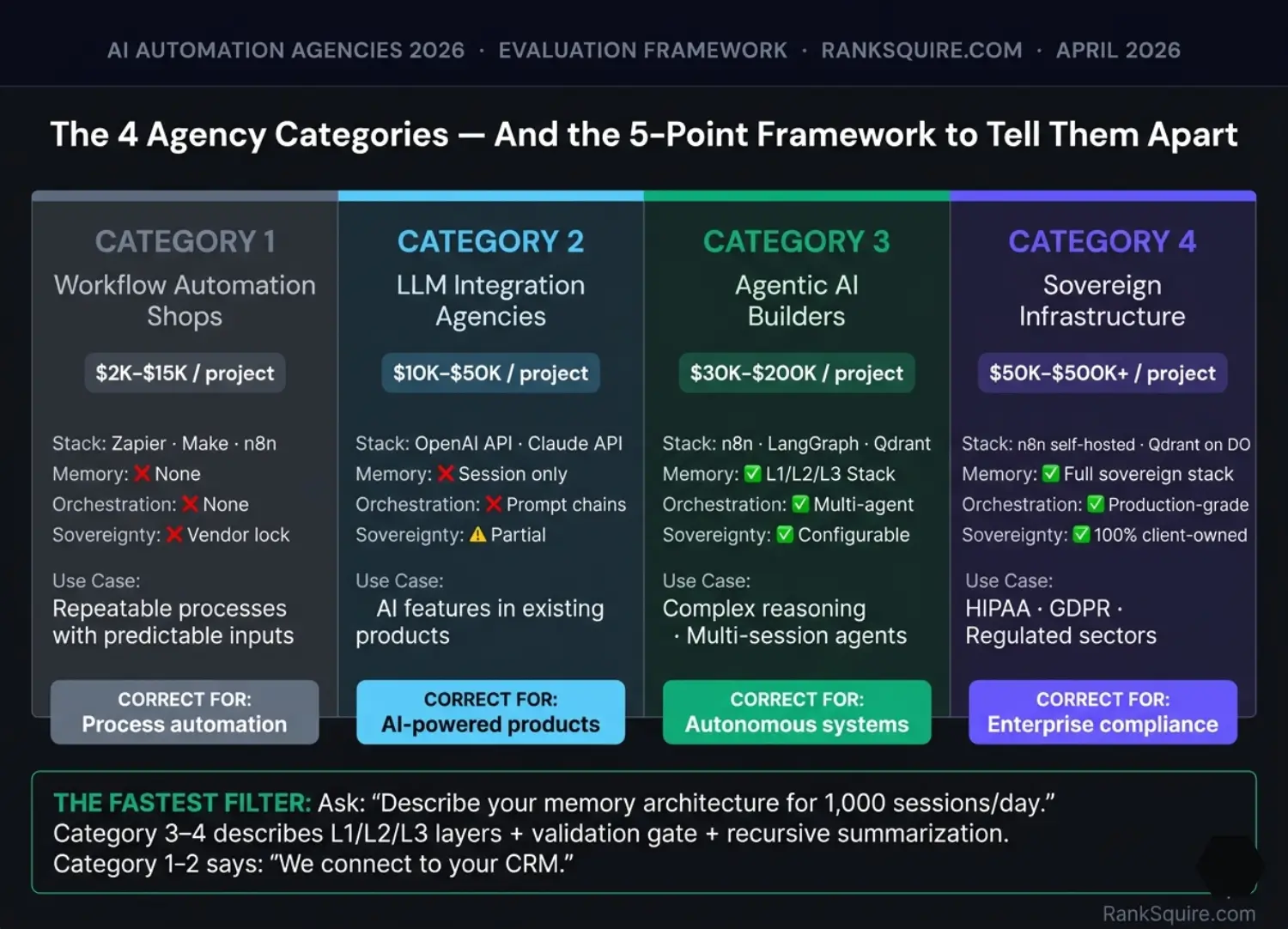
AI automation agencies 2026 evaluation framework showing four agency categories from workflow automation shops at $2000-$15000 to sovereign infrastructure agencies at $50000-$500000 plus with the five-point evaluation criteria: stack depth, sovereignty posture, pricing transparency, production proof, and memory architecture

AI automation agencies 2026: four categories — workflow shops ($2K–$15K), LLM integrators ($10K–$50K), agentic AI builders ($30K–$200K), and sovereign infrastructure agencies ($50K–$500K+). The 5-point evaluation framework identifies which category an agency actually operates in versus what they claim. Mohammed Shehu Ahmed · RankSquire.com · April 2026.

How to Choose an AI Automation Agency in 2026 (5 Tests That Actually Work)

Mohammed Shehu Ahmed by Mohammed Shehu Ahmed
April 8, 2026
in ENGINEERING
Reading Time: 46 mins read
0
587
SHARES
3.3k
VIEWS
Summarize with ChatGPTShare to Facebook

AI AUTOMATION AGENCIES 2026: THE 5-POINT EVALUATION FRAMEWORK

AI automation agencies in 2026 range from genuine agentic AI builders deploying sovereign n8n stacks and LLM-powered tool-use loops — to workflow resellers charging enterprise rates for Zapier templates renamed as “AI solutions.”
Genuine Builders
Sovereign n8n stacks, LLM-powered tool-use loops, and complex agentic architectures.
Workflow Resellers
Zapier templates and rigid automation rebranded as “Enterprise AI Solutions.”
The difference is not obvious from a proposal deck. It becomes obvious from 5 specific questions — and most buyers never ask them before signing.

THE COMPLETE EVALUATION FRAMEWORK

This post gives you the complete evaluation framework:
→
The 5 criteria that separate real AI automation agencies from glorified workflow shops — with specific signals to verify in each
→
The 4 red flags that appear in 80% of agency proposals that turn into failed deployments
→
The questions to ask before signing any engagement
→
The agency categories: what each type builds and who each type is correct for
→
When to hire an agency versus build internally — the decision threshold with specific cost calculations
→
How to structure the engagement to protect your stack and your data sovereignty
No generic advice. Production-verified criteria from architecture reviews. Verified April 2026

📅Last Updated: April 2026 · Verified Architecture Lab
🏗️Framework: 5-Point Evaluation · 4 Red Flags · 10 Due Diligence Questions
💸Agency Range: $2K–$500K+ · Category 1–4 Taxonomy · Project-Based Pricing Only
⚠️Red Flag Threshold: Managed stack >$300/month → migrate to self-hosted n8n · ROI in 60 days
🔑Stack Signal: n8n · LangGraph · Qdrant · Redis · DigitalOcean $96/mo fixed
📌Series: Agentic AI Infrastructure · RankSquire Master Content Engine v3.0

TL;DR — QUICK SUMMARY

→
AI automation agencies in 2026 fall into 4 categories: workflow automation shops (Zapier/Make resellers), LLM integration agencies (API wrappers), agentic AI builders (full orchestration stack), and sovereign infrastructure agencies (self-hosted + compliance-ready). Only the last two produce systems that compound over time.
→
The 5 evaluation criteria are: technical stack depth, sovereignty posture, pricing model transparency, proof of production (not demos), and post-delivery support architecture. All 5 must pass. One failure = wrong agency.
→
The 4 red flags that predict failed engagements: no mention of n8n or self-hosted infrastructure, demo-only proof of work, per-seat licensing at scale, and no discussion of memory or agent state management.
→
The build-vs-hire threshold: when the required automation can be described in fewer than 10 workflow steps, build internally. When it requires multi-agent orchestration, LLM reasoning loops, or vector memory — hire a specialist agency or build a dedicated internal team.
→
The correct engagement structure: output-based milestones, sovereignty clause (you own the infrastructure), and a 90-day handover with documentation before the agency exits.
Internal Architecture Review Agentic AI Architecture 2026 ranksquire.com/2026/01/05/agentic-ai-architecture/

KEY TAKEAWAYS

→
Most AI automation agencies in 2026 are workflow automation agencies with an AI rebrand. The distinction matters because workflow automation solves execution problems. Agentic AI solves reasoning problems. They require different stacks, different architects, and different engagement structures.
→
The fastest way to verify a real AI automation agency: ask them to describe their memory architecture. A Zapier shop cannot answer this. A real agentic AI builder will describe L1/L2/L3 memory layers, validation gates, and recursive summarization without prompting.
→
Sovereignty is the hidden criterion most buyers skip. An agency that deploys your automation on managed cloud platforms with per-seat licensing has created a dependency, not a solution. When they raise prices or shut down, your operations go with them.
→
The correct pricing model is project-based with milestone gates — not retainer-first. A retainer before delivery proof means you are funding the agency’s learning curve on your stack.
The $300/month signal applies here too: if your current automation stack costs more than $300/month in managed tooling fees, a sovereign self-hosted architecture (n8n on DigitalOcean, $96/month fixed) pays back the agency engagement cost within 60 days of delivery.
RankSquire.com — Production AI Infrastructure 2026

QUICK ANSWER: WHAT ARE AI AUTOMATION AGENCIES?

AI automation agencies are firms that design, build, and deploy automated systems using AI tools — ranging from simple workflow connectors to multi-agent orchestration stacks. In 2026, the market is split between agencies that produce genuine AI-powered systems and those that deliver workflow templates rebranded as AI.

The 5-point framework to choose correctly:

01
Stack depth — do they build with n8n, LangGraph, or custom agent orchestration? Or only with Zapier/Make?
02
Sovereignty posture — do you own the infrastructure or are you locked into their managed platform?
03
Pricing transparency — do they price per output (project-based) or per seat (dependency-based)?
04
Production proof — can they show systems running at production scale, not just demos?
05
Memory and state — can they describe how their agent systems remember and improve over time?
Enterprise Analysis n8n vs Zapier Enterprise Cost Analysis

ranksquire.com/2026/02/13/n8n-vs-zapier-enterprise-cost-analysis/

AI AUTOMATION AGENCIES — DEFINED

AI automation agencies are professional service firms that design, build, and deploy AI-powered automation systems for businesses. In 2026, this definition covers a wide spectrum.
Entry Level Firms deploying Zapier workflows with ChatGPT API calls.
Agentic Tier Full systems with multi-agent orchestration, vector memory, and sovereign self-hosted infrastructure.
The definition matters because the spectrum is wide, the price points overlap, and the proposal language is indistinguishable without technical due diligence. An agency may build systems that run autonomously and improve over time — or systems that break the moment a workflow step changes and require constant human intervention.
This framework closes the gap between what agencies claim and what they actually deliver.

EXECUTIVE SUMMARY: THE AI AUTOMATION AGENCY PROBLEM

The Problem
The AI automation agency market in 2026 is in a gold rush phase. Every month, hundreds of new agencies launch with AI branding, proposal decks citing GPT-4o and Claude, and portfolios of demos that have never been stress-tested at production load. Buyers — CTOs, operations leaders, and founders — cannot tell from the proposal which category they are dealing with.

The result: engagements that deliver workflow templates at consulting rates, systems that collapse under concurrent load, infrastructure that the buyer does not own, and dependency on the agency’s managed platform with increasing annual fee escalation.
The Shift

From evaluating agencies by proposal language to evaluating them by technical stack, sovereignty posture, and memory architecture. These require specific questions and specific answers.

The Outcome

An engagement that builds systems you own, on infrastructure you control, with documentation that allows your internal team to maintain the system after the agency exits.

2026 Agency Law: An AI automation agency that cannot describe your memory architecture, your data residency, and your exit strategy before the engagement starts is not an agentic AI builder. It is a workflow shop with updated branding. Verify all three before signing.
Verified RankSquire Architecture Lab — April 2026

Table of Contents

  • 1. The 4 Categories of AI Automation Agencies
  • 2. The 5-Point Evaluation Framework
  • 3. The 4 Red Flags That Predict Failed Engagements
  • 4. The Questions to Ask Before Signing
  • 5. Recommended Tools — What Real Agencies Use
  • 5. Build vs Hire: The Decision Threshold
  • 6. How to Structure the Engagement
  • 7. Conclusion
  • 8. FAQ: AI Automation Agencies 2026
  • What do AI automation agencies actually do?
  • How much do AI automation agencies charge?
  • What is the difference between an AI automationagency and a workflow automation agency?
  • How do I know if an AI automation agency is real?
  • Should I hire an AI automation agency or build internally?
  • What should an AI automation agency contract include?
  • FROM THE ARCHITECT’S DESK

AI automation agencies 2026 evaluation framework showing four agency categories from workflow automation shops at $2000-$15000 to sovereign infrastructure agencies at $50000-$500000 plus with the five-point evaluation criteria: stack depth, sovereignty posture, pricing transparency, production proof, and memory architecture
AI automation agencies 2026: four categories — workflow shops ($2K–$15K), LLM integrators ($10K–$50K), agentic AI builders ($30K–$200K), and sovereign infrastructure agencies ($50K–$500K+). The 5-point evaluation framework identifies which category an agency actually operates in versus what they claim. Mohammed Shehu Ahmed · RankSquire.com · April 2026.

1. The 4 Categories of AI Automation Agencies

THE AGENCY TAXONOMY: 4 CATEGORIES OF AUTOMATION

Not all AI automation agencies build the same thing. Before evaluating any agency, identify which category they operate in because the right category depends entirely on the problem you are solving.
Category 1: Workflow Automation Shops $2,000–$15,000
What they build: Zapier, Make.com, or n8n workflows connecting existing SaaS tools. Triggers, actions, and conditions. No LLM reasoning. No agent memory. No orchestration layer.
Who they are correct for: businesses that need specific, repeatable process automation with predictable inputs and outputs. CRM updates, email routing, form processing, data sync between tools.
Who they are NOT correct for: businesses that need systems to reason, decide, remember, or improve. A Zapier workflow cannot handle ambiguous inputs. It cannot adapt to changing conditions without a human rewriting the workflow.
Red flag: calling Zapier workflows “AI automation.”
Category 2: LLM Integration Agencies $10,000–$50,000
What they build: applications that call LLM APIs (OpenAI, Anthropic, Google) to process text, generate content, or classify inputs. Basic prompt engineering. No persistent memory. No agent orchestration.
Who they are correct for: businesses building AI-powered features into existing products customer support classification, document summarization, content generation pipelines with human review gates.
Who they are NOT correct for: businesses that need autonomous agents running without constant human oversight, multi-session continuity, or real-time decision-making.
Red flag: demos that only work with curated inputs.
Category 3: Agentic AI Builders $30,000–$200,000+
What they build: multi-agent systems with orchestration layers (n8n, LangGraph, AutoGen, custom), tool-use loops, persistent vector memory (Qdrant, Pinecone), and validation gates. These systems reason, act, and improve over time.
Who they are correct for: businesses automating complex, multi-step workflows that require reasoning, context from prior interactions, and adaptive behavior. Sales research, support escalation, and any workflow that requires senior human judgment.
Correct indicator: they ask about your data residency before they discuss features.
Category 4: Sovereign Infrastructure Agencies $50,000–$500,000+
What they build: everything in Category 3 plus full self-hosted deployment on your own infrastructure (DigitalOcean, AWS, GCP, on-premise). You own every component. GDPR, HIPAA, and SOC 2 compliance by architecture.
Who they are correct for: enterprises in regulated industries, businesses with data residency requirements, and organizations where losing access to a vendor’s managed platform would be catastrophic.
Correct indicator: they recommend n8n self-hosted, Qdrant on your infrastructure, and an exit strategy before the engagement begins.
RankSquire operates as a Category 4 architecture consultancy — building sovereign AI infrastructure that clients own, operate, and extend independently.

AI automation agencies 2026 five-point evaluation framework showing criteria: stack depth with orchestration layer question, sovereignty posture with infrastructure ownership question, pricing transparency with milestone versus retainer model, production proof requiring 90-day live systems, and memory architecture with L1 L2 L3 stack description requirement
The 5-point AI automation agency evaluation framework for 2026: (1) stack depth — what orchestration and memory system? (2) sovereignty — what do you own at engagement end? (3) pricing — milestone-based or retainer-first? (4) production proof — 90-day live system or demos only? (5) memory architecture — L1/L2/L3 or session-only? All 5 must pass. One failure = wrong agency. Mohammed Shehu Ahmed · RankSquire.com · April 2026.

2. The 5-Point Evaluation Framework

THE 5-POINT AGENCY EVALUATION FRAMEWORK

Run every agency through all five points. A failure on any single point is not a negotiation it is a signal to move to the next candidate.

Point 1

Technical Stack Depth

What to ask: “Walk me through the last production system you built. What orchestration layer did you use? What is the memory architecture? How does the system handle failure?”
Real Answer “We used n8n for orchestration with a custom Python executor layer. Memory is Qdrant with HNSW indexing — L1 Redis for working memory, L2 Qdrant for semantic retrieval, L3 episodic log in Pinecone. Failure handling uses a dead-letter queue with n8n error workflows.”
Red Flag “We use the latest AI tools including GPT-4 and Claude. We have built over 50 automations for clients across industries.”

The red flag answer describes tools, not architecture.
Point 2

Sovereignty Posture

What to ask: “At the end of this engagement, what do I own? What requires your continued involvement to operate? What happens if I want to move everything to my own infrastructure in 12 months?”
Real Answer “You own everything from day one. The n8n instance is on your DigitalOcean account. The Qdrant collection is on your server. Migration is a non-event because there is nothing to migrate — it is already yours.”
Red Flag “We manage everything on our platform for a monthly fee. You get full access to the dashboard and we handle the technical maintenance.”

This is dependency with a dashboard on top.
Point 3

Pricing Model Transparency

What to ask: “How do you price this engagement? What are the payment milestones? What constitutes delivery at each milestone?”
The correct pricing model: project-based with milestone gates tied to specific deliverables. Payment releases when you verify the deliverable.
Red Flags • Retainer-first pricing before any deliverable is specified.
• Per-seat licensing for the tools they deploy.
Point 4

Proof of Production

What to ask: “Can you show me a system you built that has been running at production load for more than 90 days? What does the monitoring look like? What failure modes have appeared?”
Why 90 days: Week 4 is demo quality. Month 3 is when edge cases and load spikes produce the failures that separate robust systems from fragile ones.
Red Flag “We have delivered over 100 AI automation projects” with no specific architecture to reference and no monitoring evidence.
Point 5

Memory and State Architecture

What to ask: “How does your agent system remember information from previous sessions? How does it handle contradicting information? How does it prevent memory pollution at scale?”
Real Answer “We implement a three-layer memory stack. L1 Redis working memory, L2 Qdrant semantic retrieval with validation gates, L3 episodic log. Above 10K interactions, we use recursive summarization.”
Red Flag “The AI remembers the conversation context within a session. For longer-term memory, we can connect it to your CRM.”

They are building stateless tools, not intelligent agents.
AI automation agencies 2026 four red flags predicting failed engagements: no mention of self-hosted infrastructure showing vendor dependency, demo-only proof of work without 90-day production evidence, per-seat licensing creating recurring dependency, and no discussion of agent state management indicating stateless automation not real AI agents
The 4 red flags that predict AI automation agency failures in 2026: (1) no self-hosted infrastructure discussion — vendor lock incoming, (2) demo-only portfolio — no production proof, (3) per-seat licensing at scale — dependency not solution, (4) no memory/state discussion — stateless automation sold as AI agents. All four are visible before signing. Mohammed Shehu Ahmed · RankSquire.com · April 2026.

3. The 4 Red Flags That Predict Failed Engagements

4 RED FLAGS IN AI AUTOMATION ENGAGEMENTS

These four signals appear in the majority of AI automation engagements that end in scope creep, cost overruns, or systems that require constant manual intervention to function.

Red Flag 1 Infrastructure
No Mention of Self-Hosted Infrastructure: Any agency building agentic AI systems in 2026 has an opinion about managed cloud versus self-hosted infrastructure. If that opinion is not stated in the first conversation, the agency does not have one.
The correct opinion: “We recommend self-hosted for production systems above $300/month managed cost. Here is why and here is what that looks like.”
The absence of this opinion means: the agency defaults to managed platforms because it is easier for them, not because it is correct for you.
Red Flag 2 Proof of Work
Demo-Only Proof of Work: A demo proves the system works with curated inputs in a controlled environment. It proves nothing about production behavior under real load, unexpected data, and concurrent usage.

If an agency cannot provide: a reference system that has been running for 90+ days at production scale, monitoring dashboards showing real load, and at least one documented failure with resolution — then their portfolio is a collection of demos, not deployed systems.
Red Flag 3 Pricing Model
Per-Seat Licensing at Scale: The pricing model reveals the business model. An agency that charges per seat per month for the automation tools they deploy has built a recurring revenue model for themselves, not a solution for you.

Calculate: if their per-seat fee at your current team size exceeds $300/month, compare this against the cost of n8n self-hosted on DigitalOcean ($96/month fixed, zero per-seat fees, complete ownership). n8n vs Zapier Enterprise Cost Analysis ranksquire.com/2026/02/13/n8n-vs-zapier-enterprise-cost-analysis/
Red Flag 4 State Management
No Discussion of Agent State Management: Agents that do not manage state are not agents — they are API chains. If the agency proposal does not discuss how the system handles:
  • State persistence between sessions
  • Contradicting inputs from different sources
  • Error recovery without human intervention
  • Memory growth management over thousands of sessions
…then the system is a stateless automation that requires a human to reset it. This is a prompt wrapper with an enterprise price tag.

4. The Questions to Ask Before Signing

DUE DILIGENCE: THE 30-MINUTE COMPETENCE TEST

These 10 questions reveal category and competence in 30 minutes. Ask all 10. Record the answers.
Do not proceed without satisfactory responses to Points 1, 2, and 5 of the evaluation framework.
Technical Questions
Q1 “What orchestration layer do you use and why? What are its failure modes?”
Q2 “Describe your memory architecture for a system that processes 1,000 sessions per day.”
Q3 “How do you handle agent failures at 3am without waking someone up?”
Q4 “What is your approach to data residency and compliance for regulated-sector clients?”
Q5 “Walk me through the monitoring stack for a system you have in production right now.”
Commercial Questions
Q6 “What do I own at the end of this engagement? What requires your continued involvement?”
Q7 “How are milestones and payment releases structured? What constitutes delivery?”
Q8 “What does your 90-day handover look like? What documentation do I receive?”
Q9 “What happens to my system if your company is acquired or shuts down in 24 months?”
Q10 “Can you provide a reference contact from a system that has been in production for more than 90 days?”

AI automation agencies 2026 production tool stack showing three layers: orchestration layer with n8n self-hosted at $96 per month on DigitalOcean and LangGraph for complex agents, memory layer with Qdrant L2 semantic at 26-35ms and Redis L1 under 1ms, and LLM integration with Claude 3.5 Sonnet and GPT-4o ranked by agent task performance
The production tool stack real AI automation agencies use in 2026: orchestration (n8n self-hosted $96/month DO, LangGraph for complex agents), memory (Redis L1 <1ms + Qdrant L2 26–35ms p99 + Pinecone L3), LLM (Claude 3.5 Sonnet for reasoning, GPT-4o for multimodal), infrastructure (DigitalOcean 16GB $96/month fixed). Agencies using Zapier + ChatGPT API are building Category 1 automations. Mohammed Shehu Ahmed · RankSquire.com · April 2026.

5. Recommended Tools — What Real Agencies Use

2026 PRODUCTION TOOL STACK STANDARDS

The tool stack is the fastest technical signal. Real agentic AI agencies in 2026 have converged on a specific set of tools because they have been tested at production scale and support sovereignty.

Orchestration Layer
n8n (self-hosted) Cost: $96/month on DigitalOcean 16GB Droplet
The production standard for sovereign AI automation. Visual workflow builder with full Python/JavaScript code nodes, error handling, and self-hosted instances that live entirely on your infrastructure. Why agencies choose it: clients own the instance and can extend the system after handover.
LangGraph
For complex multi-agent orchestration requiring explicit state management and conditional routing. Python-native. Steeper learning curve — correct for teams with engineering depth.
Custom Orchestration (Python)
For production systems where visual layers add overhead or logic is too complex for visual tools. Requires strong in-house engineering.
Memory and Vector Storage
Qdrant (self-hosted) Cost: Included in Droplet
The L2 semantic memory standard. HNSW indexing, 26–35ms p99 retrieval latency, and complete ownership. No per-query billing.
Redis / Pinecone Serverless
Redis: L1 working memory. Sub-1ms reads. Pinecone: L3 episodic log. Note: above $300/month managed billing, migrate to self-hosted Qdrant.
View: Pinecone Pricing 2026
LLM Integration Layer
Claude 3.5/3.7 Sonnet (Anthropic): Primary LLM for reasoning-heavy workloads. Strongest tool-use support.

GPT-4o (OpenAI): Strong for multimodal tasks. Higher cost at scale than Claude.

Self-hosted (Ollama, vLLM): For sovereign deployments. Llama 3, Mistral, and Mixtral are the 2026 candidates.
Deployment Infrastructure
DigitalOcean: 16GB Droplet at $96/month handles n8n, Qdrant, and Redis. GDPR compliant (Frankfurt/Amsterdam).

AWS / GCP / Azure: For enterprises requiring HIPAA, FedRAMP, or SOC 2 Type II certifications.
WHAT AGENCIES NOT USING THESE TOOLS ARE BUILDING
• Zapier + OpenAI API = workflow automation (Category 1–2)
• Make.com + Claude = workflow automation (Category 1–2)
• Retool + GPT-4o = internal tool builder (not agentic AI)
• HubSpot AI + Zapier = CRM automation (not AI agents)

None of these are wrong choices for the right problems. They are wrong choices presented as agentic AI. The distinction is the orchestration, memory, and sovereignty architecture — not the LLM brand.

5. Build vs Hire: The Decision Threshold

HIRE VS. BUILD: THE DECISION FRAMEWORK

The decision to hire an AI automation agency versus build internally depends on three variables: the complexity of the orchestration, the engineering depth of your internal team, and the timeline pressure on delivery.
Hire an Agency When:
  • The automation requires multi-agent orchestration with more than 3 concurrent agent types
  • The system requires persistent memory and learning across thousands of sessions
  • Your internal team has no experience with n8n, LangGraph, or vector database implementation
  • The timeline requires production delivery in under 90 days for a system of significant complexity
  • Compliance requirements (HIPAA, GDPR, SOC 2) need to be built into the architecture from day one
Build Internally When:
  • The automation is fewer than 10 workflow steps with predictable inputs and outputs
  • Your engineering team has Python and API experience and 2–4 weeks of dedicated capacity
  • The system does not require agent memory, reasoning loops, or adaptive behavior
  • Budget for the agency engagement would exceed the internal build cost by more than 3×

The Cost Calculation:

Variable Estimated Production Cost
Agency Engagement (Category 3) $50K–$150K
Internal Engineering Time 3–6 months × 1–2 engineers
Infrastructure (Sovereign Stack) $96–$300/month
LLM API (Production Load) $200–$2,000/month
Total Year 1 Internal $150K–$400K (Fully Loaded)

For most mid-size organizations: hiring a Category 3–4 agency for the initial build and then handing over to an internal team is cheaper than a full internal build for complex agentic AI systems. For simple workflow automation: build internally using n8n on DigitalOcean.

Deployment Blueprint Self-Hosted n8n Guide

ranksquire.com/2026/01/09/self-hosted-n8n-guide/

6. How to Structure the Engagement

THE SOVEREIGN ENGAGEMENT STRUCTURE

The engagement structure protects you regardless of which agency you hire. These three clauses belong in every AI automation agency contract.

Clause 1: Sovereignty Clause
“All infrastructure, credentials, API keys, workflow configurations, vector database collections, and documentation produced during this engagement are the exclusive property of [CLIENT] and shall be transferred to CLIENT-owned accounts before final payment is released.”

Without this clause: the agency retains control of infrastructure components as leverage for future retainer negotiations.

Clause 2: Milestone-Based Payment Gates
20% Architecture Design

Approved by client CTO. Payment on document delivery and approval.

30% Staging Verified

Core loops functional and verified by client engineering team.

30% Load Test Pass

Production deployment passing 2× expected peak concurrency.

20% Observation & Handover

30-day period complete, documentation delivered, team trained.

Clause 3: 90-Day Handover Protocol

The engagement is complete only when:

  • Your internal team can operate the system without agency involvement for 30 consecutive days
  • All architecture documentation is delivered in a format your engineers can maintain
  • All failure modes encountered during deployment are documented with resolution procedures
  • A runbook exists for the 5 most likely system failures at production load

7. Conclusion

SUMMARY: THE 2026 AGENCY GAP

AI automation agencies in 2026 are not created equal. The market has a small number of genuine agentic AI builders and a large number of workflow automation shops operating under AI branding. The evaluation framework in this post — 5 points, 4 red flags, 10 questions — closes the gap between what agencies claim and what they deliver.
The Fastest Filter Ask about the memory architecture. An agency that cannot describe L1, L2, and L3 memory layers, validation gates, and recursive summarization is not building agents. It is building automations. Both have value — but they are not the same product.
Infrastucture Review Best Vector Database for AI Agents 2026 ranksquire.com/2026/01/07/best-vector-database-ai-agents/ Technical Blueprint Agentic AI Architecture 2026 ranksquire.com/2026/01/05/agentic-ai-architecture/ Direct Review The Architecture Build ranksquire.com/apply-for-architecture/

⚙️

AI AUTOMATION SERIES · RANKSQUIRE 2026

The Complete AI Automation Library: Every guide you need to evaluate, build, and deploy sovereign agentic stacks.
📍 You Are Here

AI Automation Agencies: How to Choose the Right One

The 5-point evaluation framework for CTOs. Red flags and contract clauses that protect your stack.

🔧 Tool Comparison

Best AI Automation Tool 2026: Ranked

n8n vs Zapier vs Make vs LangGraph — ranked by AI agent depth and sovereignty.

Read Guide →
💸 Cost Analysis

n8n vs Zapier Cost Analysis 2026

The exact cost at scale. Why Zapier costs 15× more than self-hosted n8n.

Read Guide →
⭐ Pillar Post

Agentic AI Architecture: The Complete Stack

Orchestration, memory, and tool-use loops from first principles.

Read Guide →

Need an architecture review? RankSquire tells you exactly what to build and who to hire.

Apply for Review

8. FAQ: AI Automation Agencies 2026

What do AI automation agencies actually do?

AI automation agencies in 2026 design, build, and
deploy automated systems using AI tools, LLMs, and
agent orchestration frameworks. The spectrum is wide:
from connecting SaaS tools with Zapier and adding
an OpenAI API call, to building full multi-agent
systems with persistent vector memory, sovereign
self-hosted infrastructure, and adaptive reasoning
loops.

The term “AI automation agency” covers all
of these categories which is why the 5-point
evaluation framework matters. What a specific agency
actually builds is determined by their technical
stack, sovereignty posture, and ability to describe
their memory architecture. Not by their proposal deck.

How much do AI automation agencies charge?

AI automation agency pricing in 2026 ranges from
$2,000 per project for simple workflow automation
to $500,000+ for enterprise agentic AI deployments
on sovereign infrastructure. Category 1 workflow
shops: $2,000–$15,000. Category 2 LLM integration:
$10,000–$50,000. Category 3 agentic AI builders:
$30,000–$200,000.

Category 4 sovereign infrastructure
agencies: $50,000–$500,000+. The pricing model matters
as much as the total cost: project-based milestone
pricing protects the buyer. Retainer-first and
per-seat licensing models protect the agency.

What is the difference between an AI automation
agency and a workflow automation agency?

The distinction is architectural, not cosmetic.
A workflow automation agency connects existing
tools using trigger-action sequences Zapier,
Make.com, and n8n without agent orchestration.
These systems execute fixed processes with
predictable inputs.

An AI automation agency
builds systems that reason, decide, remember,
and adapt using LLM reasoning loops, multi-agent
orchestration, and persistent vector memory. The
output of a workflow automation agency is a
process. The output of a real AI automation
agency is an agent that improves over time.

How do I know if an AI automation agency is real?

Ask one question: “Describe your memory architecture
for a system that processes 1,000 sessions per day.”
A real agentic AI agency will describe L1 working
memory (Redis), L2 semantic vector memory (Qdrant),
L3 episodic log, validation gates, and recursive
summarization.

A workflow automation agency will
describe storing conversation history in a database
or connecting to your CRM. The answer takes under
2 minutes to give. If the agency cannot give it,
they are not building what they are selling.

Should I hire an AI automation agency or build internally?

Hire an agency when the system requires multi-agent
orchestration, persistent memory across thousands
of sessions, or compliance-grade sovereign infrastructure
and your internal team lacks this specific experience.

Build internally when the automation is fewer than
10 workflow steps with predictable inputs, your
engineering team has Python and API experience,
and 2–4 weeks of dedicated capacity is available.

For complex agentic AI systems, the agency build
plus internal handover is typically faster and
cheaper in Year 1 than a full internal build because the agency brings production-tested
architecture that would take an internal team
3–6 months to develop from scratch.

What should an AI automation agency contract include?

Every AI automation agency contract should contain
three non-negotiable clauses: a sovereignty clause
(all infrastructure and configurations are client
property, transferred before final payment), a
milestone-based payment structure (tied to verified
deliverables, not agency timelines), and a 90-day
handover protocol (system documentation, internal
team training, and 30 consecutive days of
independent client operation before the engagement
is considered complete).

Without these three
clauses, the agency has no contractual incentive
to produce a system your team can maintain and
extend independently.

FROM THE ARCHITECT’S DESK

CLOSING THOUGHT: ARCHITECTS VS. RESELLERS

The most consistent pattern I see when companies bring me their AI automation agency proposals in 2026 is the same one: technically impressive language, minimal technical specificity, and pricing that assumes the client will not ask the hard questions.
The memory architecture question kills the fake agencies immediately. Not because it is obscure — it is the most fundamental architectural decision in any agentic AI system.
But because an agency that has never actually built an agent system with persistent memory cannot fake a specific answer to a specific question. “We use the latest AI tools” is not an answer to “describe your L1/L2/L3 memory stack and how you prevent memory pollution above 10K interactions.”

Ask the question. Listen to the answer. The response in the first 30 seconds tells you everything about whether you are talking to an architect or a reseller.
— Mohammed Shehu Ahmed RankSquire Production Architecture Lab RankSquire.com

AFFILIATE DISCLOSURE

This post contains affiliate links. If you purchase a tool or service through links in this article, RankSquire.com may earn a commission at no additional cost to you. We only reference tools evaluated in production architectures.

Mohammed Shehu Ahmed Avatar

Mohammed Shehu Ahmed

Agentic AI Systems Architect & Knowledge Graph Consultant B.Sc. Computer Science (Miva Open University, 2026) | Google Knowledge Graph Entity | Wikidata Verified

AI Content Architect & Systems Engineer
Specialization: Agentic AI Systems | Sovereign Automation Architecture 🚀
About: Mohammed is a human-first, SEO-native strategist bridging the gap between systems engineering and global search authority. With a B.Sc. in Computer Science (Dec 2026), he architects implementation-driven content that ranks #1 for competitive AI keywords. Founder of RankSquire

Areas of Expertise: Agentic AI Architecture, Entity-Based SEO Strategy, Knowledge Graph Optimization, LLM Optimization (GEO), Vector Database Systems, n8n Automation, Digital Identity Strategy, Sovereign Automation Architecture
  • Best AI Automation Tool 2026: The Ranked Decision Guide for Engineers April 9, 2026
  • How to Choose an AI Automation Agency in 2026 (5 Tests That Actually Work) April 8, 2026
  • Pinecone Pricing 2026: True Cost, Free Tier Limits and Pod Crossover April 2, 2026
  • Agent Memory vs RAG: What Breaks at Scale 2026 (Analyzed) March 31, 2026
  • Vector Database News March 2026 March 26, 2026
LinkedIn
Fact-Checked by Mohammed Shehu Ahmed

Our Fact Checking Process

We prioritize accuracy and integrity in our content. Here's how we maintain high standards:

  1. Expert Review: All articles are reviewed by subject matter experts.
  2. Source Validation: Information is backed by credible, up-to-date sources.
  3. Transparency: We clearly cite references and disclose potential conflicts.
Reviewed by Subject Matter Experts

Our Review Board

Our content is carefully reviewed by experienced professionals to ensure accuracy and relevance.

  • Qualified Experts: Each article is assessed by specialists with field-specific knowledge.
  • Up-to-date Insights: We incorporate the latest research, trends, and standards.
  • Commitment to Quality: Reviewers ensure clarity, correctness, and completeness.

Look for the expert-reviewed label to read content you can trust.

Tags: agentic ai automationai automation agencies 2026ai automation agencyai automation tools 2026best ai automation agencyhow to choose ai automation agencyn8n automation agencyRankSquireworkflow automation agency
SummarizeShare235

Related Stories

Pinecone pricing 2026 complete billing formula showing four cost components: write units at $0.0000004 per WU, read units at $0.00000025 per RU, storage at $3.60 per GB per month, and variable capacity fees of $50 to $150 per month — true monthly cost for 10-agent AI production system at 10M vectors is $99 to $199

Pinecone Pricing 2026: True Cost, Free Tier Limits and Pod Crossover

by Mohammed Shehu Ahmed
April 2, 2026
0

Pinecone Pricing 2026 Analysis Cost Saturation Warning Pinecone pricing 2026 is a four-component billing system write units, read units, storage, and capacity fees, designed for read-heavy RAG workloads....

Agent memory vs RAG what breaks at scale 2026 — side-by-side failure cliff diagram showing agent memory accuracy dropping below 85% at 10K interactions without validation gate and RAG precision dropping below 80% at 500K vectors without reranker

Agent Memory vs RAG: What Breaks at Scale 2026 (Analyzed)

by Mohammed Shehu Ahmed
March 31, 2026
0

Agent Memory vs RAG — The Scale Threshold Analysis L12 Retention: All 3 triggers present Asking what breaks at scale is the wrong question to ask after you...

Cost failure points of vector databases in AI agents 2026 — four panels showing write unit saturation ($210/month), serverless scale cliff ($228 vs $96), egress fees ($180/month managed vs $0 self-hosted), and index rebuild tax ($100 API fees plus downtime)

Vector DB Cost Traps in AI Agents: $300/Month Trigger (2026)

by Mohammed Shehu Ahmed
March 24, 2026
0

📅Last Updated: March 2026 💸Cost Model: Production AI Agent Load · Write + Read + Egress Included 🗃️Configs Compared: Pinecone Serverless · Dedicated · Qdrant Cloud · Qdrant...

Choosing a vector DB for multi-agent systems 2026 — Qdrant vs Weaviate vs Pinecone vs Chroma benchmark comparison showing p99 latency, concurrent write throughput, namespace isolation, and cost under 10-agent concurrent load

Choosing a Vector DB for Multi-Agent Systems 2026 (Benchmarked)

by Mohammed Shehu Ahmed
March 20, 2026
0

  📅Last Updated: March 2026   🔬Benchmarks: DigitalOcean 16GB · 10 Concurrent Agents · March 2026   🗃️DBs Evaluated: Qdrant · Weaviate · Pinecone Serverless · Chroma  ...

Next Post
Best AI automation tool 2026 comparison of four tools: n8n self-hosted at $96 per month fixed with 70 plus AI nodes and full sovereignty, Zapier at $1519 per month at scale with 8000 integrations, Make at $9 per month execution-based with 1500 integrations, and LangGraph open source Python-native for complex multi-agent systems

Best AI Automation Tool 2026: The Ranked Decision Guide for Engineers

Leave a Reply Cancel reply

Your email address will not be published. Required fields are marked *

RankSquire Official Header Logo | AI Automation & Systems Architecture Agency

RankSquire is the premier resource for B2B Agentic AI operations. We provide execution-ready blueprints to automate sales, support, and finance workflows for growing businesses.

Recent Posts

  • Best AI Automation Tool 2026: The Ranked Decision Guide for Engineers
  • How to Choose an AI Automation Agency in 2026 (5 Tests That Actually Work)
  • Pinecone Pricing 2026: True Cost, Free Tier Limits and Pod Crossover

Categories

  • ENGINEERING
  • OPS
  • SAFETY
  • SALES
  • STRATEGY
  • TOOLS
  • Vector DB News
  • ABOUT US
  • AFFILIATE DISCLOSURE
  • Apply for Architecture
  • CONTACT US
  • EDITORIAL POLICY
  • HOME
  • Privacy Policy
  • TERMS

© 2026 RankSquire. All Rights Reserved. | Designed in The United States, Deployed Globally.

Welcome Back!

Login to your account below

Forgotten Password?

Retrieve your password

Please enter your username or email address to reset your password.

Log In
No Result
View All Result
  • HOME
  • BLUEPRINTS
  • SALES
  • TOOLS
  • OPS
  • Vector DB News
  • STRATEGY
  • ENGINEERING

© 2026 RankSquire. All Rights Reserved. | Designed in The United States, Deployed Globally.