
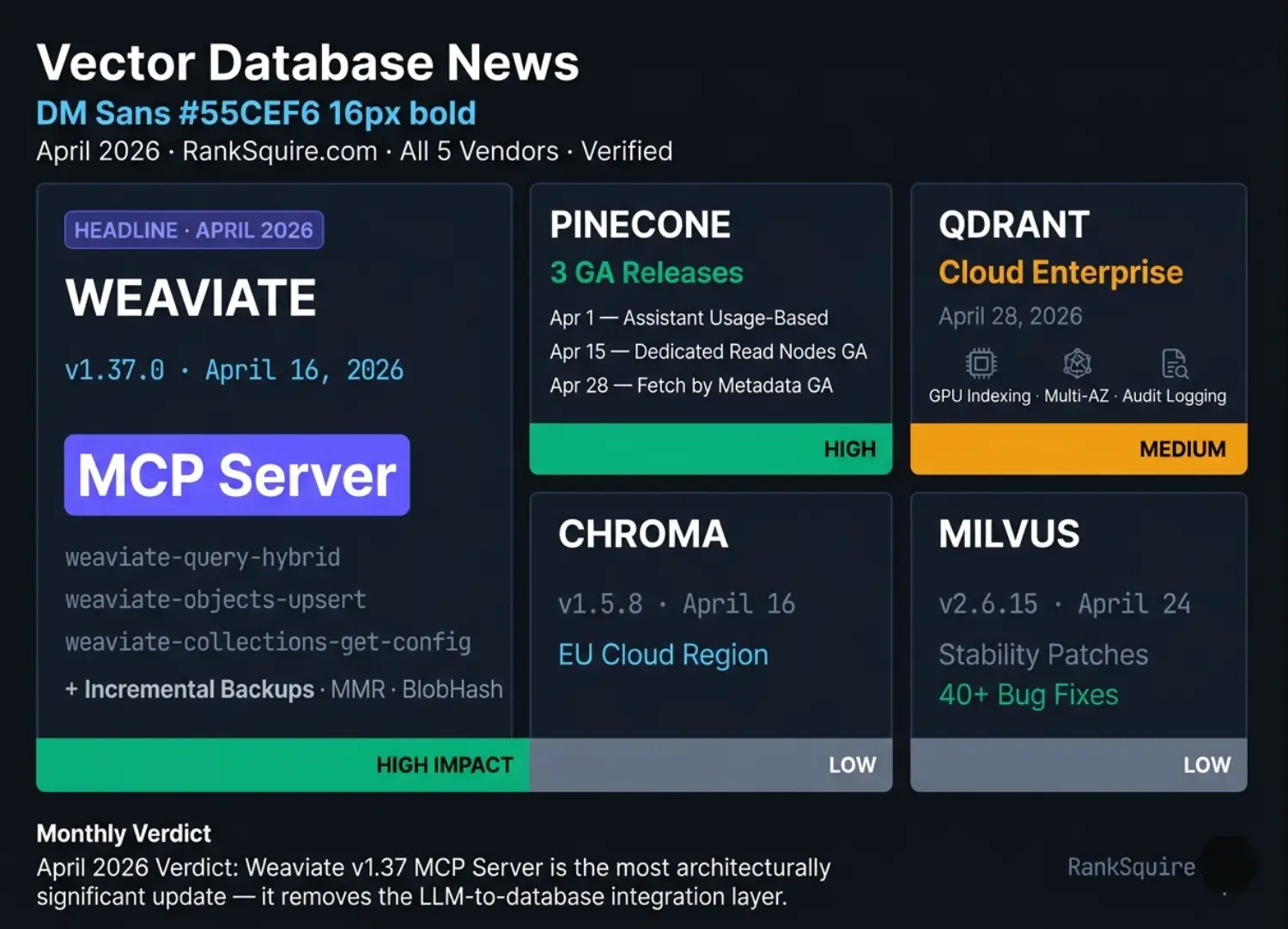

What is the vector database news for April 2026?
The vector database news April 2026 roundup covers all major releases, pricing changes, feature updates, and infrastructure announcements from Pinecone, Weaviate, Qdrant, Chroma, and Milvus during April 2026. This post serves as the canonical reference for AI engineers tracking the state of vector database infrastructure. Verified May 1, 2026 · RankSquire Infrastructure Lab.
Infrastructure Intelligence Briefing
WHAT IS THE VECTOR DATABASE NEWS FOR APRIL 2026?
The April 2026 vector database news roundup covers all major releases, pricing changes, feature updates, and infrastructure announcements from Pinecone, Weaviate, Qdrant, Chroma, and Milvus during April 2026. This post is updated on the last week of every month and serves as the canonical reference for AI engineers tracking the state of vector database infrastructure.

TL;DR Summary Block
Weaviate v1.37.0 (April 23, 2026): Built-in MCP Server preview enables native LLM/agent interaction directly with the database without custom integration layers.
Pinecone Fetch by Metadata (GA April 28, 2026): Engineers can now retrieve records by metadata filter without knowing vector IDs; includes pagination support for large sets.
Pinecone Dedicated Read Nodes (GA April 15, 2026): Dedicated hardware for predictable low-latency on Standard/Enterprise plans, claiming up to 97% lower costs for large workloads.
Pinecone Assistant (April 1, 2026): Pricing restructured to be fully usage-based (removed hourly fees); Starter limits now reset monthly.
Qdrant Cloud (April 28, 2026): Launched GPU-accelerated indexing, Multi-AZ clusters, and audit logging for enterprise-grade regulated AI workloads.
Chroma Cloud (April 2026): Added EU region support (GCP europe-west1) and SOC 2 Type II certification for distributed production workloads.
Milvus v2.6.14 & v2.6.15 (April 2026): Stability and observability patches including microsecond latency metrics and critical fixes for RBAC backup/restore.
Weaviate’s MCP Server is the most significant update in 2026 so far—it makes any LLM a native vector database client without a custom API layer.
KEY TAKEAWAYS
weaviate-query-hybrid, weaviate-objects-upsert, and weaviate-collections-get-config as RBAC-controlled tools at /v1/mcp — meaning Claude, Cursor, and VS Code can now write to and query Weaviate directly without a single line of custom integration code.
paginationToken for result sets exceeding 10,000 records — the first Pinecone feature that enables agent-style memory retrieval by attribute filter without pre-stored IDs.
The MCP Server in Weaviate v1.37 is the most architecturally significant vector database update since Qdrant shipped Relevance Feedback Query in March 2026 — it removes the integration layer between LLMs and vector databases entirely.
Quick Answer Block
As of April 2026, Weaviate released v1.37.0 (April 23), introducing a built-in MCP Server preview that allows LLMs and agents to query and upsert data natively via RBAC-governed tools. Pinecone achieved General Availability for Dedicated Read Nodes (April 15), providing fixed-cost scaling and predictable latency, alongside Fetch by metadata for retrieving records without vector IDs. Qdrant Cloud (April 28) debuted major enterprise features including GPU-accelerated indexing and Multi-AZ clusters for high availability. Chroma v1.5.8 (April 16) expanded its infrastructure with EU region support on Chroma Cloud. Finally, Milvus fortified production stability with v2.6.14 (April 7) and v2.6.15 (April 24), addressing over 40 bug fixes and optimizing MixCoord recovery speeds.
Table of Contents
1. MONTHLY VERDICT: APRIL 2026 VECTOR DB UPDATES
Engineering Blueprint — Monthly Verdict
The Disappearance of the Integration Layer
Highlights
- →
Weaviate v1.37.0 (April 16): MCP Server, Incremental Backups, Diversity Search (MMR), and Query Profiling — the most feature-dense release in its history.
- →
Pinecone Dedicated Read Nodes GA (April 15): Dedicated hardware removes shared-resource latency variance for Standard/Enterprise plans.
- →
Pinecone Fetch by metadata GA (April 28): Filter-based retrieval without vector IDs — a direct agent memory access pattern.
- →
Pinecone Assistant (April 1): Pricing restructure removes hourly fees; billing is now fully usage-based.
- →
Qdrant Cloud (April 28): GPU indexing, Multi-AZ, and audit logging bring managed cloud to parity with self-hosted performance.
RAG & Agentic Impact
- →
Diversity Search (MMR): Weaviate now reranks results at query time to reduce redundancy, directly improving multi-document RAG quality.
- →
Native Tool-Use: The Weaviate MCP Server allows Claude and Cursor to call
weaviate-query-hybridnatively—agents now read/write memory without middleware. - →
Attribute-Based Memory: Pinecone’s Fetch by metadata allows agents to retrieve prior decisions by
session_idoroutcome_statuswithout requiring embedding similarity.
Comparison Table
| Database | Update | Key Change | Impact | Price Change |
|---|---|---|---|---|
| Pinecone | Multiple GAs | Fetch by metadata + Dedicated Read Nodes | High | Yes (Assistant) |
| Weaviate | v1.37.0 | MCP Server + Incremental Backups + MMR | High | No |
| Qdrant | Cloud Enterprise | GPU indexing + Multi-AZ + Audit logging | Medium | No |
| Chroma | v1.5.8 | EU region on Chroma Cloud | Low | No |
| Milvus | v2.6.15 | Stability and observability patches | Low | No |
2. PINECONE — APRIL 2026 UPDATE
Engineering Blueprint — Pinecone Intelligence
Three separate releases in April 2026, each with a distinct production impact:
1. Assistant Usage-Based Pricing Restructure
April 1, 2026Pinecone removed the per-assistant hourly fee. The new model is fully usage-based, resetting monthly for the Starter plan:
- 500,000 chat input tokens per month
- 300,000 output tokens per month
- 500,000 context retrieval tokens per month
- 1,000 ingestion units per month
2. Dedicated Read Nodes (DRN)
General Availability — April 15, 2026Dedicated read hardware isolated from write infrastructure, eliminating shared-resource contention on Standard and Enterprise plans.
- Targets high-QPS production indexes requiring p99 predictability.
- Production Benchmark: 1.4 billion vectors at 5,700 QPS, p99 60ms.
3. Fetch by Metadata
General Availability — April 28, 2026Retrieve records using metadata filter expressions without providing vector IDs—a critical pattern for agentic memory (session_id, agent_id).
- Supports paginationToken for result sets > 10,000 records.
- Full filter syntax support ($eq, $in, $gte, etc.).
- Recommended for stable production use.
Pricing
Assistant fully restructured to usage-based. Database tier remains unchanged.
Free Tier
Starter allowances now monthly-resetting rather than all-time totals.
Performance
1.4B Vectors · 5,700 QPS · p99 60ms verified on Dedicated Nodes.
3. WEAVIATE — APRIL 2026 UPDATE
Engineering Blueprint — Weaviate Intelligence
The Agentic Infrastructure Pivot
Weaviate v1.37 is the most feature-dense release in history. The headline is the built-in MCP Server—advancing Weaviate further toward production-grade agentic AI infrastructure than any competing release in April 2026.
A native HTTP endpoint at /v1/mcp that exposes Weaviate as a direct tool-callable resource for any MCP-compliant client (Claude, Cursor, VS Code).
- Tools: hybrid-query, objects-upsert, and collections-get-config.
- Security: RBAC-controlled via
read_mcpandwrite_mcproles.
Maximum Marginal Relevance reranking reduces redundancy in top-k retrieval—preserving context window budget for multi-document RAG.
- Balance: 0.0 (pure diversity) to 1.0 (pure relevance).
- Applied at query-time; no reindexing required.
Chunk-based references store only changed data, referencing unchanged chunks from previous backups. Drastically reduces backup operational costs.
- Supports S3, GCS, Azure Blob, and Local Filesystem.
- Enables point-in-time restore chains for episodic memory.
Supporting Advancements
- Query Profiling: Per-shard timing (HNSW traversal time, layers traversed) via
return_metadata. - BlobHash: SHA-256 deduplication to reduce vectorization costs for re-submitted media.
- Extensible Tokenizers: Accent folding and custom stopwords updates without full reindexing.
- Collection Export: Export to Parquet for offline analytics/migrations.
Performance
Query Profiling enabled for self-measurement. Benchmarks pending.
Pricing
No confirmed changes. Sandbox (14-day) active for v1.37 testing.
Impact
Eliminates the integration layer for agent-native database access.
4. QDRANT — APRIL 2026 UPDATE
Engineering Blueprint — Qdrant Intelligence
Qdrant’s managed infrastructure push reduces the gap between Cloud and Self-Hosted for production workloads.
Qdrant Open Source: No new core engine release in April 2026. Latest version remains v1.17.1 (March 2026).
Index construction on Qdrant Cloud now leverages GPU compute for large collections. Previously a self-hosted exclusive, this brings managed indexing speeds closer to bare-metal GPU deployments.
Support for Availability Zone (AZ) cluster deployment adds zone-level fault tolerance. Essential for AI agents requiring high-availability retrieval loops without the risk of single-AZ failure.
Managed audit trails record timestamps, operator identifiers, and targets for all query and mutation operations. Crucial for enterprise compliance in regulated sectors (Finance, Healthcare, Legal).
Production Context: While managed Cloud availability expands, the case for self-hosted Qdrant remains strongest on pure cost at scale (e.g., $96/mo Droplets for 10M+ vectors with Binary Quantization).
Pricing
No confirmed changes. Free tier: 1GB RAM, 0.5 vCPU, 4GB Disk permanent.
Funding
Stable following $50M Series B (March 2026).
Official Sources
qdrant.tech/documentation · github/qdrant
5. CHROMA — APRIL 2026 UPDATE
Engineering Blueprint — Chroma Intelligence
Infrastructure Expansion & Compliance
Chroma’s April 2026 release is a focused infrastructure expansion. The v1.5.8 stable release adds EU region support on Chroma Cloud — the most requested compliance feature for European engineers building GDPR-adjacent RAG systems.
Chroma Cloud now serves workloads from EU infrastructure, allowing deployment of collections with no US data transfer—mitigating GDPR Article 44 compliance risks.
- Available as of April 2026.
- Applies to new collections; US collections require migration.
- No pricing premium for EU region confirmed as of April 2026.
Status Summary
BM25 / SPLADE
No new updates beyond v1.5.5 (March 2026).
Pricing
$5 Free Credits on signup. No confirmed changes.
Breaking Changes
NONE reported in v1.5.8.
Official Repo
chroma-core/chroma/releases
6. MILVUS/ZILLIZ — APRIL 2026 UPDATE
Engineering Blueprint — Milvus Intelligence
Milvus v2.6.14 + v2.6.15
Milvus shipped two stability-focused releases in April 2026. Neither introduced new features — both focused on production reliability improvements and bug elimination accumulated from the 2.6.x series.
- Faster MixCoord recovery: Reduced recovery time after coordinator restart in distributed deployments.
- Optimized filter evaluation: Improved performance for similarity queries combined with complex payload filters.
- Bug fixes: Over 20 resolved issues including OOM events under high load and data correctness errors.
- Index correctness fixes: Resolved edge cases in HNSW index construction under specific data patterns.
- RBAC corrections: Fixed permission inheritance during backup and restore in multi-tenant environments.
- Upgrade compatibility: Resolved migration issues when upgrading from specific 2.5.x sub-versions.
- Bug fixes: Over 20 additional resolved issues across search and storage layers.
Zilliz Update
Claude Code Skills integration for AI-assisted management (April 24).
BYOC Status
AWS/GCP/Azure GA (March 2026). No new April updates.
Breaking Changes
NONE major. Focus on backward compatibility.
The Complete Vector Database Intelligence Library
Every guide needed to select, deploy, price, and operate production vector databases for AI agent systems — from monthly news to deep architecture analysis.
7. WHAT THIS MEANS FOR YOUR STACK — APRIL 2026
Engineering Blueprint — Production Intelligence
The Removal of the Integration Layer
April 2026 moves the integration layer out of your codebase. That is the correct reading of Weaviate v1.37’s MCP Server — not as a developer convenience, but as an architectural shift. Every agent framework that adopted MCP after Anthropic published the protocol in late 2024 can now interact with Weaviate directly. The custom n8n workflow, the LangChain tool schema, and the FastAPI middleware are now optional, not mandatory.
For regulated industries, the MCP Server moves access control to the database layer (read_mcp / write_mcp roles), providing auditable infrastructure-level security that custom integration layers cannot match.
Pinecone’s Fetch by metadata GA closes a gap that has been forcing engineers to maintain external ID mapping tables. Fetch by metadata enables cleaner separation between episodic memory retrieval (by attribute) and semantic memory retrieval (by similarity) within the same Pinecone index, treating session-based lookups as efficient lookup operations rather than similarity searches.
Qdrant Cloud’s enterprise capabilities (GPU indexing, Multi-AZ, audit logging) matter most for the teams who were self-hosting specifically because the managed Cloud lacked these pillars. If your reason for self-hosting was cost — such as the fixed $96/month for 10M+ vectors on DigitalOcean — that logic remains; otherwise, the managed gap has effectively closed.
The Milvus v2.6.14 and v2.6.15 patches are critical for production reliability. RBAC backup/restore corrections and HNSW index correctness fixes are the kind of updates that appear in post-mortems. If you are on Milvus 2.6.x, apply both patches to address the combined 40+ resolved issues.
Key Shift
Integration middleware is becoming obsolete for agent-native memory.
Compliance
Database-level RBAC for LLM tools improves auditable security.
Reliability
Milvus patches resolve critical HNSW and RBAC edge cases.
8. FAQ: Vector Database News April 2026 — 8 Questions Answered
Q1: What vector databases updated in April 2026?
Five databases shipped confirmed updates in April 2026. Weaviate released v1.37.0 on April 16 with a built-in MCP Server, Incremental Backups, Diversity Search (MMR), Query Profiling, and BlobHash. Pinecone reached GA on Dedicated Read Nodes (April 15), Fetch by metadata (April 28), and restructured Assistant pricing to usage-based (April 1). Qdrant Cloud launched GPU-accelerated indexing, Multi-AZ clusters, and audit logging on approximately April 28. Chroma released stable v1.5.8 on April 16 with EU Cloud region support. Milvus shipped v2.6.14 (April 7) and v2.6.15 (April 24) as stability and observability patch releases.
Q2: Did Pinecone change its pricing in April 2026?
Yes. Pinecone restructured Pinecone Assistant pricing on April 1, 2026. The per-assistant hourly fee was removed entirely. The new model is fully usage-based: pay for ingestion units (~1 per ~400-token chunk), storage, and token consumption. The Starter plan now receives 500,000 chat input tokens, 300,000 output tokens, 500,000 context retrieval tokens, and 1,000 ingestion units per month — all resetting each billing cycle rather than counting against all-time project totals. No changes were confirmed to database tier pricing (Standard or Enterprise) in April 2026.
Q3: What did Weaviate release in April 2026?
Weaviate released v1.37.0 on April 16, 2026 with eight new capabilities. The headline feature is a built-in MCP Server (preview) at /v1/mcp exposing hybrid query, upsert, and schema inspection as RBAC-controlled tools for Claude, Cursor, and VS Code. Additional features include Extensible Tokenizers with accent folding and custom stopwords (preview), Diversity Search with Maximum Marginal Relevance reranking (preview), Query Profiling with per-shard timing metadata (preview), production-ready Incremental Backups with chunk-based references, Gemini audio support in multi2vec-google, the BlobHash property type for deduplication without re-vectorization, and Collection Export to Parquet format. The stability patch v1.37.2 followed to address TTL, vector cache, and export edge cases.
Q4: What did Qdrant release in April 2026?
Qdrant did not ship a new open-source engine release in April 2026 — the latest confirmed OSS version remains v1.17.1 from March 2026. Qdrant Cloud announced enterprise-grade capabilities on approximately April 28, 2026: GPU-accelerated indexing for faster collection builds, Multi-AZ cluster support for zone-level fault tolerance, and audit logging for compliance in regulated sectors. These three capabilities bring Qdrant Cloud’s feature parity with self-hosted Qdrant significantly closer for enterprise workloads.
Q5: Which vector database had the most significant update in April 2026?
Weaviate v1.37 had the most architecturally significant update in April 2026. The built-in MCP Server is the most consequential vector database release since Qdrant’s Relevance Feedback Query in March — it removes the custom integration layer between LLMs and vector databases that every agentic AI system has required since 2024. Engineers can now use Claude, Cursor, or any MCP-compliant LLM to query Weaviate hybrid search and write objects directly, with RBAC controlling database access at the infrastructure level rather than the application layer.
Q6: How do the April 2026 updates affect RAG pipelines?
Three April 2026 updates directly improve RAG retrieval quality. Weaviate’s Diversity Search (MMR) reranks top-k results at query time to reduce result redundancy — RAG systems with duplicate passage problems no longer need a separate reranking service. Weaviate’s Extensible Tokenizers improve keyword search recall for non-English content without reindexing. Pinecone’s Fetch by metadata GA enables filter-based pre-selection within RAG pipelines retrieve candidate records by attribute first, then run similarity within that filtered set reducing noise in top-k retrieval for large namespaces.
Q7: Which vector database is best for AI agents after the April 2026 updates?
For agent systems where MCP protocol integration is a priority, Weaviate v1.37 is the clear recommendation after April 2026 — it is the only vector database with a native MCP Server. For agent systems requiring cost-optimal high-write sovereign infrastructure, self-hosted Qdrant on DigitalOcean remains the production standard at $96/month fixed regardless of query volume. For agent systems on managed infrastructure requiring predictable low-latency reads at scale, Pinecone with Dedicated Read Nodes GA (April 15) is now the strongest managed option. The choice depends on whether your agent stack is MCP-native, write-heavy, or latency-sensitive.
Q8: Where can I find official vector database release notes for vector database news April 2026?
Official changelogs and release notes for all five databases: Pinecone: https://docs.pinecone.io/release-notes/2026 · Weaviate: https://docs.weaviate.io/weaviate/release-notes and https://weaviate.io/blog/weaviate-1-37-release · Qdrant: https://qdrant.tech/documentation/ and https://github.com/qdrant/qdrant/releases · Chroma: https://github.com/chroma-core/chroma/releases/tag/1.5.8 and https://www.trychroma.com/changelog · Milvus: https://milvus.io/docs/release_notes.md and https://github.com/milvus-io/milvus/releases.
This is the production-ready container for RankSquire infrastructure updates. Use the status badges above to categorize specific vendor releases.
FROM THE ARCHITECT’S DESK
Every agentic AI system I have reviewed in the last 12 months has a middle layer — a set of API wrappers, n8n workflows, LangChain tool schemas, or custom Python code that exists for one reason: to translate between what the LLM wants to do and what the vector database can accept. Weaviate v1.37’s MCP Server removes the requirement for that layer to exist.
An agent using Claude can now call weaviate-query-hybrid directly. It can write memory with weaviate-objects-upsert directly. The LLM is the client. The database is the server. The middleware that teams have been building and maintaining since 2024 is now optional.
The teams I see thriving in 2026 are the ones who treat integration complexity as a liability, not a feature. Every layer you remove from your agent stack is a layer that cannot fail at 3am. Weaviate’s MCP Server is the most significant step any vector database has taken toward removing a layer that was always a liability.
The implication for your architecture review: if you are currently running a custom tool layer between your LLM and Weaviate, evaluate whether the MCP Server can replace it. If it can, ship that removal before you add the next feature.



Comments 1