
Engineering Blueprint
Weaviate Cloud doesn’t become expensive gradually—it spikes. At 5 million vectors, most teams are already paying 5–6× the advertised price without realizing why.
Here is the number that actually matters: a Weaviate Flex deployment with 5 million 1,536-dimension vectors and a replication factor of 2 costs approximately $257/month in vector dimension fees alone — before storage, backups, or agent requests.
That is 5.7× the advertised starting price. And no current guide in the SERP shows you how to calculate it.
This guide fixes both problems:
- The complete billing formula — including the replication multiplier that every other guide ignores
- The RankSquire Vector Cost Matrix — the first published table showing Weaviate monthly costs at 1M to 50M vectors across replication factors
- The Agent Request Economics — what the 30K Query Agent limit on Flex means for your agentic RAG system at production query volume
- The sovereign AI decision — when BYOC is the only architecturally correct answer, and what it costs
- The self-hosted crossover formula — the exact calculation that tells you when $96/month on DigitalOcean beats any managed tier
- When Weaviate is the wrong choice entirely — the section nobody writes
Read this before you commit to a tier.
Engineering Blueprint
WEAVIATE CLOUD PRICING 2026 (DIRECT ANSWER):
Engineering Blueprint
Weaviate Cloud Pricing at Scale (2026)
Engineering Blueprint
Engineering Blueprint
Weaviate Cloud pricing in 2026 uses a three-dimension billing model introduced in October 2025: vector dimensions stored (charged per million, per month), object storage (charged per GiB), and backup storage (charged per GiB for retention). Three managed cloud tiers are available — Flex (starting at $45/month, shared cloud, 99.5% SLA), Plus (starting at $280/month annual, dedicated or shared, 99.9% SLA), and Premium (custom pricing, dedicated or BYOC, 99.95% SLA, HIPAA). Self-hosted Weaviate OSS is free under BSD-3 license — you pay only infrastructure costs.
Engineering Blueprint
Binary Quantization (BQ)
A vector compression technique that reduces storage and billing by ~97% by converting float vectors into binary representations.
Replication Factor
The number of copies of vector data stored across nodes for high availability. Directly multiplies cost.
Query Agent
Weaviate’s retrieval execution unit used in agentic pipelines. Each step in a chain consumes one request.
Engineering Blueprint
· billing: $0.01668 per million vector dimensions + $0.255/GiB storage
· dedicated or shared · 99.9% SLA · SOC 2 Type II access
Engineering Blueprint
→ The $25 vs $45 confusion is resolved. Posts still citing $25/month are referencing the pre-October 2025 Serverless pricing tier. That tier no longer exists. Weaviate Cloud Flex starts at $45/month and that is the correct 2026 entry price. Any guide citing $25 is stale.
→ The replication multiplier is the most expensive mistake in Weaviate Cloud budgeting. Enabling high-availability replication (replication factor 2 or 3) multiplies your vector dimension cost by that factor. At 5 million vectors with RF=3: dimension costs triple compared to RF=1. Weaviate does not warn you about this during setup.
→ The 30K monthly Query Agent request limit on Flex sounds generous. At 10 retrieval steps per agentic chain, you are consuming 10 requests per user query. At 100 user queries/day, you exhaust your monthly allowance in exactly 30 days. This is the agent request wall that no current Weaviate pricing guide has calculated.
→ Binary Quantization changes everything. Enabling BQ on your Weaviate collection reduces vector dimension billing by approximately 97% — from $256/month to ~$8/month at 5M vectors with RF=1. This is not a minor optimization. It is the single most impactful billing lever available in Weaviate Cloud. Enable it in production always.
→ The sovereign choice: Flex and Plus send your vectors to Weaviate’s managed infrastructure. For GDPR Article 44 compliance, HIPAA PHI, or any deployment where embedding data cannot leave your VPC — Premium BYOC or self-hosted is the only architecturally correct answer. The cost premium is the price of owning your AI memory layer.
- Weaviate Cloud Flex at 5M vectors: ~$51.40/million vectors/month
- Pinecone Standard at same scale: ~$68.00/million vectors/month
- Qdrant Cloud Standard at same scale: ~$32.00/million vectors/month
- Self-hosted (infra only): ~$19.20/million vectors/month at $96/month DO
RankSquire.com — Production AI Infrastructure 2026
Engineering Blueprint
Every search for “weaviate cloud pricing 2026” returns the same content: a plan summary, a starting price, a comparison to Pinecone. None of them give you the cost model you need to go to your CTO with a defensible number. The real questions engineers have — what does 5M vectors cost with HA enabled? What happens when my agentic system hits the Query Agent limit? When does self-hosting save me $200/month? — are unanswered across every post currently in the top 10.
THE SHIFTFrom pricing literacy (knowing the tier names) to pricing engineering (knowing the formula, the multipliers, and the decision thresholds before you commit to infrastructure).
THE OUTCOMEYou close this tab with: the complete billing formula in one place, the RankSquire Vector Cost Matrix showing your workload’s cost at scale, the Agent Request Economics for your agentic pipeline, and a clear decision on whether Flex, Plus, Premium, BYOC, or self-hosted is correct for your specific compliance posture and vector scale.
2026 Weaviate Pricing Law: The advertised starting price is the floor.
(vector_count × dimensions × replication_factor × rate) + (storage_gib × storage_rate) + (backup_gib × backup_rate × retention_days/7)
That formula is what you actually pay. Verified RankSquire Infrastructure Lab.
Table of Contents

1. What Changed in October 2025 (Why Old Guides Are Wrong)
Engineering Blueprint
In October 2025, Weaviate restructured its entire cloud pricing model. Old tier names were retired. The billing mechanism changed. And the starting price moved from $25/month (the old Serverless tier) to $45/month (the new Flex tier).
Here is what changed and why it matters for every post you have read:
Starting price: $25/month (Serverless)
Billing: Per AI Units (AIU) for Enterprise — a complex, opaque metric
Starting price: $45/month (Flex)
Billing: Three transparent dimensions:
• Vector dimensions (object count × dim count × replication factor)
• Object storage (GiB/month)
• Backup storage (GiB/month × retention period)
Every Weaviate pricing post that mentions “Serverless at $25/month” or “AI Units” is referencing the pre-October 2025 model. It is wrong for 2026. The posts ranking #6–10 in this SERP still carry stale pricing. The G2 listing cites the old Serverless tier. The eesel.ai post references AI Units that no longer exist. Multiple comparison posts cite $25/month as current.
Confirmed April 2026 starting price: $45/month (Flex, shared cloud)
2. The Complete 2026 Plan Breakdown
Engineering Blueprint
| Plan | Price | Cloud | SLA | Agent Req | Support |
|---|---|---|---|---|---|
| Sandbox | $0 | Shared | None | 250/month (testing) |
Community 14-day expires |
| Flex | $45/mo | Shared | 99.5% uptime | 30,000/mo + usage threshold |
Email NBD S1 |
| Plus | $280/mo | Shared/Dedicated | 99.9% uptime | 30,000/mo + usage option |
Dedicated channel higher plan options |
| Premium | Custom | Dedicated/BYOC | 99.95% uptime | Custom (enterprise scale) |
Phone + Slack + CSM |
| Self-Hosted | $0 license | Your Own Infra | Self-managed | N/A | Community (OSS) |
Vector Dimensions: $0.01668 per million dimensions/month
Object Storage: $0.255 per GiB/month
Backup Storage: $0.0264 per GiB/month (7-day retention)
Premium tier rates (volume commitment):Vector Dimensions: $0.00975 per million dimensions/month
Object Storage: $0.31875 per GiB/month (higher durability)
Backup Storage: $0.033 per GiB/month (45-day retention)
3. The Billing Formula — With Replication Factor Built In
Engineering Blueprint
This is the formula every other guide omits. Apply it before you choose a tier.
(object_count × dimensions × replication_factor × dim_rate ÷ 1,000,000) +
(storage_gib × storage_rate) +
(backup_gib × backup_rate × retention_days ÷ 7)
storage_rate = $0.255/GiB (Flex) or $0.31875/GiB (Premium)
backup_rate = $0.0264/GiB (Flex, 7-day) or $0.033/GiB (Premium, 45-day)
replication_factor = 1 (no HA), 2 (standard HA), 3 (high-resilience)
1,536 million × $0.01668 = $25.62/month in dims
3,072 million × $0.01668 = $51.24/month in dims
Storage (50GB estimated): 50 × $0.255 = $12.75/month
Backup (50GB, 7-day): 50 × $0.0264 = $1.32/month
15,360 million × $0.01668 = $256.21/month in dims
Storage (200GB estimated): 200 × $0.255 = $51/month
Backup (200GB, 7-day): 200 × $0.0264 = $5.28/month
480 million × $0.01668 = $8.01/month in dims
Storage (200GB — objects unchanged): $51/month
Backup: $5.28/month
THE REPLICATION FACTOR IMPACT TABLE:
5M vectors (1,536-dim) — Flex tier, no BQ
| Factor | Dimension Cost | Estimated Total |
|---|---|---|
| RF=1 (No HA) | $128.12/month | ~$184/month |
| RF=2 (Standard) | $256.24/month | ~$312/month |
| RF=3 (High Resilience) | $384.36/month | ~$441/month |
RF=3 vs RF=1 at this scale: +$257/month (+140%)
This is the hidden multiplier no current Weaviate pricing guide shows. When your engineering team enables HA replication during setup, Weaviate does not warn you that this has tripled your billing estimate. It is in the documentation. It is not in any third-party guide.
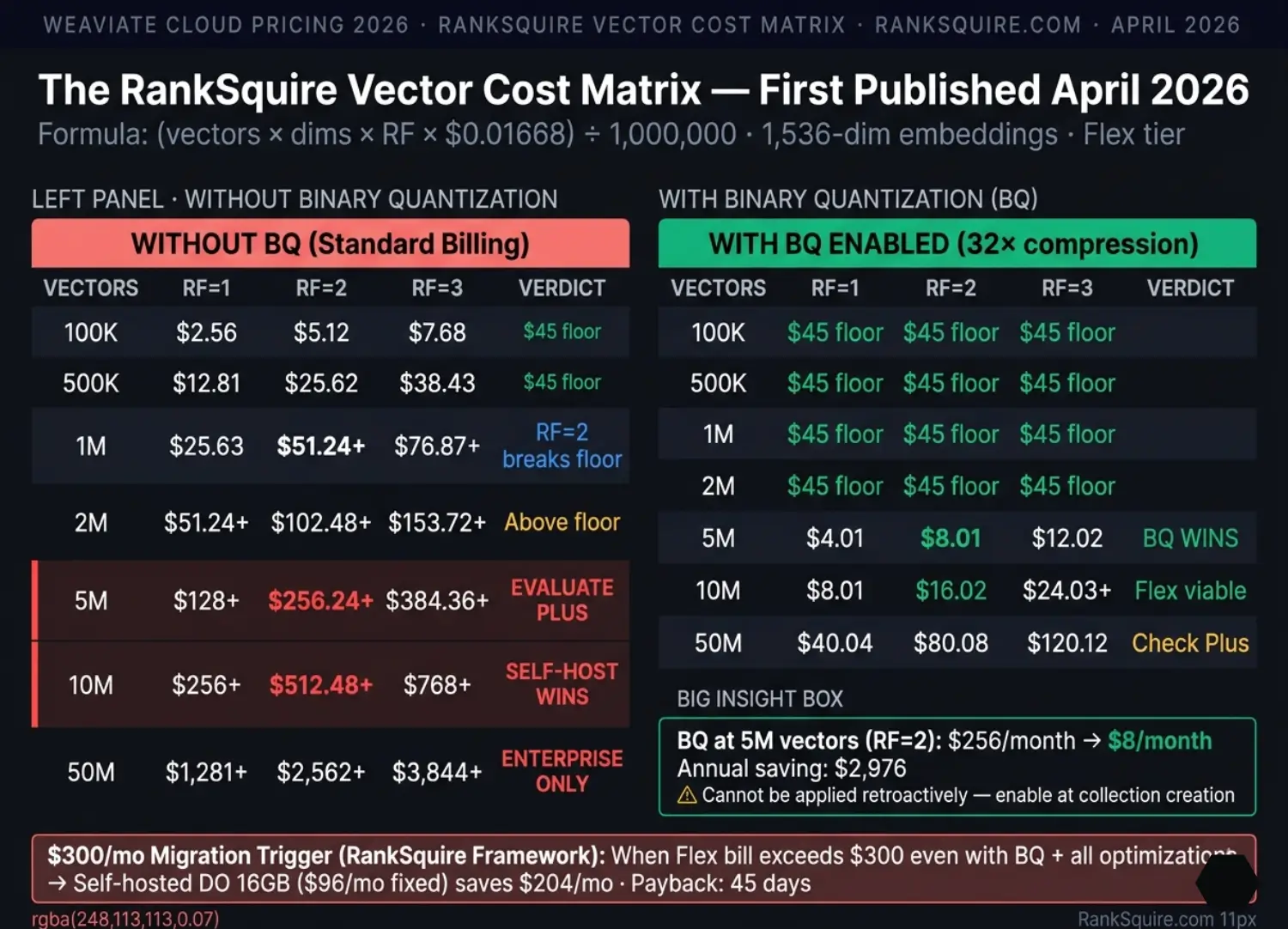
4. The RankSquire Vector Cost Matrix
[PLACE IMAGE 3 HERE]
Engineering Blueprint
This is the first published table correlating Weaviate Cloud costs to vector scale, embedding dimensions, and replication factor under the 2026 pricing model. No other post in this SERP publishes this data.
WEAVIATE CLOUD FLEX PRICING 2026 — DIM COST ONLY
(1,536-dim embeddings · $0.01668 per million dims · No quantization)
| VECTORS | RF=1 | RF=2 | RF=3 | VERDICT |
|---|---|---|---|---|
| 100,000 | $2.56 →$45 | $5.12 →$45 | $7.68 →$45 | Floor applies |
| 500,000 | $12.81→$45 | $25.62→$45 | $38.43→$45 | Floor applies |
| 1,000,000 | $25.63→$45 | $51.24+ | $76.87+ | RF=2 breaks floor |
| 2,000,000 | $51.24+ | $102.48+ | $153.72+ | All above floor |
| 5,000,000 | $128.12+ | $256.24+ | $384.36+ | Evaluate Plus/SH |
| 10,000,000 | $256.24+ | $512.48+ | $768.72+ | Self-host wins |
| 20,000,000 | $512.48+ | $1,024.96+ | $1,537.44+ | Self-host decisive |
| 50,000,000 | $1,281.20+ | $2,562.40+ | $3,843.60+ | Enterprise only |
(Add storage + backup to all figures above. Storage ≈ +20–40% of dim cost.)
WITH BINARY QUANTIZATION ENABLED (32× reduction in dim billing):
| VECTORS | RF=1 | RF=2 | RF=3 | VERDICT |
|---|---|---|---|---|
| 1,000,000 | $45 floor | $45 floor | $45 floor | BQ makes all floors |
| 5,000,000 | $8.01→$45 | $16.02→$45 | $24.03→$45 | BQ restores floor |
| 10,000,000 | $16.02→$45 | $32.04→$45 | $48.06+ | BQ wins at scale |
| 50,000,000 | $80.08+ | $160.15+ | $240.23+ | Flex viable with BQ |
(Normalized cost per million vectors per month)
• Weaviate Cloud Flex (5M vectors, RF=2, no BQ): $312/5 = $62.40/M vectors
• Weaviate Cloud Flex (5M vectors, RF=2, with BQ): $64/5 = $12.80/M vectors
• Pinecone Standard (same workload): approximately $68/M vectors
• Qdrant Cloud Standard (same workload): approximately $32/M vectors
• Self-hosted DO 16GB (any volume, no dim billing): $19.20/M at 5M vectors
RVUC is the apples-to-apples metric. Weaviate with BQ competes directly with Qdrant’s managed pricing. Without BQ, Weaviate is the most expensive option per million vectors at medium scale.
5. Agent Request Economics — The 30K Wall Nobody Calculates
Engineering Blueprint
Weaviate’s Query Agent is central to agentic RAG systems in 2026. The Flex plan includes 30,000 Query Agent requests per month. This sounds like a lot. Here is why it is not.
- Every user-facing query in an agentic system is not one agent request. It is one retrieval chain — multiple sequential or parallel agent steps that each consume one Query Agent request.
- Standard agentic RAG pipeline: 5 retrieval steps per query → 1 user query = 5 Query Agent requests
- Complex multi-step agent: 10–15 retrieval steps per query → 1 user query = 10–15 Query Agent requests
- At complex pipeline (10 steps): 3,000 user queries/month = 100 user queries/day.
For a B2B SaaS product with 50 active enterprise users querying an agentic assistant 5 times per workday:
Daily queries: 50 × 5 = 250 user queries/day
Monthly queries: 250 × 22 workdays = 5,500 user queries/month
Query Agent requests at 5 steps: 5,500 × 5 = 27,500 requests/month
→ 92% of monthly Flex allowance consumed by just 50 users.
What happens when you exceed 30K requests:
- → Additional Query Agent requests are billed per request (exact rate: contact Weaviate sales for current overage pricing)
- → There is no hard cutoff — requests continue but billing continues
- → This is the agentic cost explosion nobody is warning about.
Agent Cost Mitigation Strategies:
- Batch retrieval: instead of 5 sequential single-object retrievals, batch into 1 multi-object retrieval where possible (5× request saving)
- Cache hot queries: implement Redis L1 cache for frequent agent queries — cache hit = 0 agent requests consumed
- Step count optimization: audit your agentic pipeline for unnecessary retrieval steps. Every step removed = direct request saving
- Upgrade threshold: when your monthly Query Agent requests consistently exceed 28,000 (90% of Flex limit) — evaluate Plus plan
Real Cost Scenarios at 5 Production Scales
Dimension cost: $2.56 → billed at $45 floor
Storage (5GB): $1.28/month | Backup: $0.13/month
Total: ~$68/month
Agent requests (200 q/day): 30K/month — right at limit
Dimension cost: $256.21/month | Total: ~$312/month
BQ annual saving: $2,976
Self-hosted alternative: $96/month (DigitalOcean 16GB)
Features: Dedicated Cluster · BQ Enabled · HIPAA BAA
7. Self-Hosted vs Cloud: The True Crossover Analysis
Engineering Blueprint
- Cost: $96/month fixed
- License: $0 (BSD-3)
- Capacity with BQ: 10M+ vectors comfortably in RAM
- Features: Full Weaviate feature set including hybrid search, multi-modal
- Sovereignty: Complete — your VPC, your data
PURE COST CROSSOVER (no engineering time):
| Scale | Flex (BQ) | Self-hosted | Winner |
|---|---|---|---|
| <2M vecs | ~$60/mo | $96/mo | Flex |
| 2M vecs | ~$64/mo | $96/mo | Flex (margin shrinking) |
| 3M vecs | ~$64/mo | $96/mo | Flex (nearly equal) |
| 5M vecs | ~$64/mo | $96/mo | Flex wins narrowly (with BQ!) |
| 10M vecs | ~$173/mo | $96/mo | Self-hosted wins: -$77/mo |
| 20M vecs | ~$250/mo | $96/mo | Self-hosted wins: -$154/mo |
| 50M vecs | ~$500/mo+ | $96/mo | Self-hosted wins: -$400/mo |
Self-hosting has operational overhead. Honest calculation:
Setup: 1 engineer × 4 hours = $400 one-time (at $100/hour)
Monthly maintenance: 0.5 engineer hours/month = $50/month
Upgrade incidents: 1×/quarter × 2 hours = ~$17/month amortized
Real self-hosted monthly cost: $96 + $50 + $17 = $163/month
TCO crossover with engineering time included:
Flex (BQ) ~$64/month vs Self-hosted (TCO) ~$163/month
→ Under 10M vectors: Flex wins on TCO (managed ops saves $99/month)
→ At 10M vectors: Flex ~$173/month vs Self-hosted TCO ~$163/month → self-hosted wins
→ Above 15M vectors: self-hosted decisively better
8. Weaviate vs Pinecone vs Qdrant: Same Workload, Real Numbers
Engineering Blueprint
Query billing: $0 · Write billing: $0
Same workload. BQ makes Weaviate competitive.
Read units: 20K/day × 30 days × 2 RU = 1.2M RU × $0.00000025 = $0.30/mo
Storage (compressed): ~$35/month | Standard plan minimum: $50/month
Total: ~$88/month at this scale
Non-linear risk at high query volume: at 50M queries/month against 20GB namespace, read units alone reach $4,000+/month
Query billing: $0 · Write billing: $0
Total: ~$120–200/month
Total: $96/month regardless of workload
→ Weaviate Flex with BQ: $64/month, native BM25 at no extra billing
→ Pinecone: requires separate sparse billing for hybrid search → 20–40% more
→ No per-write billing: Weaviate or Qdrant (both charge by dimension/cluster)
→ Pinecone: per-write unit billing becomes expensive at agent frequency
→ Weaviate Premium BYOC: your cloud, Weaviate-managed
→ Self-hosted Weaviate OSS: your cloud, you manage
→ Pinecone: no self-host option
9. The Sovereign AI Decision — When BYOC Is the Only Right Answer
Engineering Blueprint
This is RankSquire’s differentiating lens: vector database pricing is not just a cost decision. It is a sovereignty decision.
WHAT FLEX AND PLUS MEAN FOR YOUR DATA:Every vector embedding you store on Flex or Plus lives in Weaviate’s managed cloud infrastructure (currently GCP, with AWS coming). Your embeddings — which encode the semantic content of your proprietary documents, customer data, and business intelligence — pass through and reside on a third-party cloud.
Weaviate’s DPA and SOC 2 certification govern what happens to that data. The data flow cannot be eliminated. It is inherent to the managed cloud model.
WHEN BYOC (PREMIUM) IS ARCHITECTURALLY MANDATORY:For regulated sectors: self-hosted at $96/month is architecturally correct and economically competitive with managed options at most scales below 10M vectors.
10. When Weaviate Is the Wrong Choice
Engineering Blueprint
11. Cost Optimization Playbook
Engineering Blueprint
These five optimizations, applied in order, give you the maximum cost reduction on Weaviate Cloud.
name=”production_collection”,
vectorizer_config=wvc.config.Configure.Vectorizer.none(),
quantizer=wvc.config.Configure.VectorIndex.quantizer(
bq=wvc.config.Configure.VectorIndex.bq(rescoring_limit=200)
)
)
• For development and staging: always use RF=1
• For production with 99.5% SLA: RF=2 is sufficient
• For RF=3: only required for 99.9%+ SLA needs that do not justify Plus
Rule: Do not set RF=3 on Flex. If you need RF=3 resilience, that need is the signal to evaluate Plus with dedicated infrastructure.
→ batch into 1 multi-object retrieval using nearVector with limit=5
→ 1 request consumed instead of 5 (80% saving per query chain)
Hot queries (same context, same user) retrieved from Redis L1:
→ 0 Query Agent requests consumed per cache hit
→ Sub-1ms response vs 26–35ms from Weaviate
Implement Redis TTL of 1–24 hours based on data freshness requirements.
For EU deployments: GCP europe-west3 (Frankfurt) is both GDPR-compliant and typically at comparable or lower per-unit rates than US regions.
Confirm current regional rate tables with Weaviate before deployment.
Engineering Blueprint
Affiliate disclosure: RankSquire.com may earn a commission. All tools production-verified.
12. Conclusion
Engineering Blueprint
Weaviate Cloud pricing in 2026 is not complicated once you have the formula. The complexity comes from three things that no other guide addresses together:
RF=2 doubles your dimension billing. RF=3 triples it. This is not mentioned during cluster setup and not calculated by any public guide before this one.
Binary Quantization reduces dimension billing by 97%. At any scale above 1M vectors, enabling BQ is not a configuration option — it is the prerequisite to having an accurate cost estimate. Without BQ, your estimate is wrong by up to 32×.
The 30K monthly Query Agent request limit on Flex is exhausted by 60 enterprise users running standard agentic pipelines. Plan for this before your system reaches that user count, not after your first overage invoice.
Engineering Blueprint
The Complete Vector Database Cost Library
Every pricing breakdown, dimension formula, and cost comparison for Weaviate, Qdrant, and Pinecone — with verified April 2026 numbers.
Weaviate Cloud Pricing 2026: Flex, Plus, Premium and Self-Hosted
Every tier explained. The dimension billing formula. Real cost at 4 vector scales. When self-hosting beats managed. Binary Quantization saves $248/month at 5M vectors.
Qdrant Cloud Pricing 2026: Tiers, Costs and Self-Hosted Crossover
Qdrant’s permanent free tier, the RAM-per-million-vectors table, and the $96/month self-hosted crossover — the Weaviate alternative for write-heavy agent workloads.
Read → 📊 Pinecone PricingPinecone Pricing 2026: True Cost, Free Tier and Pod Crossover
The exact Pinecone write unit + read unit + storage formula. The $300/month migration trigger to self-hosted Qdrant or Weaviate.
Read → 📋 Full ComparisonVector Database Pricing Comparison 2026: All 6 Databases
Weaviate, Qdrant, Pinecone, Chroma, pgvector, Milvus — full TCO at three scales. Every billing model explained side by side.
Read → ⭐ PillarBest Vector Database for AI Agents 2026: Full Ranked Guide
All 6 databases ranked across 6 production criteria for agentic workloads — when Weaviate wins over Qdrant and Pinecone.
Read →pgvector vs Weaviate vs Qdrant 2026: When PostgreSQL Is Enough
When pgvector on an existing PostgreSQL instance outperforms dedicated vector databases — cost and architecture thresholds for 2026.
Need the exact Weaviate or Qdrant setup for your AI agent system — with dimension cost modelling and the self-hosted configuration done right?
Apply for Architecture Review →13. FAQ: Weaviate Cloud Pricing 2026
How much does Weaviate Cloud cost in 2026?
Weaviate Cloud pricing in 2026 starts at $45/month for the Flex plan
(shared cloud, 99.5% SLA, 30K Query Agent requests/month). Billing
is usage-based across three dimensions: vector dimensions ($0.01668
per million on Flex), object storage ($0.255/GiB), and backup storage
($0.0264/GiB for 7-day retention). T
he $45/month is a minimum your
actual cost depends on vector count, replication factor, and storage.
At 5 million 1,536-dimensional vectors with replication factor 2 and
Binary Quantization disabled, total cost approaches $312/month.
With Binary Quantization enabled, the same workload costs approximately
$64/month. Always enable BQ at any production scale above 1M vectors.
Is Weaviate free? What does the sandbox include?
Weaviate Cloud does not have a permanent free tier. The free sandbox
is a 14-day trial cluster that includes full features (hybrid search,
multi-tenancy, RBAC, Query Agent at 250 requests/month) but expires
automatically.
It cannot be extended. After expiration, your data is
gone, you must export before the deadline or re-index from scratch.
Weaviate OSS is permanently free under a BSD-3 license for self-hosted
deployments. This is the only permanent zero-cost Weaviate option.
Qdrant Cloud offers a permanent free tier with 1GB RAM, if you need
ongoing free cloud access, Qdrant is the alternative to evaluate.
What is the Weaviate replication factor and how does it affect cost?
Weaviate’s replication factor controls how many copies of your vector
data are stored across cluster nodes for high availability. Replication
factor 1 means one copy (no HA, data loss risk on node failure).
Replication factor 2 means two copies (standard HA).
Replication factor 3
means three copies (high resilience). The critical billing impact:
your vector dimension cost is multiplied by the replication factor.
At 5 million vectors with RF=2, you pay twice the dimension cost of RF=1.
At RF=3, you pay three times. Weaviate does not prominently warn engineers
about this multiplier during cluster setup. Always calculate:
(object_count × dimensions × replication_factor × $0.01668) ÷ 1,000,000
to determine your dimension billing before enabling HA.
What is Binary Quantization and why does it matter for Weaviate billing?
Binary Quantization (BQ) in Weaviate compresses each vector dimension
from a 32-bit float to a single bit, achieving 32× compression. For
Weaviate’s dimension-based billing, this reduces your dimension cost by
approximately 97%.
At 5 million 1,536-dimensional vectors: without BQ,
dimension billing is $128/month (RF=1) or $256/month (RF=2). With BQ,
those costs become $4/month and $8/month respectively. The trade-off
is approximate recall — BQ maintains approximately 95%+ recall for
most embedding models, recoverable to near-exact with rescoring.
Enable Binary Quantization at collection creation for any production
workload. It is the single highest-impact optimization for Weaviate
Cloud billing at scale.
How do Weaviate Query Agent requests work and what is the Flex limit?
Weaviate Query Agents are AI-powered retrieval agents that use
Weaviate’s built-in generative and retrieval capabilities. The Flex
plan includes 30,000 Query Agent requests per month. For simple RAG
pipelines (single-step retrieval), 30K requests supports approximately
30,000 user queries per month.
For agentic RAG pipelines (multi-step
retrieval chains with 5–10 sequential agent steps), each user-facing
query consumes 5–10 requests. At 5 retrieval steps per query, 30K
requests support 6,000 user queries per month (200 queries/day).
At 60 active enterprise users running 5 daily queries each on a
5-step pipeline, you exhaust the monthly allowance at the end of
the month. Monitor your Query Agent consumption and implement
request batching and Redis caching to stay within the Flex limit.
When should I self-host Weaviate instead of using Weaviate Cloud?
Self-host Weaviate when: (1) your monthly Weaviate Cloud bill with
Binary Quantization enabled exceeds $300/month at that point a
DigitalOcean 16GB Droplet at $96/month provides more infrastructure
capacity at lower cost; (2) data sovereignty requires embeddings to
never leave your controlled infrastructure (GDPR Article 44, HIPAA
PHI, financial PII) and you cannot justify Premium BYOC pricing;
(3) your vector count consistently exceeds 10M at that scale
self-hosted TCO including engineering time is lower than managed cloud;
(4) your team has basic Linux/Docker capability (4-hour initial setup).
Below 10M vectors with BQ enabled and no hard sovereignty requirements,
Weaviate Cloud Flex is competitive and operationally simpler.
What is the difference between Weaviate Flex and Plus in 2026?
Flex is $45/month minimum on shared cloud infrastructure with 99.5%
SLA and email support (next-business-day severity-1 response). Plus
starts at $280/month on annual commitment, adds the option for dedicated
cloud infrastructure (isolated resources versus shared), upgrades to
99.9% SLA, and provides SOC 2 Type II audit report access and a dedicated
support channel.
The Plus billing rates are lower per vector dimension
than Flex rates, which creates potential savings at high vector volumes
if the Plus dedicated configuration matches your workload. The annual
commitment is mandatory for the $280/month rate month-to-month Plus
pricing is higher. Plus makes sense when: your monthly Flex bill exceeds
$250 even with BQ enabled, you need documented SOC 2 compliance for
enterprise contracts, or you require dedicated infrastructure isolation
not available on shared Flex.
Engineering Blueprint
The single most expensive mistake I see in Weaviate Cloud deployments in 2026 is not choosing the wrong tier. It is enabling high-availability replication without calculating the cost first.
The second mistake: not enabling Binary Quantization at collection creation. BQ cannot be retroactively applied to vectors already stored without re-indexing. If you miss this at setup, fixing it costs engineering time equivalent to the BQ savings of several months.
Both mistakes are preventable with 10 minutes of calculation before setup. The formula is in Section 3. The BQ configuration is in Section 11. Use both before you create your first Weaviate Cloud collection.