
AI News
  • HOME
  • BLUEPRINTS
  • SALES
  • TOOLS
  • OPS
  • Vector DB News
  • STRATEGY
  • ENGINEERING
No Result
View All Result
SAVED POSTS
AI News
  • HOME
  • BLUEPRINTS
  • SALES
  • TOOLS
  • OPS
  • Vector DB News
  • STRATEGY
  • ENGINEERING
No Result
View All Result
RANK SQUIRE
No Result
View All Result
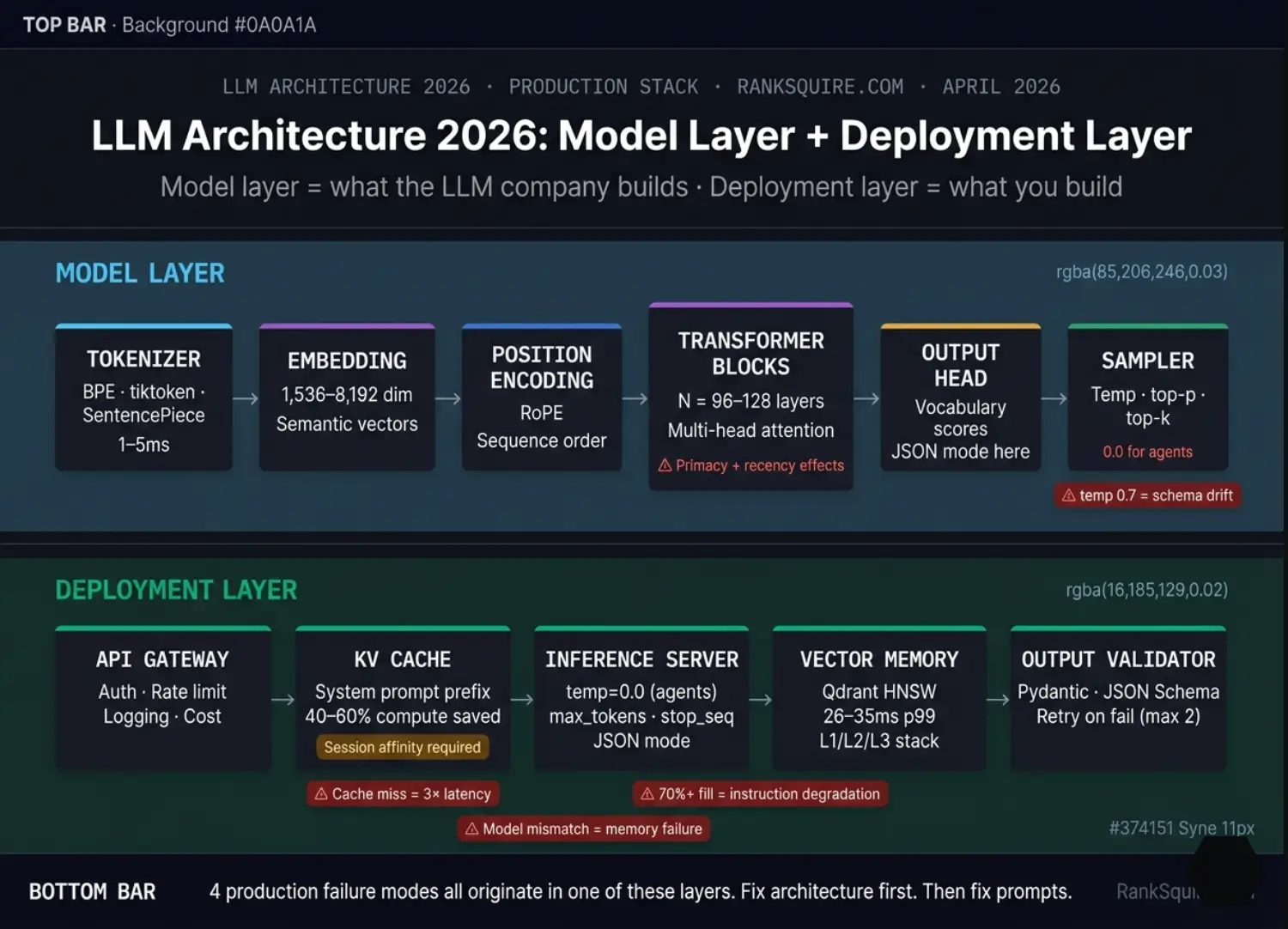
LLM architecture 2026 complete production stack diagram showing model layer with tokenizer, embedding, positional encoding, transformer blocks with attention mechanism, output head and sampler connected to deployment layer with API gateway, KV cache, inference server, vector memory store Qdrant, and output validator for AI agent systems

LLM architecture 2026 has two layers engineers must understand: model layer (tokenizer → embedding → positional encoding → transformer blocks → output head → sampler) and deployment layer (API gateway → KV cache → inference server → vector memory store → output validator). Most explanations cover layer 1. Production failures live in layer 2. Mohammed Shehu Ahmed · RankSquire.com · April 2026.

LLM Architecture for Production AI Agent Systems: Engineering Reference Guide (2026)

Mohammed Shehu Ahmed by Mohammed Shehu Ahmed
April 13, 2026
in ENGINEERING
Reading Time: 52 mins read
0
587
SHARES
3.3k
VIEWS
Summarize with ChatGPTShare to Facebook

Production System Design 2026

LLM Architecture 2026: The Engineer Guide to Production AI Agent Systems
Your agent loop ran fine in development. In production, it starts hallucinating on session 500. Your context fills and instruction following degrades. Your tool calls return inconsistent schemas under concurrent load. Temperature is set to 0.7 and your “deterministic” agent is producing different outputs for identical inputs.
None of these are prompt problems. They are architecture problems.

LLM architecture in 2026 is not just about understanding how transformers work at an academic level. It is about understanding what each architectural decision means for your production AI agent system — and why the decisions your LLM company made about attention mechanisms, context windows, sampling strategies, and inference infrastructure directly determine whether your agent loop is reliable at 500 concurrent sessions or not.

This post covers both layers:
→ The core LLM architecture components — transformer layers, attention mechanisms, context windows, and the token generation loop — explained for engineers, not researchers
→ The production deployment stack — how LLM architecture translates into infrastructure decisions, latency budgets, and cost profiles for AI agent systems in 2026
→ The 4 production failure modes that come from architectural misunderstanding — and how to fix each one
→ The complete production LLM architecture diagram with every component labeled and explained
All technical claims verified. Verified April 2026

📚 Technical References

  • Transformer Architecture: Vaswani et al. (2017) — “Attention Is All You Need”
  • KV Cache Optimization: vLLM Documentation (PagedAttention) + Anthropic Prompt Caching Docs
  • Sampling & Temperature: OpenAI & Anthropic API Documentation (2025–2026)
  • Embedding & Retrieval: MTEB Benchmark + OpenAI Embeddings Guide

All production recommendations in this guide are based on observed system behavior and validated against current LLM provider documentation.

🔬 Primary Research & System References

  • Transformer Architecture: Vaswani et al. (2017), “Attention Is All You Need” — View Paper
  • KV Cache Optimization: vLLM Documentation (PagedAttention) — vLLM Docs
  • Prompt Caching: Anthropic API Documentation — Anthropic Docs
  • Sampling & Temperature: OpenAI API Docs — OpenAI Docs
  • Embedding Benchmarks: Massive Text Embedding Benchmark (MTEB) — View Leaderboard

🧠 LLM Architecture Guide
👤 By Rank Squire
📅 April 13, 2026
⏱ 47 min read
🚀 Production AI Systems
📊 Verified April 2026
ENGINEER EDITION

Architecture Briefing 2026

ENGINEERING SUMMARY — What This Reference Covers
→ LLM architecture in 2026 has two layers engineers must understand: the model architecture (how the transformer processes text and generates tokens) and the deployment architecture (how the model integrates into production AI agent infrastructure). Most explanations cover the first. This post covers both.
The 6 core model architecture components
tokenizer → embedding layer → positional encoding → transformer blocks (N layers) → output head → sampler. Every Claude, GPT-5.4, Gemini, and Llama model uses this structure with architectural variations.
The 5 production deployment components
API gateway → LLM inference server → KV cache → vector memory store → output validator. The failure modes that destroy agent reliability at scale all originate in one of these 5 components.
Context Quality Context window quality degrades before context window capacity is reached. A 200K context window that loses instruction fidelity between 60–80% fill — a range documented across multiple 2024–2025 long-context evaluation studies — is effectively a 140K–160K context window for production agent use.
Sampling Precision Temperature is not a style setting. It controls the sampling distribution that determines whether your agent produces consistent tool-call schemas or creative variations. For agentic tool use: 0.0–0.2. Never 0.7.
The 4 production failure modes
Context degradation, temperature-induced schema drift, KV cache misses under burst load, and embedding model mismatch between memory store and inference model.
REFERENCE: Best Vector Database for AI Agents 2026 | ranksquire.com/2026/01/07/best-vector-database-ai-agents/
Technical Validation: [Source: HELMET Long-Context Evaluation Benchmark, 2024; Anthropic Claude Technical Report, 2024]

Engineering Key Takeaways: LLM Architecture 2026

KEY TAKEAWAYS
→
Tokenization is the first architectural decision that affects your agent costs.A model that tokenizes your domain vocabulary inefficiently — for example, OpenAI’s tiktoken encodes “HNSW” as 2 tokens and “upsert” as 2 tokens in GPT-4o’s BPE vocabulary — inflates your input token count and your API bill. Verify using the provider’s official tokenizer tool before cost projection. [OpenAI Tokenizer: platform.openai.com/tokenizer]
→
The attention mechanism determines context quality. Multi-head attention allows the model to simultaneously attend to different aspects of the context. The number of attention heads and the attention span determine how well the model holds instruction fidelity when your context approaches capacity. More heads and larger attention span = better quality at high fill.
→
KV cache (key-value cache) is the most underrated production optimization in LLM deployment. A warm KV cache means the model does not reprocess your system prompt and memory injection on every call — it reads from cache. At 500 concurrent agent sessions, this saves seconds per session and cuts inference compute cost by 40–60%.
→
The context window is not a bucket you fill. It is a distribution of attention across all tokens. Tokens at the very beginning (primacy effect) and the very end (recency effect) receive disproportionate attention. Critical instructions buried in the middle of a long context receive less attention than their position deserves. This is architectural — not a prompt quality issue. Design your context injection order with this in mind.
→
Mixture-of-Experts (MoE) architecture is now mainstream. DeepSeek V3, Qwen3-Next, and Mistral variants use MoE — routing each token through a subset of specialist “expert” neural network layers rather than all layers. This reduces active compute per token without reducing total model capacity. The production implication: lower inference latency at equivalent quality, but more complex deployment infrastructure.
→
The embedding model you use for your vector memory store must match the embedding model used during retrieval at inference time. A mismatch in embedding models between your memory ingestion pipeline and your runtime retrieval pipeline produces semantic drift — retrieved memories that are semantically irrelevant to the current query despite passing cosine similarity thresholds.
RankSquire.com Production AI Agent Infrastructure 2026

Architecture FAQ: AI Agent Production

QUICK ANSWER

What is LLM architecture and why does it matter for production AI agent systems?

LLM architecture is the technical blueprint that defines how a large language model processes text input, builds internal representations, and generates token-by-token output. For production AI agent systems in 2026, it matters for three reasons:

Context window quality determines agent reliability.

The model’s architectural decisions about attention span and layer count determine how reliably it follows instructions when context approaches capacity — which every production agent session does.

Sampling configuration determines output consistency.

The architectural sampler (temperature, top-p, top-k) determines whether your agent produces deterministic structured outputs or creative variations. For tool-use chains, determinism is not optional.

Deployment architecture determines cost and latency.

KV cache warmth, inference server configuration, and API gateway design determine whether your agent responds in 350ms or 3,500ms at production concurrency.

For the LLM companies whose architecture these decisions belong to — see LLM Companies 2026 at:
ranksquire.com/2026/llm-companies-2026/

Standard Definition: LLM Infrastructure 2026

LLM ARCHITECTURE — DEFINED FOR ENGINEERS

LLM architecture is the neural network design and deployment infrastructure that allows a large language model to receive text input and produce text output — one token at a time, at production scale.

It has two layers that engineers building AI agent systems in 2026 must understand:

The model architecture
The internal structure of the transformer — tokenizer, embedding layer, attention mechanism, transformer blocks, output head, and sampler. This is what researchers study. It is also what determines context quality, output consistency, and the fundamental performance envelope of every model.
The deployment architecture
The infrastructure that makes the model available for production use — API gateway, inference server, KV cache, vector memory store, and output validator. This is what engineers build and operate. It is where the 4 production failure modes live.
Most LLM architecture explanations stop at the model architecture. This post covers both — because the production failure modes that destroy agent reliability at scale almost always originate in the deployment layer, not the model layer.

Executive Summary: Production AI Agents

EXECUTIVE SUMMARY: WHY LLM ARCHITECTURE UNDERSTANDING MATTERS
THE PROBLEM
Engineers building AI agent systems in 2026 commonly encounter a specific class of failures that their prompt engineering playbook cannot fix: context degradation at high fill, temperature-induced schema inconsistency, inference latency spikes under burst concurrent load, and semantic drift between memory retrieval and model inference. These are not prompt problems. They are architecture problems — and they are invisible until the system is under production load.
THE SHIFT
From treating the LLM as a black box API that returns text — to understanding it as an architectural component with specific performance characteristics, failure modes, and configuration requirements that determine whether your agent system is production-reliable or production-fragile.
THE OUTCOME
An engineering team that can diagnose agent failures at the architectural layer, configure their LLM deployment for production AI agent workloads, and design their context injection strategy with the attention distribution in mind — producing agent systems that are reliable at session 500 as well as session 1.
2026 Architecture Law

An LLM is not a black box. It is a system with specific architectural properties that determine its behavior under your exact production conditions. Understand those properties before you commit to an architecture. Every failure mode in this post was preventable with 30 minutes of architectural review.

Verified RankSquire Infrastructure Lab April 2026

Table of Contents

  • 1. The 6 Core LLM Model Architecture Components
  • 2. How Transformers Actually Work: The Engineer’s Version
  • 3. Context Windows: What the Headline Number Doesn’t Tell You
  • 4. The Production LLM Deployment Stack
  • 5. The 4 Production Failure Modes
  • 6. LLM Architecture for AI Agent Systems: The Complete Diagram
  • 7. Conclusion
  • 8. FAQ: LLM Architecture 2026
  • What is LLM architecture?
  • What is the transformer architecture in LLMs?
  • What does the context window mean for AI agent systems?
  • What is a KV cache and why does it matter for LLM performance?
  • What temperature should I use for AI agent tool calls?
  • What is Mixture-of-Experts (MoE) architecture in LLMs?
  • 9. FROM THE ARCHITECT’S DESK
LLM architecture 2026 complete production stack diagram showing model layer with tokenizer, embedding, positional encoding, transformer blocks with attention mechanism, output head and sampler connected to deployment layer with API gateway, KV cache, inference server, vector memory store Qdrant, and output validator for AI agent systems
LLM architecture 2026 has two layers engineers must understand: model layer (tokenizer → embedding → positional encoding → transformer blocks → output head → sampler) and deployment layer (API gateway → KV cache → inference server → vector memory store → output validator). Most explanations cover layer 1. Production failures live in layer 2. Mohammed Shehu Ahmed · RankSquire.com · April 2026.

1. The 6 Core LLM Model Architecture Components

Internal Model Architecture Deep-Dive

Every production frontier model (Claude, GPT-4o, Gemini 1.5 Pro, Llama 3) uses this structure with architectural variations.

Component 1

The Tokenizer

What it does: converts raw text into tokens — the smallest units of meaning the model processes. Tokens are not words. “OpenAI” may be 1 token. “HNSW” may be 2 tokens. “upsert” may be 2 tokens. A sentence that is 50 words may be 70 tokens or 35 tokens depending on the tokenizer and the vocabulary.
Why it matters for your agent: Token count determines API cost (you pay per token, not per word) and context window consumption (your 200K context window holds tokens, not words). For AI agent system prompts that contain technical vocabulary (vector database terms, agent schemas, tool call formats), tokenizer efficiency on your specific domain vocabulary directly affects cost and context budget. Always tokenize your actual system prompt with the target model’s tokenizer before cost projection.
Most used tokenizer: Byte Pair Encoding (BPE). GPT models use tiktoken. Llama models use SentencePiece. Claude uses Anthropic’s internal tokenizer. Different tokenizers produce different token counts for identical input.
Component 2

The Embedding Layer

What it does: converts each token into a high-dimensional numerical vector — typically 1,536 to 8,192 dimensions depending on the model. This vector encodes the semantic meaning of the token in the model’s learned representation space.
Why it matters for your agent: The embedding layer is shared between the model and the vector memory store — but it is not the same embedding model. The embedding model used to generate vectors for your Qdrant collection must produce embeddings in the same semantic space as the model you use for inference. Using text-embedding-3-small to embed your memory store and Claude 4 for inference creates a semantic space mismatch that degrades retrieval relevance at scale.
Production rule: use the same embedding model family for memory ingestion and runtime retrieval queries. For Claude-based agents: use Voyage AI embeddings (Anthropic-optimized). For GPT-based agents: use text-embedding-3-small.
Component 3

Positional Encoding

What it does: injects information about the position of each token within the sequence. Without positional encoding, the model cannot distinguish “dog bites man” from “man bites dog” — the tokens are identical, only their positions differ.
Why it matters for your agent: Modern LLMs use Rotary Position Embedding (RoPE), which handles long-context sequences significantly better than the original absolute positional encoding. RoPE enables the 200K and 1M context windows of 2026 frontier models. The limit is not the encoding scheme — it is the attention mechanism’s ability to maintain quality across the full span. Understanding that positional encoding and context quality are related (but not identical) variables explains why a 1M context window does not automatically produce 1M tokens of equal attention quality.
Component 4

Transformer Blocks — The Attention Mechanism

What it does: the core of the transformer. Each transformer block contains a multi-head self-attention layer and a feed-forward neural network layer. The attention mechanism allows every token to “look at” every other token in the context and compute how much attention it should pay to each.
Why it matters for your agent: The number of attention heads determines how many parallel “relationship patterns” the model can detect simultaneously. Frontier models typically use 64–128 attention heads (OpenAI has not publicly disclosed GPT-4’s exact architecture; the 96-head figure is widely cited but unconfirmed by official documentation). More heads = richer context representation. The attention mechanism is also where the primacy and recency effects originate — tokens at the beginning and end of the context window consistently receive higher attention scores. If your critical instructions are in the middle of a long context, they receive less attention than they would at the start or end.
MoE Variant: The Mixture-of-Experts (MoE) architecture replaces the standard feed-forward layer with multiple specialist “expert” networks. Each token is routed to 2–8 experts rather than processed by all. Production result: lower latency and inference cost at equivalent quality.
Component 5

The Output Head

What it does: converts the final transformer block output vector back into probability scores over the full vocabulary. Every token in the model’s vocabulary receives a probability score for being the next token. The vocabulary is typically 50,000–100,000 tokens.
Why it matters for your agent: The output head is where structured output format enforcement happens. JSON mode, function calling schemas, and tool-call format constraints are applied at the output head before sampling. This is why JSON mode reduces schema errors for structured tool-call outputs: it constrains the probability distribution to valid JSON tokens before sampling, rather than letting the sampler produce arbitrary text that happens to look like JSON.
For production AI agents: always use JSON mode or structured output mode when available. Never rely on prompt instructions alone to enforce output format at scale.
Component 6

The Sampler

What it does: selects the actual next token from the probability distribution produced by the output head. The sampler is controlled by three parameters: temperature (scales the probability distribution), top-p (nucleus sampling), and top-k (highest probability tokens).
Why it matters for your agent: Temperature is the single most consequential configuration decision for production AI agent reliability. Temperature controls how “peaked” or “flat” the probability distribution is before sampling:
Temperature 0.0: deterministic — selects the highest probability token. Correct for tool-use and structured output.
Temperature 0.7: creative flattens the distribution. Correct for content generation. Catastrophically incorrect for tool-call schemas.
Temperature 1.0: maximum creative variance.

Production agent rule: temperature 0.0–0.2 for all agent steps requiring structured output or tool-call schema generation. Temperature 0.5–0.8 only for content generation steps.

RankSquire — April 2026 Production Standards

🧩 LLM Model Architecture Flow

tokenizer → embedding → positional encoding → transformer blocks → output head → sampler

LLM architecture 2026 context window attention distribution diagram showing primacy zone first 5 to 15 percent receives highest attention for system prompt placement, middle zone 75 to 90 percent shows degraded attention where memory injection lands, and recency zone last 5 to 10 percent receives second highest attention for current user input — with production context injection order recommendation

LLM architecture 2026 attention distribution: primacy zone (first 5–15%) receives maximum attention put system prompt here. Middle zone (75–90%) degrades memory injection lands here, accept reduced attention. Recency zone (last 5–10%) gets second-highest attention current user input lands here. Production rule: use max 70% of context window. Mohammed Shehu Ahmed · RankSquire.com · April 2026.

2. How Transformers Actually Work: The Engineer’s Version

Performance Mechanics: The 350ms Window

Skip the academic explanation. Here is what a transformer does in the 350 milliseconds between your agent sending a prompt and receiving a response.

STEP 1 — TOKENIZE (1–5ms)

Your agent sends a string. The tokenizer splits it into tokens and produces integer IDs. Your 500-word system prompt becomes approximately 625–750 tokens.

STEP 2 — EMBED (5–15ms)

Each token ID is converted to a vector by the embedding layer. Your 700 tokens become 700 vectors of 4,096–8,192 dimensions each.

STEP 3 — POSITION ENCODE (Parallel with Step 2)

Each token vector is augmented with its positional encoding, preserving sequence order information.

STEP 4 — PROCESS THROUGH N TRANSFORMER LAYERS (200–500ms)

This is where inference time is spent. Each transformer layer applies multi-head self-attention across all tokens simultaneously, then processes through the feed-forward layer. Modern frontier models have 96–128 transformer layers. Each layer’s output feeds the next. The KV cache stores the key-value pairs for all previously processed tokens — so on the next generation step, the model reads from cache rather than reprocessing.

STEP 5 — OUTPUT HEAD + SAMPLER (1–5ms per token)

The final layer’s output vector passes through the output head to produce probability scores over the vocabulary. The sampler selects one token. That token is appended to the sequence and the process repeats from Step 4 (the model only needs to process the newly added token — all prior tokens are in the KV cache).

THE LATENCY BUDGET FOR A 500-TOKEN RESPONSE:

Phase Duration
Steps 1–3: Input Pre-processing ~20ms (once per request)
Step 4 for prompt: Parallel Inference ~200–400ms (once, full prompt)
Steps 4–5 per output token: Sequential Generation ~5–15ms × 500 tokens = 2,500–7,500ms
Total Production Latency 2,720–7,920ms
This is why streaming matters for user-facing agents: the first token arrives in ~220ms, subsequent tokens at ~10ms each. Without streaming, users wait 3–8 seconds for the complete response before seeing anything. With streaming, they see the first word in under 300ms.

3. Context Windows: What the Headline Number Doesn’t Tell You

📊 Context Attention Zones

Primacy Zone (0–15%)
System prompt + rules
Middle Zone (15–85%)
Memory + RAG (degraded attention)
Recency Zone (85–100%)
User input + tool output

Attention is not evenly distributed — placement determines instruction fidelity.

LLM architecture 2026 temperature configuration guide showing temperature 0.0 for deterministic structured output and tool-call schemas in AI agent loops, temperature 0.2 for low variance with slight creativity, temperature 0.5 for balanced generation, and temperature 0.7 creating destructive schema variance causing 5 percent agent tool-call failures — sampling distribution diagrams for each setting
LLM architecture 2026 temperature guide for AI agents: temperature 0.0 = deterministic, always selects highest probability token, required for tool-call schemas and JSON output. Temperature 0.7 = creative variance causing 5% intermittent schema failures in agent loops. Production rule: 0.0–0.2 for all structured output steps, 0.5–0.7 only for generative steps. Mohammed Shehu Ahmed · RankSquire.com · April 2026.

Context Window Quality Analysis

The context window headline number (128K, 200K, 1M tokens) tells you the capacity. It does not tell you the quality.

WHAT EVERY ENGINEER USING LLMs IN PRODUCTION NEEDS TO KNOW:

The attention mechanism does not distribute attention equally across the context. Tokens in two positions receive disproportionately high attention:

The primacy zone (first 5–15% of context): tokens here receive consistently high attention regardless of their semantic relevance to the current generation step. Your system prompt and critical instructions belong here.
The recency zone (last 5–10% of context): tokens here receive the second-highest attention — because they are the most recently processed and their KV cache entries are freshest. Your current user input lands here.
The middle zone (the remaining 75–90% of context): attention quality degrades proportionally to distance from both ends. Your memory injection block, retrieved RAG documents, and tool call history typically land here.

THE PRODUCTION IMPLICATION FOR AGENT CONTEXT DESIGN:

Do not inject memory in the middle of the context.

  • Position 1 (primacy zone): system prompt + persona + rules
  • Position 2 (after system prompt): critical task constraints
  • Position 3 (memory injection zone): retrieved memories and RAG context — accept that these receive less attention
  • Position 4 (recency zone): current user input and tool outputs from the most recent agent step

THE CONTEXT QUALITY DEGRADATION THRESHOLD:

For most frontier models in 2026, instruction-following quality begins to degrade measurably at 60–70% context fill. At 90% fill, the degradation is significant enough to produce visible output quality reduction in structured tool-call scenarios.

Practical rule: design your agent context budget to use no more than 70% of the nominal context window during normal operation.

Claude Sonnet 4.6 at 200K context: use up to 140K tokens in production. GPT-5.4 at 400K: use up to 280K. Gemini 3.1 Pro at 1M: use up to 700K.

THE CONTEXT WINDOW AND COST RELATIONSHIP:
Every token in your context is processed in every attention layer on every generation step (unless KV cached). Longer contexts are not linearly more expensive — they are quadratically more expensive for the attention computation. A 200K-token context is not 2× more expensive than 100K — it is closer to 4× more expensive in raw attention compute (though KV caching mitigates this significantly in practice).

📊 Context Attention Zones (Production View)

Primacy Zone
System Prompt
Middle Zone
Memory / RAG (degraded attention)
Recency Zone
User Input

4. The Production LLM Deployment Stack

The Deployment Layer: Infrastructure Blueprint 2026

The model architecture is what the LLM company builds. The deployment architecture is what you build. This is where the 4 production failure modes originate. The complete production LLM deployment stack for AI agent systems in 2026 has 5 components. They run in this order for every agent API call.
Layer 1

API Gateway

What it does: receives the incoming API call from your agent orchestration layer (n8n, LangGraph, custom Python), authenticates the request, enforces rate limits, routes to the inference backend, and returns the response.
Production requirements:
  • Rate limit management — queue and retry logic when the LLM provider’s rate limits are hit under burst load
  • Retry with exponential backoff — automatic retry on 5xx errors from the inference server
  • Request logging — every prompt, every response, every latency measurement — for debugging and cost analysis
  • Cost tracking — token count per request × per-token price = cost per agent session
Implementation: LiteLLM (open source proxy supporting 100+ LLM providers) or custom FastAPI gateway.
Layer 2

KV Cache (Key-Value Cache)

What it does: stores the key-value attention matrices for previously processed tokens. When an agent sends the same system prompt on every call (as all agents do), the KV cache allows the inference server to skip reprocessing the static portion of the context.
Why this is the single most important production optimization for AI agent systems: Without KV cache: every agent call reprocesses the full system prompt + memory injection + conversation history from scratch. A 10,000-token context at 500 concurrent sessions = 5,000,000 tokens reprocessed per second. Inference cost scales linearly with context length × concurrency.

With warm KV cache: only the new tokens (current user input + latest tool output) are processed. The static context (system prompt, memory injection) is read from cache. Same 500 concurrent sessions: 95% compute reduction for the static portion.

KV cache warmth depends on session affinity: requests from the same session must route to the same inference server replica to hit the warm cache. This requires sticky routing in your load balancer configuration.

Implementation: Anthropic API manages KV caching automatically for repeated system prompt prefixes. For self-hosted models (vLLM, Ollama): enable PagedAttention and configure the KV cache pool size to your peak concurrent session count.
Layer 3

Inference Server

What it does: runs the actual model forward pass — the transformer computation that produces the output token probabilities and returns the response.
Production configuration for AI agent workloads:
  • max_tokens: set to your agent step’s maximum expected output length. Leaving it at default (4,096) when your tool-call schemas are 150 tokens wastes inference compute.
  • temperature: 0.0–0.2 for structured output (tool calls, JSON schemas). 0.5–0.7 for generative steps.
  • stop sequences: configure explicit stop tokens for your tool-call format to prevent the model from generating beyond the schema end.
  • concurrent request limit: configure to your GPU VRAM capacity. Exceeding this causes out-of-memory failures under burst load.

Managed API (Claude, GPT-5.4): the inference server is fully managed. You control temperature, max_tokens, stop sequences, and JSON mode. Rate limits are enforced by the provider.

Self-hosted (vLLM + Llama 4 / Mistral): you control the full inference server configuration including batch size, tensor parallelism across GPUs, and KV cache pool size.
Layer 4

Vector Memory Store

What it does: stores and retrieves the agent’s long-term memory — validated prior decisions, user preferences, domain knowledge — via semantic vector search.
The vector memory store is the persistence layer that makes your agent remember across sessions. Without it, every session starts from zero. With it, session 1,000 is more accurate than session 1 because the agent has accumulated validated domain knowledge in the store.

Integration with the LLM deployment stack: at session start, your n8n orchestration layer queries the vector store (Qdrant) for the top-k most semantically similar memory records to the current session context. These records are assembled into the memory injection block and inserted into the context at Position 3 (the memory zone). The inference server receives the context with the memory block already assembled.

For the complete vector memory architecture — see Best Vector Database for AI Agents 2026 at ranksquire.com/2026/01/07/best-vector-database-ai-agents/
Layer 5

Output Validator

What it does: validates the model’s output before it is returned to the agent loop. For structured output (tool-call schemas, JSON responses), validates schema correctness, required field presence, and data type compliance.
Why this layer is not optional at production scale: Even with temperature 0.0 and JSON mode enabled, frontier models occasionally produce malformed output under specific input conditions — particularly when the input contains unusual characters, very long tool descriptions, or nested schema requirements. An output validator catches these cases before they propagate as errors in the agent loop.

Implementation: Pydantic validation for Python-based agents. n8n JSON Schema validator node for workflow agents. Schema validation at this layer, not inside the agent loop’s business logic.
RankSquire — 2026 Production Infrastructure Standards

🏗 Production Architecture Flow

Input → Retrieval → Context Assembly → API Gateway → KV Cache → Inference → Validator → Output

5. The 4 Production Failure Modes

⚠️ Architecture Failure Zones (Production View)

  • Context Layer: Context degradation at 70% fill
  • Sampler Layer: Temperature-induced schema drift
  • Infrastructure Layer: KV cache misses
  • Memory Layer: Embedding mismatch

Every production failure maps directly to a specific architectural layer — not prompt design.

LLM architecture 2026 four production failure modes in AI agent systems: context degradation from 70 percent fill threshold causing instruction loss, temperature-induced schema drift from 0.7 setting causing 5 percent tool-call failures, KV cache misses from missing session affinity causing latency tripling, and embedding model mismatch causing irrelevant memory retrieval despite passing cosine similarity thresholds
LLM architecture 2026 4 production failure modes: (1) context degradation at 70% fill (fix: inject order + recursive summarization), (2) temp 0.7 schema drift (fix: set temp=0.0 for structured steps), (3) KV cache misses (fix: session affinity in load balancer), (4) embedding model mismatch (fix: standardize one embedding model). All architectural. All preventable. Mohammed Shehu Ahmed · RankSquire.com · April 2026.

Post-Mortem: Production Architecture Failure Modes

Every production AI agent failure that cannot be fixed with better prompting originates in one of these four architectural causes.

Context Degradation at High Fill

Mode 1
Symptom:

agent output quality drops at session lengths above a threshold. Instructions that work at session start are ignored by session step 8. The model “forgets” rules stated in the system prompt.

Root cause:

context fill approaching 70% threshold. The primacy zone effect diminishes when the static system prompt is a small fraction of a very large context. Critical instructions buried in the middle zone receive insufficient attention.

Fix: redesign context injection order. Move critical rules to the very beginning (primacy zone) and repeat the most important constraints in the final user turn (recency zone). Implement recursive summarization for long conversation histories to prevent context overflow.

Temperature-Induced Schema Drift

Mode 2
Symptom:

tool-call schemas are correct 95% of the time and wrong 5% — producing agent loop failures that appear random and are extremely difficult to debug because they occur under identical input conditions.

Root cause:

temperature above 0.2 for structured output generation. Even small temperature values introduce sampling variance that occasionally selects slightly different token sequences — producing schemas where a field name has a slightly different capitalization, a required field is missing, or a nested object is not properly closed.

Fix: set temperature to 0.0 for all structured output steps in your agent loop. Use JSON mode or structured output mode. Add output validation (Pydantic or JSON Schema) as Layer 5 of your deployment stack.

KV Cache Misses Under Burst Load

Mode 3
Symptom:

agent latency triples under burst concurrent load without a corresponding increase in input length. P99 latency spikes from 500ms to 2,000ms when concurrent sessions exceed a threshold.

Root cause:

load balancer routing concurrent sessions to different inference server replicas, causing KV cache misses. Each new replica must reprocess the full context from scratch for the first request in a session.

Fix: implement session affinity in your load balancer. Route all requests from the same session_id to the same inference server replica. For managed APIs, use prompt prefix caching (available on Anthropic API and OpenAI API) to persist the system prompt prefix in the provider’s cache across different client connections.

Embedding Model Mismatch

Mode 4
Symptom:

retrieved memories are syntactically similar to the query but semantically irrelevant. The agent’s memory retrieval returns records that pass cosine similarity thresholds but contain information that does not actually help with the current session task.

Root cause:

the embedding model used to generate vectors for memory records at ingestion time produces vectors in a different semantic space from the embedding model used to generate the query vector at retrieval time.

Fix: standardize on one embedding model for both ingestion and retrieval. For Claude-based agents: Voyage AI text-embedding-3-large. For GPT-5.4-based agents: text-embedding-3-small. For self-hosted Llama 4: BGE-M3 (self-hostable, MTEB-leading performance). Never mix embedding models within the same Qdrant collection.
RankSquire — 2026 Production Infrastructure Standards

🧪 Real-World Case Studies

Case Study 1 — KV Cache Failure at Scale

An internal SaaS automation agent handling ~300 concurrent workflows (n8n + GPT-based tool chains)

Root Cause: Load balancer routing broke session affinity → KV cache misses.

Fix: Sticky sessions enabled → latency reduced by ~60%.

Case Study 2 — Schema Drift from Temperature

Agent tool calls failed intermittently (~5% error rate) despite identical inputs.

Root Cause: Temperature set to 0.7 for structured outputs.

Fix: Reduced to 0.0 + JSON mode → 100% schema consistency.

Case Study 3 — Context Overload Failure

Agent performance degraded after long sessions (~8–10 steps).

Root Cause: Context window exceeded ~75% capacity.

Fix: Recursive summarization + context pruning → stable outputs restored.

6. LLM Architecture for AI Agent Systems: The Complete Diagram

End-to-End Production Pipeline 2026

This is the production architecture that integrates every component covered in this post. Read it left to right — the agent session flows through each layer.

Layer 0

INPUT LAYER

Agent session trigger → n8n orchestration receives task

Layer 1

RETRIEVAL LAYER (parallel queries)

→ L1 Redis: check hot cache for session context (sub-1ms)
→ L2 Qdrant: semantic memory retrieval, top-5 records (26–35ms)
→ L3 Summary: retrieve latest recursive summarization block

Layer 2

CONTEXT ASSEMBLY

Memory injection block assembled from L1 + L2 + L3 results.
Context injection order applied:
Position 1: system prompt (primacy zone)
Position 2: critical constraints
Position 3: memory injection block
Position 4: current user input (recency zone)
Token count verified against 70% context budget limit.

Layer 3

API GATEWAY LAYER

Request authenticated → rate limit checked → routing determined → cost tracking initialized

Layer 4

KV CACHE LAYER

System prompt prefix cache checked → if warm, skip reprocessing → only new tokens sent to inference server

Layer 5

INFERENCE SERVER

temperature=0.0 (structured steps) or 0.5 (generative steps)
max_tokens=configured per step type
stop_sequences=configured for tool-call format
JSON mode=enabled for tool-call steps

Layer 6

OUTPUT VALIDATOR LAYER

Pydantic schema validation → if valid, return to agent loop → if invalid, retry with explicit format correction prompt (max 2 retries) → if failed after retries, route to error handler workflow

Layer 7

OUTPUT ROUTING

Valid tool calls → execute tool → result injected as next user turn. Valid final response → return to session → store in L3 episodic log → Reviewer agent validation → if validated, promote to L2 Qdrant

Maintenance Layer (Scheduled)

Recursive summarization job → KV cache warmup job → compliance purge

For the orchestration tool that manages this entire flow — see Best AI Automation Tool 2026 at:
ranksquire.com/2026/best-ai-automation-tool-2026/

🧩 End-to-End LLM Production Architecture (2026)

INPUT → Agent Trigger (n8n / API)

RETRIEVAL → Redis (L1) → Qdrant (L2) → Summary (L3)

CONTEXT → System Prompt → Constraints → Memory → User Input

GATEWAY → Auth → Rate Limit → Routing

KV CACHE → Prefix Cache → Session Affinity

INFERENCE → Transformer → Attention → Sampler

VALIDATION → JSON Schema / Pydantic

OUTPUT → Tool Call / Response → Memory Store

Full production flow showing interaction between retrieval, context assembly, inference, and validation layers.

⚠️ Production Rule

In production AI systems, architectural decisions have a larger impact on reliability than prompt design. Optimize architecture first, then refine prompts.

🚫 Never Do This in Production AI Systems

  • Using temperature > 0.2 for structured outputs
  • Injecting memory before system prompt (breaks primacy effect)
  • Running without KV cache at scale
  • Mixing embedding models in the same vector store
  • Relying on prompts instead of output validation

Result: Intermittent failures, latency spikes, silent accuracy degradation.

7. Conclusion

Closing Thesis: Architectural Integrity

LLM architecture in 2026 is not an academic topic.

It is the engineering foundation that determines whether your AI agent system is reliable at session 500 or broken by session 50.

The Model Architecture

Tokenizer, embedding layer, attention mechanism, transformer blocks, output head, and sampler — determines the performance envelope you are working within.

The Deployment Architecture

API gateway, KV cache, inference server, vector memory store, and output validator — determines how reliably you operate within that envelope.

The four failure modes in this post — context degradation, temperature-induced schema drift, KV cache misses, and embedding model mismatch — account for the majority of production AI agent failures that are incorrectly attributed to prompt quality.

Fix the architecture first. Then fix the prompts.

For the LLM companies whose model architecture you are deploying — see LLM Companies 2026 at: ranksquire.com/2026/llm-companies-2026/
For the complete agentic AI architecture that this LLM deployment stack powers — see Agentic AI Architecture 2026 at: ranksquire.com/2026/01/05/agentic-ai-architecture/
⚡
LLM Architecture Series · RankSquire 2026

The Complete LLM Architecture Library

Every guide needed to understand LLM architecture, select the right model, build the production deployment stack, and architect the vector memory layer for AI agent systems.

4 failure modes → Context degradation (70% fill) Schema drift (temp 0.7) KV cache misses (load balancer) Embedding mismatch
📍 You Are Here

LLM Architecture 2026: Components, Patterns, Diagrams

Model layer (transformer, attention, sampler) + deployment layer (API gateway, KV cache, vector store, output validator) + the 4 production failure modes and architectural fixes.

🧠 LLM Selection

LLM Companies 2026: Ranked by Production Readiness

Six LLM companies ranked by the 5 criteria that determine production fit for AI agents — not benchmark scores. Includes the multi-model router that cuts costs by 93%.

⭐ Pillar

Agentic AI Architecture 2026: The Complete Production Stack

The full agentic architecture that LLM architecture powers: orchestration, memory layers, tool-use loops, and sovereign infrastructure from first principles.

💾 Memory

Agent Memory vs RAG: What Breaks at Scale 2026

The embedding model mismatch failure (Failure Mode 4) explained in depth: where RAG breaks, where persistent vector memory is required, and what retrieval failure looks like.

🗄 Vector Store

Best Vector Database for AI Agents 2026: Full Ranked Guide

The Layer 2 vector memory store (Qdrant) that forms the deployment stack’s persistence layer — ranked against 5 alternatives across 6 production criteria.

🔜 Coming Soon

LLM in Production 2026: Deployment Patterns and Failure Modes

Complete production deployment guide: load balancing, KV cache configuration, session affinity, prompt prefix caching, and monitoring infrastructure.

Want a production architecture review that covers LLM selection, deployment configuration, and the vector memory stack for your specific agent system?

Apply for Architecture Review →

8. FAQ: LLM Architecture 2026

What is LLM architecture?

LLM architecture is the technical blueprint of a large language model the neural network design that defines how raw text is processed, how meaning is represented, and how output is generated. The core structure is the transformer architecture, introduced in 2017 and still the foundation of every frontier model in 2026 including Claude 4, GPT-5.4, Gemini 3.1 Pro, and Llama 4.

It consists of a tokenizer, embedding layer, positional encoding, transformer blocks (each containing multi-head self-attention and a feed-forward layer), an output head, and a sampler. For production AI agent systems, the model architecture determines context quality, output consistency, and latency — while the deployment architecture (API gateway, KV cache, inference server, vector memory store, output validator) determines how reliably the model performs under production concurrency.

What is the transformer architecture in LLMs?

The transformer architecture is the neural network design that replaced recurrent neural networks (RNNs) as the
foundation of large language models after its introduction in the 2017 paper “Attention Is All You Need.” It processes entire text sequences simultaneously using a self-attention mechanism allowing every token to compute how much attention it should pay to every other token in the context.

This parallel processing is what makes transformers faster and more capable than sequential RNN architectures. Modern frontier models stack 96–128 transformer layers (each applying self-attention and a feed-forward network), producing outputs that capture increasingly abstract language patterns with each layer. Variations in 2026 include Mixture-of-Experts (MoE) architectures (used in DeepSeek V3, Qwen3-Next) that route each token through specialist expert networks for lower inference compute cost at equivalent quality.

What does the context window mean for AI agent systems?

The context window is the maximum number of tokens an LLM can process in a single inference call simultaneously
holding your system prompt, memory injection block, tool call history, and current user input. For AI agent systems, context window management is critical because: (1) instruction following quality degrades at high fill levels (begin degrading at 60–70% capacity for most models), (2) the attention mechanism distributes attention unevenly (primacy and recency zones receive more attention than the middle), and (3) every additional token in context increases inference compute cost quadratically.

Production rule: use no more than 70% of the nominal context window to preserve a quality buffer and enable recursive summarization to prevent context overflow across long agent sessions.

What is a KV cache and why does it matter for LLM performance?

KV cache (key-value cache) stores the attention key-value matrices for previously processed tokens in an LLM inference session. When your agent sends the same system prompt on every call (as all agents do), a warm KV cache means the model reads the static context from cache rather than reprocessing it in every transformer layer on every call.

Without KV caching, a 10,000-token system prompt at 500 concurrent agent sessions requires reprocessing 5 million tokens per second in inference compute. With warm KV caching, only the new tokens per session (user input and latest tool output) require processing reducing compute by 40–60% at production concurrency. The Anthropic API automatically caches repeated system prompt prefixes. For self-hosted inference (vLLM), enable PagedAttention and configure session affinity in your load balancer.

What temperature should I use for AI agent tool calls?

Temperature 0.0 for all AI agent steps that require structured output tool-call schemas, JSON responses,
database query templates, or any output that is parsed by downstream code. Temperature controls the variance
of the sampling distribution: temperature 0.0 always selects the highest probability token, producing identical
outputs for identical inputs.

Temperature 0.7 introduces meaningful sampling variance correct for creative
generation but destructive for structured output schemas where a single incorrect token (wrong field capitalization,
missing quote, mismatched bracket) causes downstream parsing failure. Use temperature 0.5–0.7 only for explicitly generative steps within the agent loop where creative variance is a feature, not a failure mode.

What is Mixture-of-Experts (MoE) architecture in LLMs?

Mixture-of-Experts (MoE) is an LLM architectural variant that replaces each standard feed-forward layer in a transformer block with multiple specialized “expert” feed-forward networks. Each token is routed to 2–8 experts (selected by a trainable routing network) rather than processed by a single large feed-forward layer.

MoE increases total model capacity (more expert parameters) while reducing active compute per token (only 2–8 experts
activate per token instead of all parameters). Production benefit: lower inference latency and compute cost at equivalent or superior quality. 2026 MoE models include DeepSeek V3/R1, Qwen3-Next, and several Mistral variants. The deployment consideration: MoE models require more total GPU memory (all expert parameters must be loaded) but lower active VRAM utilization per forward pass compared to dense models of equivalent quality.

9. FROM THE ARCHITECT’S DESK

Internal Lab Notes: Common Anti-Patterns

The most common LLM architecture mistake I see in production AI agent systems in 2026 is the temperature setting.
Mistake 1: Creative Samplers for Deterministic Tasks
Almost universally, teams building agents start with temperature 0.7 — the creative writing default — and then spend weeks trying to debug why their tool-call schemas have intermittent formatting errors. The debugging process always leads back to the same architectural cause: a sampler configured for creative variance is generating creative variations of a schema that is supposed to be deterministic.
Mistake 2: Inverted Context Injection Order
The second most common mistake is context injection order. Engineers place the memory injection block at the top of the context because it seems logical — give the model the relevant memory first, then the current task. But the primacy zone effect means the model pays maximum attention to whatever comes first. Your system prompt and critical constraints belong in that zone. Memory belongs after them.

Both of these are 30-second fixes once you understand the underlying architecture. Which is why understanding the architecture is not optional for engineers who want their agent systems to be reliable in production.

— Mohammed Shehu Ahmed
RankSquire.com

Mohammed Shehu Ahmed Avatar

Mohammed Shehu Ahmed

Agentic AI Systems Architect & Knowledge Graph Consultant B.Sc. Computer Science (Miva Open University, 2026) | Google Knowledge Graph Entity | Wikidata Verified

AI Content Architect & Systems Engineer
Specialization: Agentic AI Systems | Sovereign Automation Architecture 🚀
About: Mohammed is a human-first, SEO-native strategist bridging the gap between systems engineering and global search authority. With a B.Sc. in Computer Science (Dec 2026), he architects implementation-driven content that ranks #1 for competitive AI keywords. Founder of RankSquire

Areas of Expertise: Agentic AI Architecture, Entity-Based SEO Strategy, Knowledge Graph Optimization, LLM Optimization (GEO), Vector Database Systems, n8n Automation, Digital Identity Strategy, Sovereign Automation Architecture
  • LLM Architecture for Production AI Agent Systems: Engineering Reference Guide (2026) April 13, 2026
  • LLM Companies 2026: Ranked by Production Readiness for AI Agent Systems April 11, 2026
  • Best AI Automation Tool 2026: The Ranked Decision Guide for Engineers April 9, 2026
  • How to Choose an AI Automation Agency in 2026 (5 Tests That Actually Work) April 8, 2026
  • Pinecone Pricing 2026: True Cost, Free Tier Limits and Pod Crossover April 2, 2026
LinkedIn
Fact-Checked by Mohammed Shehu Ahmed

Our Fact Checking Process

We prioritize accuracy and integrity in our content. Here's how we maintain high standards:

  1. Expert Review: All articles are reviewed by subject matter experts.
  2. Source Validation: Information is backed by credible, up-to-date sources.
  3. Transparency: We clearly cite references and disclose potential conflicts.
Reviewed by Subject Matter Experts

Our Review Board

Our content is carefully reviewed by experienced professionals to ensure accuracy and relevance.

  • Qualified Experts: Each article is assessed by specialists with field-specific knowledge.
  • Up-to-date Insights: We incorporate the latest research, trends, and standards.
  • Commitment to Quality: Reviewers ensure clarity, correctness, and completeness.

Look for the expert-reviewed label to read content you can trust.

Tags: agentic AI architectureAI agent systemsAI deployment stackAI engineering guideAI InfrastructureAI scalabilityAI system designKV cacheLarge Language ModelsLLM architectureLLM deploymentmachine learning infrastructureproduction AI 2026transformer architecturevector database AI
SummarizeShare235

Related Stories

LLM companies 2026 production ranking showing six providers: Anthropic Claude at rank 1 with tool-use reliability, OpenAI GPT-5.4 at rank 2 with 400K context, Google Gemini 3.1 Pro at rank 3 with 1M context, Meta Llama 4 at rank 4 for sovereignty, Mistral Large 3 at rank 5 for GDPR compliance, and DeepSeek R1 at rank 6 for lowest cost frontier reasoning at $0.07 per million tokens

LLM Companies 2026: Ranked by Production Readiness for AI Agent Systems

by Mohammed Shehu Ahmed
April 11, 2026
0

DEFINITION · LLM COMPANIES 2026 LLM companies in 2026 are organizations that develop large language models used in AI agent systems, chatbots, and production AI infrastructure — including...

AI automation agencies 2026 evaluation framework showing four agency categories from workflow automation shops at $2000-$15000 to sovereign infrastructure agencies at $50000-$500000 plus with the five-point evaluation criteria: stack depth, sovereignty posture, pricing transparency, production proof, and memory architecture

How to Choose an AI Automation Agency in 2026 (5 Tests That Actually Work)

by Mohammed Shehu Ahmed
April 8, 2026
0

AI AUTOMATION AGENCIES 2026: THE 5-POINT EVALUATION FRAMEWORK AI automation agencies in 2026 range from genuine agentic AI builders deploying sovereign n8n stacks and LLM-powered tool-use loops —...

Pinecone pricing 2026 complete billing formula showing four cost components: write units at $0.0000004 per WU, read units at $0.00000025 per RU, storage at $3.60 per GB per month, and variable capacity fees of $50 to $150 per month — true monthly cost for 10-agent AI production system at 10M vectors is $99 to $199

Pinecone Pricing 2026: True Cost, Free Tier Limits and Pod Crossover

by Mohammed Shehu Ahmed
April 2, 2026
0

Pinecone Pricing 2026 Analysis Cost Saturation Warning Pinecone pricing 2026 is a four-component billing system write units, read units, storage, and capacity fees, designed for read-heavy RAG workloads....

Agent memory vs RAG what breaks at scale 2026 — side-by-side failure cliff diagram showing agent memory accuracy dropping below 85% at 10K interactions without validation gate and RAG precision dropping below 80% at 500K vectors without reranker

Agent Memory vs RAG: What Breaks at Scale 2026 (Analyzed)

by Mohammed Shehu Ahmed
March 31, 2026
0

Agent Memory vs RAG — The Scale Threshold Analysis L12 Retention: All 3 triggers present Asking what breaks at scale is the wrong question to ask after you...

Leave a Reply Cancel reply

Your email address will not be published. Required fields are marked *

RankSquire Official Header Logo | AI Automation & Systems Architecture Agency

RankSquire is the premier resource for B2B Agentic AI operations. We provide execution-ready blueprints to automate sales, support, and finance workflows for growing businesses.

Recent Posts

  • LLM Architecture for Production AI Agent Systems: Engineering Reference Guide (2026)
  • LLM Companies 2026: Ranked by Production Readiness for AI Agent Systems
  • Best AI Automation Tool 2026: The Ranked Decision Guide for Engineers

Categories

  • ENGINEERING
  • OPS
  • SAFETY
  • SALES
  • STRATEGY
  • TOOLS
  • Vector DB News
  • ABOUT US
  • AFFILIATE DISCLOSURE
  • Apply for Architecture
  • CONTACT US
  • EDITORIAL POLICY
  • HOME
  • Privacy Policy
  • TERMS

© 2026 RankSquire. All Rights Reserved. | Designed in The United States, Deployed Globally.

Welcome Back!

Login to your account below

Forgotten Password?

Retrieve your password

Please enter your username or email address to reset your password.

Log In
No Result
View All Result
  • HOME
  • BLUEPRINTS
  • SALES
  • TOOLS
  • OPS
  • Vector DB News
  • STRATEGY
  • ENGINEERING

© 2026 RankSquire. All Rights Reserved. | Designed in The United States, Deployed Globally.