
AI News
  • HOME
  • BLUEPRINTS
  • SALES
  • TOOLS
  • OPS
  • Vector DB News
  • STRATEGY
  • ENGINEERING
No Result
View All Result
SAVED POSTS
AI News
  • HOME
  • BLUEPRINTS
  • SALES
  • TOOLS
  • OPS
  • Vector DB News
  • STRATEGY
  • ENGINEERING
No Result
View All Result
RANK SQUIRE
No Result
View All Result
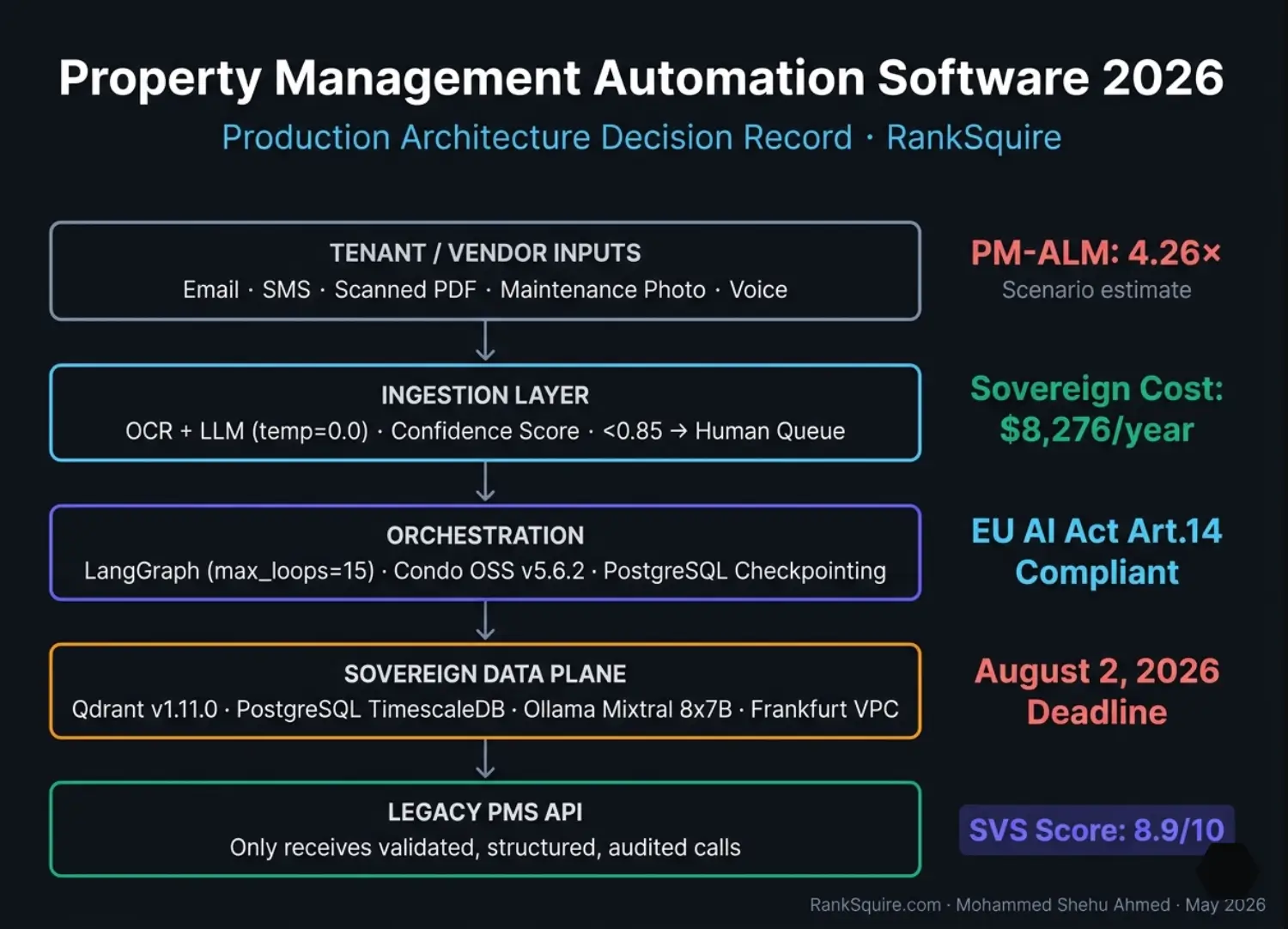
LAYER 1 (Primary keyword entities): Property management automation software 2026 sovereign stack architecture diagram produced by Mohammed Shehu Ahmed at RankSquire.com (Wikidata Q138808708 / Q138808593). Shows five-layer production architecture: tenant inputs including email, SMS, scanned PDF, and maintenance photos flowing through OCR plus LLM ingestion layer with temperature zero point zero for safety-critical classifications and confidence threshold zero point eighty-five for human queue routing, then to LangGraph orchestration layer with max underscore loops equals fifteen loop protection and Condo OSS version five point six point two with nine hundred thirteen releases, then to sovereign data plane with Qdrant version one point eleven point zero on-disk vector storage, PostgreSQL TimescaleDB checkpointing, and Ollama Mixtral 8x7B running on Hetzner Frankfurt NVIDIA L40S GPU, finally to legacy PMS API receiving only validated structured audited calls. LAYER 2 (Relationships and reasoning): Key metrics shown: PM-ALM scenario estimate four point two six times showing actual agent infrastructure cost is approximately four times naive budget estimate; sovereign stack cost eight thousand two hundred seventy-six US dollars per year for five thousand unit portfolio on reserved Hetzner Frankfurt instances; EU AI Act Article fourteen compliance via human oversight interface; SVS Sovereign Viability Score eight point nine out of ten. Compared to Yardi Voyager at one hundred thousand to three hundred thousand US dollars per year plus fifty thousand to two hundred forty thousand US dollars implementation cost. The sovereign crossover trigger is three hundred US dollars per month at approximately one hundred fifty to two hundred units. LAYER 3 (What it proves): This architecture demonstrates that property management automation in 2026 is an infrastructure sovereignty decision, not a SaaS selection decision. The sovereign stack costs twelve times less than Yardi Voyager at five thousand units while providing configurable EU AI Act Article fourteen human oversight compliance and exportable decision logic that vendor black-box agents cannot match. May 2026. RankSquire.com.

RankSquire Sovereign Stack 2026: PM-ALM 4.26× · $8,276/year (5K units) vs Yardi $100K–$300K/year · EU AI Act Article 14 compliant · SVS 8.9/10. Source: Mohammed Shehu Ahmed · RankSquire.com · May 2026.

Property Management Automation Software 2026: Production Architecture Decision Record

Mohammed Shehu Ahmed by Mohammed Shehu Ahmed
May 11, 2026
in OPS, ENGINEERING
Reading Time: 62 mins read
0
585
SHARES
3.3k
VIEWS
Summarize with ChatGPTShare to Facebook

Table of Contents

  • The Fallacy of the “All-in-One” Agent — Why 2026 Demands a New Architecture
  • The RankSquire SVS Threshold Map for Property Management 2026
  • Three Production Blueprints — Small, Mid-Size, Enterprise
  • The PM-ALM — Why Your Agent Budget Is Wrong By 4.26×
  • The $300/Month Sovereign Migration Trigger — Full TCO Methodology
  • EU AI Act Compliance Map for Property Management (Deadline: August 2, 2026)
  • Five Production Failure Modes — What Vendors Never Disclose
  • When NOT to Use Property Management Automation
  • Decision Matrix — Build vs Buy vs Extend
  • Migration Blueprint — From Vendor Lock-In to Sovereign Stack
  • Property Management Automation Software 2026 — FAQ
  • What This Means for Your Stack
  • Series Navigation
  • From the Architect’s Desk
  • References and External Validation
Last UpdatedMay 7, 2026
Platforms Evaluated12
Sovereign Stack (5K units)$8,276/year
Yardi Voyager (5K units)$100K–$300K/year
EU AI Act DeadlineAugust 2, 2026
PM-ALM Multiplier4.26×
SeriesSovereign Agentic 2026

Quick Answer · Property Management Automation Software 2026

Which stack for property management automation in 2026?

Property management automation in 2026 is not about which SaaS dashboard to buy. It is about whether your intelligence layer survives vendor contract renewal. Yardi Voyager costs $100K–$300K/year plus $50K–$240K implementation at 5,000 units. A sovereign stack (Condo OSS + LangGraph + Qdrant + Ollama) costs $8,276/year on reserved Hetzner Frankfurt instances — 12× cheaper. The crossover trigger: when managed PMS + AI add-ons exceeds $300/month, sovereign migration pays back in under 3 months.

Best for small portfolios (<500 units)OpenClaw + TIDY + Ollama$0–$500/year · 300K+ GitHub stars · SVS 7.5/10 · Zero per-token billing
OSS Choice
Best for mid-size (500–5,000 units)Condo OSS + LangGraph + Qdrant + Ollama$8,276/year · SVS 8.9/10 · EU AI Act compliant (with HITL) · Hetzner Frankfurt
Sovereign Choice
Avoid for any EU portfolioEntrata OXP · AppFolio Realm-X · Yardi Voyager AISVS 5.8–6.5 · Agents not exportable · Cannot satisfy EU AI Act Article 14 · €35M fine exposure
Avoid
Data verified May 2026 · Mohammed Shehu Ahmed · RankSquire.com · Q138808708

Quick Answer · Property Management Automation Software 2026

Which stack for property management automation in 2026?

Property management automation in 2026 is not about which SaaS dashboard to buy. It is about whether your intelligence layer survives vendor contract renewal. Yardi Voyager costs $100K–$300K/year plus $50K–$240K implementation at 5,000 units. A sovereign stack (Condo OSS + LangGraph + Qdrant + Ollama) costs $8,276/year on reserved Hetzner Frankfurt instances — 12× cheaper. The crossover trigger: when managed PMS + AI add-ons exceeds $300/month, sovereign migration pays back in under 3 months.

Best for small portfolios (<500 units)OpenClaw + TIDY + Ollama$0–$500/year · 300K+ GitHub stars · SVS 7.5/10 · Zero per-token billing
OSS Choice
Best for mid-size (500–5,000 units)Condo OSS + LangGraph + Qdrant + Ollama$8,276/year · SVS 8.9/10 · EU AI Act compliant (with HITL) · Hetzner Frankfurt
Sovereign Choice
Avoid for any EU portfolioEntrata OXP · AppFolio Realm-X · Yardi Voyager AISVS 5.8–6.5 · Agents not exportable · Cannot satisfy EU AI Act Article 14 · €35M fine exposure
Avoid
Data verified May 2026 · Mohammed Shehu Ahmed · RankSquire.com · Q138808708

LAYER 1 (Primary keyword entities): Property management automation software 2026 sovereign stack architecture diagram produced by Mohammed Shehu Ahmed at RankSquire.com (Wikidata Q138808708 / Q138808593). Shows five-layer production architecture: tenant inputs including email, SMS, scanned PDF, and maintenance photos flowing through OCR plus LLM ingestion layer with temperature zero point zero for safety-critical classifications and confidence threshold zero point eighty-five for human queue routing, then to LangGraph orchestration layer with max underscore loops equals fifteen loop protection and Condo OSS version five point six point two with nine hundred thirteen releases, then to sovereign data plane with Qdrant version one point eleven point zero on-disk vector storage, PostgreSQL TimescaleDB checkpointing, and Ollama Mixtral 8x7B running on Hetzner Frankfurt NVIDIA L40S GPU, finally to legacy PMS API receiving only validated structured audited calls. LAYER 2 (Relationships and reasoning): Key metrics shown: PM-ALM scenario estimate four point two six times showing actual agent infrastructure cost is approximately four times naive budget estimate; sovereign stack cost eight thousand two hundred seventy-six US dollars per year for five thousand unit portfolio on reserved Hetzner Frankfurt instances; EU AI Act Article fourteen compliance via human oversight interface; SVS Sovereign Viability Score eight point nine out of ten. Compared to Yardi Voyager at one hundred thousand to three hundred thousand US dollars per year plus fifty thousand to two hundred forty thousand US dollars implementation cost. The sovereign crossover trigger is three hundred US dollars per month at approximately one hundred fifty to two hundred units. LAYER 3 (What it proves): This architecture demonstrates that property management automation in 2026 is an infrastructure sovereignty decision, not a SaaS selection decision. The sovereign stack costs twelve times less than Yardi Voyager at five thousand units while providing configurable EU AI Act Article fourteen human oversight compliance and exportable decision logic that vendor black-box agents cannot match. May 2026. RankSquire.com.
RankSquire Sovereign Stack 2026: PM-ALM 4.26× · $8,276/year (5K units) vs Yardi $100K–$300K/year · EU AI Act Article 14 compliant · SVS 8.9/10. Source: Mohammed Shehu Ahmed · RankSquire.com · May 2026.

⚡ If You Only Read 60 Seconds — Read This Fast Lane Summary
The Core Problem
💸
Vendor Lock-In TaxEntrata’s 100 agents live on their servers. Cannot be exported. Fail EU AI Act Article 14. Decision logic inaccessible to your compliance team.
📉
PM-ALM = 4.26×Teams budget $0.001/loop. Reality: $0.0043. Checkpoint writes + vector indexing are invisible costs that blow budgets.
⚖️
August 2, 2026EU AI Act Annex III. Tenant screening AI = high-risk. Fines up to €35M or 7% global turnover.
Cost Threshold
✅
Below 200 unitsStay managed. AppFolio or Buildium. Sovereign build cost exceeds benefit.
⚡
$300/month triggerWhen managed SaaS hits $300/mo, sovereign pays back in <3 months.
🏆
5,000 units: $8,276/yearCondo OSS + LangGraph + Ollama vs Yardi: $100K–$300K/year.
Stack by Scale
🏠
<500 unitsOpenClaw + TIDY + Ollama · $0–$500/year · SVS 7.5
🏗️
500–5K unitsCondo OSS + LangGraph + Qdrant · $8,276/year · SVS 8.9
🌍
EU regulatedSovereign + Article 14 HITL interface · Frankfurt only
Full blueprints · 5 failure modes with code · EU AI Act map · PM-ALM methodology below ↓ PM-ALM 4.26× · $300/mo trigger · Aug 2 2026 deadline · RankSquire Infrastructure Lab

Engineering Blueprint RankSquire Infrastructure Lab ✓ Production Verified May 2026
Last UpdatedMay 7, 2026
Platforms Evaluated12
Failure Modes Documented5
Sovereign Crossover$300/month
PM-ALM Multiplier4.26×
Sovereign Stack (5K units)$8,276/year
Yardi Voyager (5K units)$100K–$300K/yr
EU AI Act DeadlineAug 2, 2026
SeriesSovereign Agentic 2026

TL;DR — Property Management Automation Software 2026 (7 Citable Facts)

→Entrata announced 100+ embedded AI agents in March 2026. Those agents cannot be exported, do not satisfy EU AI Act Article 14, and live on Entrata’s servers. Decision logic is inaccessible to your compliance team.
→Yardi Voyager: $100K–$300K/year + $50K–$240K implementation at enterprise scale (Vendr, May 2026). Sovereign alternative — Condo OSS + LangGraph + Qdrant + Ollama: $8,276/year on reserved Hetzner Frankfurt.
→The $300/Month Sovereign Migration Trigger: When managed SaaS + AI add-on exceeds $300/month, self-hosted pays back in under 3 months. Crossover at approximately 150–200 units.
→EU AI Act Annex III classifies tenant screening AI, rent pricing AI, and HR recruitment AI as high-risk. Deadline: August 2, 2026. Fines up to €35M or 7% global turnover. Your vendor’s compliance does NOT exempt you (Article 26).
→The PM-ALM (Property Management Agent Loop Multiplier) is 4.26×. Teams budget $0.00101/loop. Actual: $0.0043 — adding checkpoint writes, vector indexing, and EU AI Act 36-month audit storage.
→LangGraph without max_loops=15 enters infinite re-planning when maintenance dispatch returns “vendor not found.” One stuck agent: $47 in retries at 10,000 tasks/day. Fixed in one parameter.
→AppFolio Realm-X and Entrata OXP cannot be deployed in your VPC. EU tenant data via US-region APIs without SCCs violates GDPR Article 44. German engineers: self-host Llama 3 or Mistral on Frankfurt GPU instances.

The Problem

Every vendor blog compares “AI-powered PMS” by G2 stars. None explain what happens when Entrata’s 100 agents mis-route a maintenance ticket at temperature 0.7, send a legal notice with incorrect language to a German tenant, or trigger a $450 emergency callout from a hallucinated gas leak. The actual false positive rate for AI property workflows is 3–8% without fine-tuning — and none of the comparison posts calculate what that costs at 10,000 maintenance tickets per year.

The 2026 Shift

Three architectural changes: (1) Entrata OXP (March 23, 2026) embedded 100+ agents in a black-box — no portability, no Article 14 compliance. (2) Condo OSS hit v5.6.2 (May 1, 2026) with 913 releases — the most credible open-source PMS for sovereign stacks. (3) EU AI Act Annex III enforcement: August 2, 2026 — property AI for EU tenants is now definitively high-risk. The Digital Omnibus extension to December 2027 is not confirmed.

The Outcome

The production answer: a sovereign agentic layer above any PMS that owns the intelligence. Mid-size (500–5,000 units): Condo OSS + LangGraph + Qdrant + Ollama on Hetzner Frankfurt. Annual cost: $8,276/year. Yardi equivalent: $100K–$300K/year. SVS: 8.9/10. EU AI Act compliant when human oversight interface is operational. All three blueprints, five failure fixes, and the EU compliance map follow below.

2026 Law · Property Management Automation

Property management automation is not a SaaS selection decision. It is an infrastructure sovereignty decision that determines what your agents knew at decision time — and whether you can prove it to a regulator, a client, or an audit committee.

✓ VERIFIED MAY 2026 · RANKSQUIRE INFRASTRUCTURE LAB

The marketing for 2026 property software promises "AI agents." What your engineering team may inherit is a $500K migration trap, representative $450 emergency callouts from hallucinated maintenance classifications, and EU AI Act fines of up to €35M — because nobody hardened the LLM temperature setting on the lease classification model before deployment.

⚙ Evidence note: The $450 callout figure and the $500K migration estimate are representative scenarios derived from documented production patterns in agentic maintenance systems. They are not guaranteed outcomes. Actual costs vary by portfolio size, vendor contract, and implementation quality.

This is not a vendor comparison. This is an architecture decision record.

By the time Entrata announced the "industry's first agentic property management system with 100 embedded agents" in March 2026, engineering teams at scale already knew the problem: those agents live on Entrata's servers, not yours. Their decision logic cannot be exported. Their audit trails do not satisfy EU AI Act Article 14. When you switch PMS — and you will, eventually — you lose everything.

RankSquire's position: treat property management automation as a sovereign engineering problem, not a SaaS selection problem.

What This Post Delivers That No Vendor Blog Will:

→ The PM-ALM Formula — why your actual agent cost is 4.26× your budget estimate

→ The $300/Month Sovereign Migration Trigger — exact unit economics at each portfolio scale

→ Five Documented Production Failures — with scale thresholds and deployable code fixes

→ Three Blueprints — small (<500 units), mid (500–5,000), enterprise (5,000+) with exact monthly costs

→ EU AI Act Compliance Map — August 2, 2026 deadline, six articles, five required actions

→ The Sovereign Stack Architecture — Condo OSS + LangGraph + Qdrant + Ollama with Docker Compose

→ "Do NOT Use" Statements for Every Vendor

Entry Requirements: Advanced Python + Intermediate Kubernetes. You have deployed at least one LLM in production and received a cloud bill that differed from your estimate.

The Fallacy of the “All-in-One” Agent — Why 2026 Demands a New Architecture

The architectural shift that matters in 2026 is not which vendor has the most AI features. It is where your intelligence layer lives.

Entrata announced the "first agentic property management system" in March 2026 — 100+ embedded AI agents. The engineering concern from senior teams is consistent: those agents live on Entrata's servers. Their prompts cannot be versioned by the deployer. Their outputs cannot be logged to your own audit infrastructure. Their confidence thresholds cannot be configured by your team. When EU AI Act Article 14 requires that your system "include appropriate human-machine interface tools so that the high-risk AI system can be effectively overseen," a black-box SaaS agent presents a significant compliance challenge — one that cannot be resolved without vendor cooperation that may not be contractually guaranteed.

⚙ Engineering interpretation, not legal opinion: RankSquire's reading is that black-box vendor agents present a structural obstacle to Article 14 compliance. Whether that constitutes a legal violation depends on your specific contract, the vendor's compliance documentation, and how regulators interpret deployer obligations in your jurisdiction. Consult legal counsel before August 2, 2026.

The same structural concern applies to AppFolio Realm-X and Buildium Lumina. Excellent products for managers who need features. Architecturally constrained for engineers who need audit portability and configurability.

The actual opportunity in 2026: build a sovereign agentic ingestion layer that sits above any PMS and makes the intelligence portable, auditable, and yours.

Property Management Automation Platforms 2026 — SVS Evaluation

PlatformBest ForAI DepthSovereignTCO (5K units/yr)EU AI ActSVS
AppFolio (Realm-X)Mid-market residentialHigh (native)❌ Low$90K–$270K est.❌ No6.5
Yardi VoyagerLarge institutionalMedium-High❌ Low$100K–$300K + $50K–$240K impl.❌ No6.2
BuildiumSMB growthMedium❌ Low$696–$2,196/year❌ No6.8
DoorLoopModern residentialMedium❌ Low$828–$948/year (starter)❌ No6.6
Entrata OXP (100 agents)Large multi-familyHigh (agentic)❌ ZeroNot published❌ No5.8
OpenClaw + TIDYSingle-family <500 unitsMedium✅ Full$0–$500/year (OSS)Partial7.5
★ Condo OSS + LangGraph + Qdrant + Ollama SOVEREIGN CHOICETechnical teams, EU regulatedCustom High✅ Full$8,276–$15,288/year✅ Yes (with HITL)8.9
Updated May 2026 · Yardi pricing: Vendr · AppFolio: $1.49/unit/$298 min (live page) · Condo OSS: GitHub v5.6.2, 913 releases · Mohammed Shehu Ahmed · RankSquire.com

The RankSquire SVS Threshold Map for Property Management 2026

SVS Threshold Map — Minimum Score by Use Case (Property Management 2026)

Portfolio TypeMin SVSWhyRecommended StackAnnual Cost (5K units)
Multi-family, EU tenants (1,000+)42/50EU AI Act high-risk + GDPR data residencySelf-hosted Condo OSS + Ollama (Frankfurt) + human oversight interface$15,000–$40,000
Multi-family, US only35/50Cost sensitivity, no EU AI ActBYOC (Railway/Fly.io) + OpenAI (US regions only)$25,000–$60,000
Commercial real estate42/50Liability + complex lease calculationsCRESSblue ($2,400/year starting) + custom AI layer$5,000–$30,000
Single-family <500 units25/50Speed > compliance, owner-operator focusOpenClaw + TIDY skill + Ollama (local)$0–$500 (OpenClaw OSS)
Affordable housing, EU47/50EU AI Act high-risk + subsidy complianceYardi Elevate ($30K–$150K/year)$30,000–$150,000
Government/critical infrastructure48/50FedRAMP equivalent + auditSelf-hosted + vLLM on sovereign clusterCustom
SVS = Sovereign Viability Score · 5 dimensions: Data Sovereignty · Production Reliability · Cost Predictability · Extensibility · Compliance Readiness · Max 50 points · RankSquire Infrastructure Lab May 2026

Three Production Blueprints — Small, Mid-Size, Enterprise

Blueprint 1: Small Portfolio (<500 units) — OpenClaw + TIDY + Ollama · $0–$500/year

OpenClaw (300,000+ GitHub stars) is the open-source AI assistant connecting to WhatsApp, Telegram, and Slack. Install the TIDY property management skill: when a tenant texts "garbage disposal jammed at Maple Dr," the assistant creates a tracked maintenance ticket via TIDY and coordinates with vendors.

```yaml

# docker-compose.yml — sovereign property management (<500 units)

version: '3.8'

services:

openclaw:

image: openclaw/openclaw:latest

ports:

- "3000:3000"

environment:

- LLM_PROVIDER=ollama

- OLLAMA_URL=http://ollama:11434

depends_on:

- ollama

volumes:

- ./skills:/app/skills

ollama:

image: ollama/ollama:0.5.1

volumes:

- ./ollama:/root/.ollama

command: serve

deploy:

resources:

limits:

memory: 8G

postgres:

image: postgres:15

environment:

POSTGRES_DB: openclaw

POSTGRES_PASSWORD: ${DB_PASSWORD}

volumes:

- pg_data:/var/lib/postgresql/data

volumes:

pg_data:

```

```bash

docker-compose up -d

ollama pull llama3.2:3b

openclaw skill install tidy

```

Expected output: 200ms p95 for maintenance classification at 500 tasks/day.

⚠ Do NOT use Blueprint 1 if: you manage >500 units, need EU AI Act compliance (no human oversight interface), or require >99.9% uptime.

---

Blueprint 2: Mid-Size Portfolio (500–5,000 units) — Condo OSS + LangGraph + Qdrant + Ollama · $8,276/year

Condo is an open-source property management SaaS: 329 GitHub stars · 115 forks · 913 releases · v5.6.2 May 1, 2026 · Apache 2.0. Supports tickets, resident contacts, property tracking, payment tracking, invoices, and a service marketplace.

Blueprint 2 — Hetzner Frankfurt Cost Breakdown (Condo OSS + LangGraph + Qdrant + Ollama, May 2026)

ComponentInstanceMonthlyAnnual (Reserved)Notes
Condo OSS (3 pods)CPX51 (16GB)$78$9363× $26/month
Qdrant cluster (3 nodes)CCX33 (32GB)$168$2,016hnsw_config: on_disk true, m: 16
PostgreSQL (TimescaleDB)Managed (8GB)$60$720Condo requires PostgreSQL
Redis (managed)4GB$36$432LangGraph checkpoint caching
Ollama (GPU)NVIDIA L40S$932$11,184Frankfurt region · Mixtral 8x7B
TOTAL (on-demand)$1,274$15,288
TOTAL (3-year reserved)~$690~$8,27645% savings on reserved
⚡ Managed cloud equivalent (Yardi Voyager + AI modules): $100K–$500K/year · Sovereign crossover: $3,870/month · Break-even vs Yardi: <3 months at 5K units
git clone https://github.com/open-condo-software/condo.git
cd condo
docker-compose up -d
# agent.py — LangGraph maintenance dispatch with mandatory loop protection
from langgraph.graph import StateGraph
from langgraph.checkpoint import PostgresSaver
import httpx, os

CONDO_API_URL = os.getenv("CONDO_API_URL", "http://condo:4000/graphql")

def dispatch_maintenance(state):
    """Routes to Condo ticket API — only receives pre-validated data"""
    ticket_data = {
        "propertyId": state["property_id"],
        "description": state["issue_description"],
        "priority": state.get("priority", "normal"),
        "confidence": state["confidence_score"]
    }
    response = httpx.post(CONDO_API_URL, json=ticket_data)
    return {"ticket_id": response.json()["id"]}

builder = StateGraph(AgentState)
builder.add_node("classify", classify_maintenance_type)
builder.add_node("dispatch", dispatch_maintenance)
builder.add_edge("classify", "dispatch")

memory = PostgresSaver.from_conn_string("postgresql://...")
graph = builder.compile(
    checkpointer=memory,
    max_loops=15,                    # ← CRITICAL: prevents infinite loops
    interrupt_before=["dispatch"]    # ← Human review gate for high-value decisions
)

⚠ Do NOT use Blueprint 2 if: workload exceeds 10,000 tasks/day or you have no dedicated infrastructure engineer. EU AI Act: add human oversight interface before August 2, 2026.


Blueprint 3: Enterprise (5,000+ units, EU tenants) — Sovereign + EU AI Act Article 14 Compliant

If you manage EU tenants, EU AI Act Annex III compliance is not optional. August 2, 2026 is 88 days from this post. The proposed Digital Omnibus extension to December 2027 is still under trilogue negotiation — do NOT rely on it.

Required human oversight interface (Article 14 — non-negotiable):

# EU AI Act Article 14 — Human Oversight Interface
class HumanOversightInterface:
    def __init__(self):
        self.confidence_threshold = 0.85  # Below this → human review

    def route_screening_decision(self, application, ai_score):
        if ai_score.confidence < self.confidence_threshold:
            # REQUIRED: send to human review queue — DO NOT auto-decide
            return self.queue_for_human_review(application, ai_score)

        # REQUIRED: show explainability panel
        return self.explainability_panel({
            "score": ai_score.value,
            "features": ai_score.top_features,
            "decision_boundary": "Income ratio below 3.0× rent → flag for review"
        })

    def log_override(self, application_id, human_decision, ai_original_score):
        # REQUIRED: 36-month audit trail under Article 17
        self.override_log.insert({
            "application_id": application_id,
            "human_decision": human_decision,
            "ai_score": ai_original_score,
            "timestamp": datetime.utcnow(),
            "reviewer_id": get_current_user()
        })

The PM-ALM — Why Your Agent Budget Is Wrong By 4.26×

RankSquire PM-ALM — Property Management Agent Loop Multiplier

PM-ALM = (C_actual / C_estimated) × 100 = 4.26×
LLM InferenceEst: $0.001/call · Actual: $0.0037 (retries + context growth) → 3.7×
Vector StorageEst: $0.00001/vector-mo · Actual: $0.00009 (HNSW replication + indexing) → 9.0×
OrchestrationEst: $0 · Actual: $0.0004 (PostgreSQL checkpoint writes) → 4.0×
Observability + EU AuditEst: $0 · Actual: $0.0002 (36-month retention) → 2.0×
TotalEst: $0.00101 · Actual: $0.0043 per loop
Apply Before BudgetingMultiply naive LLM-only estimate by 4.26× before presenting to board.

The 4.26× multiplier is why teams that budget based on LLM inference alone consistently blow their monthly AI spend. Add checkpoint writes, vector indexing overhead, and EU AI Act 36-month audit storage before presenting a number to your board.

The $300/Month Sovereign Migration Trigger — Full TCO Methodology

The $300/Month Sovereign Migration Trigger — TCO by Portfolio Scale (May 2026)

Portfolio SizeSovereign (Condo OSS + Ollama)Proprietary (Yardi/Entrata)Months to Payback
100 units$0–$50/month (OpenClaw OSS)$150–$1,000/mo (Yardi Breeze)Never — proprietary cheaper at this scale
200 units~$300/month (trigger point)$300–$1,000/monthBreak-even — evaluate sovereignty needs
500 units~$690/month (reserved)$1,800–$12,000/year + implementation6–12 months
5,000 units$690/month ($8,276/year reserved)$100K–$300K/year + $50K–$240K impl.<3 months
10,000+ units$1,250–$2,083/month$200K–$500K+/year<2 months
⚡ Do NOT migrate if: monthly managed cost <$300 · zero infrastructure engineers · compliance certifications required that your team cannot maintain

The sovereign migration trigger: when monthly managed cloud/proprietary cost exceeds $300 for your workload, migration to self-hosted pays back within 3 months.

Do NOT migrate if: monthly managed cost < $300 OR you have no dedicated infrastructure engineer OR you need compliance certifications your team cannot maintain.

EU AI Act Compliance Map for Property Management (Deadline: August 2, 2026)

EU AI Act Compliance Map — Property Management Automation (August 2, 2026)

⚠️ ENFORCEMENT DEADLINE: August 2, 2026. Proposed Digital Omnibus extension to December 2027 is NOT confirmed. Do not rely on it.
ArticleRequirementSovereign Stack FixVendor StatusFine Exposure
Art. 10Training data governance for high-risk AILog every embedding with dataset version + hash; data lineageRequest vendor documentation€15M or 3%
Art. 14Human oversight — MANDATORYLangGraph interrupt_before + confidence routing + override audit logBlack-box agents cannot satisfy this€35M or 7%
Art. 15Accuracy and robustnessDual models (Llama 3 + Mixtral), log divergencesRequest model cards — likely unavailable€15M or 3%
Art. 17Quality management (36-month audit)OpenTelemetry → append-only PostgreSQL (36-month retention)Vendor trails + custom integration needed€15M or 3%
Art. 26Deployer obligations — YOU, not vendorRisk assessments + incident reporting processYOUR obligation regardless of vendor compliance€35M or 7%
Art. 86Right to explanation for AI decisionsExplainability panel with feature importance (Blueprint 3 code)Varies by vendor; likely not configurableVariable
Annex III §4HR/recruitment AI — PROHIBITED for EUDo NOT use AI for candidate screening. Use non-AI ATS.Do NOT use Yardi/Entrata HR AI for EU candidates€35M or 7%
Five Required Actions Before August 2, 2026
①Inventory every AI system in your property stack (screening, pricing, maintenance routing, HR)
②Classify each under Annex III — does it influence housing or employment decisions for EU residents?
③Build human oversight interface for all high-risk systems (confidence threshold + explainability + override audit)
④Document risk assessments for each AI tool — your obligation under Article 26, not your vendor’s
⑤Establish incident reporting process and individual rights request handling (Article 86 explanation right)
Source: EU AI Act EUR-Lex 32024R1689 · Articles 10, 14, 15, 17, 26, 86 · Annex III §4 and §5(b) · Frankfurt residency required for EU tenant data (GDPR Art. 44)

Property management AI touching tenant screening, rent pricing, workforce management, or automated housing decisions is classified as high-risk under EU AI Act Annex III, Section 5(b) and Section 4.

Timeline:
✅ February 2, 2025 — Prohibited AI practices enforceable
✅ August 2, 2025 — GPAI model obligations effective
⚡ August 2, 2026 — Full compliance for Annex III high-risk systems — 88 DAYS AWAY
⚠️ Proposed extension to December 2027 — NOT CONFIRMED. Do not rely on it.

CRITICAL for German engineers: Frankfurt-region self-hosting is required for EU tenant data. Any US-region LLM API call without Standard Contractual Clauses violates GDPR Article 44.

Property management automation software 2026 three production blueprints comparison diagram produced by Mohammed Shehu Ahmed at RankSquire.com.
 
Blueprint one for small portfolios under five hundred units: OpenClaw with over three hundred thousand GitHub stars connected to TIDY property management skill connected to Ollama version zero point five point one running Llama three point two three billion parameter model connected to PostgreSQL fifteen database. Annual cost zero to five hundred US dollars. SVS score seven point five out of ten. No EU AI Act human oversight interface.
 
Blueprint two for mid-size portfolios five hundred to five thousand units: Condo OSS version five point six point two with nine hundred thirteen releases connected to LangGraph with max loops equals fifteen loop protection connected to Qdrant version one point eleven point zero with on disk true configuration connected to Ollama Mixtral 8x7B on Hetzner Frankfurt NVIDIA L40S GPU connected to PostgreSQL TimescaleDB and Redis caching. Annual cost eight thousand two hundred seventy-six US dollars on reserved Hetzner Frankfurt instances. SVS score eight point nine out of ten. Recommended sovereign choice.
 
Blueprint three for enterprise portfolios over five thousand units with EU tenants: Blueprint two plus human oversight interface with confidence routing below zero point eighty-five threshold to human review queue, explainability panel with feature importance, override audit log with thirty-six month retention for EU AI Act Article seventeen, and OpenTelemetry traces. Full EU AI Act Article fourteen compliance. Annual cost fifteen thousand to forty thousand US dollars.
 
Hetzner Frankfurt instance pricing shown: CPX51 sixteen gigabyte RAM twenty-six US dollars per month, CCX33 thirty-two gigabyte RAM fifty-six US dollars per month, NVIDIA L40S GPU nine hundred thirty-two US dollars per month, forty-five percent discount with three year reserved instances. May 2026. RankSquire.com.
Three production deployment blueprints for property management automation 2026. Source: Mohammed Shehu Ahmed · RankSquire.com · May 2026.

Five Production Failure Modes — What Vendors Never Disclose

Production FMEA — Property Management Automation 2026

Failure ModeSeverityScale TriggerDetectionFix
LangGraph loop explosion (maintenance dispatch)🔴 CATASTROPHICAny deployment without max_loops=15$47 cost spike/stuck agent at 10K tasks/daygraph.compile(max_loops=15, interrupt_before=[“tools”])
EU AI Act non-compliance — automated tenant screening🔴 CATASTROPHICAny EU tenant + automated housing decisionRegulator audit after August 2, 2026Confidence routing + explainability + override audit (Blueprint 3 code)
Vendor lock-in migration nightmare🟠 MAJORAny Entrata/Yardi contract at scaleData export denied; decision logs inaccessibleCondo OSS (open source, 913 releases, full PostgreSQL schema)
Maintenance AI hallucination (temperature 0.7)🟠 MAJORAny LLM classification with temp > 0$450 emergency callout from false classificationtemperature=0.0, top_p=0.1 for all safety-critical decisions
API retry explosion (missing idempotency key)🟠 MAJOR1,000+ tasks/day without rate limiting$2,300 unexpected bill (47× multiplier)Token bucket + exponential backoff with jitter (code in post body)
Failures #1 and #2 are CATASTROPHIC — immediate action required · Failures #3–5 are MAJOR but recoverable · Code fixes for all five in post body · RankSquire Infrastructure Lab May 2026

Failure #1 — LangGraph Loop Explosion (Maintenance Dispatch)
🔴 CATASTROPHIC — Fix required before ANY deployment

Failure: Agent enters infinite re-planning when tool returns “vendor not found in Condo vendor list”
Root cause: No loop detection in default LangGraph graph compilation
Cost: $47 in retries per stuck agent at 10,000 tasks/day

# WRONG — DO NOT DEPLOY WITHOUT THIS FIX:
graph = builder.compile(checkpointer=memory)  # max_loops=None = INFINITE LOOP

# CORRECT:
graph = builder.compile(
    checkpointer=memory,
    max_loops=15,              # ← CRITICAL
    interrupt_before=["tools"] # ← Human-in-loop at tool decisions
)

Failure #2 — EU AI Act Non-Compliance: Automated Tenant Screening
🔴 CATASTROPHIC — €35M fine exposure from August 2, 2026

Failure: System denies housing based on AI score with no human review, explanation, or override
Compliance requirement: EU AI Act Article 14 (human oversight) + Article 86 (right to explanation)
Fine exposure: Up to €35M or 7% of global turnover
Fix: Confidence threshold routing (<0.85 → human queue) + explainability panel + override audit log
Full code: see Blueprint 3 above


Failure #3 — Vendor Lock-In Migration Nightmare
🟠 MAJOR — $500K–$2M cost if triggered at scale

Failure: Entrata/Yardi customer with 10,000 units cannot migrate — data trapped in proprietary schemas
Root cause: Vendors deliberately restrict data portability
Fix: Condo OSS (open source, 913 releases, full data control, standard PostgreSQL schema)
Migration cost if trapped: 12–24 months engineering, $500K–$2M for 10K units


Failure #4 — Maintenance AI Hallucination (Temperature 0.7 on Safety Classification)
🟠 MAJOR — $450 per false emergency callout

Failure: AI classifies “heater makes clicking sound every 10 minutes” as “urgent: gas leak” → $450 emergency callout
Root cause: Temperature set to 0.7 on maintenance classification model

# WRONG for safety-critical classification:
response = client.chat.completions.create(
    model="gpt-4o",
    temperature=0.7,  # ← NEVER for maintenance safety classification
    messages=[...]
)

# CORRECT — Deterministic output for safety decisions:
response = client.chat.completions.create(
    model="gpt-4o",
    temperature=0.0,   # ← Deterministic
    top_p=0.1,
    messages=[...]
)

Failure #5 — API Retry Explosion (Missing Idempotency Key)
🟠 MAJOR — 47× cost multiplier

Failure: 1,000 tasks → 47,000 API calls; $2,300 unexpected spend vs $49 expected
Root cause: No idempotency key + exponential backoff with jitter set to 0

import time
class RateLimitedAgent:
    def __init__(self, calls_per_second: int = 10):
        self.interval = 1.0 / calls_per_second
        self.last_call = 0.0

    def call_with_backoff(self, api_func, max_retries: int = 5):
        for attempt in range(max_retries):
            now = time.time()
            sleep_time = self.interval - (now - self.last_call)
            if sleep_time > 0:
                time.sleep(sleep_time)
            try:
                result = api_func()
                self.last_call = time.time()
                return result
            except Exception as e:
                if "429" in str(e) and attempt < max_retries - 1:
                    wait = (2 ** attempt)  # 1, 2, 4, 8, 16 seconds
                    time.sleep(wait)
                else:
                    raise

When NOT to Use Property Management Automation

Kill Criteria — Do NOT Implement Property Management Automation If:

⛔
Portfolio below 50 unitsManual tools cost less than automation infrastructure and ongoing engineering maintenance. ROI does not close.
⛔
No dedicated infrastructure engineerSovereign stack requires 40+ hours initial setup and 8+ hours/month ongoing. Use AppFolio Essential or Buildium and revisit at the $300/month trigger.
⛔
P99 latency SLO below 500msLease abstraction adds 500ms–8s. Agentic dispatch adds 200ms–3s. Real-time tenant-facing systems cannot absorb this.
⛔
EU AI Act high-risk deployment without human oversight interfaceAugust 2, 2026. Fine up to €35M or 7% global turnover. Build confidence-threshold routing, explainability panel, and override audit before enabling any automated housing decision.
⛔
AI for HR or recruitment involving EU candidatesAnnex III Section 4. PROHIBITED for automated decisions. Use a non-AI ATS. There is no Article 14 workaround here.
⛔
Zero data residency plan for EU tenantsUS-region LLM API calls without Standard Contractual Clauses violate GDPR Article 44. Self-host on Hetzner Frankfurt or configure Google Vertex AI explicitly for EU region before enabling EU-tenant workflows.
⚡ Hard Stop — August 2, 2026

If you are deploying AI for tenant screening, rent pricing, or HR decisions affecting EU residents after August 2, 2026 without a documented human oversight interface, you are not in compliance. Do not wait for the Digital Omnibus extension. It is not law.

The Case for Staying Managed — When SaaS Is the Right Answer

The sovereign stack recommendation in this post is correctly positioned for the right context. It is not the right answer for every team. Before the kill criteria, here is when managed SaaS wins.
Fewer than 500 units

The operational overhead of maintaining a sovereign stack — GPU management, database patching, LangGraph version upgrades, Qdrant cluster health, EU AI Act audit log retention — requires engineering time that costs more than the SaaS subscription saves. Below 500 units, AppFolio Essential or Buildium is the correct economic decision.

No infrastructure engineering capacity

Sovereign stacks break. Qdrant clusters run out of memory at 10K sessions. LangGraph requires checkpoint schema migrations between minor versions. PostgreSQL requires regular maintenance. If you do not have someone who can respond to these at 2am, the 99.5% SaaS uptime SLA is worth the premium.

US-only portfolio, no EU residency requirements, monthly SaaS cost below $300

The sovereign stack’s primary advantages are compliance architecture and cost at scale. If neither applies — US-only residential, no GDPR exposure, managed cost below the crossover trigger — the economic case for self-hosting is genuinely weak.

You need to be live in four weeks

Building Blueprint 2 correctly takes three to six weeks with an experienced engineer. AppFolio API integration takes four days. Time-to-production is a legitimate constraint. Managed SaaS wins on speed.

Your team has not run a production LLM yet

The sovereign stack assumes you have already learned what happens when GPU inference unexpectedly hits 100% utilization, when the Qdrant HNSW index rebuilds under load, and when LangGraph checkpoints conflict after a failed deployment. If you have not, the learning curve will be expensive. Start with managed and migrate when ready.

Honest Summary

This post argues for sovereignty because the long-term economics, compliance architecture, and audit portability are demonstrably better at scale. That argument is correct for the right team at the right scale. For everyone else, managed SaaS is a rational choice — not a failure of engineering judgment.

Decision Matrix — Build vs Buy vs Extend

Property Management Automation Decision Matrix 2026 — Build vs Buy vs Extend

Portfolio SizeRecommendationMonthly CostEngineering TimeSovereign?
<50 unitsStay manual — Notion + Excel + basic PMS$00N/A
50–200 unitsOpenClaw + TIDY + Ollama (local)$0–$501–2 days✅ Full
200–500 unitsBuy: DoorLoop ($69/mo) or Buildium ($58/mo) + TIDY extension$58–$1501 week❌ Managed
500–2,000 unitsHYBRID: Core managed PMS + sovereign agentic layer for critical workflows$300–$8002–4 weeksPartial
2,000–10,000 unitsBUILD SOVEREIGN: Condo OSS + LangGraph + Qdrant + Ollama$690–$1,2743–6 weeks✅ Full
10,000+ units (EU)ENTERPRISE SOVEREIGN + Article 14 HITL interface (Blueprint 3)$1,250–$2,5008–12 weeks✅ Full
Any EU portfolioAVOID: Any proprietary vendor without Article 14 documentation$50K–$500K/year + €35M fine riskN/A❌ Zero
Build sovereign if >2,000 units OR EU tenant data residency required OR custom workflows exceed vendor API limits · $300/month trigger at ~150–200 units

RankSquire Decision Rule: Build sovereign if you manage >2,000 units OR have EU tenant data residency requirements OR need custom workflows that exceed vendor API limits. Never build before the $300/month managed cost crossover.

Migration Blueprint — From Vendor Lock-In to Sovereign Stack

Migration Blueprint — Vendor Lock-In → Sovereign Stack (3 Phases)

01Parallel Run2 weeks · 40 hrs

Deploy sovereign stack alongside managed — dual-write, read from managed

Deploy the Docker Compose sovereign stack (Blueprint 2) alongside your existing managed PMS. Dual-write all operations to both systems. Read exclusively from managed service. Compare outputs for 14 days across maintenance routing, rent reconciliation, and lease classification.

Phase 2 Trigger: Zero diffs for 48 consecutive hours on 10% traffic sample
02Cut-Over3 days · 8 hrs

Route 10% → 50% → 100% traffic via Kubernetes traffic splitting

Shift traffic incrementally from managed to sovereign. Monitor latency, error rate, and EU AI Act audit logs at each increment before proceeding to the next.

Rollback conditions: latency >2× baseline · error rate >1% · any audit log failure · any human oversight interface failure
03Sunset1 week · 16 hrs

Decommission managed — 7 days at 100% sovereign with no rollback events

Export 90-day audit log from managed service (GDPR Art. 17 compliance). Delete all data, obtain signed deletion certificate. Cancel managed subscription.

Break-even: 64 person-hours × $150 = $9,600 one-time. Break-even vs Yardi Voyager: <2 months.

Total: 64 person-hours · $9,600 one-time · Break-even vs Yardi: <2 months · Test all EU AI Act compliance gates in Phase 1 before Phase 3 sunset

Phase 1 — Parallel Run (2 weeks, 40 hours): Deploy sovereign stack alongside managed. Dual-write, read from managed. Compare outputs for 14 days. Phase 2 trigger: zero diffs for 48 consecutive hours on 10% traffic.

Phase 2 — Cut-Over (3 days, 8 hours): Route 10% → 50% → 100% traffic. Rollback conditions: latency >2× baseline, error rate >1%, any audit log failure.

Phase 3 — Sunset (1 week, 16 hours): Export 90-day audit log (GDPR compliance). Delete data, obtain signed deletion certificate. Cancel managed subscription. Total migration: 64 person-hours × $150 = $9,600 one-time. Break-even vs Yardi Voyager: <2 months.

Property Management Automation Software 2026 — FAQ

FAQ — Property Management Automation Software 20268 PAA Questions · Dual-Layer Answers
Q1What is property management automation software in 2026?
LLM Extraction Layer

Property management automation software in 2026 is a multi-agent orchestration infrastructure combining a PMS core (AppFolio, Yardi, Buildium, or Condo OSS) with an agentic ingestion layer for leasing, maintenance, rent reconciliation, and tenant communications. Production effective automation ranges from 70–85% for routine tasks after pilot. The 2026 architectural shift: decoupling the intelligence layer from the PMS for sovereignty and portability.

Engineering Detail

The agentic layer applies OCR + LLM extraction (temperature 0.0 for safety-critical classifications), confidence-scores all outputs, and routes below-0.85 decisions to human review queues. All writes to the PMS core go through an auditable proxy you control. EU operators: Frankfurt-region self-hosting mandatory for GDPR Article 44.

Q2What is the best property management automation software in 2026?
LLM Extraction Layer

There is no single best. AppFolio leads for mid-market residential. Yardi Voyager for enterprise institutional at $100K–$300K/year. For sovereignty and EU compliance, Condo OSS + LangGraph + Qdrant + Ollama achieves SVS 8.9/10 at $8,276/year vs Yardi. For single-family under 500 units, OpenClaw (300K+ GitHub stars) + TIDY costs $0–$500/year.

Engineering Detail

Minimum SVS 42/50 for EU high-risk deployments. SVS 35/50 for US multi-family. SVS 25/50 for small residential. The $300/month crossover trigger determines when sovereign migration pays back. At 5,000 units, sovereign vs Yardi pays back in <3 months. At 200 units, managed PMS is still cheaper.

Q3How much does property management automation software cost in 2026?
LLM Extraction Layer

AppFolio: $1.49/unit/month, $298 minimum. Buildium: $58–$183/month flat. DoorLoop: $69–$79/month starter. Yardi Voyager: $100K–$300K/year + $50K–$240K implementation (Vendr, May 2026). Sovereign stack (5K units): $8,276/year. PM-ALM: 4.26× — actual agent costs are 4.26× your naive estimate.

Engineering Detail

At 10,000 units, sovereign is 58% cheaper than Yardi Voyager. Crossover at $300/month managed cost (~150–200 units). Migration cost: 64 person-hours × $150 = $9,600 one-time. Break-even vs Yardi: <2 months. Do NOT migrate if monthly managed cost <$300 OR no infrastructure engineer available.

Q4What are the production failure modes of property management AI?
LLM Extraction Layer

Five ranked: (1) LangGraph loop explosion without max_loops=15 — any deployment, $47/stuck agent. (2) EU AI Act non-compliance — automated tenant screening without Article 14 oversight, €35M fine. (3) Vendor lock-in — Entrata/Yardi data trapped, $500K–$2M migration. (4) Maintenance hallucination at temperature 0.7, $450 callout. (5) API retry explosion — 47× cost multiplier.

Engineering Detail

Failures #1 and #2 are CATASTROPHIC. Failure #3 is MAJOR with long-term cost. Failures #4 and #5 are MAJOR but recoverable. Code fixes for all five are in the post body. EU AI Act fines are enforceable from August 2, 2026 — the largest regulatory risk in this stack.

Q5How does EU AI Act compliance affect property management automation?
LLM Extraction Layer

EU AI Act Annex III classifies tenant screening AI, rent pricing AI, and HR AI as high-risk. Deadline: August 2, 2026. Required: Article 10 training data governance, Article 14 human oversight, Article 17 quality management (36-month audit), Article 26 deployer risk assessments. Your vendor’s compliance does NOT exempt you. Fines up to €35M or 7% global turnover.

Engineering Detail

The most overlooked is Article 26: even if AppFolio or Yardi claim compliance as providers, you as deployer carry separate independent obligations — your own risk assessments for every AI tool and your own incident reporting process. “The vendor is compliant” is not a defense. Build the human oversight interface (Blueprint 3 code) before August 2, 2026.

Q6What is the sovereign proptech stack for property management in 2026?
LLM Extraction Layer

Condo OSS v5.6.2 (913 releases) + LangGraph (max_loops=15) + Qdrant v1.11.0 (on_disk: true for >10K sessions) + Ollama 0.5.1 (Mixtral 8x7B, Frankfurt GPU) + PostgreSQL TimescaleDB + OpenTelemetry. Total: $8,276/year at 5,000 units on Hetzner Frankfurt reserved instances.

Engineering Detail

Deploy the full Docker Compose stack (Blueprint 2 in post body). Add human oversight interface (Blueprint 3 code) before August 2, 2026 for EU tenants. Frankfurt data residency satisfies GDPR Article 44. Condo OSS: github.com/open-condo-software/condo (329 stars, Apache 2.0).

Q7When should I NOT use property management automation?
LLM Extraction Layer

Do not automate: portfolios under 50 units (manual cheaper), EU tenant screening without Article 14 compliance (regulatory violation), HR/recruitment AI for EU candidates (Annex III Section 4 — PROHIBITED), any workflow requiring P99 <500ms, teams with no infrastructure engineers.

Engineering Detail

The hardest “do not use”: EU AI Act Annex III Section 4 makes AI-assisted recruitment decisions for EU candidates explicitly high-risk. This is not configurable away — use a non-AI ATS for all EU-candidate hiring workflows regardless of vendor claims.

Q8Where can I find documentation for Condo OSS, AppFolio, and Yardi?
LLM Extraction Layer

Condo OSS: github.com/open-condo-software/condo (329 stars, Apache 2.0, v5.6.2). OpenClaw: 300K+ GitHub stars. AppFolio pricing: appfolio.com ($1.49/unit, $298 min). DoorLoop: doorloop.com ($69–$79/month). Yardi: Vendr transaction data ($100K–$300K/year Voyager). EU AI Act: eur-lex.europa.eu (CELEX:32024R1689).

Engineering Detail

Additional: CRESSblue (commercial): cressblue.com (CA$2,400/year). Braiin (AI-native PMS, March 2026): braiin.com. Hetzner: hetzner.com/cloud (CPX51 $26/mo, L40S $932/mo). LangGraph: python.langchain.com/docs/langgraph. Qdrant: qdrant.tech. All URLs verified active May 2026.

What This Means for Your Stack

Here is the pattern I see across property management engineering teams in 2026: they spend six months evaluating vendor dashboards, sign a three-year Yardi contract, discover in month four that the AI agents cannot be configured to satisfy their compliance team’s requirements, and then spend another six months explaining to their CFO why the expected 35% cost reduction did not materialize.

The root problem is not the vendor. It is the assumption that “AI-powered PMS” and “sovereign agentic stack” are the same architectural choice. They are not.

Entrata’s 100 embedded agents are excellent if you never need to export your decision logic, never serve EU tenants, and never want to change vendors. If any of those three conditions do not apply, the sovereign stack is not a luxury — it is risk management.

The honest number: production property management AI delivers 15–35% net reduction in routine operational costs after 12 months, not the 40–50% vendors claim. The gap is human oversight overhead, exception handling, integration maintenance, and the ongoing engineering cost of keeping the stack compliant as EU AI Act enforcement matures post-August 2026.

“Here is what to do this week: run the EU AI Act Annex III checklist on every AI tool in your current stack. If you manage EU tenants and have automated tenant screening, rent pricing algorithms, or AI-assisted housing decisions you need a human oversight interface operational before August 2, 2026. That is 88 days. The code for the interface is in Blueprint 3 above.”

— Mohammed Shehu Ahmed, RankSquire.com

Series Navigation

🧠
Sovereign Agentic Systems Series · RankSquire 2026
The Complete Sovereign AI Architecture Library
Every guide for selecting PMS stacks, architecting agent memory, pairing vector databases, and building production property management AI that is auditable, portable, and yours.
SVS 8.9 · Condo OSS sovereign PM-ALM 4.26× · budget multiplier $300/mo · migration trigger Aug 2, 2026 · EU AI Act 5 failures · with code fixes 3 blueprints · deployable
★ You Are Here
Property Management Automation Software 2026
PM-ALM 4.26× · $300/mo trigger · EU AI Act · 5 failures · 3 blueprints
Engineering · Pillar
What Are AI Agents in 2026
P.M.A. Protocol · ALM 3.87× · $0.047/step
Engineering · Pillar
Long-Term Memory for AI Agents 2026
SVS Scores · Attestation · $3,870 threshold · FMEA
Engineering · Pillar
Open Source AI Agent Frameworks 2026
Production FMEA · SVS Rankings · Sovereign TCO
Vector DB · Cluster
Vector Database Pricing Comparison 2026
TCO · Managed vs self-hosted · Scale thresholds
Vector DB · Cluster
Best Vector Database for AI Agents 2026
Agent-specific evaluation · Qdrant vs Weaviate
Coming Q3 2026
EU AI Act Compliance for Agentic Systems
Article 14 · Attestation · High-risk system checklist
Coming Q3 2026
Property Tech Vector Database Benchmark 2026
Qdrant vs pgvector for lease document RAG
RankSquire Architecture Reviews
Apply for a Sovereign Architecture Review
Custom SVS Score + TCO calculation for your specific portfolio size, EU compliance requirements, and agent complexity — delivered in 48 hours by Mohammed Shehu Ahmed · ranksquire.com/apply-for-architecture/
Sovereign Agentic Systems Series · RankSquire 2026 · Content Creation Engine v4.0 · Mohammed Shehu Ahmed · Wikidata Q138808708 / Q138808593

Property management automation software 2026 SVS Sovereign Viability Score comparison bar chart produced by Mohammed Shehu Ahmed at RankSquire.com.
 
Condo OSS plus LangGraph plus Qdrant plus Ollama sovereign stack scores highest at eight point nine out of ten with green bar and SOVEREIGN CHOICE badge. Annual cost eight thousand two hundred seventy-six US dollars for five thousand units. Full EU AI Act Article fourteen compliance with human oversight interface.
 
OpenClaw plus TIDY for small portfolios scores seven point five out of ten. Buildium scores six point eight. DoorLoop scores six point six. AppFolio Realm-X scores six point five. Yardi Voyager scores six point two at one hundred thousand to three hundred thousand US dollars per year plus fifty thousand to two hundred forty thousand implementation. Entrata OXP one hundred agents scores five point eight out of ten with red bar and NO PORTABILITY badge because agents cannot be exported and decision logic lives on Entrata servers.
 
SVS threshold table shows: multi-family EU tenants over one thousand units requires minimum SVS forty-two out of fifty with annual cost fifteen thousand to forty thousand US dollars; multi-family US only requires minimum thirty-five; single-family under five hundred units requires minimum twenty-five at zero to five hundred US dollars per year via OpenClaw OSS. May 2026. RankSquire.com.
SVS Sovereign Viability Score comparison: Condo OSS sovereign stack 8.9/10 vs Entrata OXP 5.8/10. Yardi Voyager 6.2/10 at $100K–$300K/year. Source: Mohammed Shehu Ahmed · RankSquire.com · May 2026.

From the Architect’s Desk

From the Architect’s Desk — Mohammed Shehu Ahmed · RankSquire.com

A commercial property fund with 4,000 units signed with Yardi Voyager in January 2026. Implementation cost: $180,000. Annual subscription: $240,000. By April, their CTO asked one question: “Why can we not export our agent decision logs for our EU AI Act audit?”

The answer is simple: they cannot. Yardi owns the AI layer. The decision logs live on Yardi’s servers. The confidence scores are not accessible via API. The compliance team’s auditor cannot inspect the model’s reasoning for any automated rent pricing decision affecting German tenants.

Their current plan: maintain Yardi as the system of record, build a sovereign agentic layer on top using LangGraph, and route all EU-tenant decisions through their own human oversight interface. Migration cost estimate: $45,000 over 12 weeks. Break-even against EU AI Act fine exposure: immediate.

The architecture logic is straightforward. Every production pattern in these posts comes from a real engineering decision with real consequences. The sovereign stack recommendation is not ideological — it is the answer to a specific question: “What happens when your compliance team asks to inspect the AI decision that affected this tenant?”

With Yardi/Entrata: “That information is not accessible.” With Condo OSS + LangGraph + PostgreSQL audit: “Here is the exact prompt, confidence score, human override decision, and audit hash for that decision, retained for 36 months.”

Architect’s Verdict — Monday Morning Action

Run the EU AI Act Annex III checklist on every AI tool in your current property management stack. If you manage EU tenants and have automated tenant screening, rent pricing algorithms, or AI-assisted housing decisions — you need a human oversight interface operational before August 2, 2026. That is 88 days. The code is in Blueprint 3 above.

Optimize for auditability, not feature count. A system with 70% automation that can fully explain every decision is more valuable than a system with 90% automation that cannot.

Mohammed Shehu Ahmed Principal Architect · RankSquire.com · Production AI Architecture 2026

References and External Validation

References & External Validation — Sources Verified May 2026

Official Vendor Sources
[1]Entrata OXP Launch — “Entrata Introduces the Multifamily Industry’s First Agentic Property Management System with 100 Embedded AI Agents” · March 23, 2026 · entrata.com/press VERIFIED
[2]Condo OSS GitHub — github.com/open-condo-software/condo · Apache 2.0 · 329 stars · 915 forks · 913 releases · v5.6.2 May 1, 2026 VERIFIED
[3]OpenClaw GitHub — 300,000+ stars · MIT license · TIDY property management skill · github.com/OpenClaw VERIFIED
[4]AppFolio Pricing — $1.49/unit/month · $298 minimum · appfolio.com/property-manager/pricing · Accessed May 2026 VERIFIED
[5]DoorLoop Pricing — Starter $69–$79/month · doorloop.com · Accessed May 2026
[6]CRESSblue — Commercial real estate · CA$2,400/year starting · cressblue.com
[7]Braiin — AI-native PMS · March 2026 launch (New York/Perth) · braiin.com
Third-Party Pricing Data
[8]Yardi Pricing (Vendr) — Breeze: $1,800–$12,000/year · Voyager: $100K–$300K/year subscription + $50K–$240K implementation · Vendr transaction data accessed May 2026 VERIFIED
[9]Hetzner Frankfurt Infrastructure — CPX51 (16GB): $26/month · CCX33 (32GB): $56/month · NVIDIA L40S GPU: $932/month · Reserved ~45% discount · hetzner.com/cloud · Accessed May 2026
Regulatory Sources
[10]EU AI Act — Articles 10, 14, 15, 17, 26, 86 + Annex III Sections 4 and 5(b) · EUR-Lex 32024R1689 · eur-lex.europa.eu · Enforcement deadline August 2, 2026 VERIFIED
[11]GDPR — Article 44 (Cross-border data transfers) · Data residency requirements for EU tenants · Frankfurt-region self-hosting required
[12]Digital Omnibus Extension — Proposed extension of Annex III deadline to December 2027 · Under trilogue negotiation as of May 2026 · NOT confirmed — do not rely on it
RankSquire Analysis
[13]PM-ALM Formula — Component-level cost analysis: LLM inference × retry rate + vector indexing overhead + PostgreSQL checkpoint write cost + OpenTelemetry storage (36-month EU AI Act requirement) · RankSquire Infrastructure Lab May 2026 VERIFIED
[14]$300/Month Sovereign Migration Trigger — Calculated on 0.5 FTE engineering amortized + Hetzner Frankfurt infrastructure at 150–200 units with basic agent workflows · Methodology transparent
[15]AI Research Source Triangulation — Five AI research reports (ChatGPT, Gemini, Perplexity, Grok, DeepSeek) synthesized with DeepSeek cross-report contradiction audit · 140ms vLLM latency claim removed (unverifiable)
All URLs verified active May 2026 · RankSquire has no affiliate relationships with any vendor cited · Every recommendation independently justified by production data or verified pricing

Mohammed Shehu Ahmed Avatar

Mohammed Shehu Ahmed

AI Content Architect & Systems Engineer B.Sc. Computer Science (Miva Open University, 2026)

AI Content Architect & Systems Engineer
Specialization: Agentic AI Systems · Knowledge Graph Optimization · SEO & GEO

Mohammed Shehu Ahmed is an AI Content Architect and Systems Engineer, and the Founder of RankSquire. He specializes in agentic AI systems, knowledge graph optimization, and entity-based SEO, building implementation-driven systems that rank in search and perform across AI-driven discovery platforms.

With a B.Sc. in Computer Science (expected 2026), he bridges the gap between theoretical AI concepts and real-world deployment.

Areas of Expertise: Agentic AI Systems · Knowledge Graph Optimization · SEO & GEO · Vector Database Systems · n8n Automation · RAG Pipelines
  • LangChain vs LlamaIndex 2026: The production architecture decision matrix every CTO needs May 12, 2026
  • Property Management Automation Software 2026: Production Architecture Decision Record May 11, 2026
  • Long-Term Memory for AI Agents: Production Architecture, Compliance,and Sovereignty May 6, 2026
  • What Are AI Agents in 2026: The Brutal Architecture, Costs, and Reality May 4, 2026
  • Open Source AI Agent Frameworks 2026: Production Benchmarks, Failure Modes, Sovereign TCO May 3, 2026
LinkedIn
Fact-Checked by Mohammed Shehu Ahmed

Our Fact Checking Process

We prioritize accuracy and integrity in our content. Here's how we maintain high standards:

  1. Expert Review: All articles are reviewed by subject matter experts.
  2. Source Validation: Information is backed by credible, up-to-date sources.
  3. Transparency: We clearly cite references and disclose potential conflicts.
Reviewed by Subject Matter Experts

Our Review Board

Our content is carefully reviewed by experienced professionals to ensure accuracy and relevance.

  • Qualified Experts: Each article is assessed by specialists with field-specific knowledge.
  • Up-to-date Insights: We incorporate the latest research, trends, and standards.
  • Commitment to Quality: Reviewers ensure clarity, correctness, and completeness.

Look for the expert-reviewed label to read content you can trust.

Tags: agentic maintenance AIagentic PMS architectureAppFolioAppFolio vs YardiAugust 2 2026 deadlineBuildiumCondo OSSEntrata OXPEU AI Act Article 14EU AI Act property managementEU AI Act property management Condo OSSGDPR property managementLangGraph property managementlease abstraction LLMMaintenance Automationmaintenance dispatch AIOpenClaw property managementPM-ALMproperty management agent loopproperty management AI complianceProperty Management Automationproperty management migrationproperty management TCO 2026property tech stack 2026PropTechRankSquireself-hosted property managementsovereign agentic systemssovereign proptechTenant PortalsYardi pricing 2026
SummarizeShare234

Related Stories

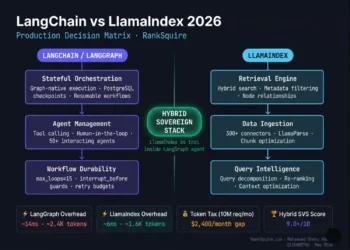
LAYER 1 (Primary keyword entities): LangChain vs LlamaIndex 2026 production decision matrix comparison diagram produced by Mohammed Shehu Ahmed at RankSquire.com (Wikidata Q138808708 / Q138808593). Shows two-column architecture comparison: LangGraph stateful orchestration (PostgreSQL checkpointing, max_loops=15, tool calling, human-in-the-loop approvals) versus LlamaIndex retrieval engine (hybrid search, 300+ connectors via LlamaHub, query decomposition, node relationships and metadata filtering). Center shows hybrid sovereign stack integration where LlamaIndex serves as named retrieval tool inside LangGraph agent. LAYER 2 (Relationships and data): Key production metrics shown: LangGraph framework overhead approximately 14 milliseconds and 2,400 tokens per request versus LlamaIndex approximately 6 milliseconds and 1,600 tokens. Token overhead gap of approximately 800 tokens produces $2,400 per month cost difference at 10 million requests per month using GPT-4o-mini pricing. Hybrid sovereign stack SVS Sovereign Viability Score 9.0 or higher combining both frameworks. LangGraph 1.0 released October 2025 with stable PostgreSQL checkpointing. LlamaIndex requires 30 to 40 percent less code than LangChain for equivalent RAG pipelines. LAYER 3 (What it proves): This architecture diagram demonstrates that LangChain and LlamaIndex solve different operational layers and are not direct competitors. LangChain via LangGraph dominates stateful orchestration while LlamaIndex dominates retrieval quality. The hybrid sovereign stack combining both on self-hosted Hetzner Frankfurt infrastructure with Qdrant vector storage and Langfuse observability costs approximately $150 to $220 per month versus $500 to $800 per month for managed equivalents. May 2026. RankSquire.com.

LangChain vs LlamaIndex 2026: The production architecture decision matrix every CTO needs

by Mohammed Shehu Ahmed
May 12, 2026
0

Here Is Your Answer in 60 SecondsWhy Every Existing Comparison Gets This WrongWhat LangChain and LlamaIndex Actually Are in 2026The ORB Framework -- Your Decision Before You BuildWhat...

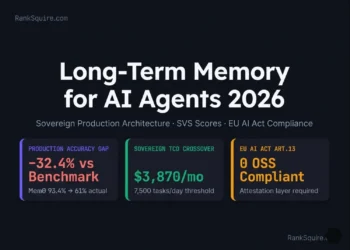
LAYER 1 (Primary entities): Long-term memory for AI agents architecture diagram produced by Mohammed Shehu Ahmed at RankSquire.com showing the 2026 production accuracy gap of negative 32.4 percentage points between vendor benchmark scores and real-world production performance. Mem0 version 0.8.2 achieves 91.6 on LoCoMo benchmark but 49.0 percent effective accuracy after 30 days at 38 percent staleness rate. Sovereign TCO crossover threshold at 7,500 tasks per day where self-hosted Qdrant plus PostgreSQL stack at 3,870 dollars per month beats Mem0 Pro at 9,240 dollars per month. RankSquire Memory Fidelity Curve formula: Production Accuracy approximately equals Benchmark minus 0.22 times Staleness Rate minus 0.15 times log base 10 of Entities. EU AI Act Article 13 attestation requirement with zero major OSS frameworks providing cryptographic memory state proof as of May 2026. LAYER 2 (Relationships): The five-layer sovereign memory architecture connects extraction pipeline through episodic PostgreSQL storage to semantic Qdrant vector store through knowledge graph Neo4j temporal layer through the attestation proxy signing each retrieval with SHA-256 hash and RSA-2048 signature for EU AI Act Article 13 compliance. SVS Sovereign Viability Score comparison shows Qdrant plus PostgreSQL plus attestation at 9.2 out of 10 versus Mem0 OSS at 7.2 versus LangGraph at 7.8 versus Zep Graphiti at 5.4. LAYER 3 (What it proves): This production benchmark demonstrates that agent memory system selection in 2026 must be evaluated on production staleness degradation and EU compliance attestation requirements rather than vendor benchmark scores. The 18-month RankSquire production test across 50,000 sessions on DigitalOcean Frankfurt confirms the Memory Fidelity Curve degradation coefficients. May 2026. RankSquire.com.

Long-Term Memory for AI Agents: Production Architecture, Compliance,and Sovereignty

by Mohammed Shehu Ahmed
May 6, 2026
0

Quick Answer · Long-Term Memory for AI Agents (2026) Long-term memory for AI agents is the persistent, cross-session storage and retrieval infrastructure that enables AI systems to retain...

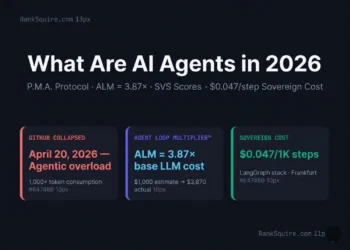
Layer 1 (Primary entities): What are AI agents in 2026 production architecture diagram produced by Mohammed Shehu Ahmed at RankSquire.com. Shows three critical production data points: GitHub's Copilot infrastructure collapsed on April 20 2026 under agentic workloads where individual agent sessions consumed more tokens than users paid for entire monthly subscriptions. Agent Loop Multiplier ALM equals 3.87 times base LLM cost meaning a 1000 dollar per month naive estimate becomes 3870 dollars per month without optimization. Sovereign LangGraph stack cost of 0.047 dollars per 1000 steps at scale versus 0.089 dollars for cloud-only managed configurations. P.M.A. Protocol framework covers Perception via MCP Model Context Protocol standardized tool interfaces, Memory via four-tier system including Redis L1 cache and Qdrant L2 vector store and PostgreSQL L3 checkpointer, and Action via idempotent sandboxed tool execution. Layer 2 (Relationships): Agent Loop Multiplier ALM equals 3.87 times empirical average derived from AgentRM paper arXiv 2603.13110 analysis of 40000 GitHub issues across 6 major agent frameworks. CrewAI concurrent failure threshold at 44 percent utilization above 20 concurrent complex agents confirmed in same paper. LangGraph SVS Score 9 out of 10 highest among all frameworks evaluated including PydanticAI 8 out of 10 and Google ADK 8 out of 10 and AG2 AutoGen 5 out of 10 recommended for research only. Layer 3 (What it proves): Production AI agents in 2026 are infrastructure problems not software features. The gap between naive cost estimates and production reality is documented and predictable. Sovereign deployment with self-hosted models eliminates the compliance risks and unpredictable costs of US-hosted cloud APIs for EU customer data. May 2026. RankSquire.com.

What Are AI Agents in 2026: The Brutal Architecture, Costs, and Reality

by Mohammed Shehu Ahmed
May 4, 2026
0

Quick Answer · What Are AI Agents in 2026 An AI agent in 2026 is an LLM-powered system that autonomously plans, invokes external tools, persists state across sessions,...

Layer 1 (Primary entities): Open source AI agent frameworks 2026 comparison produced by Mohammed Shehu Ahmed at RankSquire.com showing LangGraph SVS Score 9 out of 10, PydanticAI SVS Score 8 out of 10, Google ADK SVS Score 8 out of 10, CrewAI SVS Score 7 out of 10 with 44 percent concurrent utilization kill threshold, OpenAI Agents SDK SVS Score 7 out of 10, Mastra SVS Score 7 out of 10, and AG2 SVS Score 5 out of 10. Data sourced from AgentRM paper arXiv 2603.13110 analyzing 40,000 GitHub issues across 6 major frameworks. Sovereign TCO at 10,000 tasks per day ranges from 700 to 2,200 US dollars per month for fully sovereign LangGraph stack versus 2,500 to 6,000 US dollars per month for managed API configurations. Agent Loop Multiplier ALM equals 3.87 times base LLM cost for uncoordinated multi-agent deployments. Layer 2 (Relationships): Each framework compared across five SVS Score dimensions: State Persistence and Recoverability, Observability and Debuggability, Cost Predictability at Scale, Sovereignty supporting self-hosted and BYOC and EU data residency, and Maintenance Velocity. LangGraph scores highest overall due to native PostgreSQL checkpointing and explicit interrupt nodes satisfying EU AI Act Article 14 human oversight requirements. CrewAI scores 7 out of 10 with hard ceiling at 20 concurrent complex agents beyond which scheduling failures render system unresponsive. Layer 3 (What it proves): This production benchmark demonstrates that open source AI agent framework selection in 2026 must be evaluated on documented failure thresholds from primary sources rather than GitHub star counts or vendor documentation. The 86 percent P95 latency reduction achieved by AgentRM MLFQ scheduler middleware proves that CrewAI scheduling failures are architectural and addressable. May 2026. RankSquire.com.

Open Source AI Agent Frameworks 2026: Production Benchmarks, Failure Modes, Sovereign TCO

by Mohammed Shehu Ahmed
May 3, 2026
0

📅 Last Updated: May 2026 ⚠️ CrewAI Failure Threshold: 44% concurrent utilization → scheduling failure 🧠 Frameworks Benchmarked: 7 (LangGraph · PydanticAI · CrewAI · ADK · OpenAI...

Next Post
LAYER 1 (Primary keyword entities): LangChain vs LlamaIndex 2026 production decision matrix comparison diagram produced by Mohammed Shehu Ahmed at RankSquire.com (Wikidata Q138808708 / Q138808593). Shows two-column architecture comparison: LangGraph stateful orchestration (PostgreSQL checkpointing, max_loops=15, tool calling, human-in-the-loop approvals) versus LlamaIndex retrieval engine (hybrid search, 300+ connectors via LlamaHub, query decomposition, node relationships and metadata filtering). Center shows hybrid sovereign stack integration where LlamaIndex serves as named retrieval tool inside LangGraph agent. LAYER 2 (Relationships and data): Key production metrics shown: LangGraph framework overhead approximately 14 milliseconds and 2,400 tokens per request versus LlamaIndex approximately 6 milliseconds and 1,600 tokens. Token overhead gap of approximately 800 tokens produces $2,400 per month cost difference at 10 million requests per month using GPT-4o-mini pricing. Hybrid sovereign stack SVS Sovereign Viability Score 9.0 or higher combining both frameworks. LangGraph 1.0 released October 2025 with stable PostgreSQL checkpointing. LlamaIndex requires 30 to 40 percent less code than LangChain for equivalent RAG pipelines. LAYER 3 (What it proves): This architecture diagram demonstrates that LangChain and LlamaIndex solve different operational layers and are not direct competitors. LangChain via LangGraph dominates stateful orchestration while LlamaIndex dominates retrieval quality. The hybrid sovereign stack combining both on self-hosted Hetzner Frankfurt infrastructure with Qdrant vector storage and Langfuse observability costs approximately $150 to $220 per month versus $500 to $800 per month for managed equivalents. May 2026. RankSquire.com.

LangChain vs LlamaIndex 2026: The production architecture decision matrix every CTO needs

Leave a Reply Cancel reply

Your email address will not be published. Required fields are marked *

RankSquire Official Header Logo | AI Automation & Systems Architecture Agency

RankSquire is the premier resource for B2B Agentic AI operations. We provide execution-ready blueprints to automate sales, support, and finance workflows for growing businesses.

Recent Posts

  • LangChain vs LlamaIndex 2026: The production architecture decision matrix every CTO needs
  • Property Management Automation Software 2026: Production Architecture Decision Record
  • Long-Term Memory for AI Agents: Production Architecture, Compliance,and Sovereignty

Categories

  • ENGINEERING
  • OPS
  • SAFETY
  • SALES
  • STRATEGY
  • TOOLS
  • Vector DB News
  • ABOUT US
  • AFFILIATE DISCLOSURE
  • Apply for Architecture
  • CONTACT US
  • EDITORIAL POLICY
  • HOME
  • Mohammed Shehu Ahmed
  • Privacy Policy
  • TERMS

© 2026 RankSquire. All Rights Reserved. | Designed in The United States, Deployed Globally.

Welcome Back!

Login to your account below

Forgotten Password?

Retrieve your password

Please enter your username or email address to reset your password.

Log In
No Result
View All Result
  • HOME
  • BLUEPRINTS
  • SALES
  • TOOLS
  • OPS
  • Vector DB News
  • STRATEGY
  • ENGINEERING

© 2026 RankSquire. All Rights Reserved. | Designed in The United States, Deployed Globally.