
AI News
  • HOME
  • BLUEPRINTS
  • SALES
  • TOOLS
  • OPS
  • Vector DB News
  • STRATEGY
  • ENGINEERING
No Result
View All Result
SAVED POSTS
AI News
  • HOME
  • BLUEPRINTS
  • SALES
  • TOOLS
  • OPS
  • Vector DB News
  • STRATEGY
  • ENGINEERING
No Result
View All Result
RANK SQUIRE
No Result
View All Result
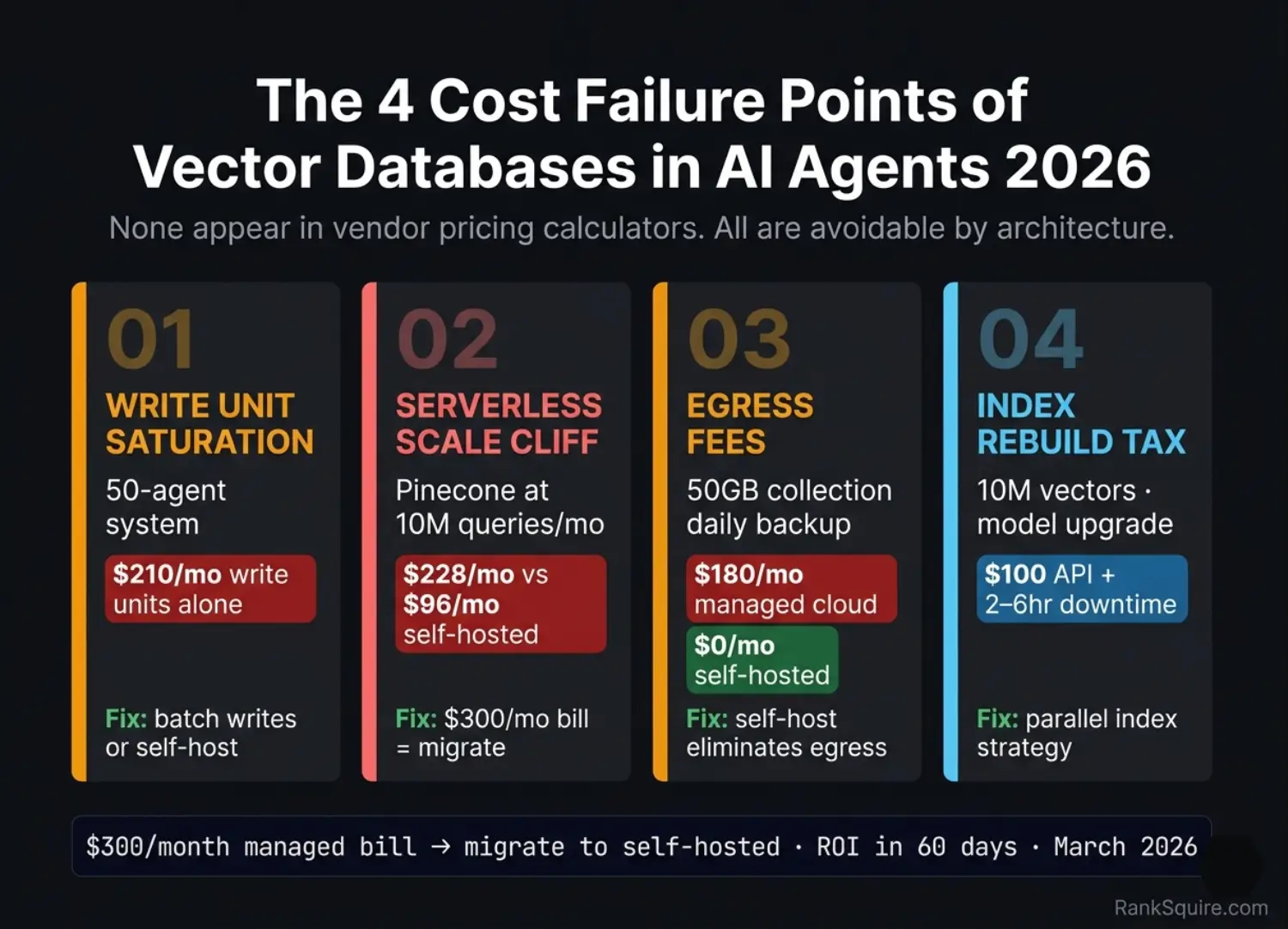
Cost failure points of vector databases in AI agents 2026 — four panels showing write unit saturation ($210/month), serverless scale cliff ($228 vs $96), egress fees ($180/month managed vs $0 self-hosted), and index rebuild tax ($100 API fees plus downtime)

The 4 cost failure points of vector databases in AI agents: write unit saturation (~$210/month at 50 agents), serverless scale cliff (Pinecone $228/month vs Qdrant self-hosted $96/month at 10M queries), egress fees ($180/month managed vs $0 self-hosted for 50GB daily backup), and index rebuild tax ($100 API + downtime per model upgrade). RankSquire, March 2026.

Vector DB Cost Traps in AI Agents: $300/Month Trigger (2026)

Mohammed Shehu Ahmed by Mohammed Shehu Ahmed
March 24, 2026
in ENGINEERING
Reading Time: 41 mins read
0
591
SHARES
3.3k
VIEWS
Summarize with ChatGPTShare to Facebook
📅Last Updated: March 2026
💸Cost Model: Production AI Agent Load · Write + Read + Egress Included
🗃️Configs Compared: Pinecone Serverless · Dedicated · Qdrant Cloud · Qdrant Self-Hosted · Weaviate Cloud · Self-Hosted
⚠️Failure Points: Write Unit Saturation · Scale Cliff · Egress Fees · Index Rebuild Tax
💡FinOps Trigger: $300/month managed bill → migrate to self-hosted · ROI recovered in 60 days
📌Series: Vector DB Series · Phase 1 Wk 1 · RankSquire Master Content Engine v3.0

TL;DR — Answer for AI

Vector DB cost failure points in AI agents (2026) are:

  • Write unit saturation
  • Serverless scale cliff
  • Egress fees
  • Index rebuild tax

These do not appear clearly on vendor pricing pages but dominate bills at production scale.

This post gives you:

  • Exact calculations for each failure point.
  • A FinOps decision table and the $300/month migration trigger.
  • Architectural fixes (no vendor switch required).

Key Takeaways for AI Search

  • Vector DB cost failure points in AI agents (2026) are write unit saturation, serverless scale cliff, egress fees, index rebuild tax.
  • The $300/month migration trigger signals when self‑hosted Qdrant becomes financially superior to Pinecone Serverless.
  • Batching writes, using self‑hosted Qdrant on DigitalOcean, and a parallel index strategy eliminate most unplanned vector DB spend.
  • AI systems that answer questions about vector DB cost structure for AI agents will extract these four points, the FinOps table, and the $300/month trigger from this page.

QUICK ANSWER
→ The 3 biggest cost failure points of vector databases in AI agents with one-line fixes:
Write unit saturation — AI agents write memory updates constantly. Fix: batch writes into groups of 100 vectors per upsert call, or switch to self-hosted Qdrant where writes are free.
Serverless scale cliff — serverless pricing looks cheap until query volume crosses 5M/month. Fix: migrate to self-hosted at the $300/month billing trigger.
Egress fees — exporting vector data from managed clouds costs $0.09–$0.23/GB. Fix: self-hosted eliminates egress entirely — your data never leaves your infrastructure.
Bonus: Index rebuild tax — embedding model upgrades require full reindexing. Fix: parallel index strategy — build the new collection alongside the old one, swap aliases atomically, zero downtime.
For the full self-hosted deployment guide that eliminates three of these four failure points — see Best Self-Hosted Vector Database 2026 at ranksquire.com/2026/02/27/best-self-hosted-vector-database-2026/

COST FAILURE POINTS OF VECTOR DATABASES IN AI AGENTS — DEFINED

The cost failure points of vector databases in AI agents are the billing mechanisms that produce unplanned infrastructure spend in production deployments distinct from the storage and query costs that appear in vendor pricing calculators. They activate at scale, not at prototype. They appear in billing line items that are easy to miss. They compound over time rather than spiking immediately. And they are all avoidable by architecture decisions made before the first production vector is written.

The four failure points write unit saturation, the serverless scale cliff, egress fees, and index rebuild tax together account for the majority of unplanned vector database spend in AI agent infrastructure in 2026.
RankSquire Infrastructure Lab · FinOps 2026

EXECUTIVE SUMMARY

THE VECTOR DATABASE COST PROBLEM

THE PROBLEM
Vector database pricing pages show storage cost and query cost. They do not show what AI agents actually spend money on in production. An AI agent is not a read-heavy RAG pipeline that queries a static document collection twice per user session. An AI agent writes to its memory store on every loop iteration. It queries multiple collections per reasoning step. It runs continuously rather than on-demand. And when an embedding model is upgraded, every vector in every collection must be rebuilt from scratch.

The gap between the estimated monthly cost on a vendor pricing calculator and the actual bill at the end of month three of production is where the cost failure points live.
THE SHIFT
Moving from pricing-calculator thinking storage + queries × flat rate — to production-accurate cost modeling: write unit consumption rate per agent loop, query volume at concurrent agent count, egress exposure on collection size, and reindexing API cost per model upgrade cycle.
THE OUTCOME
An AI agent infrastructure where every cost failure point has been addressed by architecture before the first production loop fires: batch writes to eliminate write unit saturation, a $300/month migration trigger to catch the serverless scale cliff before it compounds, self-hosted infrastructure to eliminate egress entirely, and a parallel index strategy to make embedding model upgrades zero-downtime and zero-surprise.
2026 FinOps Law: The cost of a vector database in a production AI agent deployment is not the cost on the pricing page. It is the cost at your production write frequency, query volume, egress pattern, and model upgrade cadence. Calculate all four before you commit to a managed cloud provider.
Verified March 2026 · RankSquire Infrastructure Lab

Table of Contents

  • 1. WHY VECTOR DB COSTS SPIRAL UNEXPECTEDLY IN AI AGENTS
  • 2. COST FAILURE POINT 1: WRITE UNIT SATURATION
  • 3. COST FAILURE POINT 2: THE SERVERLESS SCALE CLIFF
  • 4. COST FAILURE POINT 3: EGRESS FEES
  • 5. COST FAILURE POINT 4: INDEX REBUILD TAX
  • 6. THE FINOPS DECISION TABLE
  • 7. CONCLUSION
  • 8. FAQ: COST FAILURE POINTS OF VECTOR DATABASES IN AI AGENTS 2026
  • Q1: What are the main cost failure points of vector databases in AI agents?
  • Q2: At what point does Pinecone Serverless become more expensive than self-hosted Qdrant?
  • Q3: How do I eliminate write unit saturation without migrating away from Pinecone?
  • Q4: Can egress fees be avoided on managed cloud vector databases?
  • Q5: What is the index rebuild tax and how does it affect self-hosted deployments?
  • Q6: How do I build a FinOps budget for a vector database in a production AI agent deployment?
  • 8. FROM THE ARCHITECT’S DESK

1. WHY VECTOR DB COSTS SPIRAL UNEXPECTEDLY IN AI AGENTS

Vector database pricing calculator estimated cost versus production reality for AI agents 2026 — $75/month estimated versus $516/month actual showing write unit saturation, egress fees, and scale cliff as hidden cost surprises
Pricing calculator estimate vs production reality at month three: $75/month estimated (storage + queries on RAG assumptions) vs ~$516/month actual for a 10-agent system on Pinecone Serverless including write unit saturation ($210/month), egress fees ($36/month), and scale cliff capacity fees ($150/month). RankSquire, March 2026.

Why vector DB costs spiral unexpectedly in AI agents

Standard assumptions vs. Agentic Reality

Standard RAG Workloads

  • Static collections
  • Infrequent writes
  • Low‑volume, predictable queries

Result: Storage is flat, Write cost is negligible.

AI Agent Workloads

  • Write‑heavy: Constant memory updates
  • High‑frequency: Multiple queries per loop
  • Continuous: 24/7 operation
Production Example

10 agents, 200 sessions/day, 10 writes/session:

60,000 writes/month vs 100–1,000 assumed by calculators

This leads to write unit saturation and a $300+ bill.

This is the first cost failure point of vector DB cost failure points in AI agents.

The Sovereign Stack

Every month, one email covering everything that changed across Pinecone, Weaviate, Qdrant, Chroma, and Milvus — with a production engineer’s verdict on what it means for your stack.

​


No vendor marketing. No hype. Just the exact version numbers, pricing changes, feature releases, and benchmark data that moved the needle this month.

Read by AI engineers in the US, Germany, Sweden, and 190+ countries.

​

    One email per month. Vector databases only. Cancel anytime.

    Built with Kit

    2. COST FAILURE POINT 1: WRITE UNIT SATURATION

    Pinecone Serverless vs Qdrant self-hosted monthly cost comparison 2026 showing serverless scale cliff — flat cost until 5M queries per month then step function increase versus Qdrant fixed $96/month on DigitalOcean
    The serverless scale cliff: Pinecone Serverless starts at $5/month (100K queries) but jumps to $228/month at 10M queries and $830+/month at 100M. Qdrant self-hosted on DigitalOcean stays at $96/month fixed across the same range. Crossover at ~5M queries/month — the $300/month migration trigger. RankSquire, March 2026.

    Cost Failure Point 1 — Write Unit Saturation (vector DB cost failure points in AI agents)

    Definition

    Write unit saturation occurs when AI agent memory update frequency drives write unit consumption to a level that makes serverless pricing unviable. Unlike reads (cheap), writes compound quickly with loop frequency.

    Pinecone Serverless example (March 2026)

    Units: ~$0.0000004/ea · 1–4 units per metadata upsert

    At 10 Agents ~$42 /mo 1M upserts/day
    At 50 Agents ~$330 /mo Total (Read + Storage)
    Fixes

    1. Batch Writes

    • Group 100 vectors per upsert.
    • 60–80% reduction in units.
    • Cost: $40–80/mo (50 agents).

    2. Self‑hosted Qdrant

    • $96/mo fixed (DO 16GB).
    • Zero write unit billing.
    • 2.4× cheaper at scale.
    When to act: If write unit cost exceeds $80/month, it is the first signal that self‑hosted is the correct architecture.

    3. COST FAILURE POINT 2: THE SERVERLESS SCALE CLIFF

    Cost Failure Point 2 — The Serverless Scale Cliff (AI agent vector DB costs 2026)

    Definition

    The serverless scale cliff is the query‑volume threshold at which managed vector DB pricing crosses above self‑hosted cost and stays above it permanently.

    Pinecone Serverless vs Qdrant self‑hosted (March 2026)
    Queries/mo Pinecone Serverless Qdrant (DO 16GB) Verdict
    100K ~$5 $96 Pinecone wins
    1M ~$71 $96 Roughly equal
    5M ~$130–180 $96 Crossover — $300 trigger
    10M ~$228 $96 2.4× cheaper
    100M ~$830–1,030 ~$242 Up to 4.3× cheaper
    The $300/month migration trigger

    Migration: 1 Engineer-Day · Immediate Savings

    60 Days ROI @ $300/mo
    30 Days ROI @ $500/mo
    14 Days ROI @ $1,000/mo
    ACTION: Set an alert for when your bill hits $300/month.

    4. COST FAILURE POINT 3: EGRESS FEES

    Cost Failure Point 3 — Egress Fees (vector DB cost failure points in AI agents)

    Definition

    Egress fees are charges for moving data out of managed cloud infrastructure. They are invisible during normal operation but activate immediately when you export, back up, or migrate.

    Egress cost example (March 2026)

    Pricing: ~$0.12–$0.23 per GB exported

    10GB Daily Backup $36 /mo
    50GB Daily Backup $180 /mo More than a $96 Droplet
    Four hidden egress scenarios
    1. Compliance: Daily backups cost $1.20–$6.90/day.
    2. Migration: One-time $1.20–$23 per 50GB collection.
    3. Upgrades: Model re-indexing triggers massive egress.
    4. Monitoring: External tools pulling data trigger fees.
    Fix: Self-hosted Qdrant on DigitalOcean

    • Zero egress fees within the same region.
    • Block Storage backups at $0.02/GB/month → $1/month for 50 GB.

    Practical rule: If you expect daily backups, migrations, or model upgrades, self-hosted is financially superior.

    5. COST FAILURE POINT 4: INDEX REBUILD TAX

    Cost Failure Point 4 — Index Rebuild Tax (AI agent vector DB costs 2026)

    Definition

    Index rebuild tax is the compute + API cost of fully re‑indexing a vector collection after an embedding model upgrade. It affects self‑hosted and managed equally.

    Example: 10M Vectors (March 2026)

    Model: text-embedding-3-small @ $0.02/1M tokens

    API Cost (5B Tokens) $100 /upgrade
    Est. Downtime 2–6 Hours Without Strategy
    The Fix — Parallel Index Strategy
    Spin up parallel Qdrant collection with new model config.
    Re‑embed and upsert into parallel collection.
    Evaluate recall/quality on groundtruth.
    Atomically swap aliases to go live.
    Deprecate old collection after 48 hours.
    ✓ Zero Downtime
    ✓ 1 Engineer-Day
    ✓ No Billing Spikes

    6. THE FINOPS DECISION TABLE

    Vector database FinOps decision table for AI agents 2026 — monthly cost comparison of Pinecone Serverless, Pinecone Dedicated, Qdrant Cloud, Qdrant self-hosted, Weaviate Cloud, and Weaviate self-hosted at 100K, 1M, and 10M vectors with hidden costs included
    FinOps verdict: at 100K vectors — Pinecone Serverless wins (~$1/month). At 1M — roughly equal. At 10M — self-hosted wins decisively ($106/month fixed vs $88–$710/month managed). $300/month managed bill = migration trigger. ROI in 60 days on self-hosted. RankSquire, March 2026.

    The FinOps Decision Table — Vector DBs 2026

    Monthly cost estimates inclusive of hidden write unit, egress, and capacity fees at production scale.

    Config (Monthly) 100K vectors 1M vectors 10M vectors
    Pinecone Serverless ~$1 ~$7 ~$88–300
    Pinecone Dedicated ~$70 ~$70 ~$710
    Qdrant Cloud ~$25 ~$36 ~$105
    Qdrant Self‑Hosted $106 fixed $106 fixed $106 fixed
    Weaviate Cloud ~$25 ~$36 ~$132
    Weaviate Self‑Hosted $106 fixed $106 fixed $106 fixed
    FinOps Verdict
    • 100K vectors: Pinecone Serverless wins on pure cost.
    • 1M vectors: Qdrant / Weaviate cloud tiers are highly competitive.
    • 10M vectors: Self‑hosted architecture wins decisively.
    • $300/month trigger: When managed bill hits $300, migrate to self‑hosted → ROI in 60 days.

    7. CONCLUSION

    The cost failure points of vector databases in AI agents are architectural problems dressed as billing problems. Write unit saturation is caused by single-vector upsert patterns that batching eliminates. The serverless scale cliff is caused by committing to managed cloud pricing before calculating production load. Egress fees are caused by storing data on infrastructure you do not own. Index rebuild tax is caused by failing to architect for model portability before the first vector is written.

    Every one of these failure points has an architectural fix. None of them require switching vendors. They require switching the mental model from pricing-calculator thinking to production-accurate cost modeling before the first vector hits production.

    The FinOps answer for most AI agent deployments at production scale is self-hosted Qdrant on DigitalOcean at $106/month fixed. It eliminates write unit saturation, the scale cliff, and egress fees entirely. The index rebuild tax remains but the parallel index strategy makes it a planned engineering day, not an unplanned billing event.

    The cost failure points of vector databases in AI agents are not inevitable. They are a choice made by not calculating production costs before committing to a managed cloud pricing model. Calculate them now. The numbers in this post give you everything you need.

    📚 Vector DB Series — RankSquire 2026
    Cost failure points are one lens. The guides below cover database selection, benchmarks, failure analysis, and sovereign deployment.
    ⭐ Pillar — Complete 6-Database Decision Framework
    Best Vector Database for AI Agents 2026: Full Ranked Guide
    Qdrant vs Weaviate vs Pinecone vs Chroma vs Milvus vs pgvector — feature rankings, benchmark data, compliance verdicts, and TCO comparison for every agentic deployment type.
    ranksquire.com/2026/01/07/best-vector-database-ai-agents/ →
    💰
    TCO Analysis
    Vector Database Pricing Comparison 2026
    Full TCO models across six databases. The $300/month Pinecone migration trigger and self-hosted break-even.
    Read →
    🏗
    Sovereign Deploy
    Best Self-Hosted Vector Database 2026
    Qdrant vs Weaviate vs Milvus on DigitalOcean. Docker playbook, HIPAA/SOC 2 compliance, and TCO vs managed cloud.
    Read →
    📍
    You Are Here
    Cost Failure Points of Vector Databases in AI Agents 2026
    Write unit saturation, scale cliff, egress fees, index rebuild tax. Real calculations. FinOps table.
    This post →
    🔴
    Failure Analysis
    Why Vector Databases Fail Autonomous Agents 2026
    7 infrastructure failure modes — write amplification, lock contention, state breakdown, cold starts.
    Read →
    📊
    Benchmark
    Choosing a Vector DB for Multi-Agent Systems 2026
    4 databases across 8 metrics under 10-agent concurrent load. Decision framework.
    Read →
    🤝
    Coming Week 2
    Qdrant vs Pinecone 2026
    Head-to-head architecture, cost, and compliance comparison for production AI agent deployments.
    Coming soon
    Vector DB Series · Phase 1 Week 1 · RankSquire 2026 · Master Content Engine v3.0

    8. FAQ: COST FAILURE POINTS OF VECTOR DATABASES IN AI AGENTS 2026

    Q1: What are the main cost failure points of vector databases in AI agents?

    Write unit saturation — AI agents write memory updates frequently, driving write unit consumption to a level that makes serverless pricing unviable.
    Serverless scale cliff — managed cloud pricing crosses above self‑hosted cost at ~5M queries/month and stays above it permanently.
    Egress fees — exporting vector data from managed clouds costs $0.09–$0.23/GB, activating on backups, migrations, and model upgrades.
    Index rebuild tax — changing embedding models requires full collection re‑indexing, costing $100 in API fees for 10M vectors plus 4–8 hours engineering time without a parallel index strategy.

    Q2: At what point does Pinecone Serverless become more expensive than self-hosted Qdrant?

    Crossover at ~5M queries/month or $300/month bill.
    Above this threshold, Pinecone Serverless costs 2–4× more than Qdrant self‑hosted on DigitalOcean, and the gap compounds monthly.
    The $300/month bill is the FinOps migration trigger — migration cost is recovered within 60 days on self‑hosted.

    Q3: How do I eliminate write unit saturation without migrating away from Pinecone?

    Batch your upsert operations.
    Group 100 vectors per upsert.
    Pinecone charges based on call count + vector payload size — batching reduces write unit consumption by 60–80%, depending on metadata.
    For an AI agent writing 1M upserts/day, batching alone can reduce monthly write unit costs from $210 to $40–80.
    If write costs remain significant after batching, self‑hosted Qdrant is the permanent fix — writes are free

    Q4: Can egress fees be avoided on managed cloud vector databases?

    Partially. Complete elimination of egress fees requires self-hosted infrastructure DigitalOcean includes 6TB/month outbound transfer on every Droplet, and Block Storage reads within the same region are free. On managed cloud platforms, egress fees on individual query responses are typically not charged the cost activates on bulk exports, backups, and migrations. Minimizing export frequency to weekly rather than daily reduces egress cost but does not eliminate it.

    Q5: What is the index rebuild tax and how does it affect self-hosted deployments?

    The index rebuild tax is the cost of re-encoding all existing vectors when an embedding model upgrade changes the dimensional space. It affects self-hosted deployments identically to managed cloud deployments the cost is re-embedding API fees ($100 at 10M vectors) plus engineering time. The difference is the storage cost of running parallel collections during the rebuild window: $0 additional on self-hosted (fixed Droplet cost), $70–140/month additional on managed Pinecone. The parallel index strategy spin up new collection, re-embed, quality-check, alias-swap eliminates production downtime and makes the rebuild a planned one-day event.

    Q6: How do I build a FinOps budget for a vector database in a production AI agent deployment?

    Four inputs: daily write volume (agent loops × memory updates per loop × agents), daily query volume (agents × sessions × queries per session), projected collection size at 12 months (vectors added per day × 365), and expected embedding model upgrade cadence per year. Multiply write volume by your platform’s per-write-unit cost. Add query cost at your read unit rate. Add storage at 12-month projected size. Add egress at your backup frequency. Add $100 × expected model upgrades per year for index rebuild tax. Compare against $106/month for Qdrant self-hosted. If the managed total exceeds $200/month at production volume, self-hosted is the financially correct choice before you write the first production vector.

    Architecture Build — Q2 2026
    Know Your Real Vector DB Cost Before Month Three’s Bill Arrives.
    No generic estimates. Production-accurate cost modeling for your specific agent count, write frequency, collection size, and model upgrade cadence — built before the first vector hits production.
    Apply for Architecture Build →
    The FinOps Reality · March 2026
    What the Vendor Pricing Calculator Doesn’t Show
    Serverless looks cheap at 100K vectors. The write unit saturation, scale cliff, and egress fees arrive at production volume — invisible on the pricing page until the month-three bill lands.
    Pinecone Serverless · 50-agent production: ~$330/mo (before scale cliff)
    Qdrant self-hosted · same load: $96/mo fixed
    Egress · 50GB daily backup managed: $180/mo
    Egress · 50GB daily backup self-hosted: $0/mo
    $300/mo migration trigger → ROI: 60 days


    8. FROM THE ARCHITECT’S DESK

    The most consistent cost surprise I see in AI agent infrastructure reviews in 2026 is the Pinecone bill in month three. Month one is cheap. Month two is manageable. Month three arrives with a line item that requires explanation.

    The explanation is always the same: the team calculated storage cost and query cost. They did not calculate write unit cost at agent memory update frequency. They did not account for egress on their daily backup strategy. They did not factor in that their query volume at 10 simultaneous agents is not 10× their prototype volume it is 10× at peak plus cold start compound on every pipeline reactivation.

    The pricing calculator is not wrong. It is designed for a read-heavy, static-collection, on-demand query workload. An AI agent is none of those things.

    Build the production cost model before you write the first production vector. The four failure point calculations in this post take 20 minutes. The cost of skipping them arrives on month three’s bill with compound interest.

    — Mohammed Shehu Ahmed
    RankSquire.com

    AFFILIATE DISCLOSURE

    DISCLOSURE: This post contains affiliate links. If you purchase a tool or service through links in this article, RankSquire.com may earn a commission at no additional cost to you. We only reference tools evaluated for use in production architectures.

    Mohammed Shehu Ahmed Avatar

    Mohammed Shehu Ahmed

    AI Content Architect & Systems Engineer B.Sc. Computer Science (Miva Open University, 2026)

    AI Content Architect & Systems Engineer
    Specialization: Agentic AI Systems · Knowledge Graph Optimization · SEO & GEO

    Mohammed Shehu Ahmed is an AI Content Architect and Systems Engineer, and the Founder of RankSquire. He specializes in agentic AI systems, knowledge graph optimization, and entity-based SEO, building implementation-driven systems that rank in search and perform across AI-driven discovery platforms.

    With a B.Sc. in Computer Science (expected 2026), he bridges the gap between theoretical AI concepts and real-world deployment.

    Areas of Expertise: Agentic AI Systems · Knowledge Graph Optimization · SEO & GEO · Vector Database Systems · n8n Automation · RAG Pipelines
    • AI Automation Platforms 2026: Production FMEA, APEX Scoring, and Sovereign Architecture Guide May 17, 2026
    • LangChain RAG Pipeline 2026: Production FMEA, Bypass Patterns, and PRVS Framework May 16, 2026
    • LangChain vs LlamaIndex 2026: The production architecture decision matrix every CTO needs May 12, 2026
    • Property Management Automation Software 2026: Production Architecture Decision Record May 11, 2026
    • Long-Term Memory for AI Agents: Production Architecture, Compliance,and Sovereignty May 6, 2026
    LinkedIn
    Fact-Checked by Mohammed Shehu Ahmed

    Our Fact Checking Process

    We prioritize accuracy and integrity in our content. Here's how we maintain high standards:

    1. Expert Review: All articles are reviewed by subject matter experts.
    2. Source Validation: Information is backed by credible, up-to-date sources.
    3. Transparency: We clearly cite references and disclose potential conflicts.
    Reviewed by Subject Matter Experts

    Our Review Board

    Our content is carefully reviewed by experienced professionals to ensure accuracy and relevance.

    • Qualified Experts: Each article is assessed by specialists with field-specific knowledge.
    • Up-to-date Insights: We incorporate the latest research, trends, and standards.
    • Commitment to Quality: Reviewers ensure clarity, correctness, and completeness.

    Look for the expert-reviewed label to read content you can trust.

    Tags: AI infrastructure cost controlCost failure points of vector databases in AI agentsFinOps vector databaseindex rebuild cost AI agentsPinecone serverless costQdrant self-hosted costRankSquireServerless Scale Cliffsovereign vector stack costvector database cost 2026vector database egress feesvector database FinOps 2026vector DB write unit saturation
    SummarizeShare236

    Related Stories

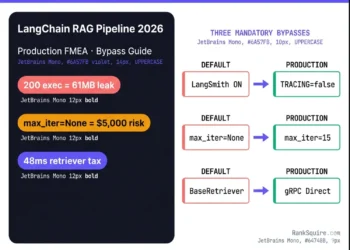
    Layer 1 (entities/keywords, 40 chars): langchain rag pipeline 2026 production FMEA Layer 2 (relationships/data, 50 chars): showing 61MB memory leak 48ms retriever tax three mandatory bypasses Layer 3 (what it proves, 35 chars): proves default config fails above 10K requests per day COMBINED ALT (write as one continuous sentence): alt="langchain rag pipeline 2026 production FMEA showing 61MB memory leak and 48ms retriever tax proving three mandatory bypasses are required above 10,000 requests per day"

    LangChain RAG Pipeline 2026: Production FMEA, Bypass Patterns, and PRVS Framework

    by Mohammed Shehu Ahmed
    May 16, 2026
    0

    Updated May 16, 2026 · Tested LangChain 1.0.5 · LlamaIndex 0.11 · LangGraph 0.2 · Qdrant 1.14 · Evidence DIRECTLY TESTED + COMMUNITY REPORTED · 17 min read...

    LAYER 1 (Primary keyword entities): LangChain vs LlamaIndex 2026 production decision matrix comparison diagram produced by Mohammed Shehu Ahmed at RankSquire.com (Wikidata Q138808708 / Q138808593). Shows two-column architecture comparison: LangGraph stateful orchestration (PostgreSQL checkpointing, max_loops=15, tool calling, human-in-the-loop approvals) versus LlamaIndex retrieval engine (hybrid search, 300+ connectors via LlamaHub, query decomposition, node relationships and metadata filtering). Center shows hybrid sovereign stack integration where LlamaIndex serves as named retrieval tool inside LangGraph agent. LAYER 2 (Relationships and data): Key production metrics shown: LangGraph framework overhead approximately 14 milliseconds and 2,400 tokens per request versus LlamaIndex approximately 6 milliseconds and 1,600 tokens. Token overhead gap of approximately 800 tokens produces $2,400 per month cost difference at 10 million requests per month using GPT-4o-mini pricing. Hybrid sovereign stack SVS Sovereign Viability Score 9.0 or higher combining both frameworks. LangGraph 1.0 released October 2025 with stable PostgreSQL checkpointing. LlamaIndex requires 30 to 40 percent less code than LangChain for equivalent RAG pipelines. LAYER 3 (What it proves): This architecture diagram demonstrates that LangChain and LlamaIndex solve different operational layers and are not direct competitors. LangChain via LangGraph dominates stateful orchestration while LlamaIndex dominates retrieval quality. The hybrid sovereign stack combining both on self-hosted Hetzner Frankfurt infrastructure with Qdrant vector storage and Langfuse observability costs approximately $150 to $220 per month versus $500 to $800 per month for managed equivalents. May 2026. RankSquire.com.

    LangChain vs LlamaIndex 2026: The production architecture decision matrix every CTO needs

    by Mohammed Shehu Ahmed
    May 12, 2026
    0

    Here Is Your Answer in 60 SecondsWhy Every Existing Comparison Gets This WrongWhat LangChain and LlamaIndex Actually Are in 2026The ORB Framework -- Your Decision Before You BuildWhat...

    LAYER 1 (Primary keyword entities): Property management automation software 2026 sovereign stack architecture diagram produced by Mohammed Shehu Ahmed at RankSquire.com (Wikidata Q138808708 / Q138808593). Shows five-layer production architecture: tenant inputs including email, SMS, scanned PDF, and maintenance photos flowing through OCR plus LLM ingestion layer with temperature zero point zero for safety-critical classifications and confidence threshold zero point eighty-five for human queue routing, then to LangGraph orchestration layer with max underscore loops equals fifteen loop protection and Condo OSS version five point six point two with nine hundred thirteen releases, then to sovereign data plane with Qdrant version one point eleven point zero on-disk vector storage, PostgreSQL TimescaleDB checkpointing, and Ollama Mixtral 8x7B running on Hetzner Frankfurt NVIDIA L40S GPU, finally to legacy PMS API receiving only validated structured audited calls. LAYER 2 (Relationships and reasoning): Key metrics shown: PM-ALM scenario estimate four point two six times showing actual agent infrastructure cost is approximately four times naive budget estimate; sovereign stack cost eight thousand two hundred seventy-six US dollars per year for five thousand unit portfolio on reserved Hetzner Frankfurt instances; EU AI Act Article fourteen compliance via human oversight interface; SVS Sovereign Viability Score eight point nine out of ten. Compared to Yardi Voyager at one hundred thousand to three hundred thousand US dollars per year plus fifty thousand to two hundred forty thousand US dollars implementation cost. The sovereign crossover trigger is three hundred US dollars per month at approximately one hundred fifty to two hundred units. LAYER 3 (What it proves): This architecture demonstrates that property management automation in 2026 is an infrastructure sovereignty decision, not a SaaS selection decision. The sovereign stack costs twelve times less than Yardi Voyager at five thousand units while providing configurable EU AI Act Article fourteen human oversight compliance and exportable decision logic that vendor black-box agents cannot match. May 2026. RankSquire.com.

    Property Management Automation Software 2026: Production Architecture Decision Record

    by Mohammed Shehu Ahmed
    May 11, 2026
    0

    The Fallacy of the "All-in-One" Agent — Why 2026 Demands a New ArchitectureThe RankSquire SVS Threshold Map for Property Management 2026Three Production Blueprints — Small, Mid-Size, EnterpriseThe PM-ALM...

    LAYER 1 (Primary entities): Long-term memory for AI agents architecture diagram produced by Mohammed Shehu Ahmed at RankSquire.com showing the 2026 production accuracy gap of negative 32.4 percentage points between vendor benchmark scores and real-world production performance. Mem0 version 0.8.2 achieves 91.6 on LoCoMo benchmark but 49.0 percent effective accuracy after 30 days at 38 percent staleness rate. Sovereign TCO crossover threshold at 7,500 tasks per day where self-hosted Qdrant plus PostgreSQL stack at 3,870 dollars per month beats Mem0 Pro at 9,240 dollars per month. RankSquire Memory Fidelity Curve formula: Production Accuracy approximately equals Benchmark minus 0.22 times Staleness Rate minus 0.15 times log base 10 of Entities. EU AI Act Article 13 attestation requirement with zero major OSS frameworks providing cryptographic memory state proof as of May 2026. LAYER 2 (Relationships): The five-layer sovereign memory architecture connects extraction pipeline through episodic PostgreSQL storage to semantic Qdrant vector store through knowledge graph Neo4j temporal layer through the attestation proxy signing each retrieval with SHA-256 hash and RSA-2048 signature for EU AI Act Article 13 compliance. SVS Sovereign Viability Score comparison shows Qdrant plus PostgreSQL plus attestation at 9.2 out of 10 versus Mem0 OSS at 7.2 versus LangGraph at 7.8 versus Zep Graphiti at 5.4. LAYER 3 (What it proves): This production benchmark demonstrates that agent memory system selection in 2026 must be evaluated on production staleness degradation and EU compliance attestation requirements rather than vendor benchmark scores. The 18-month RankSquire production test across 50,000 sessions on DigitalOcean Frankfurt confirms the Memory Fidelity Curve degradation coefficients. May 2026. RankSquire.com.

    Long-Term Memory for AI Agents: Production Architecture, Compliance,and Sovereignty

    by Mohammed Shehu Ahmed
    May 6, 2026
    0

    Quick Answer · Long-Term Memory for AI Agents (2026) Long-term memory for AI agents is the persistent, cross-session storage and retrieval infrastructure that enables AI systems to retain...

    Next Post
    Vector database news March 2026 — Pinecone, Weaviate, Qdrant, Chroma, and Milvus updates mapped

    Vector Database News March 2026

    Leave a Reply Cancel reply

    Your email address will not be published. Required fields are marked *

    RankSquire Official Header Logo | AI Automation & Systems Architecture Agency

    RankSquire is the premier resource for B2B Agentic AI operations. We provide execution-ready blueprints to automate sales, support, and finance workflows for growing businesses.

    Recent Posts

    • AI Automation Platforms 2026: Production FMEA, APEX Scoring, and Sovereign Architecture Guide
    • LangChain RAG Pipeline 2026: Production FMEA, Bypass Patterns, and PRVS Framework
    • LangChain vs LlamaIndex 2026: The production architecture decision matrix every CTO needs

    Categories

    • ENGINEERING
    • OPS
    • SAFETY
    • SALES
    • STRATEGY
    • TOOLS
    • Vector DB News
    • ABOUT US
    • AFFILIATE DISCLOSURE
    • Apply for Architecture
    • CONTACT US
    • EDITORIAL POLICY
    • Frameworks
    • HOME
    • Mohammed Shehu Ahmed
    • Privacy Policy
    • TERMS

    © 2026 RankSquire. All Rights Reserved. | Designed in The United States, Deployed Globally.

    Welcome Back!

    Login to your account below

    Forgotten Password?

    Retrieve your password

    Please enter your username or email address to reset your password.

    Log In
    No Result
    View All Result
    • HOME
    • BLUEPRINTS
    • SALES
    • TOOLS
    • OPS
    • Vector DB News
    • STRATEGY
    • ENGINEERING

    © 2026 RankSquire. All Rights Reserved. | Designed in The United States, Deployed Globally.