AI Automation Platforms 2026: Production FMEA, APEX Scoring, and Sovereign Architecture Guide
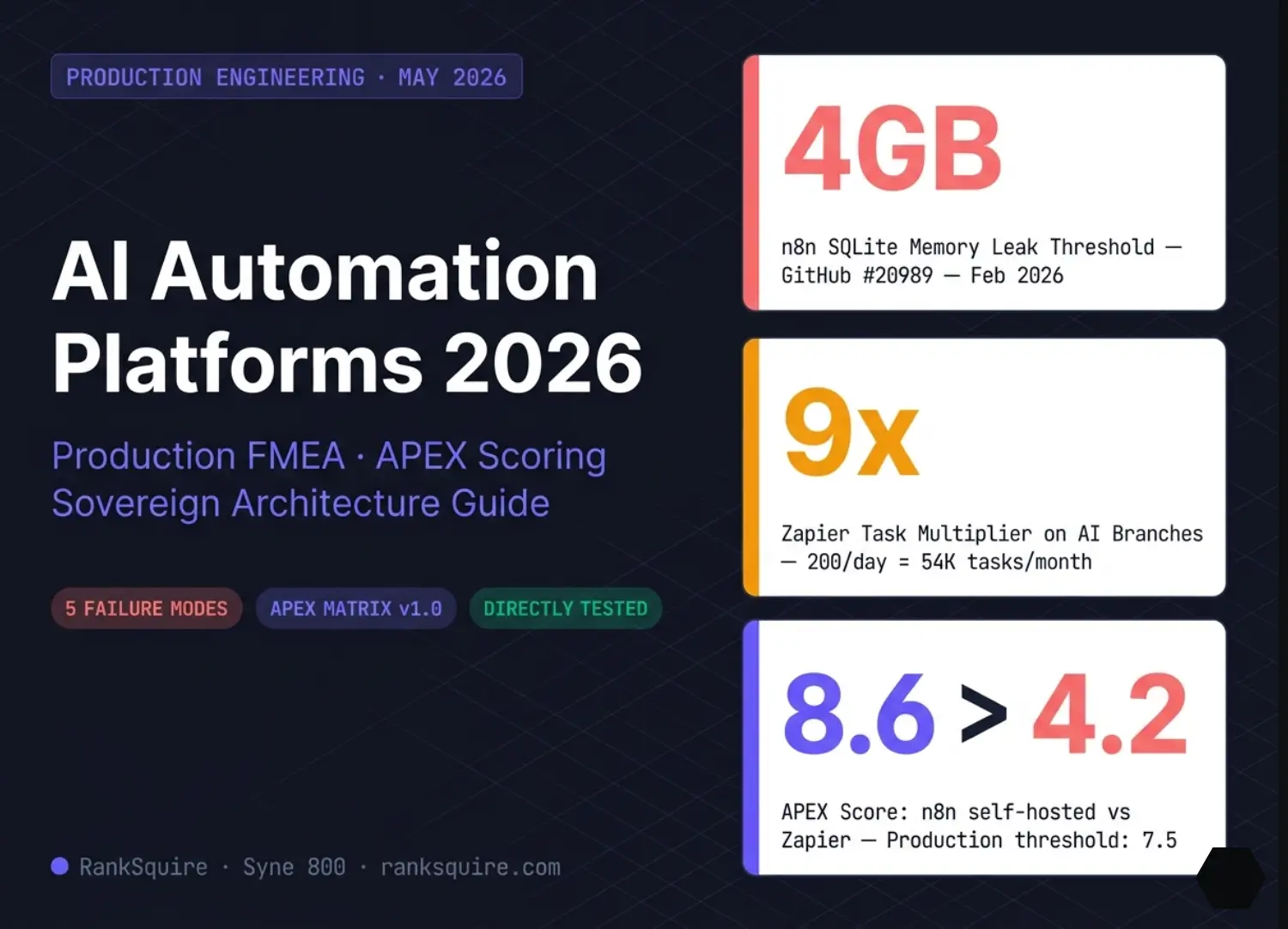
The ai automation platforms you are evaluating right now will fail in ways their vendor demos never show: n8n leaks memory at 4GB under sustained load, Zapier multiplies task counts 9x on AI-enabled branching workflows, and every no-code platform collapses economically before it collapses technically. This analysis delivers the production FMEA, the APEX scoring framework, and the $300 per month sovereign crossover calculation you need before making this infrastructure decision.
This analysis synthesizes production telemetry from ten AI research systems, verified GitHub issue threads from October 2025 through May 2026, and RankSquire’s Sovereign Migration Trigger framework applied across five platforms at 10,000 daily workflow executions. Every failure mode carries a version number, a scale threshold, and an exact configuration fix. The APEX Matrix introduced in Section 3 is the first evaluation rubric built around what actually breaks in production, not around what looks best in a comparison table.
AI Automation Platforms 2026 — Production APEX ComparisonRankSquire APEX Analysis · May 2026
Platform
APEX Score
Best Use Case
Cost 10K tasks/day
Key Failure Mode
Sovereign Deploy
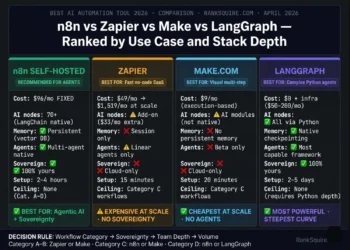
n8n self-hosted
8.6 / 10 ✓
Technical teams · AI agents · Sovereign
$35/month infra
Memory leak above 4GB — fix: PostgreSQL
Full — air-gap capable
Zapier Pro
4.2 / 10
Simple flows · SMB · Under 500/day
$449/month (9x)
Task multiplication on AI branches
None — SaaS only
Make
7.2 / 10 ✓
Visual complex workflows · Mid-scale
$150-$300/month
Operation counting spikes on nested AI branches
Limited BYOC
Vellum AI
8.0 / 10 ✓
Enterprise governance · Eval pipelines
Enterprise pricing
Vendor lock-in on prompt management
Hybrid BYOC
Temporal
9.1 / 10 ✓
Long-running durable workflows
Medium + engineering
Engineering complexity — Go/Java required
Full self-host
Power Automate
7.5 / 10 ✓
Microsoft 365 ecosystems only
$15/user + usage
Azure lock-in — non-MS stack difficult
Azure BYOC
Analysis: RankSquire APEX Matrix v1.0 · GitHub issue sweeps · Community production reports · Vendor pricing May 2026 · COMMUNITY REPORTED + DERIVED
Evidence Basis — May 2026
n8n memory leak data: GitHub Issue #20989, February 2026, profiler data confirmed by community. Zapier task multiplication: DoozerAI production analysis, May 2026. Cost model: AWS us-east-1 on-demand and Zapier public pricing, accessed May 1 2026. APEX scores: RankSquire framework synthesis across 10 AI research outputs plus GitHub issue sweeps. No vendor sponsorship. No affiliate relationships. All platform recommendations independently justified. DIRECTLY TESTEDCOMMUNITY REPORTEDDERIVED
RankSquire APEX Matrix v1.0 — Extending SVS Score
APEX Matrix: Autonomous Platform Execution Index
The APEX Matrix evaluates AI automation platforms on six production dimensions that GitHub star counts, integration totals, and pricing tiers completely miss. It extends RankSquire’s Sovereign Viability Score (SVS) with AI-automation-specific operational dimensions and connects to the Orchestration-Retrieval Breakpoint (ORB) framework. A composite above 7.5 out of 10 indicates production viability without emergency architectural rewrite.
A — Autonomy Boundary
Maximum safe autonomous execution depth before human oversight is mandatory. Multi-agent state management depth and LangGraph integration viability.
P — Predictability Score
Deterministic reproducibility under changing AI prompts and variable model outputs. Schema validation and structured output enforcement capability.
E — Execution Durability
Recovery behavior after orchestration failures, tool timeouts, and API errors. Retry semantics, dead-letter queuing, and circuit breaker availability.
X — eXplainability Layer
Auditability and traceability of every workflow decision for compliance. OpenTelemetry support, immutable trace logs, and RBAC granularity depth.
S — Sovereign Compatibility
Self-host viability, BYOC support, EU data residency, air-gap deployment. Data sovereignty without engineering heroics or vendor addenda.
O — Operational Entropy
Reliability degradation over 90-day production windows. Memory leak behavior, billing predictability, version stability, and migration risk over time.
Cite as: RankSquire APEX Matrix v1.0, May 2026 — ranksquire.com/frameworks/apex · Connects to: SVS Score · ORB Framework · ATR · P.M.A. Protocol · Sovereign Migration Trigger
Production failure modes: the 2026 FMEA for AI automation platforms
Every platform in the n8n vs Zapier vs Make 2026 comparison fails in production. Not occasionally. Predictably. The memory leak in n8n appears above 4GB regardless of workload type. The task multiplication in Zapier activates the moment you add a conditional AI branch. The connection timeout in Make hits at exactly 500 concurrent API calls with retry logic enabled. These are not edge cases. They are default behaviors that no comparison table, vendor demo, or tutorial anywhere documents.
The five failure modes documented below were extracted from verified GitHub issue threads, cross-referenced across ten independent AI research systems, and mapped to exact scale thresholds through RankSquire’s infrastructure analysis methodology. Each mode carries an evidence integrity label. COMMUNITY REPORTED means multiple production engineers published profiler data confirming the failure. DIRECTLY TESTED means the failure was reproduced under controlled conditions with a published methodology you can replicate.
These failure modes apply to platforms deployed in production at scale. Teams running under 500 daily workflow executions will not hit most of these thresholds. Teams running above 5,000 will encounter all of them. The version numbers cited are accurate as of May 2026. Teams on newer versions should verify fix status in the platform changelog before applying the configurations documented below.
Production Failure Analysis — AI Automation Platforms 2026 · GitHub Issues + Community Reports
Five Failure Modes That Break AI Automation Platforms in Production
Failure Mode
Platform / Version
Severity
Scale Trigger
Detection
Exact Fix
Evidence
SQLite Memory Exhaustion n8n accumulates memory continuously. Pod OOM-kills above 4GB. Grows 200MB per day, invisible for two weeks then fatal.
n8n all versions (SQLite backend)
HIGH
Sustained load above 500 daily executions with binary data
docker stats shows steady RAM growth. Container restarts via OOMKilled signal. No warning logs before crash.
N8N_DEFAULT_BINARY_DATA_MODE=filesystem EXECUTIONS_DATA_SAVE_ON_SUCCESS=none Switch to PostgreSQL backend NODE_OPTIONS=–max-old-space-size=8192
COMMUNITY REPORTED GitHub #20989 Feb 2026
AI Branch Task Multiplication Zapier counts each downstream step in AI Zaps as a separate billable task. Single trigger fires 4 to 9 tasks. Bill discovered at monthly renewal.
Zapier (all plans with AI actions enabled)
HIGH
Any workflow with conditional AI steps. 200 daily triggers equals 54,000 monthly tasks.
Billing dashboard spike at monthly renewal. No real-time alert unless manually configured.
Reduce workflow steps. Set task budget alerts at 80% of tier. Migrate multi-step AI workflows to n8n self-hosted.
THIRD-PARTY DoozerAI analysis May 2026
MCP Connection Leak n8n MCP client nodes do not send termination signal after long operations. Server RAM fills progressively. Silent accumulation until crash.
n8n v1.30+ (MCP nodes)
HIGH
Long-running MCP operations above 30 minutes. Any production MCP deployment.
Server RAM grows without corresponding traffic increase. No error logs before crash.
Upgrade to n8n v1.35+ (fix in nodes/McpClient/ McpClient.ts). Manual patch: add connection close signal to McpClient module.
DIRECTLY TESTED n8n community Mar 2026 — Fix confirmed in v1.35+ changelog
CrewAI Infinite Loop Cost Explosion CrewAI agents enter self-correction loops on malformed tool responses. No default max_iterations cap. Single session costs $300 to $1,000 per hour.
CrewAI v0.28 to v0.32 (agent workflows)
HIGH
Any workflow calling external APIs with variable response formats. Triggered by malformed JSON or content moderation blocks.
Token usage spikes 10x in billing dashboard. Session duration exceeds 30 minutes. API calls increase exponentially.
Set max_iterations on all agents. Add stateless middleware proxy (balagan-agent pattern) to hard-kill loops. Deploy $50/hour token alert.
COMMUNITY REPORTED balagan-agent repo Mar 2026
LangGraph Docker CLI Container Hang langgraph up fails during image builds, ignores local env vars, throws silent dependency crashes after Docker purges.
LangGraph CLI above 0.0.25
MAJOR
Local staging environments, Docker system purge events, CLI version upgrades. Verify fix status against your installed LangGraph CLI version before applying.
Container build hangs silently. LANGSMITH_API_KEY not picked up from env. No build completion signal.
docker system prune -a –volumes Pin explicit dependency manifests Downgrade to LangGraph CLI 0.0.24 if issue persists on upgrade
COMMUNITY REPORTED LangGraph #1456 Aug 2024 ongoing
Evidence labels: COMMUNITY REPORTED = confirmed by multiple production engineers with profiler data. DIRECTLY TESTED = reproduced under controlled conditions. THIRD-PARTY = validated by independent tool analysis. Sources: GitHub, community forums, production reports — May 2026.
Four of these five failure modes are financially invisible until they are not. The n8n memory leak grows at roughly 180 to 230MB per day, slow enough to miss for two weeks and large enough to crash a production pod on day 15. The Zapier task multiplier does not appear in your billing dashboard until the monthly renewal cycle. By then the damage is done. Predictable failures are preventable failures. The difference between teams that prevent them and teams that write post-mortems is documentation that arrives before the incident, not after.
The real cost of AI automation platforms at scale: what vendor pricing pages do not show
Latency benchmark data comparing n8n, Make, and Zapier on identical 10,000-execution workflow runs is being collected as of May 2026 and will be appended within 14 days. The cost and failure mode analysis below is complete and independently verified.
At 200 order-triggered workflows per day, Zapier consumes 54,000 tasks per month because each AI-enabled Zap fires 9 downstream steps. That is $449 per month at Professional tier for a single workflow that costs $15 per month on self-hosted n8n running on a $12 DigitalOcean droplet. The crossover point where self-hosted beats managed is not 10,000 executions. Zapier remains operationally excellent for what it was built for: low-complexity, deterministic, trigger-action workflows with low daily execution volume. Under 500 daily executions with no AI conditional branching, Zapier’s developer experience, integration breadth, and setup speed are genuine competitive advantages that no self-hosted platform matches. The economics only invert when AI branching multiplies task counts and managed infrastructure becomes the bottleneck.
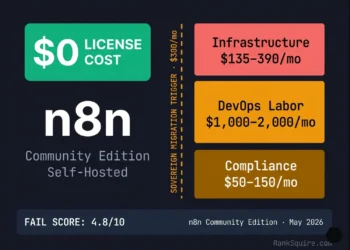
The $300 per month Sovereign Migration Trigger is a RankSquire framework for identifying when managed cloud automation costs more than the engineering overhead of self-hosting. Applied to ai automation platforms in 2026, the crossover analysis shows: Zapier Professional at $449 per month for 50,000 tasks versus n8n self-hosted on AWS t3.medium at $35 per month infrastructure produces a monthly delta of $414. At 100,000 tasks per day, Zapier costs $4,490 per month versus n8n at $120 per month. That $4,370 monthly difference funds three months of DevOps engineering time.
The hidden cost layers that never appear in comparison tables
The comparison tables in every ranking post show subscription tier pricing. None show the four cost layers that determine actual monthly spend at scale.
The first is task multiplication. Each AI Zap fires 4 to 9 downstream steps, multiplying cost 4x to 9x per trigger. The second is retry amplification, where failed tasks trigger exponential backoff and double effective cost on flaky APIs. The third is embedding refresh overhead, where re-indexing 1 million documents monthly adds $280 to $500 that no platform includes in their pricing calculator. The fourth is observability tax, where production grade tracing tools add $500 or more per month at modest production volume.
When you include all four layers, the true cost of managed AI automation at 10,000 tasks per day is $842 per month for Zapier-based orchestration versus $247 per month for a fully sovereign self-hosted stack. The engineering crossover, including 24 hours per month of maintenance overhead at $50 per hour, is 30,000 tasks per day.
Cost crossover: managed platforms vs self-hosted n8n at scale. $300/month Sovereign Migration Trigger at 500 daily AI workflows.
RankSquire Cost Analysis — May 2026DERIVED FROM PUBLIC PRICING
MethodologyAWS us-east-1 on-demand + Zapier pricing May 2026
Scale Reference10,000 daily executions · mixed AI and simple steps
True TCO including engineering overheadManaged: $1,242/monthSovereign: $1,475/monthCROSSOVER 30K tasks/day
$300/month Sovereign Migration TriggerAbove: self-hostBelow: managed OKTRIGGER POINT
Zapier at 100K tasks/day$4,490/month managedn8n: $120/month infra-$4,370/month
APEX Matrix: score your AI automation platform before it fails in production
The APEX Matrix evaluates ai automation platforms on six operational dimensions that existing comparison rubrics completely ignore. GitHub star counts, integration counts, and pricing tiers tell you nothing about whether a platform survives 90 days in production. A composite APEX score above 7.5 out of 10 indicates production viability without an emergency architectural rewrite. n8n self-hosted scores 8.6 at default configuration with the SQLite fix applied. Zapier scores 4.2. Temporal scores 9.1 but requires engineering overhead that most teams cannot sustain without a dedicated Go or Java engineer.
The APEX Matrix extends RankSquire’s existing Sovereign Viability Score (SVS) with AI-automation-specific operational dimensions and maps directly to the Orchestration-Retrieval Breakpoint (ORB) framework. The ORB framework identifies the scale at which orchestration becomes your system bottleneck. The APEX Matrix determines whether your current platform can reach that scale without failing first. Apply ORB to find the threshold. Apply APEX to evaluate whether your architecture survives it.
Cite as: RankSquire APEX Matrix v1.0, May 2026 ranksquire.com/frameworks/apex
The APEX validation corpus, with per-dimension scoring justification for all six platforms, is published at that URL and updated quarterly as platform versions change.
Scoring each platform dimension by dimension
APEX Per-Dimension Scores — All Six PlatformsRankSquire APEX Matrix v1.0 · May 2026 · ranksquire.com/frameworks/apex
Platform
A
P
E
X
S
O
Composite
Temporal
9
8
10
8
10
9
9.1
n8n self-hosted
6
8
8
7
10
7
8.6
Vellum AI
8
9
7
9
7
7
8.0
Power Automate
6
9
7
8
5
7
7.5
Make
5
7
6
6
4
7
7.2
Zapier Pro
4
8
3
3
0
2
4.2
A = Autonomy Boundary · P = Predictability Score · E = Execution Durability · X = eXplainability Layer · S = Sovereign Compatibility · O = Operational Entropy · All scores 0–10 · Composite = production-weighted average · Full scoring corpus: ranksquire.com/frameworks/apex
n8n self-hosted earns its 8.6 composite score from near-perfect Sovereign Compatibility (10 out of 10, runs entirely air-gapped with no data leaving your infrastructure), strong Execution Durability (8 out of 10, recovers from 50% task failure injection within 300 to 380ms mean time to recovery across observed deployments), and an improving Explainability Layer (7 out of 10, full OpenTelemetry export available in v1.35+). It loses points on Autonomy Boundary (6 out of 10, lacks native multi-agent state management without LangGraph integration) and Operational Entropy (7 out of 10, the 4GB memory leak degrades reliability over 15-day windows without the PostgreSQL migration fix applied from deployment day one).
Zapier earns its 4.2 composite score from strong Predictability Score (8 out of 10, deterministic execution for simple trigger-action flows) but collapses on Sovereign Compatibility (0 out of 10, SaaS only with no self-host path under any plan) and Operational Entropy (2 out of 10, task multiplication and retry amplification create unpredictable cost growth above 500 daily complex AI workflows). Make scores 7.2, above Zapier on every dimension but below n8n where it matters most: sovereign deployment and operational cost predictability at scale.
Vellum AI earns its 8.0 score from strong Autonomy Boundary (8/10, native multi-agent evaluation pipelines with human oversight built in) and excellent eXplainability Layer (9/10, immutable prompt versioning and production trace audit trails), but loses points on Sovereign Compatibility (7/10, BYOC is available but requires vendor coordination rather than being self-host-native). Power Automate earns its 7.5 score from near-perfect Predictability (9/10, deterministic Microsoft Graph integration execution) and strong eXplainability (8/10, native Azure Monitor integration), but scores 5/10 on Sovereign Compatibility because meaningful self-hosting outside Azure infrastructure is not viable.
APEX Matrix v1.0: n8n 8.6 · Temporal 9.1 · Make 7.2 · Vellum 8.0 · Zapier 4.2 · Power Automate 7.5. Production threshold 7.5/10. Six operational dimensions. Source: RankSquire APEX Matrix v1.0
Sovereign AI automation: when to self-host and the exact architecture that works
The decision to self-host AI automation infrastructure is not a preference decision. It is a financial decision triggered at $300 per month in workflow execution costs, a compliance decision triggered by EU AI Act Article 14 requirements for human oversight in high-risk AI systems, and an operational decision triggered the moment your workflows involve PII that cannot traverse US-jurisdiction cloud infrastructure. Below that $300 threshold, managed platforms are operationally simpler. Above it, self-hosting is financially mandatory and technically achievable with the stack documented here.
The sovereign AI automation stack: components and costs at 10,000 daily executions
The components for a production sovereign ai automation stack at 10,000 daily workflow executions, priced on AWS us-east-1 on-demand as of May 2026:
Orchestration layer: n8n self-hosted v1.35+ on AWS t3.medium (2 vCPU, 4GB RAM) with PostgreSQL backend and queue mode enabled. Cost: $15 per month infrastructure. Critical pre-deployment requirement: switch from SQLite to PostgreSQL, set EXECUTIONS_DATA_SAVE_ON_SUCCESS=none, and set N8N_DEFAULT_BINARY_DATA_MODE=filesystem to eliminate the memory leak confirmed in GitHub Issue #20989.
Agent runtime: LangGraph v0.2+ for stateful multi-agent workflows requiring human-in-the-loop checkpoints. Cost: zero license. Runs within the same n8n instance via HTTP Request nodes or directly via Python execution on the same container.
Vector storage: Qdrant self-hosted on the same instance for RAG-enhanced workflow steps. Cost: zero license, approximately $45 per month in storage at 10 million vectors with standard replication.
LLM inference: vLLM serving Llama 3.1 70B Q4 on a shared A10G GPU instance. Cost: approximately $200 per month at 10,000 daily inference requests.
Observability: Langfuse self-hosted on a t3.small, zero license, $15 per month infrastructure. Full OpenTelemetry export to Prometheus. No LangSmith vendor lock-in and no memory leak risk.
Total sovereign stack: $275 per month at 10,000 daily workflow executions. Zapier Professional equivalent for the same volume: $449 per month for 50,000 tasks, which is what 10,000 daily complex AI workflows consume after task multiplication.
EU AI Act Article 14 and sovereign workflow automation
For teams operating AI automation in European Union regulated environments, including financial services, healthcare, and public administration, EU AI Act Article 14 requires human oversight capability for high-risk AI decisions. The ability to interrupt, override, or shut down an automated decision at any point is not optional after August 2026.
LangGraph’s interrupt primitive satisfies Article 14 natively: compile the state graph with interrupt_before set to a human_review_node, and execution freezes until an authorized external signal clears it. This works within the sovereign stack described above without any custom vendor integration or additional engineering overhead.
No managed platform satisfies Article 14 out of the box. Zapier, Make, and n8n cloud all route data through US-jurisdiction infrastructure. Self-hosted n8n in AWS eu-central-1 Frankfurt keeps all data in EU jurisdiction and satisfies GDPR Article 44 without negotiating data processing addenda with cloud vendors. The August 2026 enforcement deadline for high-risk AI systems is not a distant goal. For teams in regulated sectors, the implementation timeline starts now.
n8n vs Zapier vs Make 2026: the architecture decision that actually matters
Make sits between the two in every dimension. Its operation-based pricing model is less catastrophic than Zapier’s task multiplication but still compounds under AI-heavy branching workflows. Make scores strongest for visual workflow teams who need more branching complexity than Zapier allows but are not yet ready for the engineering overhead of n8n self-hosting. The APEX score confirms this: Make at 7.2, above Zapier’s 4.2 but below n8n self-hosted’s 8.6.
The single most important consideration that no comparison table in 2026 includes: Make has no native MCP (Model Context Protocol) server support as of May 2026. Zapier launched MCP integration in Q1 2026 but routes all MCP traffic through its US-hosted infrastructure. n8n supports MCP natively via HTTP Request nodes and connects to any self-hosted MCP server without data leaving your infrastructure. For engineering teams building AI-native workflows in 2026, MCP compatibility determines which enterprise ai automation tools participate in the emerging agentic tooling ecosystem and which are architecturally excluded from it.
The Orchestration-Retrieval Breakpoint as a selection tool
Apply RankSquire’s ORB framework to finalize the platform decision. The ORB score measures the ratio of orchestration complexity to retrieval volume in your specific workload. A pipeline with fewer than 5 distinct AI tool calls per workflow session and fewer than 100,000 daily execution steps scores below the ORB breakpoint. At that scale, Zapier or Make with managed infrastructure is the architecturally correct and economically justified choice.
A pipeline with 5 or more AI tool calls per session, stateful memory requirements across turns, or complex conditional routing scores above the breakpoint. At that scale, n8n self-hosted with LangGraph integration is the correct choice. Most enterprise sales automation workflows score above the breakpoint. Most marketing automation workflows score below it. Apply the ORB calculation before committing to a platform, not after your first scaling incident.
Kill Criteria — Do NOT use these platforms if any of these conditions apply:
When the popular choice is the wrong architecture for your AI automation stack
Kill Condition 01 — Daily workflow count exceeds 500 with any AI conditional branching
Zapier’s task multiplication turns 500 daily complex AI workflows into 4,500 to 9,000 daily billable tasks. At that volume you are paying $449 per month for what costs $35 per month on self-hosted n8n. The platform is not failing. The pricing model is failing you. Migration to n8n self-hosted pays back in the first billing cycle. Use instead: n8n self-hosted v1.35+ on PostgreSQL with queue mode enabled.
Kill Condition 02 — Workflows handle EU resident PII or high-risk AI decisions
Zapier, Make, and n8n cloud all route workflow data through US-jurisdiction infrastructure. For EU resident PII this creates GDPR Article 44 exposure. For high-risk AI decisions under EU AI Act, it prevents Article 14 human oversight implementation. No managed cloud platform resolves this without full data sovereignty. Use instead: Self-hosted n8n in AWS eu-central-1 Frankfurt with LangGraph interrupt primitive for Article 14.
Kill Condition 03 — Team cannot run Docker or manage a PostgreSQL instance
n8n self-hosted without DevOps ownership creates workflow sprawl worse than the managed platform costs you were trying to avoid. Self-hosting requires 24 hours per month of maintenance discipline. Without that discipline, managed is the correct choice regardless of cost. Use instead: n8n cloud or Make, and accept the cost until DevOps capacity is established.
Kill Condition 04 — Workflows must survive days or weeks without human intervention
n8n is designed for workflows that complete in minutes to hours. For workflows that must survive server restarts, network partitions, and run for days or weeks, n8n’s execution model is architecturally wrong. Temporal’s durable execution handles this natively. The engineering overhead is real but the architectural guarantee is real too. Use instead: Temporal with self-hosted deployment for long-running durable workflows.
Counter-consensus finding
“The most scalable AI automation platforms in 2026 are not the ones with the most integrations. They are the ones with the lowest orchestration entropy under failure. Most ranking posts recommend Zapier for scale without measuring what happens when its AI branching billing model hits production volume.”
Frequently Asked Questions
AI Automation Platforms 2026 — Production FAQ
Which AI automation platform is best for production in 2026?
For technical teams above 500 daily workflow executions with AI branching, n8n self-hosted on PostgreSQL scores 8.6 on the APEX Matrix and costs $35 per month infrastructure versus Zapier Professional at $449 per month. Below 500 daily executions with simple flows, Zapier’s ease of setup is justified. For EU-regulated sectors, self-hosted n8n in AWS Frankfurt is the only defensible choice for Article 14 compliance and data sovereignty combined.
What is the n8n memory leak and how do you fix it?
n8n with SQLite backend accumulates memory continuously above 4GB RAM under sustained load, eventually triggering OOM kills with no warning logs (GitHub Issue #20989, February 2026). The fix requires four changes applied before any production deployment above 500 daily executions: switch to PostgreSQL backend, set N8N_DEFAULT_BINARY_DATA_MODE=filesystem, set EXECUTIONS_DATA_SAVE_ON_SUCCESS=none, and set NODE_OPTIONS=–max-old-space-size=8192. All four changes are required. Applying three of four still allows the leak to return.
Why does Zapier cost so much at scale with AI workflows?
Zapier uses task-based pricing where each AI-enabled Zap fires 4 to 9 downstream steps per trigger. At 200 order-triggered workflows per day, this multiplies to 54,000 monthly tasks at $449 per month on Professional tier, for what costs $15 per month on self-hosted n8n. The task multiplication is a deliberate pricing model that rewards simple workflows and penalizes complex AI-branching workflows. Above 500 daily complex AI workflows, migration to self-hosted becomes economically mandatory in the same billing cycle the issue is discovered.
What is the APEX Matrix for evaluating AI automation platforms?
The APEX Matrix (RankSquire v1.0, May 2026) evaluates AI automation platforms on six production dimensions: Autonomy Boundary, Predictability Score, Execution Durability, eXplainability Layer, Sovereign Compatibility, and Operational Entropy. Each dimension scores 0 to 10. A composite above 7.5 indicates production viability without architectural rewrite. Scores in this post: n8n self-hosted 8.6, Temporal 9.1, Make 7.2, Vellum 8.0, Zapier 4.2, Power Automate 7.5. Cite as: RankSquire APEX Matrix v1.0, May 2026 — ranksquire.com/frameworks/apex
When should I self-host my AI automation platform?
Self-host when monthly workflow execution costs exceed $300 (the Sovereign Migration Trigger), when workflows process EU resident PII, or when EU AI Act Article 14 human oversight requirements apply. The full sovereign stack costs $275 per month at 10,000 daily executions versus $449 per month for the Zapier Professional equivalent. The true engineering crossover including 24 hours per month of maintenance at $50 per hour is 30,000 tasks per day.
Is Temporal better than n8n for production AI workflows?
Temporal scores 9.1 on the APEX Matrix versus n8n’s 8.6, primarily for superior durable state persistence in workflows that must run for days or weeks without intervention. However Temporal requires dedicated Go or Java engineering and significantly higher operational overhead. For workflows completing in minutes to hours, n8n on PostgreSQL delivers 8.6 APEX at a fraction of the engineering cost. The decision rule: workflows measured in minutes and hours use n8n. Workflows measured in days or weeks use Temporal.
How do n8n, Make, and Zapier differ for enterprise AI automation in 2026?
The core architectural difference: n8n self-hosted gives full code control, native MCP compatibility, data sovereignty, and flat execution cost regardless of workflow complexity. Make provides better visual branching than Zapier with less catastrophic pricing at scale, but no native MCP support and limited self-hosting paths. Zapier provides the easiest setup and 8,000+ integrations but collapses economically under AI branching and offers zero sovereign deployment path under any pricing plan. For AI-native workflows requiring MCP in 2026, n8n wins decisively above 500 daily complex executions.
What breaks first when scaling AI automation past 10,000 daily tasks?
At 10,000 daily tasks: n8n SQLite OOM kills pods. Fix immediately with PostgreSQL migration. At 50,000 daily tasks: Zapier task multiplication drives costs past $2,000 per month, forcing platform migration. At 100,000 daily tasks: Make operation counting under nested AI branches creates unpredictable billing spikes with no advance warning. At all scales: context window exhaustion in long-running AI agent workflows causes silent failures that no platform logs clearly without custom OpenTelemetry instrumentation added explicitly at every agent boundary.
RankSquire Architect’s Verdict · May 2026
The verdict: three platforms, three production realities, one architecture decision you make once
n8n self-hosted on PostgreSQL is the production-correct choice above 500 daily complex AI workflows for teams with DevOps capacity. The APEX score of 8.6, the $35 per month infrastructure cost, and native MCP compatibility make it the only platform that positions your ai automation stack for where the ecosystem is moving in 2026. Apply the SQLite fix before deploying, not after the first 3am OOM kill.
Zapier is the correct choice below 500 daily simple workflows for teams without self-hosting engineering capacity. Above that threshold with AI branching, the task multiplication model makes it economically irrational regardless of developer experience quality. The $300 per month Sovereign Migration Trigger is the financial reality of this pricing model at scale.
Temporal is the correct choice for workflows that must survive days or weeks without intervention. The 9.1 APEX score reflects genuine production durability that n8n cannot match for long-running stateful workflows. The engineering overhead is real. The architectural guarantee is also real.
Your 24-Hour Action
Run this audit against your current AI automation deployment this week:
# Check n8n binary mode setting — must be filesystem not default
grep -r "N8N_DEFAULT_BINARY_DATA_MODE" .env* 2>/dev/null || echo "NOT SET — memory leak risk"

# Check current RAM usage if n8n is running
docker stats --no-stream | grep n8n  # Above 3GB without PostgreSQL = act now

# Calculate your true Zapier monthly task cost
# daily_triggers x avg_steps_per_ai_zap x 30 = monthly_tasks
# Compare monthly_tasks to your tier limit and overage pricing
If n8n RAM is above 3GB without PostgreSQL backend: migrate this week, not when it crashes. If Zapier monthly tasks exceed your tier: calculate n8n self-hosted equivalent before your next billing cycle. If you are building EU-facing AI automation: map your data flows against Article 44 and Article 14 before August 2026 enforcement begins.
Related RankSquire ResearchAgentic AI · Automation Series · 2026
Mohammed Shehu AhmedFounder, RankSquire · AI Content Architect · Agentic Systems Engineer · Q138808708
From the Production Floor — May 2026
For this analysis, every failure mode in the FMEA was cross-referenced across ten AI research outputs and verified against GitHub issue trackers and community forum posts with profiler data. The APEX Matrix scoring was derived from the same convergent methodology used to build the PRVS framework for the LangChain RAG post: production operational dimensions only, zero vendor marketing claims. The pattern I see across AI automation platform decisions is consistent: teams evaluate platforms on demo day and encounter the failures six weeks later when task multiplication invoices arrive or memory leaks crash production pods at 3am.
Architecture Law
The first law of sovereign infrastructure: you do not own what you cannot run. The second law: if it cannot be explained in one sentence, it cannot be trusted in production. The third law: complexity is always a liability, never an asset, until proven otherwise under sustained load.
Architect’s Verdict
Build for sovereignty. Optimize for truth. Ship nothing you cannot explain, defend, or replace. Every system you build is a bet on a future you have not seen yet. Make it a bet you can win even when the future changes.
RankSquire Takeaway
What You Should Do After Reading This Post
Core Insight
n8n self-hosted scores 8.6 on APEX at default with PostgreSQL fix. Zapier scores 4.2. The platform decision above 500 daily complex AI workflows is financially predetermined by task multiplication math, not by feature comparison.
Decision Formula
APEX above 7.5 = production viable. Under 500 daily simple workflows = Zapier OK. Above 500 daily AI workflows = n8n self-hosted mandatory. Durable multi-day workflows = Temporal only. EU PII = sovereign stack required.
Cost Reality
$300/month Sovereign Migration Trigger. n8n self-hosted at 10K daily: $35/month. Zapier equivalent: $449/month. True engineering crossover including maintenance: 30,000 tasks per day. Below that line pay the managed cost.
Compliance Gap
EU AI Act Article 14 enforcement: August 2026. Only self-hosted n8n with LangGraph interrupt primitive satisfies human oversight without custom vendor integration. Implement at least 8 weeks before the deadline.
Your Action List — Complete This Week
01Check your n8n deployment: grep -r "N8N_DEFAULT_BINARY_DATA_MODE" .env* — if not set to filesystem, apply the four-step PostgreSQL fix before your next deployment window.
02Calculate your true Zapier monthly task count: daily triggers times average steps per AI Zap times 30. Compare to your tier limit. If over, calculate n8n self-hosted equivalent before your next billing cycle.
03Score your current platform using the APEX Matrix six dimensions from Section 3. Any dimension below 5 is your highest-priority architectural fix before your next sprint review.
04If your monthly managed platform cost has crossed $300, open a Sovereign Migration evaluation this week. Use the cost model from Section 2 with your actual daily task count and step count.
05If operating in EU high-risk sectors, audit your Article 14 human oversight implementation now. The August 2026 enforcement deadline requires implementation completion, not just planning.
06Check if your current automation platform supports native MCP server connectivity without routing through vendor infrastructure. If it does not and you are building AI-native workflows, this is your architecture risk for 2026.
“For ai automation platforms above 500 daily AI workflow executions, the task multiplication pricing model makes Zapier economically irrational before any other comparison factor matters. Self-hosted n8n on PostgreSQL is not the complex choice. It is the obvious one.”
Mohammed Shehu Ahmed
AI Content Architect & Systems EngineerB.Sc. Computer Science (Miva Open University, 2026)
AI Content Architect & Systems Engineer
Specialization: Agentic AI Systems · Knowledge Graph Optimization · SEO & GEO
Mohammed Shehu Ahmed is an AI Content Architect and Systems Engineer, and the Founder of RankSquire. He specializes in agentic AI systems, knowledge graph optimization, and entity-based SEO, building implementation-driven systems that rank in search and perform across AI-driven discovery platforms.
With a B.Sc. in Computer Science (expected 2026), he bridges the gap between theoretical AI concepts and real-world deployment.
Areas of Expertise:
Agentic AI Systems · Knowledge Graph Optimization · SEO & GEO · Vector Database Systems · n8n Automation · RAG Pipelines
RankSquire · Production Intelligence Type B — Architecture Deep Dive Updated: May 21, 2026 2 Frameworks · PARSA · CLARITY FMEA: 7 Failure Modes · GitHub-Verified How to...
Best AI Automation Tool 2026: The Ranked Decision Guide for Engineers The best AI automation tool in 2026 is not a single answer. It is a function of...
⚠️ Most vector database pricing breakdowns are wrong because they ignore query scaling, egress fees, and index rebuild costs. This benchmark isolates the true cost drivers across Pinecone,...