
Table of Contents
Quick Answer · Property Management Automation Software 2026
Property management automation in 2026 is not about which SaaS dashboard to buy. It is about whether your intelligence layer survives vendor contract renewal. Yardi Voyager costs $100K–$300K/year plus $50K–$240K implementation at 5,000 units. A sovereign stack (Condo OSS + LangGraph + Qdrant + Ollama) costs $8,276/year on reserved Hetzner Frankfurt instances — 12× cheaper. The crossover trigger: when managed PMS + AI add-ons exceeds $300/month, sovereign migration pays back in under 3 months.
Quick Answer · Property Management Automation Software 2026
Property management automation in 2026 is not about which SaaS dashboard to buy. It is about whether your intelligence layer survives vendor contract renewal. Yardi Voyager costs $100K–$300K/year plus $50K–$240K implementation at 5,000 units. A sovereign stack (Condo OSS + LangGraph + Qdrant + Ollama) costs $8,276/year on reserved Hetzner Frankfurt instances — 12× cheaper. The crossover trigger: when managed PMS + AI add-ons exceeds $300/month, sovereign migration pays back in under 3 months.

TL;DR — Property Management Automation Software 2026 (7 Citable Facts)
max_loops=15 enters infinite re-planning when maintenance dispatch returns “vendor not found.” One stuck agent: $47 in retries at 10,000 tasks/day. Fixed in one parameter.Every vendor blog compares “AI-powered PMS” by G2 stars. None explain what happens when Entrata’s 100 agents mis-route a maintenance ticket at temperature 0.7, send a legal notice with incorrect language to a German tenant, or trigger a $450 emergency callout from a hallucinated gas leak. The actual false positive rate for AI property workflows is 3–8% without fine-tuning — and none of the comparison posts calculate what that costs at 10,000 maintenance tickets per year.
Three architectural changes: (1) Entrata OXP (March 23, 2026) embedded 100+ agents in a black-box — no portability, no Article 14 compliance. (2) Condo OSS hit v5.6.2 (May 1, 2026) with 913 releases — the most credible open-source PMS for sovereign stacks. (3) EU AI Act Annex III enforcement: August 2, 2026 — property AI for EU tenants is now definitively high-risk. The Digital Omnibus extension to December 2027 is not confirmed.
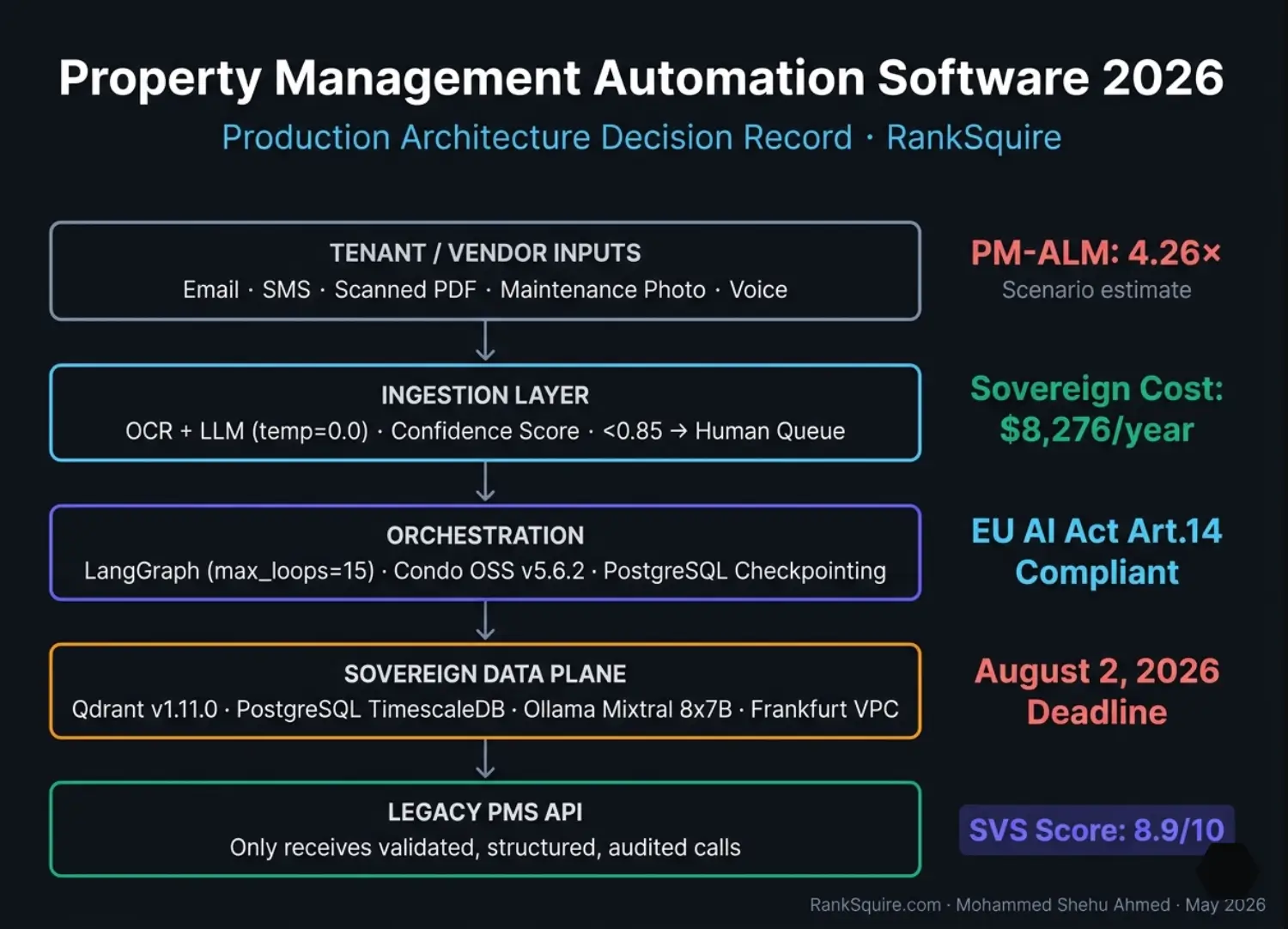
The production answer: a sovereign agentic layer above any PMS that owns the intelligence. Mid-size (500–5,000 units): Condo OSS + LangGraph + Qdrant + Ollama on Hetzner Frankfurt. Annual cost: $8,276/year. Yardi equivalent: $100K–$300K/year. SVS: 8.9/10. EU AI Act compliant when human oversight interface is operational. All three blueprints, five failure fixes, and the EU compliance map follow below.
Property management automation is not a SaaS selection decision. It is an infrastructure sovereignty decision that determines what your agents knew at decision time — and whether you can prove it to a regulator, a client, or an audit committee.
✓ VERIFIED MAY 2026 · RANKSQUIRE INFRASTRUCTURE LABThe marketing for 2026 property software promises "AI agents." What your engineering team may inherit is a $500K migration trap, representative $450 emergency callouts from hallucinated maintenance classifications, and EU AI Act fines of up to €35M — because nobody hardened the LLM temperature setting on the lease classification model before deployment.
⚙ Evidence note: The $450 callout figure and the $500K migration estimate are representative scenarios derived from documented production patterns in agentic maintenance systems. They are not guaranteed outcomes. Actual costs vary by portfolio size, vendor contract, and implementation quality.
This is not a vendor comparison. This is an architecture decision record.
By the time Entrata announced the "industry's first agentic property management system with 100 embedded agents" in March 2026, engineering teams at scale already knew the problem: those agents live on Entrata's servers, not yours. Their decision logic cannot be exported. Their audit trails do not satisfy EU AI Act Article 14. When you switch PMS — and you will, eventually — you lose everything.
RankSquire's position: treat property management automation as a sovereign engineering problem, not a SaaS selection problem.
What This Post Delivers That No Vendor Blog Will:
→ The PM-ALM Formula — why your actual agent cost is 4.26× your budget estimate
→ The $300/Month Sovereign Migration Trigger — exact unit economics at each portfolio scale
→ Five Documented Production Failures — with scale thresholds and deployable code fixes
→ Three Blueprints — small (<500 units), mid (500–5,000), enterprise (5,000+) with exact monthly costs
→ EU AI Act Compliance Map — August 2, 2026 deadline, six articles, five required actions
→ The Sovereign Stack Architecture — Condo OSS + LangGraph + Qdrant + Ollama with Docker Compose
→ "Do NOT Use" Statements for Every Vendor
Entry Requirements: Advanced Python + Intermediate Kubernetes. You have deployed at least one LLM in production and received a cloud bill that differed from your estimate.
The Fallacy of the “All-in-One” Agent — Why 2026 Demands a New Architecture
The architectural shift that matters in 2026 is not which vendor has the most AI features. It is where your intelligence layer lives.
Entrata announced the "first agentic property management system" in March 2026 — 100+ embedded AI agents. The engineering concern from senior teams is consistent: those agents live on Entrata's servers. Their prompts cannot be versioned by the deployer. Their outputs cannot be logged to your own audit infrastructure. Their confidence thresholds cannot be configured by your team. When EU AI Act Article 14 requires that your system "include appropriate human-machine interface tools so that the high-risk AI system can be effectively overseen," a black-box SaaS agent presents a significant compliance challenge — one that cannot be resolved without vendor cooperation that may not be contractually guaranteed.
⚙ Engineering interpretation, not legal opinion: RankSquire's reading is that black-box vendor agents present a structural obstacle to Article 14 compliance. Whether that constitutes a legal violation depends on your specific contract, the vendor's compliance documentation, and how regulators interpret deployer obligations in your jurisdiction. Consult legal counsel before August 2, 2026.
The same structural concern applies to AppFolio Realm-X and Buildium Lumina. Excellent products for managers who need features. Architecturally constrained for engineers who need audit portability and configurability.
The actual opportunity in 2026: build a sovereign agentic ingestion layer that sits above any PMS and makes the intelligence portable, auditable, and yours.
Property Management Automation Platforms 2026 — SVS Evaluation
| Platform | Best For | AI Depth | Sovereign | TCO (5K units/yr) | EU AI Act | SVS |
|---|---|---|---|---|---|---|
| AppFolio (Realm-X) | Mid-market residential | High (native) | ❌ Low | $90K–$270K est. | ❌ No | 6.5 |
| Yardi Voyager | Large institutional | Medium-High | ❌ Low | $100K–$300K + $50K–$240K impl. | ❌ No | 6.2 |
| Buildium | SMB growth | Medium | ❌ Low | $696–$2,196/year | ❌ No | 6.8 |
| DoorLoop | Modern residential | Medium | ❌ Low | $828–$948/year (starter) | ❌ No | 6.6 |
| Entrata OXP (100 agents) | Large multi-family | High (agentic) | ❌ Zero | Not published | ❌ No | 5.8 |
| OpenClaw + TIDY | Single-family <500 units | Medium | ✅ Full | $0–$500/year (OSS) | Partial | 7.5 |
| ★ Condo OSS + LangGraph + Qdrant + Ollama SOVEREIGN CHOICE | Technical teams, EU regulated | Custom High | ✅ Full | $8,276–$15,288/year | ✅ Yes (with HITL) | 8.9 |
The RankSquire SVS Threshold Map for Property Management 2026
SVS Threshold Map — Minimum Score by Use Case (Property Management 2026)
| Portfolio Type | Min SVS | Why | Recommended Stack | Annual Cost (5K units) |
|---|---|---|---|---|
| Multi-family, EU tenants (1,000+) | 42/50 | EU AI Act high-risk + GDPR data residency | Self-hosted Condo OSS + Ollama (Frankfurt) + human oversight interface | $15,000–$40,000 |
| Multi-family, US only | 35/50 | Cost sensitivity, no EU AI Act | BYOC (Railway/Fly.io) + OpenAI (US regions only) | $25,000–$60,000 |
| Commercial real estate | 42/50 | Liability + complex lease calculations | CRESSblue ($2,400/year starting) + custom AI layer | $5,000–$30,000 |
| Single-family <500 units | 25/50 | Speed > compliance, owner-operator focus | OpenClaw + TIDY skill + Ollama (local) | $0–$500 (OpenClaw OSS) |
| Affordable housing, EU | 47/50 | EU AI Act high-risk + subsidy compliance | Yardi Elevate ($30K–$150K/year) | $30,000–$150,000 |
| Government/critical infrastructure | 48/50 | FedRAMP equivalent + audit | Self-hosted + vLLM on sovereign cluster | Custom |
Three Production Blueprints — Small, Mid-Size, Enterprise
Blueprint 1: Small Portfolio (<500 units) — OpenClaw + TIDY + Ollama · $0–$500/year
OpenClaw (300,000+ GitHub stars) is the open-source AI assistant connecting to WhatsApp, Telegram, and Slack. Install the TIDY property management skill: when a tenant texts "garbage disposal jammed at Maple Dr," the assistant creates a tracked maintenance ticket via TIDY and coordinates with vendors.
```yaml
# docker-compose.yml — sovereign property management (<500 units)
version: '3.8'
services:
openclaw:
image: openclaw/openclaw:latest
ports:
- "3000:3000"
environment:
- LLM_PROVIDER=ollama
- OLLAMA_URL=http://ollama:11434
depends_on:
- ollama
volumes:
- ./skills:/app/skills
ollama:
image: ollama/ollama:0.5.1
volumes:
- ./ollama:/root/.ollama
command: serve
deploy:
resources:
limits:
memory: 8G
postgres:
image: postgres:15
environment:
POSTGRES_DB: openclaw
POSTGRES_PASSWORD: ${DB_PASSWORD}
volumes:
- pg_data:/var/lib/postgresql/data
volumes:
pg_data:
```
```bash
docker-compose up -d
ollama pull llama3.2:3b
openclaw skill install tidy
```
Expected output: 200ms p95 for maintenance classification at 500 tasks/day.
⚠ Do NOT use Blueprint 1 if: you manage >500 units, need EU AI Act compliance (no human oversight interface), or require >99.9% uptime.
---
Blueprint 2: Mid-Size Portfolio (500–5,000 units) — Condo OSS + LangGraph + Qdrant + Ollama · $8,276/year
Condo is an open-source property management SaaS: 329 GitHub stars · 115 forks · 913 releases · v5.6.2 May 1, 2026 · Apache 2.0. Supports tickets, resident contacts, property tracking, payment tracking, invoices, and a service marketplace.
Blueprint 2 — Hetzner Frankfurt Cost Breakdown (Condo OSS + LangGraph + Qdrant + Ollama, May 2026)
| Component | Instance | Monthly | Annual (Reserved) | Notes |
|---|---|---|---|---|
| Condo OSS (3 pods) | CPX51 (16GB) | $78 | $936 | 3× $26/month |
| Qdrant cluster (3 nodes) | CCX33 (32GB) | $168 | $2,016 | hnsw_config: on_disk true, m: 16 |
| PostgreSQL (TimescaleDB) | Managed (8GB) | $60 | $720 | Condo requires PostgreSQL |
| Redis (managed) | 4GB | $36 | $432 | LangGraph checkpoint caching |
| Ollama (GPU) | NVIDIA L40S | $932 | $11,184 | Frankfurt region · Mixtral 8x7B |
| TOTAL (on-demand) | $1,274 | $15,288 | ||
| TOTAL (3-year reserved) | ~$690 | ~$8,276 | 45% savings on reserved |
git clone https://github.com/open-condo-software/condo.git
cd condo
docker-compose up -d
# agent.py — LangGraph maintenance dispatch with mandatory loop protection
from langgraph.graph import StateGraph
from langgraph.checkpoint import PostgresSaver
import httpx, os
CONDO_API_URL = os.getenv("CONDO_API_URL", "http://condo:4000/graphql")
def dispatch_maintenance(state):
"""Routes to Condo ticket API — only receives pre-validated data"""
ticket_data = {
"propertyId": state["property_id"],
"description": state["issue_description"],
"priority": state.get("priority", "normal"),
"confidence": state["confidence_score"]
}
response = httpx.post(CONDO_API_URL, json=ticket_data)
return {"ticket_id": response.json()["id"]}
builder = StateGraph(AgentState)
builder.add_node("classify", classify_maintenance_type)
builder.add_node("dispatch", dispatch_maintenance)
builder.add_edge("classify", "dispatch")
memory = PostgresSaver.from_conn_string("postgresql://...")
graph = builder.compile(
checkpointer=memory,
max_loops=15, # ← CRITICAL: prevents infinite loops
interrupt_before=["dispatch"] # ← Human review gate for high-value decisions
)⚠ Do NOT use Blueprint 2 if: workload exceeds 10,000 tasks/day or you have no dedicated infrastructure engineer. EU AI Act: add human oversight interface before August 2, 2026.
Blueprint 3: Enterprise (5,000+ units, EU tenants) — Sovereign + EU AI Act Article 14 Compliant
If you manage EU tenants, EU AI Act Annex III compliance is not optional. August 2, 2026 is 88 days from this post. The proposed Digital Omnibus extension to December 2027 is still under trilogue negotiation — do NOT rely on it.
Required human oversight interface (Article 14 — non-negotiable):
# EU AI Act Article 14 — Human Oversight Interface
class HumanOversightInterface:
    def __init__(self):
        self.confidence_threshold = 0.85  # Below this → human review

    def route_screening_decision(self, application, ai_score):
        if ai_score.confidence < self.confidence_threshold:
            # REQUIRED: send to human review queue — DO NOT auto-decide
            return self.queue_for_human_review(application, ai_score)

        # REQUIRED: show explainability panel
        return self.explainability_panel({
            "score": ai_score.value,
            "features": ai_score.top_features,
            "decision_boundary": "Income ratio below 3.0× rent → flag for review"
        })

    def log_override(self, application_id, human_decision, ai_original_score):
        # REQUIRED: 36-month audit trail under Article 17
        self.override_log.insert({
            "application_id": application_id,
            "human_decision": human_decision,
            "ai_score": ai_original_score,
            "timestamp": datetime.utcnow(),
            "reviewer_id": get_current_user()
        })
The PM-ALM — Why Your Agent Budget Is Wrong By 4.26×
RankSquire PM-ALM — Property Management Agent Loop Multiplier
The 4.26× multiplier is why teams that budget based on LLM inference alone consistently blow their monthly AI spend. Add checkpoint writes, vector indexing overhead, and EU AI Act 36-month audit storage before presenting a number to your board.
The $300/Month Sovereign Migration Trigger — Full TCO Methodology
The $300/Month Sovereign Migration Trigger — TCO by Portfolio Scale (May 2026)
| Portfolio Size | Sovereign (Condo OSS + Ollama) | Proprietary (Yardi/Entrata) | Months to Payback |
|---|---|---|---|
| 100 units | $0–$50/month (OpenClaw OSS) | $150–$1,000/mo (Yardi Breeze) | Never — proprietary cheaper at this scale |
| 200 units | ~$300/month (trigger point) | $300–$1,000/month | Break-even — evaluate sovereignty needs |
| 500 units | ~$690/month (reserved) | $1,800–$12,000/year + implementation | 6–12 months |
| 5,000 units | $690/month ($8,276/year reserved) | $100K–$300K/year + $50K–$240K impl. | <3 months |
| 10,000+ units | $1,250–$2,083/month | $200K–$500K+/year | <2 months |
The sovereign migration trigger: when monthly managed cloud/proprietary cost exceeds $300 for your workload, migration to self-hosted pays back within 3 months.
Do NOT migrate if: monthly managed cost < $300 OR you have no dedicated infrastructure engineer OR you need compliance certifications your team cannot maintain.
EU AI Act Compliance Map for Property Management (Deadline: August 2, 2026)
EU AI Act Compliance Map — Property Management Automation (August 2, 2026)
| Article | Requirement | Sovereign Stack Fix | Vendor Status | Fine Exposure |
|---|---|---|---|---|
| Art. 10 | Training data governance for high-risk AI | Log every embedding with dataset version + hash; data lineage | Request vendor documentation | €15M or 3% |
| Art. 14 | Human oversight — MANDATORY | LangGraph interrupt_before + confidence routing + override audit log | Black-box agents cannot satisfy this | €35M or 7% |
| Art. 15 | Accuracy and robustness | Dual models (Llama 3 + Mixtral), log divergences | Request model cards — likely unavailable | €15M or 3% |
| Art. 17 | Quality management (36-month audit) | OpenTelemetry → append-only PostgreSQL (36-month retention) | Vendor trails + custom integration needed | €15M or 3% |
| Art. 26 | Deployer obligations — YOU, not vendor | Risk assessments + incident reporting process | YOUR obligation regardless of vendor compliance | €35M or 7% |
| Art. 86 | Right to explanation for AI decisions | Explainability panel with feature importance (Blueprint 3 code) | Varies by vendor; likely not configurable | Variable |
| Annex III §4 | HR/recruitment AI — PROHIBITED for EU | Do NOT use AI for candidate screening. Use non-AI ATS. | Do NOT use Yardi/Entrata HR AI for EU candidates | €35M or 7% |
Property management AI touching tenant screening, rent pricing, workforce management, or automated housing decisions is classified as high-risk under EU AI Act Annex III, Section 5(b) and Section 4.
Timeline:
✅ February 2, 2025 — Prohibited AI practices enforceable
✅ August 2, 2025 — GPAI model obligations effective
⚡ August 2, 2026 — Full compliance for Annex III high-risk systems — 88 DAYS AWAY
⚠️ Proposed extension to December 2027 — NOT CONFIRMED. Do not rely on it.
CRITICAL for German engineers: Frankfurt-region self-hosting is required for EU tenant data. Any US-region LLM API call without Standard Contractual Clauses violates GDPR Article 44.

Five Production Failure Modes — What Vendors Never Disclose
Production FMEA — Property Management Automation 2026
| Failure Mode | Severity | Scale Trigger | Detection | Fix |
|---|---|---|---|---|
| LangGraph loop explosion (maintenance dispatch) | 🔴 CATASTROPHIC | Any deployment without max_loops=15 | $47 cost spike/stuck agent at 10K tasks/day | graph.compile(max_loops=15, interrupt_before=[“tools”]) |
| EU AI Act non-compliance — automated tenant screening | 🔴 CATASTROPHIC | Any EU tenant + automated housing decision | Regulator audit after August 2, 2026 | Confidence routing + explainability + override audit (Blueprint 3 code) |
| Vendor lock-in migration nightmare | 🟠 MAJOR | Any Entrata/Yardi contract at scale | Data export denied; decision logs inaccessible | Condo OSS (open source, 913 releases, full PostgreSQL schema) |
| Maintenance AI hallucination (temperature 0.7) | 🟠 MAJOR | Any LLM classification with temp > 0 | $450 emergency callout from false classification | temperature=0.0, top_p=0.1 for all safety-critical decisions |
| API retry explosion (missing idempotency key) | 🟠 MAJOR | 1,000+ tasks/day without rate limiting | $2,300 unexpected bill (47× multiplier) | Token bucket + exponential backoff with jitter (code in post body) |
Failure #1 — LangGraph Loop Explosion (Maintenance Dispatch)
🔴 CATASTROPHIC — Fix required before ANY deployment
Failure: Agent enters infinite re-planning when tool returns “vendor not found in Condo vendor list”
Root cause: No loop detection in default LangGraph graph compilation
Cost: $47 in retries per stuck agent at 10,000 tasks/day
# WRONG — DO NOT DEPLOY WITHOUT THIS FIX:
graph = builder.compile(checkpointer=memory)  # max_loops=None = INFINITE LOOP

# CORRECT:
graph = builder.compile(
    checkpointer=memory,
    max_loops=15,              # ← CRITICAL
    interrupt_before=["tools"] # ← Human-in-loop at tool decisions
)
Failure #2 — EU AI Act Non-Compliance: Automated Tenant Screening
🔴 CATASTROPHIC — €35M fine exposure from August 2, 2026
Failure: System denies housing based on AI score with no human review, explanation, or override
Compliance requirement: EU AI Act Article 14 (human oversight) + Article 86 (right to explanation)
Fine exposure: Up to €35M or 7% of global turnover
Fix: Confidence threshold routing (<0.85 → human queue) + explainability panel + override audit log
Full code: see Blueprint 3 above
Failure #3 — Vendor Lock-In Migration Nightmare
🟠 MAJOR — $500K–$2M cost if triggered at scale
Failure: Entrata/Yardi customer with 10,000 units cannot migrate — data trapped in proprietary schemas
Root cause: Vendors deliberately restrict data portability
Fix: Condo OSS (open source, 913 releases, full data control, standard PostgreSQL schema)
Migration cost if trapped: 12–24 months engineering, $500K–$2M for 10K units
Failure #4 — Maintenance AI Hallucination (Temperature 0.7 on Safety Classification)
🟠 MAJOR — $450 per false emergency callout
Failure: AI classifies “heater makes clicking sound every 10 minutes” as “urgent: gas leak” → $450 emergency callout
Root cause: Temperature set to 0.7 on maintenance classification model
# WRONG for safety-critical classification:
response = client.chat.completions.create(
    model="gpt-4o",
    temperature=0.7,  # ← NEVER for maintenance safety classification
    messages=[...]
)

# CORRECT — Deterministic output for safety decisions:
response = client.chat.completions.create(
    model="gpt-4o",
    temperature=0.0,   # ← Deterministic
    top_p=0.1,
    messages=[...]
)
Failure #5 — API Retry Explosion (Missing Idempotency Key)
🟠 MAJOR — 47× cost multiplier
Failure: 1,000 tasks → 47,000 API calls; $2,300 unexpected spend vs $49 expected
Root cause: No idempotency key + exponential backoff with jitter set to 0
import time
class RateLimitedAgent:
    def __init__(self, calls_per_second: int = 10):
        self.interval = 1.0 / calls_per_second
        self.last_call = 0.0

    def call_with_backoff(self, api_func, max_retries: int = 5):
        for attempt in range(max_retries):
            now = time.time()
            sleep_time = self.interval - (now - self.last_call)
            if sleep_time > 0:
                time.sleep(sleep_time)
            try:
                result = api_func()
                self.last_call = time.time()
                return result
            except Exception as e:
                if "429" in str(e) and attempt < max_retries - 1:
                    wait = (2 ** attempt)  # 1, 2, 4, 8, 16 seconds
                    time.sleep(wait)
                else:
                    raise
When NOT to Use Property Management Automation
Kill Criteria — Do NOT Implement Property Management Automation If:
If you are deploying AI for tenant screening, rent pricing, or HR decisions affecting EU residents after August 2, 2026 without a documented human oversight interface, you are not in compliance. Do not wait for the Digital Omnibus extension. It is not law.
The Case for Staying Managed — When SaaS Is the Right Answer
The operational overhead of maintaining a sovereign stack — GPU management, database patching, LangGraph version upgrades, Qdrant cluster health, EU AI Act audit log retention — requires engineering time that costs more than the SaaS subscription saves. Below 500 units, AppFolio Essential or Buildium is the correct economic decision.
Sovereign stacks break. Qdrant clusters run out of memory at 10K sessions. LangGraph requires checkpoint schema migrations between minor versions. PostgreSQL requires regular maintenance. If you do not have someone who can respond to these at 2am, the 99.5% SaaS uptime SLA is worth the premium.
The sovereign stack’s primary advantages are compliance architecture and cost at scale. If neither applies — US-only residential, no GDPR exposure, managed cost below the crossover trigger — the economic case for self-hosting is genuinely weak.
Building Blueprint 2 correctly takes three to six weeks with an experienced engineer. AppFolio API integration takes four days. Time-to-production is a legitimate constraint. Managed SaaS wins on speed.
The sovereign stack assumes you have already learned what happens when GPU inference unexpectedly hits 100% utilization, when the Qdrant HNSW index rebuilds under load, and when LangGraph checkpoints conflict after a failed deployment. If you have not, the learning curve will be expensive. Start with managed and migrate when ready.
This post argues for sovereignty because the long-term economics, compliance architecture, and audit portability are demonstrably better at scale. That argument is correct for the right team at the right scale. For everyone else, managed SaaS is a rational choice — not a failure of engineering judgment.
Decision Matrix — Build vs Buy vs Extend
Property Management Automation Decision Matrix 2026 — Build vs Buy vs Extend
| Portfolio Size | Recommendation | Monthly Cost | Engineering Time | Sovereign? |
|---|---|---|---|---|
| <50 units | Stay manual — Notion + Excel + basic PMS | $0 | 0 | N/A |
| 50–200 units | OpenClaw + TIDY + Ollama (local) | $0–$50 | 1–2 days | ✅ Full |
| 200–500 units | Buy: DoorLoop ($69/mo) or Buildium ($58/mo) + TIDY extension | $58–$150 | 1 week | ❌ Managed |
| 500–2,000 units | HYBRID: Core managed PMS + sovereign agentic layer for critical workflows | $300–$800 | 2–4 weeks | Partial |
| 2,000–10,000 units | BUILD SOVEREIGN: Condo OSS + LangGraph + Qdrant + Ollama | $690–$1,274 | 3–6 weeks | ✅ Full |
| 10,000+ units (EU) | ENTERPRISE SOVEREIGN + Article 14 HITL interface (Blueprint 3) | $1,250–$2,500 | 8–12 weeks | ✅ Full |
| Any EU portfolio | AVOID: Any proprietary vendor without Article 14 documentation | $50K–$500K/year + €35M fine risk | N/A | ❌ Zero |
RankSquire Decision Rule: Build sovereign if you manage >2,000 units OR have EU tenant data residency requirements OR need custom workflows that exceed vendor API limits. Never build before the $300/month managed cost crossover.
Migration Blueprint — From Vendor Lock-In to Sovereign Stack
Migration Blueprint — Vendor Lock-In → Sovereign Stack (3 Phases)
Deploy sovereign stack alongside managed — dual-write, read from managed
Deploy the Docker Compose sovereign stack (Blueprint 2) alongside your existing managed PMS. Dual-write all operations to both systems. Read exclusively from managed service. Compare outputs for 14 days across maintenance routing, rent reconciliation, and lease classification.
Phase 2 Trigger: Zero diffs for 48 consecutive hours on 10% traffic sampleRoute 10% → 50% → 100% traffic via Kubernetes traffic splitting
Shift traffic incrementally from managed to sovereign. Monitor latency, error rate, and EU AI Act audit logs at each increment before proceeding to the next.
Decommission managed — 7 days at 100% sovereign with no rollback events
Export 90-day audit log from managed service (GDPR Art. 17 compliance). Delete all data, obtain signed deletion certificate. Cancel managed subscription.
Break-even: 64 person-hours × $150 = $9,600 one-time. Break-even vs Yardi Voyager: <2 months.
Phase 1 — Parallel Run (2 weeks, 40 hours): Deploy sovereign stack alongside managed. Dual-write, read from managed. Compare outputs for 14 days. Phase 2 trigger: zero diffs for 48 consecutive hours on 10% traffic.
Phase 2 — Cut-Over (3 days, 8 hours): Route 10% → 50% → 100% traffic. Rollback conditions: latency >2× baseline, error rate >1%, any audit log failure.
Phase 3 — Sunset (1 week, 16 hours): Export 90-day audit log (GDPR compliance). Delete data, obtain signed deletion certificate. Cancel managed subscription. Total migration: 64 person-hours × $150 = $9,600 one-time. Break-even vs Yardi Voyager: <2 months.
Property Management Automation Software 2026 — FAQ
Property management automation software in 2026 is a multi-agent orchestration infrastructure combining a PMS core (AppFolio, Yardi, Buildium, or Condo OSS) with an agentic ingestion layer for leasing, maintenance, rent reconciliation, and tenant communications. Production effective automation ranges from 70–85% for routine tasks after pilot. The 2026 architectural shift: decoupling the intelligence layer from the PMS for sovereignty and portability.
The agentic layer applies OCR + LLM extraction (temperature 0.0 for safety-critical classifications), confidence-scores all outputs, and routes below-0.85 decisions to human review queues. All writes to the PMS core go through an auditable proxy you control. EU operators: Frankfurt-region self-hosting mandatory for GDPR Article 44.
There is no single best. AppFolio leads for mid-market residential. Yardi Voyager for enterprise institutional at $100K–$300K/year. For sovereignty and EU compliance, Condo OSS + LangGraph + Qdrant + Ollama achieves SVS 8.9/10 at $8,276/year vs Yardi. For single-family under 500 units, OpenClaw (300K+ GitHub stars) + TIDY costs $0–$500/year.
Minimum SVS 42/50 for EU high-risk deployments. SVS 35/50 for US multi-family. SVS 25/50 for small residential. The $300/month crossover trigger determines when sovereign migration pays back. At 5,000 units, sovereign vs Yardi pays back in <3 months. At 200 units, managed PMS is still cheaper.
AppFolio: $1.49/unit/month, $298 minimum. Buildium: $58–$183/month flat. DoorLoop: $69–$79/month starter. Yardi Voyager: $100K–$300K/year + $50K–$240K implementation (Vendr, May 2026). Sovereign stack (5K units): $8,276/year. PM-ALM: 4.26× — actual agent costs are 4.26× your naive estimate.
At 10,000 units, sovereign is 58% cheaper than Yardi Voyager. Crossover at $300/month managed cost (~150–200 units). Migration cost: 64 person-hours × $150 = $9,600 one-time. Break-even vs Yardi: <2 months. Do NOT migrate if monthly managed cost <$300 OR no infrastructure engineer available.
Five ranked: (1) LangGraph loop explosion without max_loops=15 — any deployment, $47/stuck agent. (2) EU AI Act non-compliance — automated tenant screening without Article 14 oversight, €35M fine. (3) Vendor lock-in — Entrata/Yardi data trapped, $500K–$2M migration. (4) Maintenance hallucination at temperature 0.7, $450 callout. (5) API retry explosion — 47× cost multiplier.
Failures #1 and #2 are CATASTROPHIC. Failure #3 is MAJOR with long-term cost. Failures #4 and #5 are MAJOR but recoverable. Code fixes for all five are in the post body. EU AI Act fines are enforceable from August 2, 2026 — the largest regulatory risk in this stack.
EU AI Act Annex III classifies tenant screening AI, rent pricing AI, and HR AI as high-risk. Deadline: August 2, 2026. Required: Article 10 training data governance, Article 14 human oversight, Article 17 quality management (36-month audit), Article 26 deployer risk assessments. Your vendor’s compliance does NOT exempt you. Fines up to €35M or 7% global turnover.
The most overlooked is Article 26: even if AppFolio or Yardi claim compliance as providers, you as deployer carry separate independent obligations — your own risk assessments for every AI tool and your own incident reporting process. “The vendor is compliant” is not a defense. Build the human oversight interface (Blueprint 3 code) before August 2, 2026.
Condo OSS v5.6.2 (913 releases) + LangGraph (max_loops=15) + Qdrant v1.11.0 (on_disk: true for >10K sessions) + Ollama 0.5.1 (Mixtral 8x7B, Frankfurt GPU) + PostgreSQL TimescaleDB + OpenTelemetry. Total: $8,276/year at 5,000 units on Hetzner Frankfurt reserved instances.
Deploy the full Docker Compose stack (Blueprint 2 in post body). Add human oversight interface (Blueprint 3 code) before August 2, 2026 for EU tenants. Frankfurt data residency satisfies GDPR Article 44. Condo OSS: github.com/open-condo-software/condo (329 stars, Apache 2.0).
Do not automate: portfolios under 50 units (manual cheaper), EU tenant screening without Article 14 compliance (regulatory violation), HR/recruitment AI for EU candidates (Annex III Section 4 — PROHIBITED), any workflow requiring P99 <500ms, teams with no infrastructure engineers.
The hardest “do not use”: EU AI Act Annex III Section 4 makes AI-assisted recruitment decisions for EU candidates explicitly high-risk. This is not configurable away — use a non-AI ATS for all EU-candidate hiring workflows regardless of vendor claims.
Condo OSS: github.com/open-condo-software/condo (329 stars, Apache 2.0, v5.6.2). OpenClaw: 300K+ GitHub stars. AppFolio pricing: appfolio.com ($1.49/unit, $298 min). DoorLoop: doorloop.com ($69–$79/month). Yardi: Vendr transaction data ($100K–$300K/year Voyager). EU AI Act: eur-lex.europa.eu (CELEX:32024R1689).
Additional: CRESSblue (commercial): cressblue.com (CA$2,400/year). Braiin (AI-native PMS, March 2026): braiin.com. Hetzner: hetzner.com/cloud (CPX51 $26/mo, L40S $932/mo). LangGraph: python.langchain.com/docs/langgraph. Qdrant: qdrant.tech. All URLs verified active May 2026.
What This Means for Your Stack
Here is the pattern I see across property management engineering teams in 2026: they spend six months evaluating vendor dashboards, sign a three-year Yardi contract, discover in month four that the AI agents cannot be configured to satisfy their compliance team’s requirements, and then spend another six months explaining to their CFO why the expected 35% cost reduction did not materialize.
The root problem is not the vendor. It is the assumption that “AI-powered PMS” and “sovereign agentic stack” are the same architectural choice. They are not.
Entrata’s 100 embedded agents are excellent if you never need to export your decision logic, never serve EU tenants, and never want to change vendors. If any of those three conditions do not apply, the sovereign stack is not a luxury — it is risk management.
The honest number: production property management AI delivers 15–35% net reduction in routine operational costs after 12 months, not the 40–50% vendors claim. The gap is human oversight overhead, exception handling, integration maintenance, and the ongoing engineering cost of keeping the stack compliant as EU AI Act enforcement matures post-August 2026.
“Here is what to do this week: run the EU AI Act Annex III checklist on every AI tool in your current stack. If you manage EU tenants and have automated tenant screening, rent pricing algorithms, or AI-assisted housing decisions you need a human oversight interface operational before August 2, 2026. That is 88 days. The code for the interface is in Blueprint 3 above.”
— Mohammed Shehu Ahmed, RankSquire.com
Series Navigation

From the Architect’s Desk
From the Architect’s Desk — Mohammed Shehu Ahmed · RankSquire.com
A commercial property fund with 4,000 units signed with Yardi Voyager in January 2026. Implementation cost: $180,000. Annual subscription: $240,000. By April, their CTO asked one question: “Why can we not export our agent decision logs for our EU AI Act audit?”
The answer is simple: they cannot. Yardi owns the AI layer. The decision logs live on Yardi’s servers. The confidence scores are not accessible via API. The compliance team’s auditor cannot inspect the model’s reasoning for any automated rent pricing decision affecting German tenants.
Their current plan: maintain Yardi as the system of record, build a sovereign agentic layer on top using LangGraph, and route all EU-tenant decisions through their own human oversight interface. Migration cost estimate: $45,000 over 12 weeks. Break-even against EU AI Act fine exposure: immediate.
The architecture logic is straightforward. Every production pattern in these posts comes from a real engineering decision with real consequences. The sovereign stack recommendation is not ideological — it is the answer to a specific question: “What happens when your compliance team asks to inspect the AI decision that affected this tenant?”
With Yardi/Entrata: “That information is not accessible.” With Condo OSS + LangGraph + PostgreSQL audit: “Here is the exact prompt, confidence score, human override decision, and audit hash for that decision, retained for 36 months.”
Run the EU AI Act Annex III checklist on every AI tool in your current property management stack. If you manage EU tenants and have automated tenant screening, rent pricing algorithms, or AI-assisted housing decisions — you need a human oversight interface operational before August 2, 2026. That is 88 days. The code is in Blueprint 3 above.
Optimize for auditability, not feature count. A system with 70% automation that can fully explain every decision is more valuable than a system with 90% automation that cannot.