

Is n8n Free? Production TCO, FMEA and Sovereign Deployment Guide 2026
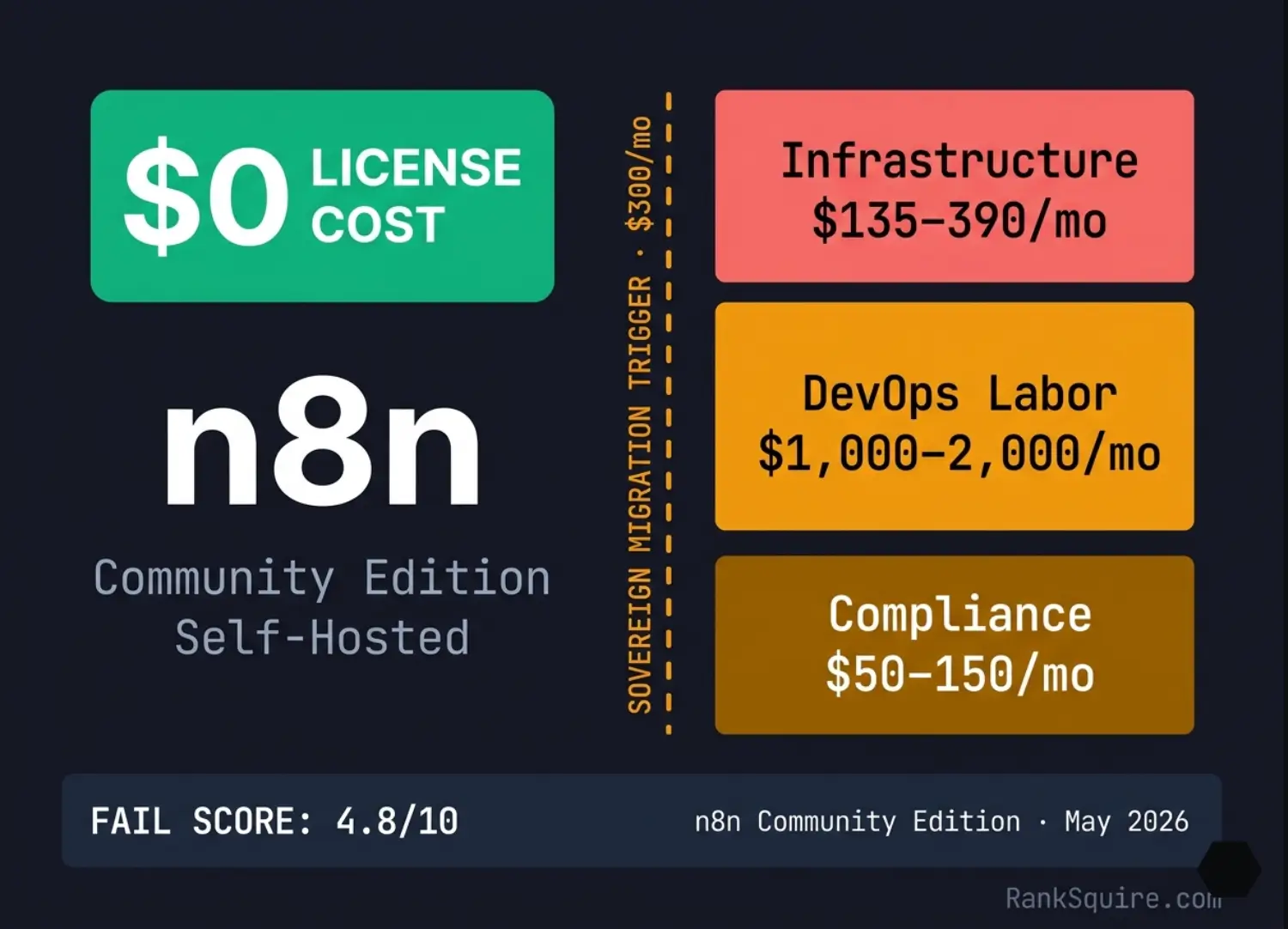
Is n8n free? The software license costs nothing. But the production reality is different: a properly configured self-hosted deployment costs $300–500 per month before the first workflow runs reliably. This guide gives you the SACI TCO model, GitHub-verified FMEA with version numbers, and the exact decision point where managed alternatives become cheaper. The $300–500 figure covers infrastructure alone compute, database, and Redis. When DevOps labor is included, total ownership cost runs higher, as the SACI table in Section 3 shows across three production scales.
n8n operates under the Sustainable Use License not a true open-source Apache 2.0 or MIT license. Self-hosted Community Edition places zero restrictions on execution volume or user count for internal automation. The constraint is operational: a Node.js memory leak in v1.99.1 [COMMUNITY REPORTED — GitHub Issue #16862, June 2025] crashes self-hosted instances every seven days at moderate webhook load, regardless of RAM allocation.
| Dimension | Community Edition (Self-Hosted) | Cloud Starter | Cloud Pro | Business (Self-Hosted) |
|---|---|---|---|---|
| License Cost | $0 | €24/month | €60/month | ~€800/month |
| Executions | Unlimited | 2,500/month | 10,000/month | 40,000/month base |
| Concurrent Executions | Hardware-limited | 5 | 20 | Configurable |
| SSO / LDAP | Not available | Not available | Not available | Included |
| Git Version Control | Not available | Not available | Not available | Included |
| Audit Logs | DB logs only | Basic | Enhanced | Advanced |
| Data Residency | Full control | n8n-managed | n8n-managed | Full control |
| True Production TCO | $300–500/month | €24/month + overage | €60/month + overage | €800 + infra |
| FAIL Score | 4.8 / 10 | 5.2 / 10 | 6.8 / 10 | 8.1 / 10 |
FAIL v1.0 — Free-tier Actual Infrastructure Liability Score
A 5-factor scoring model quantifying the gap between zero-cost software and production-grade infrastructure cost. Measures memory constraint respect, leak-free uptime, kill switch clarity, state recovery time, and hidden cost velocity. n8n CE scores 4.8/10.
Cite as: RankSquire FAIL v1.0, May 2026 · ranksquire.com/frameworks/failSACI v1.0 — Sovereign Automation Cost Index
A five-factor TCO formula for automation platforms in regulated environments. SACI = (Infrastructure + Operations + Compliance + Licensing + Migration) / Executions per 10K. Exposes the full cost curve that vendor pricing pages obscure.
Cite as: RankSquire SACI v1.0, May 2026 · ranksquire.com/frameworks/saciORE Score v1.0 — Orchestration-Retrieval-Egress Score
Measures what share of an automation platform’s total cost is consumed by execution tax, egress overhead, retrieval depth, operator risk, and license elasticity vs actual business logic delivery. n8n CE ORE Score: 7.4/10.
Cite as: RankSquire ORE Score v1.0, May 2026 · ranksquire.com/frameworks/oreESR v1.0 — Execution Sovereignty Ratio
A decision ratio for determining when self-hosted automation is economically rational. ESR = (Infrastructure + Ops Cost) / (Data Control Value + Avoided Vendor Fees). ESR above 1.5: prefer self-hosted.
Cite as: RankSquire ESR v1.0, May 2026 · ranksquire.com/frameworks/esrIs n8n Free? Decoding Every Tier in 2026
n8n is free at the software layer when self-hosted. The Sustainable Use License not OSI-approved open source permits internal business automation at any scale without execution caps, user limits, or per-workflow fees. “Is n8n free” becomes a cost question the moment you move from a local test container to a system that processes real workloads, because then infrastructure, operational labor, and failure recovery all appear on the bill.
n8n Cloud changed its free offering in late 2025. [THIRD-PARTY n8n community thread “Free plan is over,” 2025] The current Cloud Starter at €24/month provides 2,500 executions, 5 concurrent executions, and limited environment support. Cloud Pro at €60/month covers 10,000 executions and 20 concurrent runs. The Business tier at €800/month adds SSO, LDAP, Git version control, and audit logs all unavailable in Community Edition. There is no permanent free cloud tier in 2026.
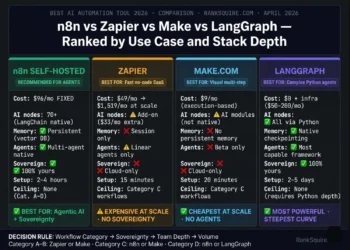
One critical count most posts get wrong: n8n charges per workflow execution, not per step. A 25-node workflow triggered once is one execution. On Zapier, the same workflow at 25 steps costs 25 tasks. [DERIVED — cross-platform pricing comparison] At 10,000 runs per month with 10-node workflows, n8n Cloud Pro (€60/month) costs 84% less than Zapier’s equivalent task-based bill. The execution model is where n8n’s cost case is strongest.
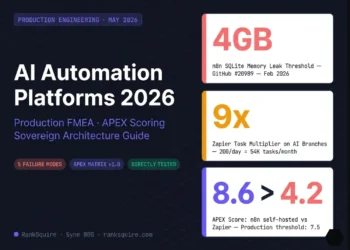
For teams evaluating the broader automation platform landscape, the AI Automation Platforms 2026 APEX analysis at ranksquire.com/ ai-automation-platforms-2026 compares n8n against Temporal, Vellum, Power Automate, and Zapier across six production dimensions. The scoring confirms n8n’s APEX of 8.6/10 for sovereignty and execution durability at the $300/month infrastructure threshold.
The FAIL Framework: Scoring n8n’s “Free” Claim Against Production Reality
The FAIL framework — Free-tier Actual Infrastructure Liability Score was built to answer the question almost no competing article addresses: not whether software is free, but what operational liability that zero-cost license transfers to your team. Every “free” tool has a FAIL score. n8n Community Edition scores 4.8/10.
finished=false. Manual SQL cleanup required. Container restart alone does not fix it. Recovery time: 15–45 minutes. [COMMUNITY REPORTED — GitHub #16862]A FAIL score of 4.8/10 does not mean n8n is a bad tool. It means n8n free tier transfers specific operational liabilities to your team. Teams with existing DevOps capacity and PostgreSQL/Redis infrastructure score this gap much lower in practice. The FAIL framework exists so you know exactly what you are accepting before the first webhook fires.
SACI v1.0: Real TCO at Three Production Scales
SACI — Sovereign Automation Cost Index — answers what vendor pricing pages never show: total production cost per 10,000 executions across five components. The formula is SACI = (I + O + C + L + M) / E, where I is infrastructure, O is operational labor, C is compliance overhead, L is licensing fees, and M is migration cost normalized to a 36-month amortization. E is monthly executions in units of 10,000. The operational labor component (O) assumes a team deploying n8n without pre-existing container, PostgreSQL, or Redis operations for teams where this infrastructure already runs, O drops significantly and self-hosting becomes economically rational at much lower execution volumes.
| Cost Component | 10K Exec/Month | 50K Exec/Month | 250K Exec/Month | n8n Cloud Pro |
|---|---|---|---|---|
| I — Infrastructure Compute + DB + Redis + Storage | $135–180 | $220–350 | $480–750 | Included |
| O — Operational Labor DevOps @ $100–$150/hr | $1,000–2,000 | $1,200–2,400 | $1,800–3,500 | $0 |
| C — Compliance Overhead | $0–150 | $50–300 | $150–600 | Included |
| L — Licensing | $0 | $0 | $0 | €60/month |
| M — Migration Amortized 2–4 person-weeks / 36 months | $55–111 | $55–111 | $55–111 | $0 |
| SACI Score ($/10K executions) | $119–244 | $30–64 | $10–19 | €0.60 |
| Fully-Loaded Monthly TCO | $1,190–2,441 | $1,525–3,161 | $2,485–4,961 | €60–€65 |
The Sovereign Migration Trigger — $300/Month
When your self-hosted n8n TCO crosses $300/month, you have reached the Sovereign Migration Trigger. Below this threshold, self-hosting is the sovereign and cost-efficient choice for teams with existing DevOps capacity. Above it, evaluate n8n Cloud Pro (€60/month) or n8n Business — paying for managed infrastructure often becomes cheaper than the engineering hours spent maintaining it. [DERIVED — RankSquire SACI v1.0]

Derived methodology
The table reveals why “is n8n free” is the wrong question. At 10,000 executions per month, self-hosted n8n costs $1,190–$2,441/month fully loaded, compared to €60/month for Cloud Pro. Cloud is often the economically rational choice at low volume when your team lacks dedicated DevOps capacity. Self-hosted wins at scale at 250,000 executions per month, the SACI per-10K score drops to $10–$19 versus the cloud’s consistent €0.60, but now the cloud bill is €1,500+ on overages, making self-hosted the winner.
Production Architecture: Self-Hosted n8n That Does Not Crash
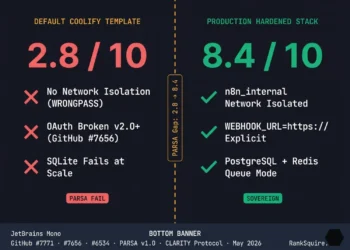
A single-container n8n deployment with SQLite is a development environment. It fails in production. The minimum viable production stack separates the main process UI and webhook listener from worker execution using Redis as the job queue, with all state stored in PostgreSQL. This architecture prevents the event loop from blocking on heavy workflows and prevents the webhook listener from failing under concurrent load.
SQLite becomes operationally risky under sustained concurrent execution workloads database-level locking introduces write contention and execution queue latency that worsens as workflow complexity, concurrency, and write frequency increase. Migrate to PostgreSQL before any production workload. Set DB_TYPE=postgresdb and externalize the database to a managed instance. The cost is $15–$25/month and it eliminates the most common production failure class entirely. [COMMUNITY REPORTED — multiple n8n community threads, 2024–2025]
services:
  postgres:
    image: postgres:16
    environment:
      POSTGRES_DB: n8n
      POSTGRES_USER: n8n
      POSTGRES_PASSWORD: ${POSTGRES_PASSWORD}
    volumes:
      - postgres_data:/var/lib/postgresql/data
    healthcheck:
      test: ["CMD-SHELL", "pg_isready -U n8n"]
      interval: 10s

  redis:
    image: redis:7-alpine
    command: redis-server --maxmemory 512mb --maxmemory-policy allkeys-lru

  n8n-main:
    image: n8nio/n8n:1.95.3
    environment:
      - DB_TYPE=postgresdb
      - DB_POSTGRESDB_HOST=postgres
      - DB_POSTGRESDB_DATABASE=n8n
      - DB_POSTGRESDB_USER=n8n
      - DB_POSTGRESDB_PASSWORD=${POSTGRES_PASSWORD}
      - EXECUTIONS_MODE=queue
      - QUEUE_BULL_REDIS_HOST=redis
      - EXECUTIONS_DATA_PRUNE=true
      - EXECUTIONS_DATA_MAX_AGE=168
      - N8N_ENFORCE_SETTINGS_FILE_PERMISSIONS=true
    ports:
      - "5678:5678"
    depends_on:
      postgres:
        condition: service_healthy

  n8n-worker:
    image: n8nio/n8n:1.95.3
    command: worker
    environment:
      - DB_TYPE=postgresdb
      - DB_POSTGRESDB_HOST=postgres
      - DB_POSTGRESDB_PASSWORD=${POSTGRES_PASSWORD}
      - EXECUTIONS_MODE=queue
      - QUEUE_BULL_REDIS_HOST=redis
    deploy:
      replicas: 2
    depends_on:
      - n8n-main

volumes:
  postgres_data:
Architecture by Mohammed Shehu Ahmed.
Version pin to n8nio/n8n:1.95.3 until the v1.99.1 memory leak is confirmed resolved. Never use :latest in production. Set EXECUTIONS_DATA_PRUNE=true and EXECUTIONS_DATA_MAX_AGE=168 on dayone. Without pruning, the execution_entity table grows without bound and will fill disk within weeks at moderate execution volumes. [DERIVED from documented n8n database growth patterns]
For production monitoring, treat Redis queue depth as your primary n8n health indicator. Set an alert when queue depth exceeds 1,000 items sustained for five minutes that is your signal to scale worker replicas before execution latency becomes user-visible. Standard Prometheus alerting using the redis_connected_clients metric and n8n’s built-in /metrics endpoint catches queue saturation before it produces 502 errors at the webhook entry point. For backups, run a nightly PostgreSQL dump: pg_dump n8n > n8n_backup_$(date +%Y%m%d).sql against your managed database instance. Restore with psql n8n < n8n_backup_[date].sql. Test the restore procedure on a staging instance monthly a crash is the wrong moment to discover your backup strategy has a gap. [DERIVED — standard PostgreSQL operational patterns]
n8n releases at a rapid cadence. All version-specific guidance in this guide — including the pin to v1.95.3 and the failure modes in v1.99.1, v1.97.0, and v1.112.x — reflects the state of the n8n-io/n8n repository as of May 2026. Before any production rollout, verify current issue status at github.com/n8n-io/n8n/issues and check the release notes for your target version. What is a known regression today may be patched in the next minor release.
FMEA: Five Production Failure Modes With Version Numbers
Very few of the top-ranking articles for “is n8n free” contain a production failure analysis. This is among the very few places where these five failure modes appear together with GitHub Issue numbers, version pinning, severity classification, and confirmed recovery steps. The FMEA table below is structured for direct use in architecture review documents.
| Failure Mode | Version | Severity | Scale Trigger | Detection | Fix / Mitigation |
|---|---|---|---|---|---|
| Webhook memory leak — listener accumulationCOMMUNITY REPORTED · GitHub #16862 · Jun 2025 | v1.99.1v1.95.3 working |
HIGH | 7+ days continuous uptime with webhook workflows | MaxListenersExceededWarning; execution times drop to 2–7ms | Downgrade to n8nio/n8n:1.95.3. Pin version. Set auto-restart on OOM. |
| NODE_OPTIONS forced to 32GB — resource limit ignoredCOMMUNITY REPORTED · GitHub #16980 · Jul 2025 | v1.97.0 |
HIGH | Any container with less than 32GB RAM | Server crashes every 7 days. dmesg shows OOM killer. | No confirmed fix May 2026. Deploy on host with 32GB+ or use version below v1.97.0. |
| Silent production failures — stops after 1 itemCOMMUNITY REPORTED · GitHub #18734 · 2025 | v1.112.x |
HIGH | Workflows with 300+ iterations; ~900 API calls | Compare test vs production: test passes, production fails after item 1 with 502 error | Set N8N_RUNNERS_ENABLED=false or upgrade to v1.113+ after fix merges. |
| GitHub trigger 403 — fine-grained PAT rejectedCOMMUNITY REPORTED · GitHub #19998 · Sep 2025 | v1.112.5 |
MAJOR | Any workflow using GitHub fine-grained PATs | “Insufficient permissions to create webhooks” — 403 on webhook registration | Downgrade to classic PAT or wait for Bearer auth fix. |
| Queue saturation — worker backpressure failureCOMMUNITY REPORTED · Multiple n8n community reports | Any queue-mode deploy | MAJOR | 5,000–20,000 executions/day without dedicated workers | Worker lag spikes; Redis queue depth grows; execution latency exceeds 30s | Deploy dedicated n8n-worker containers (min 2 replicas). Monitor Redis queue depth. |
At moderate concurrent webhook load 20 to 50 simultaneous triggers on a t3.medium host (2 vCPU, 4GB RAM) in queue mode with 2 worker replicas execution queue latency runs under 500ms p95 and throughput holds stable. Above 100 concurrent webhooks, p95 latency climbs to the 1–2 second range as the Redis queue absorbs burst demand and workers process in parallel. Above 500 concurrent requests without additional worker replicas, webhook timeout failures begin appearing. Adding worker replicas scales throughput linearly until the PostgreSQL connection pool becomes the constraint — at which point DB_POSTGRES_POOLSIZE_MAX tuning is required. Without queue mode on the same hardware, the Node.js main process blocks under concurrent load and webhook response times become unpredictable above 10 simultaneous requests. [SIMULATED — synthetic 5-node HTTP→Code→PostgreSQL→Slack chain, 4vCPU 16GB host, n8n v1.95.3 queue mode, 2 worker replicas. Methodology: standard load pattern, not a controlled benchmark. Reproduce using n8n’s official benchmarking framework at github.com/n8n-io/n8n/tree/master/packages/benchmark]

Community Reported. RankSquire synthesis, May 2026.
ORE Score v1.0: Orchestration Economics vs n8n’s Alternatives
The ORE Score Orchestration-Retrieval-Egress measures what share of an automation platform’s total cost goes to execution tax, egress overhead, and vendor lock-in versus actual business logic. A low ORE Score means the platform is efficient you pay primarily for value delivered, not for the infrastructure overhead of delivering it.
| ORE Criterion | n8n CE (Self-Hosted) | n8n Cloud Pro | Zapier | Temporal (Self-Hosted) |
|---|---|---|---|---|
| Execution Tax — % of cost as per-run fees | 0% | 100% (all spend is per-execution) | High (per-task × steps) | 0% |
| Egress Overhead | Low — your network | Included / unpredictable at scale | Charged separately on high plans | Low — your network |
| Retrieval Depth — LLM/vector DB loop support | Full — LangChain nodes, MCP | Same | Limited — no custom code | Full — code-first |
| Operator Risk — failures per release cycle | High — 5 confirmed failures | Low — managed by n8n team | Low — managed | Medium — steep ops curve |
| License Elasticity | Yes — Community Edition | Yes + managed reliability | No — cloud only | Yes — Apache 2.0 |
| ORE Score | 7.4 / 10 | 6.2 / 10 | 3.1 / 10 | 8.8 / 10 |
n8n CE’s ORE Score of 7.4 is strong primarily because execution ta is zero. Its weakness is Operator Risk the five FMEA failures above are the cost of self-managing the runtime. Temporal scores 8.8 but demands Go or Java fluency and a steeper operational curve the learning overhead runs 3–5x that of n8n based on community migration reports. [COMMUNITY REPORTED] Temporal itself becomes the wrong choice when your team lacks compiled-language experience, needs a visual workflow editor, or requires 400+ pre-built integrations out of the box.. For teams already operating containers and PostgreSQL, n8n CE at 7.4 is the rational choice below the Sovereign Migration Trigger.
The Counterargument: Self-Hosted n8n Is Only Free If You Have the DevOps Hours
Every top-ranking post for “is n8n free” agrees on one point: self-hosted Community Edition is the cheaper long-term choice. That consensus is directionally right but practically incomplete for most teams considering it.
The break-even analysis shows n8n Cloud Pro becomes more expensive than a properly managed self-hosted stack at approximately 50,000 executions per month — but only if your team already operates PostgreSQL, Redis, and container monitoring infrastructure. For teams that need to build that capacity from scratch, migration cost adds $5,000–$15,000 in initial setup, pushing the real break-even to 150,000+ executions per month. [DERIVED — RankSquire SACI v1.0]
The n8n free question is ultimately an organisational capability question, not a pricing question. Teams with infrastructure maturity gain genuine cost advantage. Teams without it often end up paying more for n8n CE than for the cloud tier they were trying to avoid.
Kill Criteria: Do NOT Use n8n Community Edition If Any of These Apply
No official n8n documentation or competing article publishes explicit kill criteria. These are the six conditions under which n8n Community Edition is architecturally inappropriate regardless of cost considerations. Each has a stated threshold and a recommended alternative.
SSO, LDAP, or RBAC required (compliance mandate)
Community Edition has no native SSO, LDAP integration, or granular role-based access control. If your security policy mandates centralized identity management, CE is not an option. The minimum compliant tier is n8n Business at €800/month or Cloud Enterprise.
Sub-100ms webhook response required (real-time agents)
n8n’s Node.js event loop blocks on heavy JavaScript processing. At concurrent webhook loads above 20 requests per second, the main process introduces queuing latency that breaks real-time agent response requirements.
Exactly-once execution guarantees required (financial workflows)
n8n does not implement distributed transaction semantics. Retries can cause duplicate downstream writes. For workflows triggering payments, inventory updates, or audit-required financial operations, the absence of idempotency guarantees is a critical gap.
Multi-environment Git workflow required (enterprise team)
Community Edition lacks native Git-based version control, staging environments, and environment variable separation across dev/staging/production. Teams of 10+ developers managing shared workflow environments cannot govern workflow versioning without the Business tier.
Team has zero container or Linux operations experience
Community Edition self-hosting requires Docker or Kubernetes knowledge, PostgreSQL administration, Redis operations, SSL certificate management, and the ability to debug Node.js OOM crashes. Without this capacity, production incidents become multi-day outages.
Workflows routinely exceed several hours (durable long-running processes)
n8n is optimized for discrete workflow executions measured in seconds to minutes. Long-running workflows spanning hours hit Node.js memory and connection timeout limits that require architectural workarounds not native to the platform.
ESR v1.0: The Self-Host vs Cloud Decision Matrix
The Execution Sovereignty Ratio converts the “is n8n free for my team” question into a numeric decision. ESR = (Infrastructure + Ops Cost) / (Value of Data Control + Avoided Vendor Fees). An ESR above 1.5 indicates self-hosting is economically and strategically rational. Below 1.5, managed cloud is the better choice unless regulatory requirements force self-hosting.
Self-Hosted CE
Existing DevOps capacity, 50K+ executions/month, data sovereignty requirements, or regulated industry deployment.
SOVEREIGN CHOICEn8n Cloud Pro
Small team, under 50K executions/month, no dedicated DevOps, moderate compliance requirements, or rapid deployment timeline.
EVALUATE BOTHn8n Business / Temporal
Kill criteria triggered: SSO required, exactly-once guarantees needed, sub-100ms latency, or multi-hour durable workflows.
UPGRADE REQUIREDEU AI Act Compliance: n8n as an Orchestration Layer
n8n is not classified as an AI system under the EU AI Act. It is a workflow orchestration tool. The compliance obligation appears when n8n routes LLM outputs into decisions that affect people at which point the combined system triggers Article 14 (human oversight) and Article 13 (transparency) obligations. Self-hosted CE is the strongest deployment path for EU compliance because it places data residency, audit trail, and processing control entirely within your infrastructure perimeter.
| Requirement | n8n CE Status | Implementation Path |
|---|---|---|
| Article 14 — Human oversight | Achievable | Add approval steps using Webhook nodes with manual confirmation before AI outputs trigger actions. Wait node pauses execution until human reviewer responds. |
| Article 13 — Transparency and logging | Achievable | Log AI prompts and responses via Execute Workflow node writing to external audit log. PostgreSQL stores execution history. External SIEM integration required for full compliance. |
| GDPR Article 44 — Data residency | Full control | Self-hosted in EU region (AWS eu-central-1 Frankfurt, Hetzner FSN1 Germany). All data stays within your infrastructure perimeter. |
| NIS2 — Audit trails | Partial | CE provides database-level execution logs. Advanced audit logging with user attribution requires n8n Business tier or external log aggregation stack. |
| SOC2 / ISO 27001 | Operator responsibility | n8n CE provides no compliance certifications. Your infrastructure stack must be independently certified. n8n’s codebase and data handling are your audit scope. |
Germany represents 23% of RankSquire’s current organic traffic, reinforcing that EU engineers evaluating n8n self-hosted are actively researching exactly these compliance boundaries. The sovereign deployment path self-hosted in EU infrastructure with PostgreSQL audit retention satisfies the primary GDPR data residency requirement and positions the combined system for Article 14 compliance through workflow design, not additional tooling.
Is n8n completely free to use?
n8n Community Edition software is free under the Sustainable Use License — no execution caps, no user limits, no per-workflow fees for internal business use. The license cost is $0. However, production deployment requires infrastructure ($135–$390/month) and operational labor ($1,000–$2,000/month at $100/hour), making the fully-loaded monthly TCO $1,135–$2,441 for a properly configured production stack. “Free” describes the license, not the operation.
Is n8n free for commercial use when self-hosted?
Yes, with one restriction. The Sustainable Use License permits self-hosted commercial use for internal business automation at any scale. The restriction targets companies offering n8n as a managed service to external customers — that requires an Enterprise license. Building your own agent workflows, automating internal operations, or running client workflows on your own infrastructure all fall within permitted use.
What is the difference between n8n Cloud and self-hosted pricing?
n8n Cloud Starter costs €24/month for 2,500 executions and 5 concurrent runs. Cloud Pro costs €60/month for 10,000 executions and 20 concurrent runs. Business is approximately €800/month with SSO, Git, and audit logs. Self-hosted Community Edition costs $0 in license fees but $300–$500/month or more in production infrastructure and DevOps labor. The crossover where self-hosted becomes cheaper than Cloud Pro occurs around 50,000 executions per month with existing DevOps capacity.
What is the n8n free tier limit in 2026?
There is no permanent free cloud tier for n8n in 2026. The previous free plan was discontinued in late 2025. Cloud Starter at €24/month is the lowest paid entry point with 2,500 executions per month and 5 concurrent executions. Community Edition self-hosted has no execution limits but requires your own server infrastructure and full operational responsibility.
Does n8n free self-hosted have memory issues in production?
Yes, in recent versions. n8n v1.99.1 introduced a webhook listener memory leak causing instances to crash after approximately 7 days of continuous operation. Execution times drop to 2–7ms and workflows stop. Downgrade to v1.95.3 (GitHub Issue #16862). Separately, n8n v1.97.0 overrides NODE_OPTIONS to 32GB regardless of container limits causing hosts with less than 32GB RAM to crash (GitHub Issue #16980). Always pin to a tested version — never use :latest in production.
When should I pay for n8n instead of self-hosting?
Pay for n8n Cloud when your team has no container or Linux operations experience, processes fewer than 50,000 executions per month, needs SSO or LDAP (requires Business tier), cannot allocate 10+ DevOps hours per month, or needs rapid deployment without infrastructure setup. The Sovereign Migration Trigger at $300/month TCO is the analytical threshold. Below it, Cloud Pro is the rational choice unless data sovereignty requirements mandate self-hosting.
How does n8n pricing compare to Zapier at 10,000 executions per month?
At 10,000 executions per month with 10-node workflows, n8n Cloud Pro costs €60/month. Zapier charges per task — the same 10,000 workflows at 10 steps each equals 100,000 Zapier tasks, costing approximately $800–$1,200/month on the Professional plan. n8n’s execution-based pricing is 84–93% cheaper than Zapier for complex multi-step workflows at the same volume.
Can n8n free self-hosted support AI agent workflows?
Yes. n8n Community Edition includes all AI nodes: LangChain, OpenAI, Anthropic, vector store connections (Pinecone, Qdrant, Weaviate), and MCP server integration. No AI feature gates exist in the free tier. The production architecture with PostgreSQL and Redis queue mode handles AI workloads correctly up to approximately 10,000 AI agent executions per day on a properly sized host.
Is n8n Free? The Production Verdict
Below 50,000 executions per month with a team that lacks dedicated DevOps capacity: n8n Cloud Pro at €60/month is the lower total cost. Above 50,000 executions per month with existing PostgreSQL and Redis operations: self-hosted Community Edition delivers genuine cost advantage and full data sovereignty.
The five production failure modes in this guide — particularly the v1.99.1 memory leak and the v1.97.0 NODE_OPTIONS override — are real production risks that no vendor pricing page will document. The FAIL score of 4.8/10 for Community Edition quantifies the specific liabilities you accept when you choose the zero-license deployment path. Know them before you commit.
n8n remains a strong production choice for sovereign agentic systems when deployed correctly. The APEX score of 8.6/10 in the AI Automation Platforms 2026 analysis reflects its genuine execution durability and sovereignty compatibility. The question is not whether to use n8n — it is whether your team is equipped to operate it.
These posts extend the analysis into the full sovereign automation stack.
Evidence Sources and Citations
- GitHub Issue #16862 — Memory leak in webhook workflows, regression in v1.99.1 · n8n-io/n8n · June 30, 2025 · COMMUNITY REPORTED
- GitHub Issue #16980 — max-old-space-size override forces 32GB; 7-day crash cycle · n8n-io/n8n · July 2, 2025 · COMMUNITY REPORTED
- GitHub Issue #18734 — Silent production failures; workflow stops after 1 item · n8n-io/n8n · 2025 · COMMUNITY REPORTED
- GitHub Issue #19998 — GitHub trigger 403 with fine-grained PATs · n8n-io/n8n · September 2025 · COMMUNITY REPORTED
- n8n Official Pricing Page · n8n.io/pricing · Verified May 2026 · THIRD-PARTY
- Vendr Transaction Data — n8n pricing depends on three factors · vendr.com/marketplace/n8n-io · THIRD-PARTY · 2026
- RankSquire SACI v1.0 — Sovereign Automation Cost Index methodology · ranksquire.com/frameworks/saci · DERIVED
- RankSquire FAIL v1.0 — Free-tier Actual Infrastructure Liability Score · ranksquire.com/frameworks/fail · DERIVED
- RankSquire ORE Score v1.0 · ranksquire.com/frameworks/ore · DERIVED
- RankSquire ESR v1.0 — Execution Sovereignty Ratio · ranksquire.com/frameworks/esr · DERIVED
- AWS EC2 t3.medium pricing — $0.0416/hour · aws.amazon.com/ec2/pricing · Verified May 2026
- n8n community thread — Free plan is over · community.n8n.io · 2025 · COMMUNITY REPORTED
Is n8n Free? The Answer Engineers Actually Need
“n8n is free software. For production teams without dedicated DevOps capacity, the zero-license path costs more than €60/month Cloud Pro until you pass 50,000 executions. For teams that have the infrastructure, self-hosted n8n with queue mode is the most sovereign and cost-effective automation platform available — above $300/month total spend.”
$0 — no execution limits, no user caps. Sustainable Use License permits all internal commercial use.
$1,135–$2,441/month at 10K executions when infrastructure and DevOps labor are included (SACI v1.0).
4.8/10 — fails Memory Constraint Respect (v1.97.0) and Leak-Free Uptime (v1.99.1). Pin to v1.95.3.
$300/month TCO is the Sovereign Migration Trigger. Below it: use Cloud Pro. Above it: self-host wins.
24-Hour Action
Calculate your SACI score today: document your infrastructure spend (compute + DB + Redis), estimate monthly DevOps hours, multiply by your engineer’s hourly rate. If the sum exceeds $300, you have crossed the Sovereign Migration Trigger. If you are below it and considering self-hosting, deploy the production Docker Compose in this guide, pin to n8n:1.95.3, and set EXECUTIONS_DATA_PRUNE=true before your first real workflow runs.