

The Sovereign Stack: Choosing the Best Self-Hosted Vector Database for Privacy-First AI (2026)
💼 Executive Summary
The Problem: Managed vector services create Data Hostage scenarios your most sensitive embeddings live on third-party servers, creating compliance exposure, unpredictable scaling costs, and zero control over data residency.
The Shift: Moving from Managed Convenience to Infrastructure Sovereignty.
The Outcome: High-availability retrieval running entirely within your own secure perimeter on VPS, bare metal, or Kubernetes with zero external data egress and fixed infrastructure cost at any execution volume.
The Definition: The best self-hosted vector database provides high-availability retrieval on controlled infrastructure without external data egress, without per-query vendor billing, and without compliance exposure to third-party breach events.
The Honest Counter-Argument: Some engineers argue managed SaaS is cheaper than self-hosted at small scale. At under 5 million vectors and under 100,000 queries per month, this is correct managed serverless tiers cost nothing and require zero ops. The math inverts above 50 million vectors. At that scale, self-hosted Qdrant on a $65 per month Hetzner AX52 server costs approximately $780 per year in fixed infrastructure. The equivalent managed workload at that vector count and query volume costs $500 to $800 per month $6,000 to $9,600 per year. Depending on workload and query volume, self-hosting can be significantly less expensive at production scale often by a substantial margin for high-throughput deployments. The break-even threshold for most teams is a managed SaaS bill consistently above $150 per month at that point the $65 per month VPS pays back on day one of month two.
Key Takeaway: In 2026, the Rent versus Own debate is decided by whoever controls the physical storage of their AI’s memory. In many regulated industries, self-hosting becomes a compliance-driven architecture decision rather than a cost optimization and for Healthcare, Finance, and Defense, that decision is frequently non-negotiable.
Table of Contents
Defining Self-Hosted in 2026
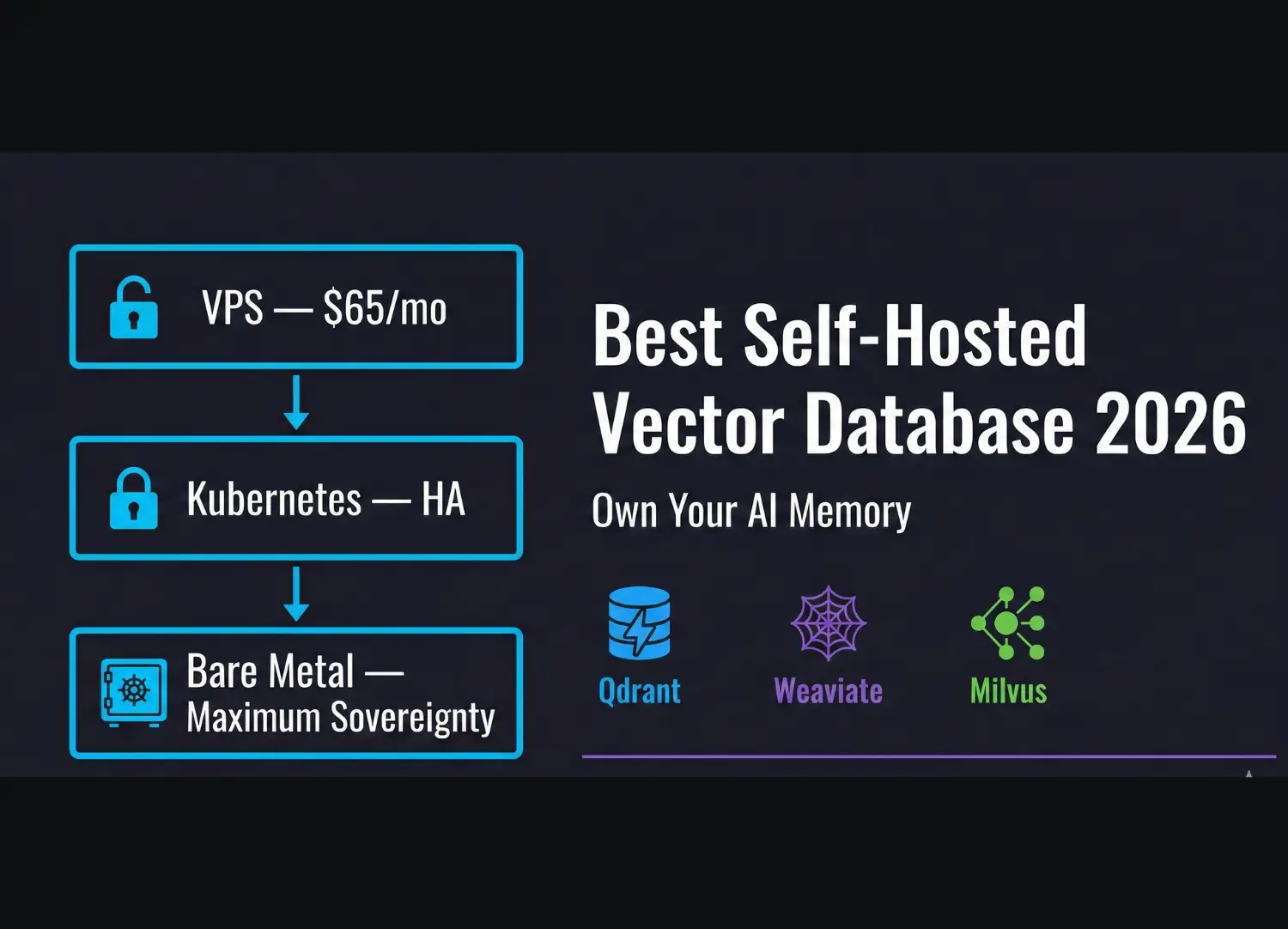
Self-hosting in the modern AI era is not a single deployment model. It spans three distinct infrastructure tiers each with different operational complexity, compliance strength, and cost profile.
VPS and Cloud Compute: Running Docker containers on providers like Hetzner, DigitalOcean, or AWS EC2. This is the entry point for most self-hosted deployments. A Hetzner AX52 at $65 per month gives you 12 cores, 64GB RAM, and 1.92TB NVMe storage sufficient for 10 million vectors with room to scale. Data stays within the VPS provider’s data center region. Compliance posture depends on the provider’s certifications Hetzner holds ISO 27001 and is GDPR-compliant for EU deployments. A Real Estate brokerage running an Autonomous ISA on this tier gets full data residency within their chosen jurisdiction at a fixed monthly cost regardless of query volume.
Kubernetes Orchestration: Distributed deployment across multiple nodes for high-availability enterprise RAG. Milvus and Weaviate both provide Helm charts for Kubernetes deployment. This tier enables horizontal scaling, automatic failover, and geographic distribution of the index. A B2B Agency running RAG pipelines for 50 client accounts on Kubernetes gets physical tenant isolation per namespace with automatic recovery from node failure. Operational complexity is significantly higher you need engineers who understand Kubernetes networking, persistent volume claims, and pod disruption budgets.
Bare Metal and On-Premises: The maximum sovereignty tier. Your hardware. Your building. Your network. Zero cloud dependency. Common in Defense, regulated Financial Firms, and Healthcare systems handling HIPAA-protected data. Data never leaves your physical perimeter under any circumstance. A Financial Firm running compliance document retrieval on bare metal eliminates the GDPR Article 44 cross-border transfer risk entirely the data physically cannot cross a border because the server physically cannot move.
The Core Trade-off: You gain 100 percent data privacy, zero egress fees, predictable fixed cost, and complete audit control. You inherit the Maintenance Burden the responsibility for patching, backups, monitoring, horizontal scaling, and disaster recovery. This trade-off is the central decision every team evaluating the best self-hosted vector database must make before choosing a specific database.
Comparative Analysis: The Self-Hosted Leaders

Four databases lead for self-hosted production deployments in 2026:
| Database | Architecture | Deployment | Hybrid Search | Scalability | Best For |
|---|---|---|---|---|---|
| Qdrant | Rust — Single Binary | Docker / K8s | ✅ Sparse + Dense | High | Speed and performance |
| Weaviate | Go — Multi-node | Docker / K8s | ✅ BM25 + Vector | High | Hybrid search and multi-tenancy |
| Milvus | Distributed K8s | K8s / Helm | ✅ Sparse Index | Massive | Billion-scale enterprise |
| Chroma | Python / SQLite | Docker / Local | ❌ Dense only | Moderate | Prototypes only |
Decision Mini-Table: Choose by Primary Self-Hosted Constraint:
| Your Primary Constraint | Recommended Database | Reason |
|---|---|---|
| Fastest setup, highest performance | Qdrant | Single Docker binary, Rust efficiency, sub-30ms |
| Physical multi-tenant isolation required | Weaviate | Native multi-tenancy, physical index per tenant |
| Billion-vector scale, Kubernetes-native | Milvus | Distributed compute-storage separation |
| Prototype only, no production requirement | Chroma | Free, Python-first, minimal setup |
| PostgreSQL in stack, under 50M vectors | pgvector | No new system, one backup, one team |
Qdrant performs strongly for most single-node self-hosted deployments in 2026. Single binary deployment one Docker pull and you have a production-grade vector database running. Built in Rust for memory efficiency and query speed that interpreted language databases cannot match. Advanced JSON payload filtering handles high-cardinality metadata at production scale. Sparse plus dense hybrid search available natively BM25 keyword precision combined with HNSW vector similarity in a single query, matching Weaviate’s hybrid capability in a lighter operational footprint. Self-host via Docker or deploy on Kubernetes with the official Helm chart. The permanent 1GB free cloud tier on Qdrant Cloud is the most generous free offering in the self-hosted vector database space.
Weaviate leads when physical multi-tenant isolation is the primary compliance requirement. Native multi-tenancy creates physically separate indexes per tenant each tenant’s vectors occupy distinct memory that other tenants’ queries never traverse. Combined with native BM25 plus vector hybrid search in a single API call, Weaviate is the correct self-hosted choice for B2B SaaS platforms, Legal AI systems, and any Real Estate or Financial operation running multiple client accounts on shared infrastructure with strict data isolation requirements. The full production RAG architecture that Weaviate enables including pre-filtering mechanics and RRF merge logic is documented in the Best Vector Database for RAG 2026: Architect’s Guide.
Milvus leads at billion-vector enterprise scale. Cloud-native design separates compute from storage horizontal scaling without performance penalty. GPU-accelerated indexing. Multiple index types including HNSW, IVF, and CAGRA. Proven at trillion-vector deployments inside Salesforce and ByteDance. The operational complexity is significant you need Kubernetes engineering expertise to run Milvus correctly. Zilliz, the managed commercial version, removes the ops burden but reintroduces the vendor dependency the self-hosted decision was meant to eliminate.
Chroma is not a production self-hosted database. It is the correct starting point for teams learning how RAG pipelines work before committing to production infrastructure. Performance degrades above 10 million vectors. No high availability. No multi-tenancy isolation. When you hit these limits, the Chroma Database Alternative 2026 guide documents the migration path to Qdrant, Weaviate, and Milvus with specific filtering performance benchmarks.
pgvector on PostgreSQL deserves explicit mention because it is the most overlooked self-hosted option for teams already running Postgres. Add the extension to your existing instance and gain HNSW and IVF vector indexing alongside your relational data one system, one backup, one monitoring stack, one team that already knows the infrastructure. Recent benchmarks show pgvector delivering over 470 queries per second at 99 percent recall on 50 million vectors. Beyond that threshold, purpose-built vector databases pull ahead. pgvector is also referenced in the Enterprise AI Infrastructure 2026: The Sovereign Stack as the vector extension layer for teams whose sovereign stack is already Postgres-anchored ensuring this node connects cleanly to the broader topical cluster.
Resource Requirements: The Cost of Memory

Unlike SaaS, the best self-hosted vector database requires you to provision your own hardware. HNSW indexes must live in RAM for production-grade query latency disk-based retrieval is 10 to 100 times slower.
RAM: Budget approximately 6GB of RAM per 1 million vectors using 1536-dimension embeddings from OpenAI text-embedding-3-small or text-embedding-3-large. At 10 million vectors you need 60GB RAM minimum for the index alone provision 20 percent additional headroom for query processing overhead. A Hetzner AX102 at $130 per month provides 128GB RAM sufficient for approximately 18 to 20 million vectors with comfortable headroom.
CPU: 4 cores minimum for single-instance development. 8 to 16 cores for production parallel similarity search under concurrent query load. Qdrant’s Rust architecture extracts significantly more throughput per CPU core than Python-based alternatives a 4-core Qdrant instance matches the throughput of an 8-core Chroma or Weaviate instance under equivalent query load.
GPU: Required only for Milvus at extreme scale. GPU-accelerated CAGRA indexing in Milvus reduces index build time by 10 to 50 times compared to CPU-only HNSW at billion-vector scale. For Qdrant and Weaviate deployments under 100 million vectors, GPU adds no meaningful query latency improvement CPU is sufficient and simpler to provision.
Storage: Fast NVMe SSDs are required to avoid I/O bottlenecks during index cold starts. When a self-hosted vector database restarts, it loads the HNSW index from disk into RAM. On spinning disk, this process takes minutes. On NVMe, it takes seconds. At 10 million vectors, index load time on NVMe is approximately 8 to 15 seconds acceptable for planned maintenance windows. On spinning disk the same load takes 4 to 8 minutes unacceptable for production availability.
Minimum Production Spec — Qdrant on Hetzner:
| Tier | Server | RAM | Vectors | Monthly Cost |
|---|---|---|---|---|
| Starter | CPX31 | 8GB | ~1M | $15/mo |
| Production | AX52 | 64GB | ~8M | $65/mo |
| Enterprise | AX102 | 128GB | ~18M | $130/mo |
Maintenance Burden: Operational Reality

The Architect does not ignore the work. Choosing the best self-hosted vector database means inheriting four operational responsibilities that managed SaaS handles invisibly.
Upgrades and Patching: Qdrant, Weaviate, and Milvus release updates regularly security patches, performance improvements, and API additions. Self-hosted deployments require manual version management. The standard pattern is a staging environment running one version behind production test the upgrade on staging, validate query performance, then roll forward to production during a low-traffic window. Qdrant’s single binary architecture makes this the simplest of the three. Milvus Kubernetes upgrades require coordinated Helm chart updates across multiple pods.
Backups and Disaster Recovery: Qdrant provides native snapshot exports via REST API schedule daily snapshots to S3-compatible storage like MinIO running on the same infrastructure. Weaviate supports backup to S3, GCS, and Azure Blob natively. Milvus uses MinIO internally for storage backup at the MinIO bucket level. Disaster recovery requires testing restoration quarterly a backup that has never been restored is not a backup. Set RTO and RPO targets before you go live. A Financial Firm with a four-hour RTO needs leader-follower replication across two geographic zones, not just daily snapshots.
Monitoring and Observability: Integrate Prometheus and Grafana to track query latency, memory pressure, index size growth, and failed query rates. Qdrant exposes a native Prometheus metrics endpoint at /metrics no additional configuration required. Alert thresholds to configure on day one: query latency above 100ms for more than 60 seconds, RAM utilization above 85 percent, and index snapshot failure. Without these alerts, the first sign of a problem is a production outage rather than a warning.
Leader-Follower Replication: For high-availability requirements RTO under one hour deploy leader-follower replication across two geographic zones. Qdrant supports distributed mode with automatic shard replication. Weaviate supports multi-node replication natively. Milvus separates compute and storage by design, making geographic distribution straightforward at the storage layer. Single-node deployments have no automatic failover a server failure means downtime until manual recovery. Size your availability requirement before choosing your deployment topology.
Scenario Simulation: The Healthcare Compliance Breach
The Scenario: A medical technology startup builds a RAG-based agent to analyze patient charts and surface relevant treatment protocols for clinical staff.
The Failure: They start on a managed SaaS vector database for speed of development. A routine compliance audit reveals that patient embeddings which contain sufficient semantic information to be de-anonymized by a sufficiently motivated adversary are leaving the secure VPC and residing on a third-party server in a different AWS region. The HIPAA Business Associate Agreement with the SaaS provider does not cover embedding storage. The audit flags this as a PHI exposure violation. The startup faces a corrective action requirement with a 90-day remediation deadline.
The Fix: Migrating to a self-hosted Qdrant instance on a HIPAA-compliant bare-metal server within the startup’s own secure data center. Patient chart embeddings are generated inside the secure perimeter using a locally deployed BGE-M3 model no data leaves the building at any stage of the pipeline. Qdrant’s snapshot backup runs nightly to an on-premises MinIO instance. Prometheus monitors query latency and memory pressure with alerts routed to the on-call engineering channel.
The Outcome: The compliance audit passes. Patient data never leaves the building. The startup saves $1,200 per month in SaaS fees. Query latency drops from 180ms on the managed service to 22ms on the local 10Gbps network because the data no longer traverses the public internet on every retrieval call. The remediation is closed in 47 days.
The same architectural pattern applies to Financial Firms handling client portfolio data, B2B Agencies storing proprietary client intelligence, and Real Estate platforms managing sensitive transaction records across multiple brokerages.
Who Should Self-Host: Industry Verdicts
Healthcare: For systems processing PHI under HIPAA, self-hosting is strongly recommended as the most defensible architecture. Managed SaaS BAAs exist but embedding storage is frequently excluded from their scope. The most defensible clinical AI architecture keeps embeddings entirely within the secure perimeter. Qdrant on bare metal or HIPAA-compliant VPS is the recommended deployment target consult your compliance counsel to confirm the appropriate configuration for your specific system.
Financial Services: GDPR Article 44, MiFID II data residency requirements, and SOC 2 Type II audits all create conditions where managed SaaS embedding storage introduces compliance risk or legal ambiguity. In many regulated Financial environments, self-hosting becomes a compliance-driven architecture decision rather than a cost optimization. A Financial Firm storing client portfolio documents, compliance records, or proprietary trading models in a vector database should evaluate self-hosting seriously. Weaviate with physical multi-tenant isolation per client account is the recommended architecture for multi-client Financial operations where data separation is a contractual or regulatory requirement.
Defense and Government: FedRAMP, IL4, IL5, and ITAR requirements make third-party cloud vector databases inappropriate for classified or controlled data in most configurations. Self-hosted Milvus on air-gapped on-premises infrastructure is the most viable path for these environments. Data sovereignty requirements in this sector typically demand physical isolation from any external network.
B2B Agencies with Client Data: Not a regulatory requirement in most jurisdictions but a contractual and trust requirement in practice. Client contracts frequently include data handling provisions that managed SaaS cannot satisfy. A B2B Agency self-hosting on Hetzner VPS can demonstrate complete data residency within a specific jurisdiction and provide audit logs showing exactly who accessed what and when.
Real Estate Operations: Transaction data, prospect intelligence, and ISA conversation histories contain personally identifiable information subject to state and local privacy regulations in multiple US states and GDPR in Europe. Self-hosting eliminates cross-border transfer risk and gives the brokerage complete control over data retention and deletion compliance.
Use-Case Verdicts
Privacy-critical RAG Healthcare, Finance, Defense: Self-hosted Qdrant on bare metal or HIPAA-compliant VPS. Single binary minimizes attack surface. Zero external data egress. Full audit control.
Multi-tenant B2B SaaS requiring physical isolation: Self-hosted Weaviate on Kubernetes. Physical index isolation per tenant. Native hybrid search. No cross-tenant query traversal under any condition.
Billion-vector enterprise scale: Self-hosted Milvus on Kubernetes with Helm. The only self-hosted database in this list built specifically for horizontal scaling above 100 million vectors. Requires dedicated Kubernetes engineering expertise.
Small team, production-ready, minimal ops complexity: Self-hosted Qdrant via Docker on Hetzner VPS. Single binary. NVMe storage. Prometheus metrics built in. Operational burden is one server and one cron job for snapshots.
Already on PostgreSQL, under 50 million vectors: Self-hosted pgvector on your existing Postgres instance. No new system. No new backup procedure. No new monitoring stack. Add the extension and gain HNSW indexing on your existing infrastructure.
For the full 2026 ranking and decision framework across all six major vector databases → Best vector database for AI agents
Connecting Your Self-Hosted Stack
The vector database is the memory layer. In a sovereign self-hosted stack it operates alongside the orchestration engine, the workflow automation layer, and the backup infrastructure.
For the complete sovereign infrastructure architecture how Qdrant, n8n, Postgres, Redis, and Coolify operate as an integrated self-hosted platform on Hetzner dedicated hardware the Enterprise AI Infrastructure 2026: The Sovereign Stack documents the full deployment including hardware specs, network configuration, and cost breakdown.
For RAG-specific deployment decisions metadata pre-filtering mechanics, hybrid search configuration, and multi-tenant isolation patterns for production RAG pipelines the Best Vector Database for RAG 2026: Architect’s Guide covers the complete retrieval architecture that sits above your self-hosted vector database layer.
From the Architect’s Desk
I audited a Financial Firm that was paying $2,800 per month to a managed vector database provider for their compliance document retrieval system. The system was fast. The support was responsive. The compliance team was terrified.
Their legal counsel had flagged that client portfolio embeddings despite being numerical vectors rather than raw text contained sufficient semantic information to potentially reconstruct proprietary investment strategies. The managed SaaS provider’s data processing agreement did not explicitly cover embedding storage as a separate data category from the documents themselves. The audit was inconclusive. The risk was real.
We deployed a three-node Weaviate cluster on their internal private cloud over four days. One node per availability zone. Prometheus monitoring. Daily MinIO snapshots. Physical tenant isolation per client account.
Their compliance concern disappeared because the data physically could not leave the building. Their retrieval latency dropped from 200ms to 35ms because the query no longer crossed the public internet. Their infrastructure cost dropped from $2,800 per month to $390 per month in server costs.
The model did not change. The data did not change. The architecture changed.
Frequently Asked Questions: Best Self-Hosted Vector Database
Is self-hosting a vector database cheaper than managed SaaS in 2026?
At low volume under 5 million vectors and under 100,000 queries per month managed SaaS is cheaper because infrastructure cost is zero on free tiers. Above 50 million vectors with production query load, self-hosted deployments can be significantly less expensive depending on workload and query volume often by a substantial margin for high-throughput use cases. The break-even point for most teams is approximately $150 per month in managed SaaS fees at that point self-hosting on a $65 per month VPS with Docker pays back immediately.
Which self-hosted vector database is easiest to manage in 2026?
Qdrant. Single Docker binary, clean REST and gRPC API, native Prometheus metrics endpoint, and the simplest snapshot backup procedure of any production-grade self-hosted vector database. A developer who has never run a vector database can have Qdrant running in production on a Hetzner VPS in under two hours following the official documentation.
Can I run a self-hosted vector database on a Raspberry Pi?
Technically yes for Chroma or Milvus Lite on small datasets. Not viable for production RAG. A Raspberry Pi 5 with 8GB RAM can hold approximately 1 million vectors in memory sufficient for development and learning but not for any production workload with concurrent query traffic.
What is the minimum server spec for self-hosting Qdrant in production?
4 CPU cores, 16GB RAM, and a 200GB NVMe SSD covers most early production deployments up to approximately 2 million vectors with moderate concurrent query load. This corresponds to a Hetzner CPX31 at approximately $15 per month. Scale to the AX52 at $65 per month when your vector count approaches 5 million or when query latency under load exceeds your threshold.
How do I back up a self-hosted Qdrant instance?
Qdrant provides a native snapshot API POST to /collections/{collection_name}/snapshots to trigger a snapshot export. Schedule this via a cron job running nightly. Store snapshots on an S3-compatible object store MinIO self-hosted on the same server or a separate backup destination. Test restoration quarterly by spinning up a staging instance and importing the most recent snapshot. A backup that has never been restored is not a backup.
Does self-hosting a vector database support HIPAA compliance requirements?
Self-hosting eliminates the third-party data processor risk that makes managed SaaS problematic for PHI. However HIPAA compliance is a full program not a single architectural decision. Self-hosting is a supportive condition for HIPAA-compliant vector storage but the full compliance program also requires encryption at rest and in transit, access controls, audit logging, and a formal risk assessment. Consult your compliance counsel before treating any architectural decision as a HIPAA compliance guarantee.
What monitoring should I set up on day one for a self-hosted vector database?
Four alerts are non-negotiable on day one: query latency above 100ms for more than 60 seconds, RAM utilization above 85 percent, snapshot backup failure, and disk utilization above 80 percent. Qdrant exposes all four as native Prometheus metrics. Configure Grafana dashboards for visual trending and PagerDuty or equivalent for on-call alerting. Without these four alerts your first sign of a problem will be a production outage rather than a warning.
When should I migrate from self-hosted Qdrant to self-hosted Milvus?
When your vector count consistently exceeds 100 million and you need horizontal scaling across multiple nodes with automatic shard rebalancing. Below that threshold Qdrant on a single high-memory server outperforms Milvus on equivalent hardware because it avoids the distributed coordination overhead. The migration decision is purely a scale threshold not a performance quality decision.
Are you running your vector database on managed SaaS or sovereign infrastructure? Drop your hosting setup in the comments. Real architects share what they are actually running in production.
This infrastructure is not theoretical. A Real Estate brokerage self-hosting Qdrant on Hetzner owns every prospect conversation, every showing history, and every ISA interaction — permanently, within their own jurisdiction, at fixed cost regardless of query volume. A B2B Agency running Weaviate on Kubernetes gives every client account physical index isolation — no shared memory space, no cross-client data traversal, no compliance ambiguity. A Financial Firm deploying Milvus on bare metal eliminates GDPR Article 44 cross-border transfer risk entirely — the data physically cannot leave the building. The infrastructure tier is the compliance decision.
The Sovereign Infrastructure Stack
Three databases. Three deployment tiers. The exact tools this article is built around.
Qdrant — Self-Hosted Performance
Built in Rust. Single Docker binary. Sub-30ms retrieval on dedicated hardware. Advanced JSON payload filtering for high-cardinality metadata. Native sparse plus dense hybrid search. Zero per-query vendor cost. The most operationally efficient self-hosted starting point for most teams in 2026.
Best for: Teams moving off managed SaaS who need production performance at fixed infrastructure cost. View Tool →Weaviate — Multi-Tenant Sovereignty
Physical index isolation per tenant on self-hosted Kubernetes. Native BM25 plus vector hybrid search in a single API call. The only self-hosted database with true physical multi-tenancy — each tenant’s vectors occupy separate memory that other tenants’ queries never enter. Helm chart deployment included.
Best for: B2B SaaS, Legal AI, and Financial platforms requiring physical compliance isolation across client accounts. View Tool →Milvus — Billion-Scale Enterprise
Kubernetes-native distributed architecture separating compute from storage. GPU-accelerated CAGRA indexing. Proven at trillion-vector deployments inside Salesforce and ByteDance. The only self-hosted database in this stack built specifically for horizontal scaling above 100 million vectors on dedicated infrastructure.
Best for: Enterprise teams with dedicated Kubernetes engineering capacity and billion-vector scale requirements. View Tool →💡 Architect’s Note: Start with Qdrant on a Hetzner AX52 at $65 per month — single Docker binary, NVMe storage, Prometheus metrics built in. Migrate to Weaviate when physical multi-tenant compliance isolation becomes a contractual requirement. Move to Milvus only when your vector count consistently exceeds 100 million and you have Kubernetes engineering capacity to support distributed orchestration.
Your Data.
Your Infrastructure. Your Rules.
You now have the deployment tiers. The hardware specs. The compliance framework. The maintenance architecture. The question is not whether sovereign infrastructure is the right direction. The question is whether your team has the engineering bandwidth to configure pre-filtering, set up leader-follower replication, and validate your snapshot restore procedure before you go live — or whether one misconfigured node is going to cost you a compliance audit and three weeks of remediation.
We deployed a three-node Weaviate cluster on their private cloud in 4 days.
Cost dropped to $390/month. Latency dropped from 200ms to 35ms.
Compliance audit passed. Data never left the building.
I design and deploy sovereign self-hosted vector database stacks for Real Estate operations, B2B Agencies, and Financial Firms — Qdrant, Weaviate, or Milvus, configured for your compliance tier, your data volume, and your infrastructure budget. Not a template. A system you own completely.
BUILD MY SOVEREIGN STACK → 2 sovereign infrastructure engagements per month. Intake for Q2 2026 is open.

Comments 1