
AI News
  • HOME
  • BLUEPRINTS
  • SALES
  • TOOLS
  • OPS
  • Vector DB News
  • STRATEGY
  • ENGINEERING
No Result
View All Result
SAVED POSTS
AI News
  • HOME
  • BLUEPRINTS
  • SALES
  • TOOLS
  • OPS
  • Vector DB News
  • STRATEGY
  • ENGINEERING
No Result
View All Result
RANK SQUIRE
No Result
View All Result
A 3D illustration representing what is a webhook, showing a digital nervous system transmitting a signal instantly versus a slow polling loop.

The Digital Reflex: A Webhook is the nervous system of your business, reacting instantly without asking permission.

What Is a Webhook? (2026 Guide for AI & Automation)

Mohammed Shehu Ahmed by Mohammed Shehu Ahmed
January 6, 2026
in OPS
Reading Time: 7 mins read
1
603
SHARES
3.3k
VIEWS
Summarize with ChatGPTShare to Facebook

The Executive Summary

  • The Problem: Hustlers use polling checking for data every 15 minutes, which makes automation slow and expensive.
  • The Solution: Using webhooks instant data transmission that acts like a digital reflex.
  • The Outcome: Your AI Agents react in real time 0 seconds latency and you stop paying for empty checks.

Introduction: Stop Asking Are We There Yet?

What is a webhook? Understanding it is the technical barrier that separates the clickers from the Architects.

If you are using standard Zapier triggers, you are likely using polling. Imagine a child in the back seat asking, are we there yet? every 5 minutes. That is polling. It wastes energy and money.

Webhooks are different. A Webhook is the driver tapping the child on the shoulder the second they arrive.

In our Agentic AI Architecture, we defined the perception layer which is the eyes. If your AI cannot feel data the moment it happens, it is blind. To build the AI sales agent, you cannot wait 15 minutes for a lead. You need to strike while the iron is hot.

This is the definitive guide to the nervous system of your automation.

Table of Contents

  • The Executive Summary
  • Introduction: Stop Asking Are We There Yet?
  • The Anatomy: What is a Webhook Actually?
  • How to Use Webhooks. The Handshake
  • Webhooks in the Wild: Real Use Cases
  • Conclusion
  • Frequently Asked Questions (FAQ)
  • From the Architect’s Desk

The Anatomy: What is a Webhook Actually?

Technically, a webhook is just a digital doorbell. When an event happens in App A, e.g., Stripe Payment, it instantly rings the doorbell of App B e.g., Make.com and drops off a package of data JSON.

The Architect’s Definition: Polling is pulling data periodically. Webhooks are pushing data instantly.

Why Architects Prefer Webhooks

  1. Speed: Latency drops from 15 minutes to 0.1 seconds.
  2. Cost: In tools like Make vs Zapier vs n8n Review, polling costs you money every time it checks even if no data is there. Webhooks only cost money when data actually moves.
  3. Efficiency: It reduces API load, preventing you from hitting rate limits.
Technical comparison chart answering what is a webhook: showing Polling as a circular clock loop and Webhook as a direct instant arrow.
Polling asks, Are we there yet? Slow. Webhooks say We have arrived Instant.

How to Use Webhooks. The Handshake

Visualization of two software applications performing a webhook handshake, connecting a data pipe securely.
The Handshake: Connecting the Ear which in this case is Make.com to the Finger, your CRM.

Implementing a webhook requires a simple Handshake between two apps.

Step 1: Create the Listener, this is called the Ear

In Make.com, you drag in a Custom Webhook module. It gives you a unique URL, e.g., https://hook.make.com/xyz. This is your doorbell address.

Step 2: Configure the Sender. That is the finger here.

Go to your source app, e.g., Calendly, Stripe, Typeform. Find developer settings or integrations. Paste your Make URL into the Webhook URL field.

Step 3: The Test

Trigger an event, Book a meeting. Your Make scenario will instantly wake up.

Warning for Architects: Some platforms like old CRMs do not support webhooks. In those rare cases, you must use polling. But for 95% of modern tools, webhooks are mandatory for the P.M.A. Protocol.

Webhooks in the Wild: Real Use Cases

How does this apply to your business?

  • The Sales Agent: Instead of checking your CRM every hour for new leads, a webhook instantly triggers your AI Sales Agent the second a form is submitted on your website.
  • The Support Agent: A webhook notifies your AI immediately when a urgent ticket lands in Zendesk, allowing for a 10-second response time.
  • The Finance Bot: Stripe sends a Webhook upon payment failed, triggering an instant SMS to the customer before they leave your site.

Conclusion

So, what is a webhook? It is the difference between a sluggish, reactive business and a real time, proactive Enterprise.

If you want to move up the Automation Maturity Curve, you must stop Polling and start Listening. Your AI is only as fast as its nervous system.

Frequently Asked Questions (FAQ)

  • What is a webhook vs API? An API is like a phone call you make to ask for data. A Webhook is a text message the app sends you automatically when something happens.
  • Are webhooks secure? Yes, but you should use Secret Keys to verify the data is coming from a trusted source, especially in sovereign tools like n8n.
  • Do webhooks cost money? The webhook itself is usually free. However, the automation platform like Make or Zapier counts the processing of the webhook as an operation.

From the Architect’s Desk

Mohammed Shehu Ahmed, lead architect, working on a complex webhook automation workflow on multiple monitors at night.
The shift from user to developer happens the moment you stop fearing the code.

When I first started, I was scared of Webhooks. They looked like code. I stuck to Zapier’s pre made triggers because they felt safe. But I realized I was building a laggy business. My leads were waiting 15 minutes for a welcome email. In 2026, 15 minutes is an eternity.

Mastering the Webhook was the moment I stopped being a User and became a Developer.

Join the conversation: Are you still Polling, or have you switched to Webhooks? Let me know in the comments!

Mohammed Shehu Ahmed Avatar

Mohammed Shehu Ahmed

AI Content Architect & Systems Engineer B.Sc. Computer Science (Miva Open University, 2026)

AI Content Architect & Systems Engineer
Specialization: Agentic AI Systems · Knowledge Graph Optimization · SEO & GEO

Mohammed Shehu Ahmed is an AI Content Architect and Systems Engineer, and the Founder of RankSquire. He specializes in agentic AI systems, knowledge graph optimization, and entity-based SEO, building implementation-driven systems that rank in search and perform across AI-driven discovery platforms.

With a B.Sc. in Computer Science (expected 2026), he bridges the gap between theoretical AI concepts and real-world deployment.

Areas of Expertise: Agentic AI Systems · Knowledge Graph Optimization · SEO & GEO · Vector Database Systems · n8n Automation · RAG Pipelines
  • Vector Database News May 2026: Every Release, Every Pricing Change, Every Production Action May 27, 2026
  • How to Host n8n with Coolify 2026: The Production Hardening Guide May 23, 2026
  • Is n8n Free? Production TCO, FMEA and Sovereign Deployment Guide 2026 May 21, 2026
  • AI Automation Platforms 2026: Production FMEA, APEX Scoring, and Sovereign Architecture Guide May 17, 2026
  • LangChain RAG Pipeline 2026: Production FMEA, Bypass Patterns, and PRVS Framework May 16, 2026
LinkedIn
Fact-Checked by Mohammed Shehu Ahmed

Our Fact Checking Process

We prioritize accuracy and integrity in our content. Here's how we maintain high standards:

  1. Expert Review: All articles are reviewed by subject matter experts.
  2. Source Validation: Information is backed by credible, up-to-date sources.
  3. Transparency: We clearly cite references and disclose potential conflicts.
Reviewed by Subject Matter Experts

Our Review Board

Our content is carefully reviewed by experienced professionals to ensure accuracy and relevance.

  • Qualified Experts: Each article is assessed by specialists with field-specific knowledge.
  • Up-to-date Insights: We incorporate the latest research, trends, and standards.
  • Commitment to Quality: Reviewers ensure clarity, correctness, and completeness.

Look for the expert-reviewed label to read content you can trust.

SummarizeShare241

Related Stories

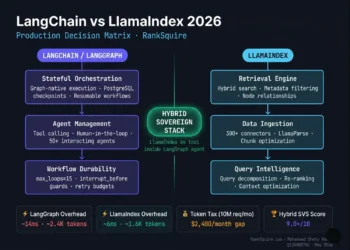
LAYER 1 (Primary keyword entities): LangChain vs LlamaIndex 2026 production decision matrix comparison diagram produced by Mohammed Shehu Ahmed at RankSquire.com (Wikidata Q138808708 / Q138808593). Shows two-column architecture comparison: LangGraph stateful orchestration (PostgreSQL checkpointing, max_loops=15, tool calling, human-in-the-loop approvals) versus LlamaIndex retrieval engine (hybrid search, 300+ connectors via LlamaHub, query decomposition, node relationships and metadata filtering). Center shows hybrid sovereign stack integration where LlamaIndex serves as named retrieval tool inside LangGraph agent. LAYER 2 (Relationships and data): Key production metrics shown: LangGraph framework overhead approximately 14 milliseconds and 2,400 tokens per request versus LlamaIndex approximately 6 milliseconds and 1,600 tokens. Token overhead gap of approximately 800 tokens produces $2,400 per month cost difference at 10 million requests per month using GPT-4o-mini pricing. Hybrid sovereign stack SVS Sovereign Viability Score 9.0 or higher combining both frameworks. LangGraph 1.0 released October 2025 with stable PostgreSQL checkpointing. LlamaIndex requires 30 to 40 percent less code than LangChain for equivalent RAG pipelines. LAYER 3 (What it proves): This architecture diagram demonstrates that LangChain and LlamaIndex solve different operational layers and are not direct competitors. LangChain via LangGraph dominates stateful orchestration while LlamaIndex dominates retrieval quality. The hybrid sovereign stack combining both on self-hosted Hetzner Frankfurt infrastructure with Qdrant vector storage and Langfuse observability costs approximately $150 to $220 per month versus $500 to $800 per month for managed equivalents. May 2026. RankSquire.com.

LangChain vs LlamaIndex 2026: The production architecture decision matrix every CTO needs

by Mohammed Shehu Ahmed
May 12, 2026
0

Here Is Your Answer in 60 SecondsWhy Every Existing Comparison Gets This WrongWhat LangChain and LlamaIndex Actually Are in 2026The ORB Framework -- Your Decision Before You BuildWhat...

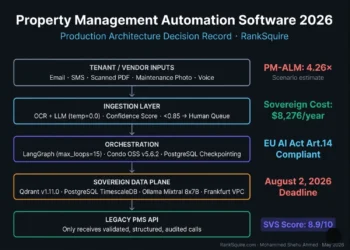
LAYER 1 (Primary keyword entities): Property management automation software 2026 sovereign stack architecture diagram produced by Mohammed Shehu Ahmed at RankSquire.com (Wikidata Q138808708 / Q138808593). Shows five-layer production architecture: tenant inputs including email, SMS, scanned PDF, and maintenance photos flowing through OCR plus LLM ingestion layer with temperature zero point zero for safety-critical classifications and confidence threshold zero point eighty-five for human queue routing, then to LangGraph orchestration layer with max underscore loops equals fifteen loop protection and Condo OSS version five point six point two with nine hundred thirteen releases, then to sovereign data plane with Qdrant version one point eleven point zero on-disk vector storage, PostgreSQL TimescaleDB checkpointing, and Ollama Mixtral 8x7B running on Hetzner Frankfurt NVIDIA L40S GPU, finally to legacy PMS API receiving only validated structured audited calls. LAYER 2 (Relationships and reasoning): Key metrics shown: PM-ALM scenario estimate four point two six times showing actual agent infrastructure cost is approximately four times naive budget estimate; sovereign stack cost eight thousand two hundred seventy-six US dollars per year for five thousand unit portfolio on reserved Hetzner Frankfurt instances; EU AI Act Article fourteen compliance via human oversight interface; SVS Sovereign Viability Score eight point nine out of ten. Compared to Yardi Voyager at one hundred thousand to three hundred thousand US dollars per year plus fifty thousand to two hundred forty thousand US dollars implementation cost. The sovereign crossover trigger is three hundred US dollars per month at approximately one hundred fifty to two hundred units. LAYER 3 (What it proves): This architecture demonstrates that property management automation in 2026 is an infrastructure sovereignty decision, not a SaaS selection decision. The sovereign stack costs twelve times less than Yardi Voyager at five thousand units while providing configurable EU AI Act Article fourteen human oversight compliance and exportable decision logic that vendor black-box agents cannot match. May 2026. RankSquire.com.

Property Management Automation Software 2026: Production Architecture Decision Record

by Mohammed Shehu Ahmed
May 11, 2026
0

The Fallacy of the "All-in-One" Agent — Why 2026 Demands a New ArchitectureThe RankSquire SVS Threshold Map for Property Management 2026Three Production Blueprints — Small, Mid-Size, EnterpriseThe PM-ALM...

A conceptual illustration showing a funnel filtering thousands of grey leads into a few glowing gold leads using an algorithm.

Real Estate Lead Scoring Models 2026: Architect’s Guide

by Mohammed Shehu Ahmed
February 6, 2026
0

EXECUTIVE SUMMARY The Problem: Most real estate teams operate on LIFO, Last In, First Out. They call the newest lead, regardless of quality. This means your best agents...

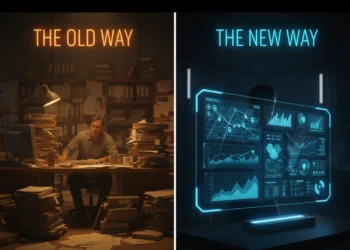
A split screen comparison showing a chaotic manual office versus a sleek automated dashboard running a real estate brokerage.

Real Estate CRM Automation 2026: Full Playbook

by Mohammed Shehu Ahmed
February 6, 2026
0

EXECUTIVE SUMMARY The Problem: The average real estate CRM is a Digital Graveyard. It is full of duplicate contacts, messy notes, and tasks that are 400 days overdue....

Next Post
Abstract visualization of the Clay vs Apollo debate: a heavy, blunt hammer Apollo versus a precise, laser-guided scalpel Clay on a dark tech background.

Clay vs Apollo (2026): Best B2B Data Tool Ranked

Comments 1

  1. Pingback: Best Vector Database For AI Agents: The 2026 Comparison | RankSquire | Agentic AI Automation & Operations Blueprints

Leave a Reply Cancel reply

Your email address will not be published. Required fields are marked *

RankSquire Official Header Logo | AI Automation & Systems Architecture Agency

RankSquire is the premier resource for B2B Agentic AI operations. We provide execution-ready blueprints to automate sales, support, and finance workflows for growing businesses.

Recent Posts

  • Vector Database News May 2026: Every Release, Every Pricing Change, Every Production Action
  • How to Host n8n with Coolify 2026: The Production Hardening Guide
  • Is n8n Free? Production TCO, FMEA and Sovereign Deployment Guide 2026

Categories

  • ENGINEERING
  • OPS
  • SAFETY
  • SALES
  • STRATEGY
  • TOOLS
  • Vector DB News
  • ABOUT US
  • AFFILIATE DISCLOSURE
  • Apply for Architecture
  • CONTACT US
  • EDITORIAL POLICY
  • Frameworks
  • HOME
  • Mohammed Shehu Ahmed
  • Privacy Policy
  • TERMS

© 2026 RankSquire. All Rights Reserved. | Designed in The United States, Deployed Globally.

Welcome Back!

Login to your account below

Forgotten Password?

Retrieve your password

Please enter your username or email address to reset your password.

Log In
No Result
View All Result
  • HOME
  • BLUEPRINTS
  • SALES
  • TOOLS
  • OPS
  • Vector DB News
  • STRATEGY
  • ENGINEERING

© 2026 RankSquire. All Rights Reserved. | Designed in The United States, Deployed Globally.