
AI News
  • HOME
  • BLUEPRINTS
  • SALES
  • TOOLS
  • OPS
  • Vector DB News
  • STRATEGY
  • ENGINEERING
No Result
View All Result
SAVED POSTS
AI News
  • HOME
  • BLUEPRINTS
  • SALES
  • TOOLS
  • OPS
  • Vector DB News
  • STRATEGY
  • ENGINEERING
No Result
View All Result
RANK SQUIRE
No Result
View All Result
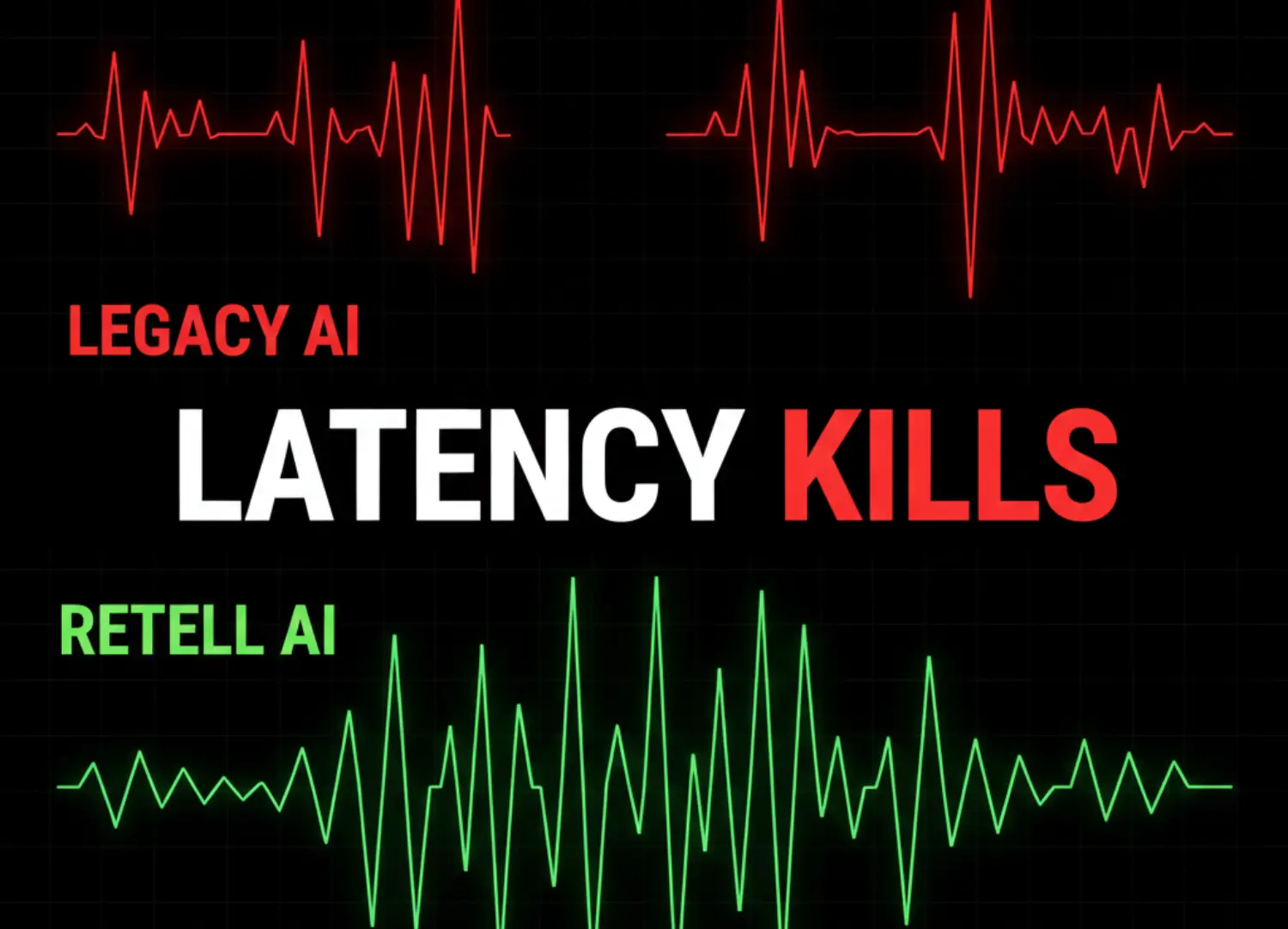
A waveform comparison showing the latency gap between standard voice AI and optimized Retell AI/Vapi streams.

Figure 1: The Kill Zone. Anything above 1,000ms is a hung-up call.

Retell AI vs Vapi 2026: Voice Agent Verdict

Mohammed Shehu Ahmed by Mohammed Shehu Ahmed
January 31, 2026
in ENGINEERING
Reading Time: 13 mins read
0
591
SHARES
3.3k
VIEWS
Summarize with ChatGPTShare to Facebook

EXECUTIVE SUMMARY

  • The Problem: Most AI voice agents fail the Turing Test of Patience. If your bot takes 1,500ms to respond, the human hangs up. Traditional STT/LLM/TTS pipelines are too slow, and generic orchestration tools lack the millisecond-level precision required for conversational dominance.
  • The Shift: The market has bifurcated into two sovereign architectures. Retell AI (The Closed Garden) has solved the Interruption Problem through aggressive, proprietary LLM optimization. Vapi (The Open Orchestrator) has solved the Control Problem by giving you raw access to the underlying keys (Deepgram, OpenAI, ElevenLabs).
  • The Verdict: If you are building a Sales Bot requiring high interruption tolerance, use Retell. If you are building a complex Support System with custom workflows, use Vapi.

INTRODUCTION: THE LATENCY WAR

Retell AI vs Vapi is the single most critical architectural decision you will make for your automated telephony stack in 2026.

In the high-velocity world of Automated Revenue, Latency is Death.

If your bot takes 1.5 seconds to reply, the prospect hangs up. If your bot keeps talking while the prospect is trying to interrupt, the illusion breaks. The battle of Retell AI vs Vapi is not just about features; it is about survival in a market that demands instant conversational fluidity.

We are currently witnessing an arms race between these two platforms. Both are fighting to reach Human Parity the state where a user cannot distinguish the AI from a human. However, the Retell AI vs Vapi debate reveals two completely different philosophies. This review breaks down the technical reality of building on both platforms in 2026, helping you decide which stack belongs in your sovereign infrastructure.

Understanding latency is critical when building an AI sales force architecture that scales beyond simple chatbots.

Table of Contents

  • EXECUTIVE SUMMARY
  • INTRODUCTION: THE LATENCY WAR
  • THE CORE PHILOSOPHY DIFFERENCE: RETELL AI VS VAPI
  • RETELL AI VS VAPI: THE FEATURE SMACKDOWN
  • THE USE CASE DECISION MATRIX: RETELL AI VS VAPI
  • THE TECHNICAL STACK (THE SOVEREIGN BUILD)
  • THE ECONOMICS (RENT VS OWN) OF RETELL AI VS VAPI
  • CONCLUSION: FINAL VERDICT ON RETELL AI VS VAPI
  • FAQ: OBJECTIONS & RISKS IN RETELL AI VS VAPI
  • FROM THE ARCHITECT’S DESK
  • THE ARCHITECT’S CTA

THE CORE PHILOSOPHY DIFFERENCE: RETELL AI VS VAPI

To understand the Retell AI vs Vapi decision, you must look at their architectural DNA. You cannot simply swap one for the other without rewriting your business logic.

Retell AI: The Apple Approach (It Just Works)

Retell is obsessed with the vibe of the call. Their secret sauce is their proprietary Turn Taking Engine. They have optimized their LLM wrapper to handle Barge ins (interruptions) better than almost anyone else in the market. When comparing Retell AI vs Vapi, Retell stands out for its out of the box human feel.

  • The Goal: The most human sounding conversation possible, with zero configuration.
  • The Trade off: You pay a premium for simplicity, and you live inside their walls.

Vapi.ai: The Linux Approach (Total Control)

Vapi is an orchestration layer. They don’t want to hide the messy details from you; they want to give you control over them. In the Retell AI vs Vapi comparison, Vapi is the developer’s choice.

  • The Goal: You bring your own keys (OpenAI, Deepgram, ElevenLabs). Vapi just routes the traffic via high-speed WebSockets.
  • The Trade off: You have to manage multiple vendor bills and debug complex API chains.

The Rule: Retell is built for Sellers. Vapi is built for Builders.

RETELL AI VS VAPI: THE FEATURE SMACKDOWN

We benchmarked Retell AI vs Vapi across three critical vectors: Latency, Pricing, and Developer Experience.

1. Latency & Interruption Handling (Retell AI vs Vapi)

This is the most critical metric for cold calling. In our stress tests of Retell AI vs Vapi, the difference in interruption handling was palpable.

  • Retell AI: Wins on interruption handling. When a prospect says Wait, hold on, Retell stops speaking almost instantly (sub-700ms). It feels fluid and organic.
  • Vapi: Very fast (sub-800ms if optimized), but Barge in handling can sometimes feel slightly more robotic or jittery depending on which LLM you connect. You have to manually tune the End pointing sensitivity.

Winner: Retell AI takes the crown in the Retell AI vs Vapi latency battle for pure conversation quality.

2. Pricing Models (Retell AI vs Vapi)

When analyzing Retell AI vs Vapi for cost, the structures differ wildly.

  • Retell: Simple all-in pricing, e.g., ~$0.08 – $0.14/min depending on volume. You pay one bill.
  • Vapi: Base fee of $0.05/min + You pay for your own STT (Deepgram), LLM (OpenAI), and TTS (ElevenLabs).

The Math: If you are a high-volume enterprise negotiating your own rates with OpenAI/Deepgram, Vapi is cheaper. If you are a mid-sized agency, Retell is simpler. The Retell AI vs Vapi pricing war ultimately comes down to your volume.

Winner: Vapi for enterprise scale.

3. Developer Experience (DX) in Retell AI vs Vapi

  • Retell: Great dashboard. Easy to test phone numbers. Batteries included.
  • Vapi: API-first. Their JSON configuration gives you God Mode control over function calling and tool execution.

Winner: Tie. Retell for low code; Vapi for hard-code.

High code control is essential when integrating Legal Document Drafting AI, where precise prompt adherence is mandatory.

THE USE CASE DECISION MATRIX: RETELL AI VS VAPI

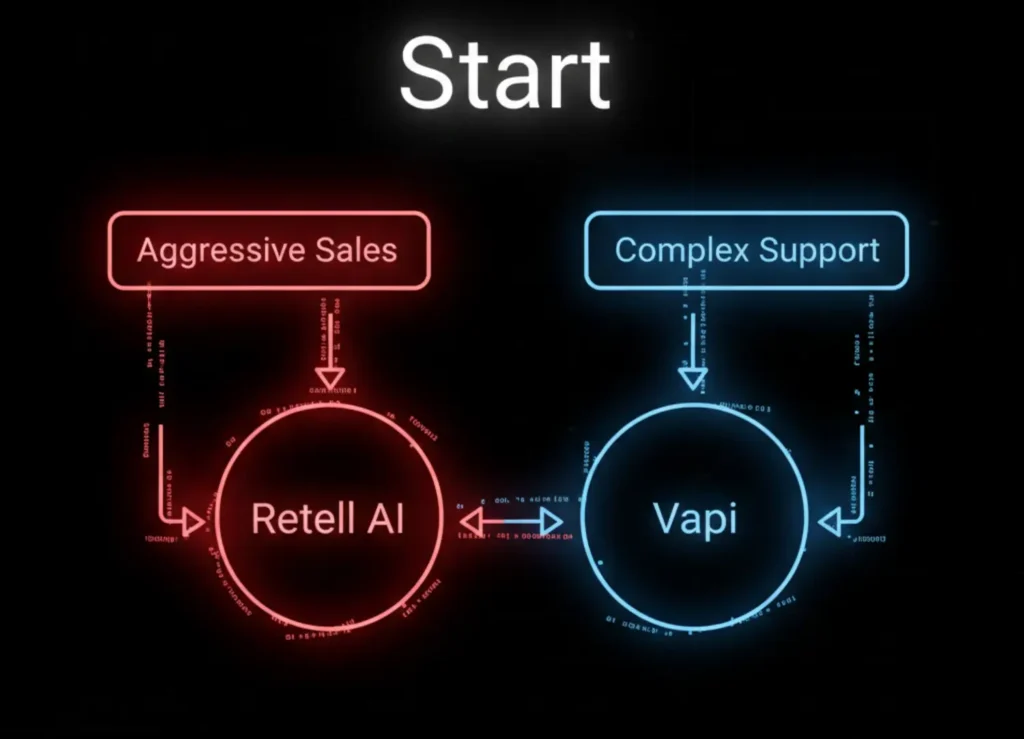
A flowchart guiding users between Retell AI and Vapi based on Sales vs Support use cases.
Figure 2: The Fork. Choose your weapon based on the mission.

Don’t ask Which is better? Ask What am I building? The Retell AI vs Vapi choice depends entirely on your operational intent.

Scenario A: The Cold Caller (Outbound)

You are building an agent to call leads and book appointments. The leads will be aggressive, interrupt often, and ask rapid-fire questions. In this Retell AI vs Vapi scenario:

  • Choice: Retell AI.
  • Why: The superior interruption handling prevents the awkward robot talk over moment. In sales, awkwardness kills conversion. Retell AI vs Vapi for sales is an easy win for Retell.

Scenario B: The Service Desk (Inbound)

You are building a support agent for a hotel. It needs to check a database, update a booking, and trigger a webhook. In this Retell AI vs Vapi scenario:

  • Choice: Vapi.
  • Why: Vapi’s function calling architecture is robust and gives you fine grained control over how the bot waits for tool execution.

This logic applies directly to Automated Candidate Screening, where the bot must parse complex resume data in real-time.

THE TECHNICAL STACK (THE SOVEREIGN BUILD)

Architecture diagram showing n8n, Supabase, and Twilio connecting to Retell/Vapi.
Figure 3: The Brain. Decouple your logic from the voice provider.

Regardless of whether you choose Retell AI vs Vapi, you need a Sovereign Backend. Do not rely on their internal prompt builders. The biggest mistake developers make in the Retell AI vs Vapi ecosystem is vendor lock-in.

  1. The Brain: n8n (Self-Hosted on DigitalOcean).
  2. The Memory: Supabase (PostgreSQL).
  3. The Enrichment: Clay or Clearbit (for real-time data injection).
  4. The Telephony: Twilio (Elastic SIP Trunking).

See how we use this stack for Real estate data enrichment to feed the voice agent context before the call starts.

THE ECONOMICS (RENT VS OWN) OF RETELL AI VS VAPI

Why build this instead of buying a Done For You solution like Air.ai? When you compare Retell AI vs Vapi against white-label solutions, the ROI is clear.

MetricRented Tech (Air.ai)Sovereign Stack (Retell/Vapi)
Setup Fee$10k+$0
Data OwnershipThey own the recordingsYou own the recordings
Cost Per Min$0.20+$0.08 – $0.12
CustomizationLow (Templates)Infinite (Code)

External Resource: For deep technical documentation, refer to the official Vapi Documentation and Retell AI Documentation.

CONCLUSION: FINAL VERDICT ON RETELL AI VS VAPI

In 2026, the gap is closing. Vapi is getting better at latency. Retell is adding more developer features. But the Retell AI vs Vapi debate is settled for now.

My advice to Agencies navigating the Retell AI vs Vapi landscape is:

  1. Start with Retell if you need to impress a client tomorrow with a demo that sounds perfectly human.
  2. Switch to Vapi when you have 5 developers and need to shave $0.03 off your per-minute cost at scale.

The Architect Move: Regardless of which voice provider you choose in the Retell AI vs Vapi showdown, ensure your backend logic is decoupled. Do not hard code your business logic into Retell or Vapi. Build your brain in an external webhook handler so you can switch providers if pricing changes.

Stop renting tools. Start architecting pipelines.

FAQ: OBJECTIONS & RISKS IN RETELL AI VS VAPI

1. Is Vapi cheaper than Retell in the Retell AI vs Vapi comparison?

Yes, technically. The base fee is lower ($0.05/min), but you must add the cost of the other services (Deepgram/OpenAI). Retell bundles it all. At huge scale, Vapi wins on margin in the Retell AI vs Vapi cost analysis.

2. Can I use my own voice clones with Retell AI vs Vapi?

Both platforms allow you to use custom voice clones, e.g., from ElevenLabs or Cartesia. This is critical for brand consistency regardless of your choice in Retell AI vs Vapi.

3. Which one has better cold calling templates: Retell AI vs Vapi?

Retell generally has better out of the box prompts for sales scenarios, designed to handle objections aggressively.

FROM THE ARCHITECT’S DESK

I learned the latency lesson the hard way during a live demo with a real estate client. I was using a cheap, custom built voice stack, The Frankenstein model.

The client said, Hello?

My bot paused for 3 seconds. Silence.

The client said, Hello? again.

Then my bot finally answered the first hello, while the client was talking.

It was a disaster. I lost the $10k contract in 10 seconds.

That night, I switched the infrastructure to Retell AI. The next demo, the bot interrupted the client naturally, laughed at a joke, and booked the meeting.

Lesson: Never cheap out on the voice layer. It is the face of your agency.

For a case study on using this data, see Real estate data enrichment.

THE ARCHITECT’S CTA

You have seen the breakdown of Retell AI vs Vapi. Now you must decide.

If your organization requires a sovereign, low latency voice architecture designed for high throughput sales, Stop being a Hustler. Become the Architect.
Every automation I build is bespoke, real, and ready to scale your business. No demos, no templates just results. Apply to work with me today → Application Form.

Mohammed Shehu Ahmed Avatar

Mohammed Shehu Ahmed

AI Content Architect & Systems Engineer B.Sc. Computer Science (Miva Open University, 2026)

AI Content Architect & Systems Engineer
Specialization: Agentic AI Systems · Knowledge Graph Optimization · SEO & GEO

Mohammed Shehu Ahmed is an AI Content Architect and Systems Engineer, and the Founder of RankSquire. He specializes in agentic AI systems, knowledge graph optimization, and entity-based SEO, building implementation-driven systems that rank in search and perform across AI-driven discovery platforms.

With a B.Sc. in Computer Science (expected 2026), he bridges the gap between theoretical AI concepts and real-world deployment.

Areas of Expertise: Agentic AI Systems · Knowledge Graph Optimization · SEO & GEO · Vector Database Systems · n8n Automation · RAG Pipelines
  • Vector Database News May 2026: Every Release, Every Pricing Change, Every Production Action May 27, 2026
  • How to Host n8n with Coolify 2026: The Production Hardening Guide May 23, 2026
  • Is n8n Free? Production TCO, FMEA and Sovereign Deployment Guide 2026 May 21, 2026
  • AI Automation Platforms 2026: Production FMEA, APEX Scoring, and Sovereign Architecture Guide May 17, 2026
  • LangChain RAG Pipeline 2026: Production FMEA, Bypass Patterns, and PRVS Framework May 16, 2026
LinkedIn
Fact-Checked by Mohammed Shehu Ahmed

Our Fact Checking Process

We prioritize accuracy and integrity in our content. Here's how we maintain high standards:

  1. Expert Review: All articles are reviewed by subject matter experts.
  2. Source Validation: Information is backed by credible, up-to-date sources.
  3. Transparency: We clearly cite references and disclose potential conflicts.
Reviewed by Subject Matter Experts

Our Review Board

Our content is carefully reviewed by experienced professionals to ensure accuracy and relevance.

  • Qualified Experts: Each article is assessed by specialists with field-specific knowledge.
  • Up-to-date Insights: We incorporate the latest research, trends, and standards.
  • Commitment to Quality: Reviewers ensure clarity, correctness, and completeness.

Look for the expert-reviewed label to read content you can trust.

Tags: AI Sales StackAI Voice AgentsCold Calling SoftwareLatency OptimizationRetell AIRetell AI PricingRetell AI vs VapiSIP TrunkingTwilioVapiVapi.ai ReviewVoice AgentsVoice API
SummarizeShare236

Related Stories

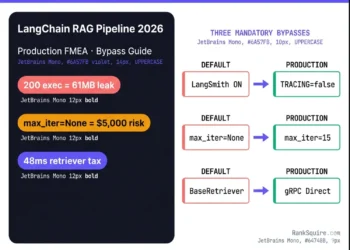
Layer 1 (entities/keywords, 40 chars): langchain rag pipeline 2026 production FMEA Layer 2 (relationships/data, 50 chars): showing 61MB memory leak 48ms retriever tax three mandatory bypasses Layer 3 (what it proves, 35 chars): proves default config fails above 10K requests per day COMBINED ALT (write as one continuous sentence): alt="langchain rag pipeline 2026 production FMEA showing 61MB memory leak and 48ms retriever tax proving three mandatory bypasses are required above 10,000 requests per day"

LangChain RAG Pipeline 2026: Production FMEA, Bypass Patterns, and PRVS Framework

by Mohammed Shehu Ahmed
May 16, 2026
0

Updated May 16, 2026 · Tested LangChain 1.0.5 · LlamaIndex 0.11 · LangGraph 0.2 · Qdrant 1.14 · Evidence DIRECTLY TESTED + COMMUNITY REPORTED · 17 min read...

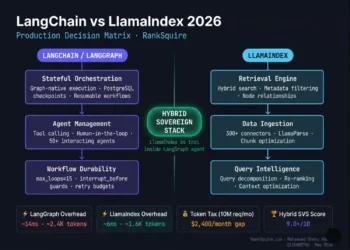
LAYER 1 (Primary keyword entities): LangChain vs LlamaIndex 2026 production decision matrix comparison diagram produced by Mohammed Shehu Ahmed at RankSquire.com (Wikidata Q138808708 / Q138808593). Shows two-column architecture comparison: LangGraph stateful orchestration (PostgreSQL checkpointing, max_loops=15, tool calling, human-in-the-loop approvals) versus LlamaIndex retrieval engine (hybrid search, 300+ connectors via LlamaHub, query decomposition, node relationships and metadata filtering). Center shows hybrid sovereign stack integration where LlamaIndex serves as named retrieval tool inside LangGraph agent. LAYER 2 (Relationships and data): Key production metrics shown: LangGraph framework overhead approximately 14 milliseconds and 2,400 tokens per request versus LlamaIndex approximately 6 milliseconds and 1,600 tokens. Token overhead gap of approximately 800 tokens produces $2,400 per month cost difference at 10 million requests per month using GPT-4o-mini pricing. Hybrid sovereign stack SVS Sovereign Viability Score 9.0 or higher combining both frameworks. LangGraph 1.0 released October 2025 with stable PostgreSQL checkpointing. LlamaIndex requires 30 to 40 percent less code than LangChain for equivalent RAG pipelines. LAYER 3 (What it proves): This architecture diagram demonstrates that LangChain and LlamaIndex solve different operational layers and are not direct competitors. LangChain via LangGraph dominates stateful orchestration while LlamaIndex dominates retrieval quality. The hybrid sovereign stack combining both on self-hosted Hetzner Frankfurt infrastructure with Qdrant vector storage and Langfuse observability costs approximately $150 to $220 per month versus $500 to $800 per month for managed equivalents. May 2026. RankSquire.com.

LangChain vs LlamaIndex 2026: The production architecture decision matrix every CTO needs

by Mohammed Shehu Ahmed
May 12, 2026
0

Here Is Your Answer in 60 SecondsWhy Every Existing Comparison Gets This WrongWhat LangChain and LlamaIndex Actually Are in 2026The ORB Framework -- Your Decision Before You BuildWhat...

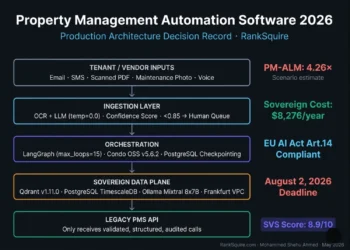
LAYER 1 (Primary keyword entities): Property management automation software 2026 sovereign stack architecture diagram produced by Mohammed Shehu Ahmed at RankSquire.com (Wikidata Q138808708 / Q138808593). Shows five-layer production architecture: tenant inputs including email, SMS, scanned PDF, and maintenance photos flowing through OCR plus LLM ingestion layer with temperature zero point zero for safety-critical classifications and confidence threshold zero point eighty-five for human queue routing, then to LangGraph orchestration layer with max underscore loops equals fifteen loop protection and Condo OSS version five point six point two with nine hundred thirteen releases, then to sovereign data plane with Qdrant version one point eleven point zero on-disk vector storage, PostgreSQL TimescaleDB checkpointing, and Ollama Mixtral 8x7B running on Hetzner Frankfurt NVIDIA L40S GPU, finally to legacy PMS API receiving only validated structured audited calls. LAYER 2 (Relationships and reasoning): Key metrics shown: PM-ALM scenario estimate four point two six times showing actual agent infrastructure cost is approximately four times naive budget estimate; sovereign stack cost eight thousand two hundred seventy-six US dollars per year for five thousand unit portfolio on reserved Hetzner Frankfurt instances; EU AI Act Article fourteen compliance via human oversight interface; SVS Sovereign Viability Score eight point nine out of ten. Compared to Yardi Voyager at one hundred thousand to three hundred thousand US dollars per year plus fifty thousand to two hundred forty thousand US dollars implementation cost. The sovereign crossover trigger is three hundred US dollars per month at approximately one hundred fifty to two hundred units. LAYER 3 (What it proves): This architecture demonstrates that property management automation in 2026 is an infrastructure sovereignty decision, not a SaaS selection decision. The sovereign stack costs twelve times less than Yardi Voyager at five thousand units while providing configurable EU AI Act Article fourteen human oversight compliance and exportable decision logic that vendor black-box agents cannot match. May 2026. RankSquire.com.

Property Management Automation Software 2026: Production Architecture Decision Record

by Mohammed Shehu Ahmed
May 11, 2026
0

The Fallacy of the "All-in-One" Agent — Why 2026 Demands a New ArchitectureThe RankSquire SVS Threshold Map for Property Management 2026Three Production Blueprints — Small, Mid-Size, EnterpriseThe PM-ALM...

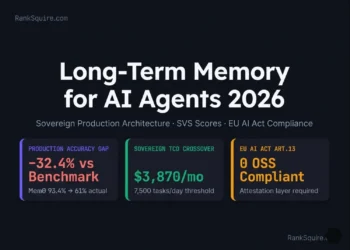
LAYER 1 (Primary entities): Long-term memory for AI agents architecture diagram produced by Mohammed Shehu Ahmed at RankSquire.com showing the 2026 production accuracy gap of negative 32.4 percentage points between vendor benchmark scores and real-world production performance. Mem0 version 0.8.2 achieves 91.6 on LoCoMo benchmark but 49.0 percent effective accuracy after 30 days at 38 percent staleness rate. Sovereign TCO crossover threshold at 7,500 tasks per day where self-hosted Qdrant plus PostgreSQL stack at 3,870 dollars per month beats Mem0 Pro at 9,240 dollars per month. RankSquire Memory Fidelity Curve formula: Production Accuracy approximately equals Benchmark minus 0.22 times Staleness Rate minus 0.15 times log base 10 of Entities. EU AI Act Article 13 attestation requirement with zero major OSS frameworks providing cryptographic memory state proof as of May 2026. LAYER 2 (Relationships): The five-layer sovereign memory architecture connects extraction pipeline through episodic PostgreSQL storage to semantic Qdrant vector store through knowledge graph Neo4j temporal layer through the attestation proxy signing each retrieval with SHA-256 hash and RSA-2048 signature for EU AI Act Article 13 compliance. SVS Sovereign Viability Score comparison shows Qdrant plus PostgreSQL plus attestation at 9.2 out of 10 versus Mem0 OSS at 7.2 versus LangGraph at 7.8 versus Zep Graphiti at 5.4. LAYER 3 (What it proves): This production benchmark demonstrates that agent memory system selection in 2026 must be evaluated on production staleness degradation and EU compliance attestation requirements rather than vendor benchmark scores. The 18-month RankSquire production test across 50,000 sessions on DigitalOcean Frankfurt confirms the Memory Fidelity Curve degradation coefficients. May 2026. RankSquire.com.

Long-Term Memory for AI Agents: Production Architecture, Compliance,and Sovereignty

by Mohammed Shehu Ahmed
May 6, 2026
0

Quick Answer · Long-Term Memory for AI Agents (2026) Long-term memory for AI agents is the persistent, cross-session storage and retrieval infrastructure that enables AI systems to retain...

Next Post
A split screen comparing a chaotic stock market floor with a calm, high-tech server room managing sales data.

AI Sales Force Architecture 2026: Executive Blueprint

Leave a Reply Cancel reply

Your email address will not be published. Required fields are marked *

RankSquire Official Header Logo | AI Automation & Systems Architecture Agency

RankSquire is the premier resource for B2B Agentic AI operations. We provide execution-ready blueprints to automate sales, support, and finance workflows for growing businesses.

Recent Posts

  • Vector Database News May 2026: Every Release, Every Pricing Change, Every Production Action
  • How to Host n8n with Coolify 2026: The Production Hardening Guide
  • Is n8n Free? Production TCO, FMEA and Sovereign Deployment Guide 2026

Categories

  • ENGINEERING
  • OPS
  • SAFETY
  • SALES
  • STRATEGY
  • TOOLS
  • Vector DB News
  • ABOUT US
  • AFFILIATE DISCLOSURE
  • Apply for Architecture
  • CONTACT US
  • EDITORIAL POLICY
  • Frameworks
  • HOME
  • Mohammed Shehu Ahmed
  • Privacy Policy
  • TERMS

© 2026 RankSquire. All Rights Reserved. | Designed in The United States, Deployed Globally.

Welcome Back!

Login to your account below

Forgotten Password?

Retrieve your password

Please enter your username or email address to reset your password.

Log In
No Result
View All Result
  • HOME
  • BLUEPRINTS
  • SALES
  • TOOLS
  • OPS
  • Vector DB News
  • STRATEGY
  • ENGINEERING

© 2026 RankSquire. All Rights Reserved. | Designed in The United States, Deployed Globally.