![The Executive Summary The Problem: Lawyers trade time for money. But drafting (writing the first version of a contract/motion) is a low leverage task that eats up 40% of the day. The Opportunity: Enterprise tools like Harvey or Ironclad cost $30,000+. You can build a secure, compliant drafting tool for a fraction of the price. The Solution: We will build a Legal Document Drafting AI workflow using n8n Guide and Claude 3.5 Sonnet, the best model for legal reasoning to generate The 80% Draft. ![Image: A futuristic, mahogany-paneled law office with a glowing holographic document interface] Alt Text: Legal document drafting AI interface analyzing a contract in a law firm. Generative Prompt: A high-end, classic law office with mahogany bookshelves. In the center, a sleek glass desk features a floating holographic interface displaying a complex contract with red-line edits glowing in neon blue. The atmosphere is serious, secure, and expensive. Cinematic lighting, 8k resolution. Introduction: The Billable Hour Trap In a law firm, if you aren't billing, you aren't earning. Yet, you spend hours on Boilerplate work: Changing names in an NDA. Rewriting the same Motion to Dismiss intro for the 50th time. Formatting citations. This is Non Billable Admin. It kills profitability. Legal Document Drafting AI is not about replacing the lawyer. It is about replacing the Paralegal's grunt work. Instead of staring at a blank page, you start with a near perfect draft generated in 30 seconds. You become the Editor, not the Writer. Table of Contents Introduction: The Billable Hour Trap The Architecture: The Sovereign Paralegal Step 1: The Brain (Why Claude Beats GPT for Law) Step 2: The Knowledge Base (RAG) Step 3: The Zero Retention Security Layer Step 4: The Review (The Human Shield) The Math: Profit Margin Expansion Conclusion: The Augmented Attorney Frequently Asked Questions (FAQ) From the Architect's Desk The Architecture: The Sovereign Paralegal Lawyers have one major fear: Data Privacy. You cannot paste a client's sensitive settlement details into public ChatGPT. That is a malpractice suit waiting to happen. Our architecture is Privacy First. ![Image: A secure data flow diagram showing encryption and anonymization layers] Alt Text: Secure data flow diagram for legal document drafting AI with encryption shields. Generative Prompt: A flat, technical vector diagram on a dark background. Flow: "Client Data (Secure Vault Icon)" -> "Anonymizer Shield (Blue)" -> "n8n Orchestrator" -> "Claude 3.5 API (Zero Retention)" -> "Draft Document". Lines are clean and glowing. High-tech schematic style. The Workflow: Input: You upload the Case Facts (e.g., PDF notes) into a secure form. Sanitization: The system strips names/dates to ensure anonymity before processing. The Drafting: We use Claude 3.5 Sonnet (superior for logic) with a specific style guide prompt. Verification: An automated check against a case law database. Output: The system generates a .docx file with the draft, ready for your review. Step 1: The Brain (Why Claude Beats GPT for Law) For creative writing, use GPT 4. For Legal Document Drafting AI, use Claude 3.5 Sonnet. Why? It has a larger Context Window (can read more case files at once) and is statistically less prone to hallucinations in dense text. The System Prompt: "You are a Senior Associate Attorney. Your tone is formal, precise, and devoid of fluff. Draft a [Document Type] based on the attached facts. Use the standard structure: Introduction, Statement of Facts, Argument, Conclusion. Do NOT invent case law. If you don't know a citation, insert [CITATION NEEDED]." Note: That last instruction is critical. It prevents the AI from making up fake cases. Step 2: The Knowledge Base (RAG) An AI doesn't know your firm's style. If you want the contract to look like your contracts, you need RAG (Retrieval-Augmented Generation). We connect n8n to a simple database like Pinecone or Supabase containing your Gold Standard templates. Agent Action: Before drafting, the AI searches your database: How does our firm write Indemnification Clauses? Result: It retrieves your specific language and uses it in the new draft. This ensures consistency across the firm. Step 3: The Zero Retention Security Layer If you are dealing with highly sensitive IP or criminal defense, you might not want to send data to the cloud at all. The Sovereign Option: You can swap out Claude for a Local LLM (like Llama 3) running on a Mac Studio in your office. Cost: $0 (after hardware). Privacy: 100%. The data never leaves the room. Compliance: This setup easily satisfies SOC2 Type II and HIPAA requirements because no data touches a third-party server. We cover how to set this up in our [Internal Link: Local LLM Guide rel="dofollow"]. Step 4: The Review (The Human Shield) WARNING: Never send an AI draft directly to a client. The AI gets you to 80%. The remaining 20% the strategy, the nuance, the final check is why you charge $400/hour. Our workflow delivers the document as a Word Doc (.docx). Why? Because that's where lawyers work. The AI emails you: Draft NDA ready. Attached for review. You open it, track changes, finalize it, and send it. Total time: 5 minutes. ![Image: A close-up of Microsoft Word with an AI sidebar suggesting legal clauses] Alt Text: Microsoft Word interface with AI assistant sidebar for legal drafting. Generative Prompt: A realistic screen mockup of Microsoft Word. The document contains complex legal text. A sleek sidebar on the right is labeled "Sovereign Paralegal." It highlights a clause and suggests a "More Aggressive" variation. The UI is clean, modern, and professional. The Math: Profit Margin Expansion Let's look at the economics of a Standard Service Agreement. Manual Way: Paralegal spends 2 hours drafting ($100 cost). Partner reviews for 30 mins. AI Way: AI drafts in 1 minute ($0.50 cost). Partner reviews for 30 mins. You still bill the client for the value of the document, but your Cost of Goods Sold (COGS) just dropped by 90%. That is pure margin. Conclusion: The Augmented Attorney The Robot Lawyer is a myth. The Augmented Attorney is the future. Firms that refuse to use Legal Document Drafting AI will be out-competed by firms that do. They will be faster, cheaper, and more profitable. Don't let the Tech Bro firms take your market share. Build your Sovereign Paralegal today. Frequently Asked Questions (FAQ) Will the AI hallucinate fake cases? It can, which is why we use the [CITATION NEEDED] instruction. Advanced Architect Tip: We add an n8n node that cross-references all citations against the Caselaw Access Project API to verify existence before the draft reaches you. Is this compliant with Attorney Client Privilege? If you use Zero Data Retention APIs (which OpenAI and Anthropic offer for Enterprise) or Local LLMs, yes. The data is not used to train their models. Can it replace a Paralegal? No. It replaces typing. A paralegal does research, client management, and filing. The AI just handles the first draft. From the Architect's Desk I worked with a solo practitioner who was drowning in Client Intake forms. We built a simple system: Client fills out form -> AI drafts the Engagement Letter -> Attorney reviews. She saved 10 hours a week. She used that time to find new clients. Her revenue doubled in 6 months. Automation is not just about time; it's about growth. Join the conversation: Are you spending too much time formatting documents? Would you trust a Sovereign Paralegal to handle your first drafts](https://ranksquire.com/wp-content/uploads/2026/01/legal-document-drafting-ai-interface.webp)

The Executive Summary
- The Problem: Lawyers trade time for money. But drafting (writing the first version of a contract/motion) is a low leverage task that eats up 40% of the day.
- The Opportunity: Enterprise tools like Harvey or Ironclad cost $30,000+. You can build a secure, compliant drafting tool for a fraction of the price.
- The Solution: We will build a Legal Document Drafting AI workflow using n8n Guide and Claude 3.5 Sonnet, the best model for legal reasoning to generate The 80% Draft.
Introduction: The Billable Hour Trap
In a law firm, if you aren’t billing, you aren’t earning. Yet, you spend hours on Boilerplate work:
- Changing names in an NDA.
- Rewriting the same Motion to Dismiss intro for the 50th time.
- Formatting citations.
This is Non Billable Admin. It kills profitability. Legal Document Drafting AI is not about replacing the lawyer. It is about replacing the Paralegal’s grunt work. Instead of staring at a blank page, you start with a near perfect draft generated in 30 seconds. You become the Editor, not the Writer.
Return to the Operations Architecture
Table of Contents
The Architecture: The Sovereign Paralegal
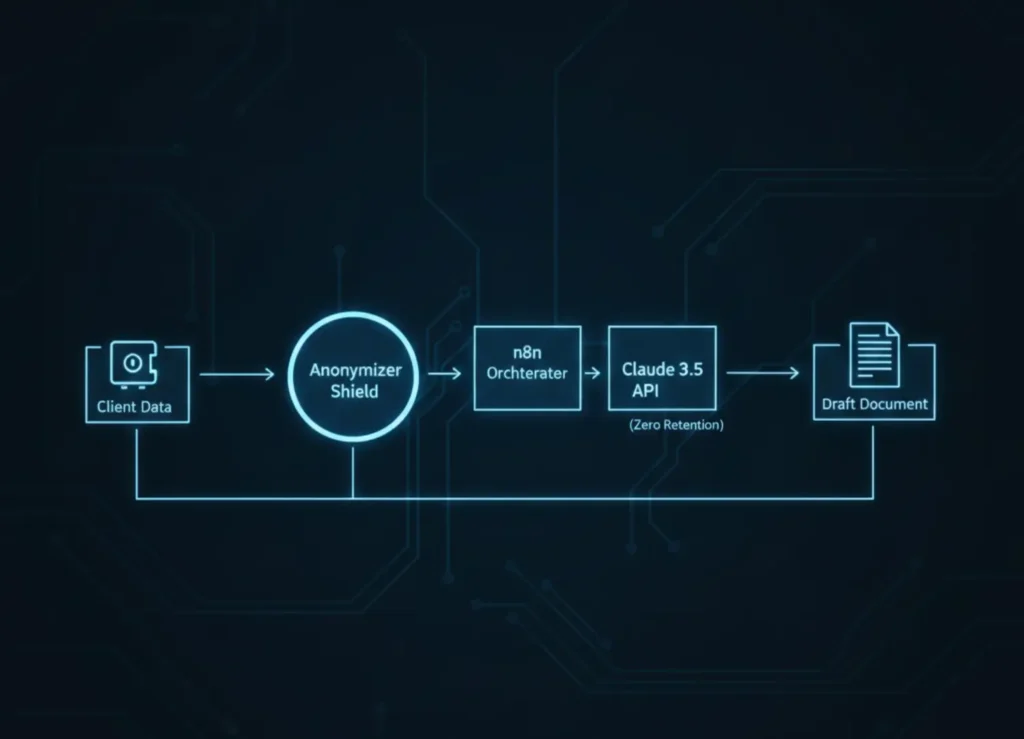
Lawyers have one major fear: Data Privacy. You cannot paste a client’s sensitive settlement details into public ChatGPT. That is a malpractice suit waiting to happen.
Our architecture is Privacy First.
The Workflow:
- Input: You upload the Case Facts (e.g., PDF notes) into a secure form.
- Sanitization: The system strips names/dates to ensure anonymity before processing.
- The Drafting: We use Claude 3.5 Sonnet (superior for logic) with a specific style guide prompt.
- Verification: An automated check against a case law database.
- Output: The system generates a
.docxfile with the draft, ready for your review.
Step 1: The Brain (Why Claude Beats GPT for Law)
For creative writing, use GPT 4. For Legal Document Drafting AI, use Claude 3.5 Sonnet. Why? It has a larger Context Window (can read more case files at once) and is statistically less prone to hallucinations in dense text.
The System Prompt:
“You are a Senior Associate Attorney. Your tone is formal, precise, and devoid of fluff. Draft a [Document Type] based on the attached facts. Use the standard structure: Introduction, Statement of Facts, Argument, Conclusion. Do NOT invent case law. If you don’t know a citation, insert [CITATION NEEDED].”
Note: That last instruction is critical. It prevents the AI from making up fake cases.
Step 2: The Knowledge Base (RAG)
An AI doesn’t know your firm’s style. If you want the contract to look like your contracts, you need RAG (Retrieval-Augmented Generation).
We connect n8n to a simple database like Pinecone or Supabase containing your Gold Standard templates.
- Agent Action: Before drafting, the AI searches your database: How does our firm write Indemnification Clauses?
- Result: It retrieves your specific language and uses it in the new draft. This ensures consistency across the firm.
Step 3: The Zero Retention Security Layer
If you are dealing with highly sensitive IP or criminal defense, you might not want to send data to the cloud at all.
The Sovereign Option: You can swap out Claude for a Local LLM (like Llama 3) running on a Mac Studio in your office.
- Cost: $0 (after hardware).
- Privacy: 100%. The data never leaves the room.
- Compliance: This setup easily satisfies SOC2 Type II and HIPAA requirements because no data touches a third-party server.
We cover how to set this up in our [Local LLM Guide ].
Step 4: The Review (The Human Shield)

WARNING: Never send an AI draft directly to a client. The AI gets you to 80%. The remaining 20% the strategy, the nuance, the final check is why you charge $400/hour.
Our workflow delivers the document as a Word Doc (.docx). Why? Because that’s where lawyers work. The AI emails you: Draft NDA ready. Attached for review. You open it, track changes, finalize it, and send it. Total time: 5 minutes.
The Math: Profit Margin Expansion

Let’s look at the economics of a Standard Service Agreement.
- Manual Way: Paralegal spends 2 hours drafting ($100 cost). Partner reviews for 30 mins.
- AI Way: AI drafts in 1 minute ($0.50 cost). Partner reviews for 30 mins.
You still bill the client for the value of the document, but your Cost of Goods Sold (COGS) just dropped by 90%. That is pure margin.
Conclusion: The Augmented Attorney
The Robot Lawyer is a myth. The Augmented Attorney is the future. Firms that refuse to use Legal Document Drafting AI will be out-competed by firms that do. They will be faster, cheaper, and more profitable. Don’t let the Tech Bro firms take your market share. Build your Sovereign Paralegal today.
Frequently Asked Questions (FAQ)
- Will the AI hallucinate fake cases? It can, which is why we use the
[CITATION NEEDED]instruction. Advanced Architect Tip: We add an n8n node that cross-references all citations against the Caselaw Access Project API to verify existence before the draft reaches you. - Is this compliant with Attorney Client Privilege? If you use Zero Data Retention APIs (which OpenAI and Anthropic offer for Enterprise) or Local LLMs, yes. The data is not used to train their models.
- Can it replace a Paralegal? No. It replaces typing. A paralegal does research, client management, and filing. The AI just handles the first draft.
From the Architect’s Desk
I worked with a solo practitioner who was drowning in Client Intake forms. We built a simple system: Client fills out form -> AI drafts the Engagement Letter -> Attorney reviews. She saved 10 hours a week. She used that time to find new clients. Her revenue doubled in 6 months. Automation is not just about time; it’s about growth.
Join the conversation: Are you spending too much time formatting documents? Would you trust a Sovereign Paralegal to handle your first drafts.
Stop being a Hustler. Become the Architect.
Every automation I build is bespoke, real, and ready to scale your business. No demos, no templates just results. Apply to work with me today → Application Form.