


The Executive Summary
- The Problem: Posting a job on LinkedIn in 2026 generates 500+ applications. 95% are unqualified spam. Reading them all is impossible.
- The Opportunity: Agencies are charging $5,000+ to implement Automated Candidate Screening systems that filter talent instantly.
- The Solution: We will build a “Sovereign Recruiter” agent using Self-Hosted n8n Guide and LLMs to grade resumes like a human.
Introduction: The $100,000 Inbox Problem
If you are a recruitment agency, your inbox is a crime scene. You post a role for a senior React Developer. Within 24 hours, you have 400 PDF attachments.
- Candidate #1 is a graphic designer.
- Candidate #2 is a bot.
- Candidate #3 is perfect, but you won’t see their email for 3 days. By then, they are hired by someone else.
This is why companies pay $34 per click for the keyword Automated Candidate Screening. They are drowning in noise. The old solution was resume parsing looking for keywords. It failed because it rejected good candidates who didn’t use the exact right words.
The new solution is Agentic Screening. We don’t just parse the resume; we read it with AI.
Return to the Operations Architecture
Table of Contents
The Architecture of Automated Candidate Screening
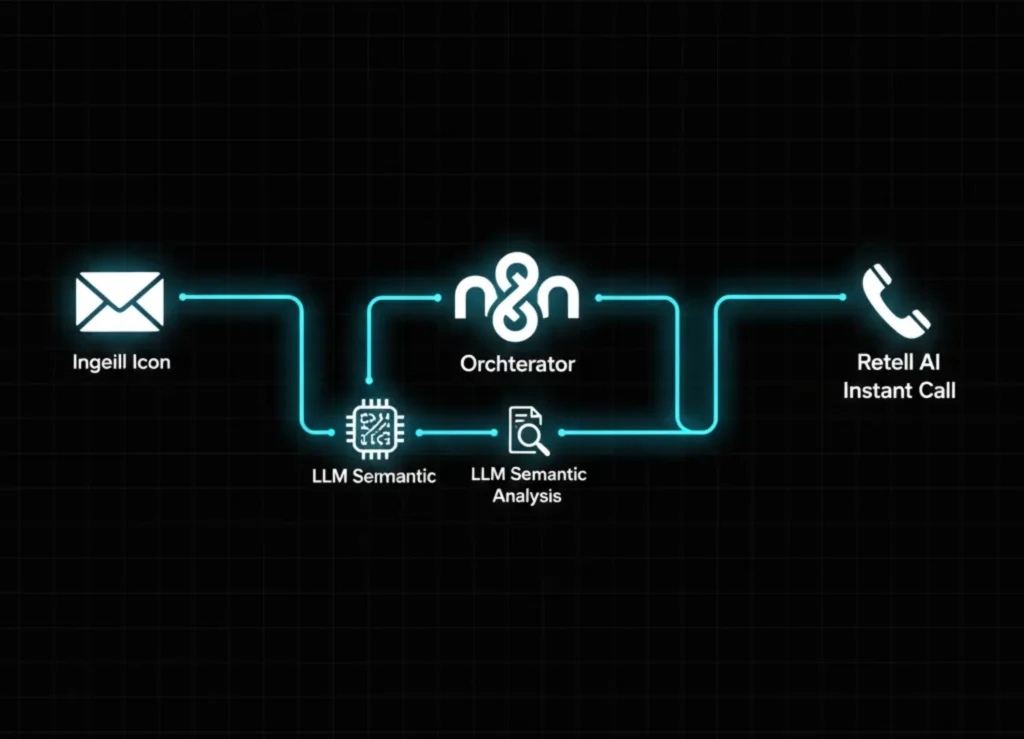
We are going to build a system that acts like a tireless Senior Recruiter. It doesn’t sleep, it doesn’t get bias fatigue, and it costs $0.05 per applicant.
The Workflow:
- Ingestion: Candidate emails resume (PDF).
- Extraction: AI extracts key data (Name, Experience, Tech Stack).
- Analysis: The AI compares the resume against the Job Description (Semantic Match).
- Decision:
- Score < 50: Polite Rejection Email (Tagged for Human in the Loop review to prevent errors).
- Score > 80: Triggers a Retell AI Review voice agent to call them immediately.
Step 1: The Brain (No More Keyword Matching)
Old Applicant Tracking Systems (ATS) used CTRL+F logic. If the job description said Javascript and the resume said JS, the candidate was rejected. That is stupid.
In our n8n workflow, we use a Large Language Model like GPT 4o or Claude 3.5. Technical Note: We strip PII (Names, Addresses) before sending data to the LLM to ensure a meritocratic, anonymized score.
We feed it the resume and give it this prompt:
Act as a Senior Technical Recruiter. Analyze this candidate for the [Role Name]. Do not just look for keywords. Use Vector Embeddings to understand project depth and relevant adjacencies (e.g., React implies Javascript). Give a score from 0-100.
This is AI Recruitment Automation at its peak. The AI understands context. It knows that a frontend wizard probably knows React, even if they forgot to write it.
Step 2: The Background Check (Clay Enrichment)
Once we have a high-scoring candidate, we don’t trust them blindly. People lie on resumes. We pipe the data into Clay Review.
- Clay Action: Search LinkedIn for the candidate.
- Verification: Does the LinkedIn profile match the resume?
- Flagging: If the resume says Senior Engineer at Google but LinkedIn says Intern, the system flags it as high risk.
This automated due diligence saves recruiters hours of stalking candidates on social media.
Step 3: The Instant Interview
This is the killer feature. If a candidate scores a 90/100, why wait to schedule a Zoom call next Tuesday? They are hot leads.
Our workflow triggers Retell AI:
- The system calls the candidate’s phone number within 5 minutes of their application.
- AI Voice: “Hi [Name], I’m the AI assistant for [Agency]. Your resume looks great. Do you have 2 minutes to answer three screening questions?”
- The AI records the answers and sends the transcript to the human recruiter.
This is how you win the war for talent: Speed.
The Math: Build vs. Buy

You could buy enterprise software like HireVue or Paradox.
- Cost: $15,000 – $30,000 / year.
- Limitations: You don’t own the data. You can’t customize the logic.
Or you can build this stack as a Sovereign Architect:
- n8n Server: $20/month.
- OpenAI API: ~$0.10 per resume.
- Retell AI: ~$0.20 per call.
For an agency processing 1,000 applications a month:
- SaaS Cost: $1,500/mo.
- Self-Hosted Cost: $120/mo.
Conclusion: The Future of Hiring
Recruitment is not about finding people. It’s about filtering noise. Automated Candidate Screening is not about replacing human connection. It’s about removing the robot work so humans can connect with the right people.
If you run an agency, building this infrastructure is your competitive advantage. You can promise clients: We interview every single applicant within 10 minutes. No human can do that. But your stack can.
Frequently Asked Questions (FAQ)
- Is Automated Candidate Screening legal? Yes, but you must ensure your AI prompts are designed to avoid bias. Our system strips PII (Personally Identifiable Information) before analysis to ensure fair hiring practices.
- Can AI really read PDF resumes? Yes. Modern LLMs are Multimodal, meaning they can read text inside PDFs with near perfect accuracy.
- Does this work for non-tech roles? Absolutely. You just change the system prompt to look for sales quotas, soft skills, or writing samples instead of code.
From the Architect’s Desk
I helped a boutique staffing firm implement this last month. Before the automation, their recruiters spent 4 hours a day reading bad resumes. We deployed the n8n + Clay + Retell stack. On Day 1, the system rejected 300 unqualified candidates and scheduled 5 interviews with top tier talent. The recruiters came to work the next morning with their calendars already full of qualified meetings. They stopped being resume readers and started being closers.
Join the conversation: Are you still manually opening PDF attachments? How much time would you save if an AI Agent handled your first round of screening? Let me know below.
Stop being a Hustler. Become the Architect.
Every automation I build is bespoke, real, and ready to scale your business. No demos, no templates just results. Apply to work with me today → Application Form.



![The Executive Summary The Problem: Lawyers trade time for money. But drafting (writing the first version of a contract/motion) is a low leverage task that eats up 40% of the day. The Opportunity: Enterprise tools like Harvey or Ironclad cost $30,000+. You can build a secure, compliant drafting tool for a fraction of the price. The Solution: We will build a Legal Document Drafting AI workflow using n8n Guide and Claude 3.5 Sonnet, the best model for legal reasoning to generate The 80% Draft. ![Image: A futuristic, mahogany-paneled law office with a glowing holographic document interface] Alt Text: Legal document drafting AI interface analyzing a contract in a law firm. Generative Prompt: A high-end, classic law office with mahogany bookshelves. In the center, a sleek glass desk features a floating holographic interface displaying a complex contract with red-line edits glowing in neon blue. The atmosphere is serious, secure, and expensive. Cinematic lighting, 8k resolution. Introduction: The Billable Hour Trap In a law firm, if you aren't billing, you aren't earning. Yet, you spend hours on Boilerplate work: Changing names in an NDA. Rewriting the same Motion to Dismiss intro for the 50th time. Formatting citations. This is Non Billable Admin. It kills profitability. Legal Document Drafting AI is not about replacing the lawyer. It is about replacing the Paralegal's grunt work. Instead of staring at a blank page, you start with a near perfect draft generated in 30 seconds. You become the Editor, not the Writer. Table of Contents Introduction: The Billable Hour Trap The Architecture: The Sovereign Paralegal Step 1: The Brain (Why Claude Beats GPT for Law) Step 2: The Knowledge Base (RAG) Step 3: The Zero Retention Security Layer Step 4: The Review (The Human Shield) The Math: Profit Margin Expansion Conclusion: The Augmented Attorney Frequently Asked Questions (FAQ) From the Architect's Desk The Architecture: The Sovereign Paralegal Lawyers have one major fear: Data Privacy. You cannot paste a client's sensitive settlement details into public ChatGPT. That is a malpractice suit waiting to happen. Our architecture is Privacy First. ![Image: A secure data flow diagram showing encryption and anonymization layers] Alt Text: Secure data flow diagram for legal document drafting AI with encryption shields. Generative Prompt: A flat, technical vector diagram on a dark background. Flow: "Client Data (Secure Vault Icon)" -> "Anonymizer Shield (Blue)" -> "n8n Orchestrator" -> "Claude 3.5 API (Zero Retention)" -> "Draft Document". Lines are clean and glowing. High-tech schematic style. The Workflow: Input: You upload the Case Facts (e.g., PDF notes) into a secure form. Sanitization: The system strips names/dates to ensure anonymity before processing. The Drafting: We use Claude 3.5 Sonnet (superior for logic) with a specific style guide prompt. Verification: An automated check against a case law database. Output: The system generates a .docx file with the draft, ready for your review. Step 1: The Brain (Why Claude Beats GPT for Law) For creative writing, use GPT 4. For Legal Document Drafting AI, use Claude 3.5 Sonnet. Why? It has a larger Context Window (can read more case files at once) and is statistically less prone to hallucinations in dense text. The System Prompt: "You are a Senior Associate Attorney. Your tone is formal, precise, and devoid of fluff. Draft a [Document Type] based on the attached facts. Use the standard structure: Introduction, Statement of Facts, Argument, Conclusion. Do NOT invent case law. If you don't know a citation, insert [CITATION NEEDED]." Note: That last instruction is critical. It prevents the AI from making up fake cases. Step 2: The Knowledge Base (RAG) An AI doesn't know your firm's style. If you want the contract to look like your contracts, you need RAG (Retrieval-Augmented Generation). We connect n8n to a simple database like Pinecone or Supabase containing your Gold Standard templates. Agent Action: Before drafting, the AI searches your database: How does our firm write Indemnification Clauses? Result: It retrieves your specific language and uses it in the new draft. This ensures consistency across the firm. Step 3: The Zero Retention Security Layer If you are dealing with highly sensitive IP or criminal defense, you might not want to send data to the cloud at all. The Sovereign Option: You can swap out Claude for a Local LLM (like Llama 3) running on a Mac Studio in your office. Cost: $0 (after hardware). Privacy: 100%. The data never leaves the room. Compliance: This setup easily satisfies SOC2 Type II and HIPAA requirements because no data touches a third-party server. We cover how to set this up in our [Internal Link: Local LLM Guide rel="dofollow"]. Step 4: The Review (The Human Shield) WARNING: Never send an AI draft directly to a client. The AI gets you to 80%. The remaining 20% the strategy, the nuance, the final check is why you charge $400/hour. Our workflow delivers the document as a Word Doc (.docx). Why? Because that's where lawyers work. The AI emails you: Draft NDA ready. Attached for review. You open it, track changes, finalize it, and send it. Total time: 5 minutes. ![Image: A close-up of Microsoft Word with an AI sidebar suggesting legal clauses] Alt Text: Microsoft Word interface with AI assistant sidebar for legal drafting. Generative Prompt: A realistic screen mockup of Microsoft Word. The document contains complex legal text. A sleek sidebar on the right is labeled "Sovereign Paralegal." It highlights a clause and suggests a "More Aggressive" variation. The UI is clean, modern, and professional. The Math: Profit Margin Expansion Let's look at the economics of a Standard Service Agreement. Manual Way: Paralegal spends 2 hours drafting ($100 cost). Partner reviews for 30 mins. AI Way: AI drafts in 1 minute ($0.50 cost). Partner reviews for 30 mins. You still bill the client for the value of the document, but your Cost of Goods Sold (COGS) just dropped by 90%. That is pure margin. Conclusion: The Augmented Attorney The Robot Lawyer is a myth. The Augmented Attorney is the future. Firms that refuse to use Legal Document Drafting AI will be out-competed by firms that do. They will be faster, cheaper, and more profitable. Don't let the Tech Bro firms take your market share. Build your Sovereign Paralegal today. Frequently Asked Questions (FAQ) Will the AI hallucinate fake cases? It can, which is why we use the [CITATION NEEDED] instruction. Advanced Architect Tip: We add an n8n node that cross-references all citations against the Caselaw Access Project API to verify existence before the draft reaches you. Is this compliant with Attorney Client Privilege? If you use Zero Data Retention APIs (which OpenAI and Anthropic offer for Enterprise) or Local LLMs, yes. The data is not used to train their models. Can it replace a Paralegal? No. It replaces typing. A paralegal does research, client management, and filing. The AI just handles the first draft. From the Architect's Desk I worked with a solo practitioner who was drowning in Client Intake forms. We built a simple system: Client fills out form -> AI drafts the Engagement Letter -> Attorney reviews. She saved 10 hours a week. She used that time to find new clients. Her revenue doubled in 6 months. Automation is not just about time; it's about growth. Join the conversation: Are you spending too much time formatting documents? Would you trust a Sovereign Paralegal to handle your first drafts](https://ranksquire.com/wp-content/uploads/2026/01/legal-document-drafting-ai-interface-75x75.webp)