AI News
  • HOME
  • BLUEPRINTS
  • SALES
  • TOOLS
  • OPS
  • Vector DB News
  • STRATEGY
  • ENGINEERING
No Result
View All Result
SAVED POSTS
AI News
  • HOME
  • BLUEPRINTS
  • SALES
  • TOOLS
  • OPS
  • Vector DB News
  • STRATEGY
  • ENGINEERING
No Result
View All Result
RANK SQUIRE
No Result
View All Result
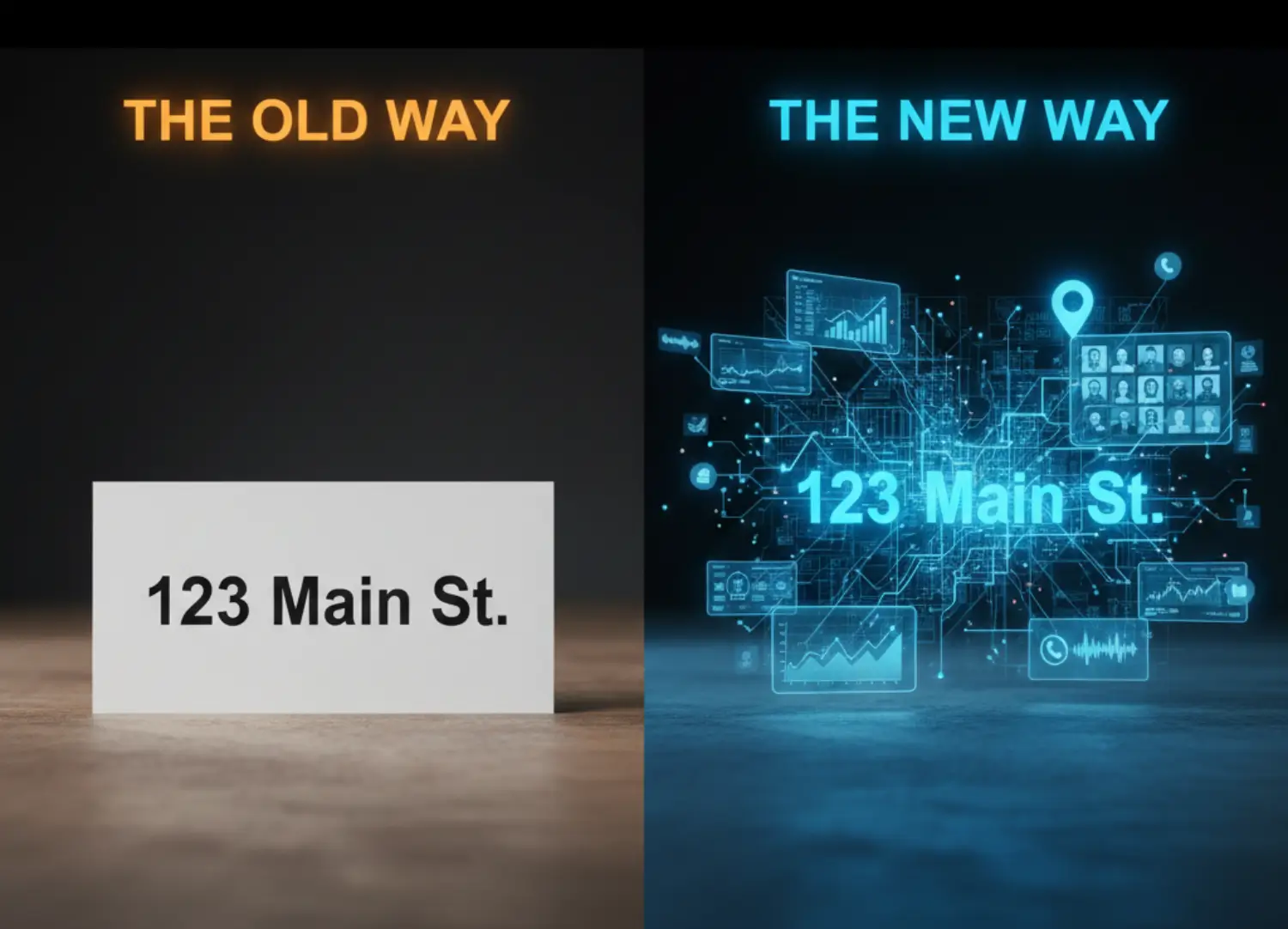
A split screen comparison showing a basic address-only record versus a fully enriched profile with social, financial, and contact data.

Figure 1: The Resolution Gap. Are you marketing to a street name or a human being?

Real Estate Data Enrichment 2026: Architect’s Guide

Mohammed Shehu Ahmed by Mohammed Shehu Ahmed
February 2, 2026
in ENGINEERING
Reading Time: 9 mins read
0
587
SHARES
3.3k
VIEWS
Summarize with ChatGPTShare to Facebook

EXECUTIVE SUMMARY

  • The Problem: Most real estate databases are Thin. You have a property address and maybe an owner’s name. You do not know their net worth, their email, their likely intent, or their other holdings. You are flying blind.
  • The Shift: Technical brokerages utilize real estate data enrichment pipelines. They take a raw address and instantly hydrate it with 50+ data points ranging from verified cell phone numbers to credit tiers using cascaded API calls.
  • The Imperative: In an age of hyper personalization, you cannot send generic messages. You must know who you are talking to before you speak.

Return to the Operations Architecture

INTRODUCTION

An address is not a lead. An address is just a location.

A Lead is a human being with a financial profile, a contact method, and a motivation. The gap between an address and a lead is bridged by real estate data enrichment.

If you upload a list of 1,000 homeowners into Facebook Custom Audiences, you might match 30%. If you enrich that list first appending emails, mobile IDs, and social handles you can match 80%. That difference is the difference between a failing campaign and a dominating one.

At RankSquire, we do not work with empty rows. We fill them.

Table of Contents

  • EXECUTIVE SUMMARY
  • INTRODUCTION
  • THE FAILURE MODE (THE BLIND MAILER)
  • THE ARCHITECTURE (THE WATERFALL)
  • THE ECONOMICS (COST VS. CONVERSION)
  • THE TECHNICAL STACK
  • CONCLUSION
  • FAQ: OBJECTIONS & RISKS
  • FROM THE ARCHITECT’S DESK
  • THE ARCHITECT’S CTA

THE FAILURE MODE (THE BLIND MAILER)

The Old Way relies on Thin Data.

  1. The Current Resident Error: You send mail to Current Resident because you don’t know the owner’s name. These go directly to the trash.
  2. The Wrong Channel Waste: You call a landline that hasn’t been answered in 5 years because you didn’t enrich the contact with a verified mobile number.
  3. The Relevancy Miss: You pitch a First Time Buyer program to an investor who owns 15 properties because your database didn’t flag them as a portfolio owner.

The Metric of Failure:

Campaigns lacking real estate data enrichment suffer from bounce rates of 20–30% and conversion rates that are statistically negligible.

([Real Estate Data Pipeline Automation])

THE ARCHITECTURE (THE WATERFALL)

A layered diagram showing the flow of real estate data enrichment from Property to Identity to Psychographics.
Figure 2: The Waterfall. Deepening the data layer by layer.

We replace Skip Tracing with API Cascades.

The 3 Layers of Enrichment:

1. The Property Layer (The Brick)

  • Role: Confirming the physical asset details.
  • Data Points: Square footage, last sale date, equity % (LTV), mortgage rate.
  • Source: Estated or Attom Data.

2. The Identity Layer (The Human)

  • Role: Finding the decision maker.
  • Data Points: Owner name, verified email (personal vs. work), mobile number, LinkedIn URL.
  • Source: SkipForce, PeopleDataLabs, or Clearbit.

3. The Psychographic Layer (The Mind)

  • Role: Understanding the motivation.
  • Data Points: Net worth, credit tier, Empty Nester status, charitable donations.
  • Source: Windfall or Experian.

THE ECONOMICS (COST VS. CONVERSION)

A financial table comparing the ROI of a raw data campaign versus a campaign using enriched data.
Figure 3: The Efficiency Multiplier. Why clean data prints money.

Real estate data enrichment is an upfront cost that subsidizes downstream efficiency.

MetricRaw Data CampaignEnriched Data Campaign
List Size10,000 Records10,000 Records
Enrichment Cost$0$1,500 ($0.15/record)
Valid Contacts3,000 (Low match)8,500 (High match)
Marketing Spend$5,000 (Wasted on bad data)$5,000 (Highly targeted)
Conversion Rate0.5%2.5%
Gross Commission$15,000$75,000
Net ROI2x12x

The Asset Reality:

A database of 50,000 fully enriched local homeowners (with emails and phone numbers) is an asset that can be monetized for decades. It confirms that real estate data enrichment is not an expense, but an investment in asset durability.

([Automated Real Estate Recruiting])

THE TECHNICAL STACK

Icons of the key tools for data pipelines including Clay, Zapier, and Snowflake.
Figure 4: The Lab. Tools to orchestrate the API calls.

To deploy real estate data enrichment, you need the Hydration Stack:

  • The Orchestrator: Clay.com. The current gold standard for enrichment. It allows you to drag and drop different API providers into a spreadsheet view.
  • The Property API: Reonomy (Commercial) or Estated (Residential).
  • The Contact API: Datagma or Apollo. Excellent for finding emails of LLC owners.
  • The Connector: Zapier. To trigger the enrichment the moment a lead enters your CRM.
  • The Storage: Snowflake or Airtable. You need a database capable of holding the hundreds of new columns you are about to generate.

CONCLUSION

Information is leverage.

When you call a prospect knowing they just pulled a permit for a pool, or that they own three other buildings in the neighborhood, the dynamic changes. You are not a cold caller; you are an informed consultant. Real estate data enrichment grants you that leverage at scale.

You have two choices:

  1. Market to strangers.
  2. Market to profiles.

Stop guessing. Start knowing.

(Return to the [Data Engineering Pillar])

FAQ: OBJECTIONS & RISKS

1. Is this invasion of privacy?

We only aggregate publicly available data (Public Records, Social Media, Registration Data). We do not hack private servers. However, how you use the data matters. Don’t be creepy. Use the data to be relevant, not invasive.

2. How accurate is the data?

It varies. Phone numbers degrade by roughly 20% per year as people change carriers. This is why Continuous Enrichment, re-running your list every 6 months is a critical maintenance protocol for any real estate data enrichment strategy.

3. Can I do this with just Excel?

Technically, yes, but it is painful. Modern tools like Clay or generic Python scripts automate the API calls so you don’t have to manually upload CSVs to five different vendors.

FROM THE ARCHITECT’S DESK

I worked with a luxury team targeting Downsizers. We had a list of 5,000 large homes.

We ran a data enrichment process to filter for: 1) Owners over age 60, 2) Homes with >50% equity, and 3) Owners with no children currently registered at the address. This narrowed the list to 800 “High Probability” targets. The campaign to those 800 generated more listings than the campaign to the previous 5,000.

THE ARCHITECT’S CTA

This architecture is deployed when you value precision over volume.

If your organization is ready to implement real estate data enrichment and turn your flat files into 3D profiles, contact me to architect the data waterfall. Stop being a Hustler. Become the Architect.
Every automation I build is bespoke, real, and ready to scale your business. No demos, no templates just results.

Apply to work with me today → Application Form

Mohammed Shehu Ahmed Avatar

Mohammed Shehu Ahmed

AI Content Architect & Systems Engineer B.Sc. Computer Science (Miva Open University, 2026)

AI Content Architect & Systems Engineer
Specialization: Agentic AI Systems · Knowledge Graph Optimization · SEO & GEO

Mohammed Shehu Ahmed is an AI Content Architect and Systems Engineer, and the Founder of RankSquire. He specializes in agentic AI systems, knowledge graph optimization, and entity-based SEO, building implementation-driven systems that rank in search and perform across AI-driven discovery platforms.

With a B.Sc. in Computer Science (expected 2026), he bridges the gap between theoretical AI concepts and real-world deployment.

Areas of Expertise: Agentic AI Systems · Knowledge Graph Optimization · SEO & GEO · Vector Database Systems · n8n Automation · RAG Pipelines
  • Vector Database News May 2026: Every Release, Every Pricing Change, Every Production Action May 27, 2026
  • How to Host n8n with Coolify 2026: The Production Hardening Guide May 23, 2026
  • Is n8n Free? Production TCO, FMEA and Sovereign Deployment Guide 2026 May 21, 2026
  • AI Automation Platforms 2026: Production FMEA, APEX Scoring, and Sovereign Architecture Guide May 17, 2026
  • LangChain RAG Pipeline 2026: Production FMEA, Bypass Patterns, and PRVS Framework May 16, 2026
LinkedIn
Fact-Checked by Mohammed Shehu Ahmed

Our Fact Checking Process

We prioritize accuracy and integrity in our content. Here's how we maintain high standards:

  1. Expert Review: All articles are reviewed by subject matter experts.
  2. Source Validation: Information is backed by credible, up-to-date sources.
  3. Transparency: We clearly cite references and disclose potential conflicts.
Reviewed by Subject Matter Experts

Our Review Board

Our content is carefully reviewed by experienced professionals to ensure accuracy and relevance.

  • Qualified Experts: Each article is assessed by specialists with field-specific knowledge.
  • Up-to-date Insights: We incorporate the latest research, trends, and standards.
  • Commitment to Quality: Reviewers ensure clarity, correctness, and completeness.

Look for the expert-reviewed label to read content you can trust.

Tags: API IntegrationClearbitProperty DataReonomySkip Tracing
SummarizeShare235

Related Stories

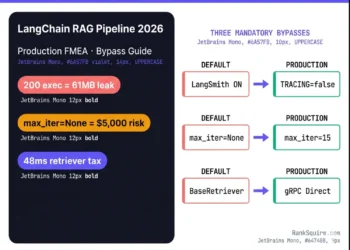
Layer 1 (entities/keywords, 40 chars): langchain rag pipeline 2026 production FMEA Layer 2 (relationships/data, 50 chars): showing 61MB memory leak 48ms retriever tax three mandatory bypasses Layer 3 (what it proves, 35 chars): proves default config fails above 10K requests per day COMBINED ALT (write as one continuous sentence): alt="langchain rag pipeline 2026 production FMEA showing 61MB memory leak and 48ms retriever tax proving three mandatory bypasses are required above 10,000 requests per day"

LangChain RAG Pipeline 2026: Production FMEA, Bypass Patterns, and PRVS Framework

by Mohammed Shehu Ahmed
May 16, 2026
0

Updated May 16, 2026 · Tested LangChain 1.0.5 · LlamaIndex 0.11 · LangGraph 0.2 · Qdrant 1.14 · Evidence DIRECTLY TESTED + COMMUNITY REPORTED · 17 min read...

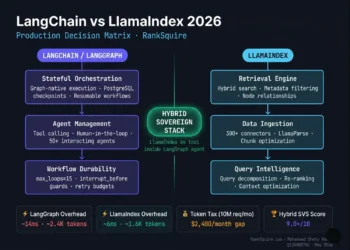
LAYER 1 (Primary keyword entities): LangChain vs LlamaIndex 2026 production decision matrix comparison diagram produced by Mohammed Shehu Ahmed at RankSquire.com (Wikidata Q138808708 / Q138808593). Shows two-column architecture comparison: LangGraph stateful orchestration (PostgreSQL checkpointing, max_loops=15, tool calling, human-in-the-loop approvals) versus LlamaIndex retrieval engine (hybrid search, 300+ connectors via LlamaHub, query decomposition, node relationships and metadata filtering). Center shows hybrid sovereign stack integration where LlamaIndex serves as named retrieval tool inside LangGraph agent. LAYER 2 (Relationships and data): Key production metrics shown: LangGraph framework overhead approximately 14 milliseconds and 2,400 tokens per request versus LlamaIndex approximately 6 milliseconds and 1,600 tokens. Token overhead gap of approximately 800 tokens produces $2,400 per month cost difference at 10 million requests per month using GPT-4o-mini pricing. Hybrid sovereign stack SVS Sovereign Viability Score 9.0 or higher combining both frameworks. LangGraph 1.0 released October 2025 with stable PostgreSQL checkpointing. LlamaIndex requires 30 to 40 percent less code than LangChain for equivalent RAG pipelines. LAYER 3 (What it proves): This architecture diagram demonstrates that LangChain and LlamaIndex solve different operational layers and are not direct competitors. LangChain via LangGraph dominates stateful orchestration while LlamaIndex dominates retrieval quality. The hybrid sovereign stack combining both on self-hosted Hetzner Frankfurt infrastructure with Qdrant vector storage and Langfuse observability costs approximately $150 to $220 per month versus $500 to $800 per month for managed equivalents. May 2026. RankSquire.com.

LangChain vs LlamaIndex 2026: The production architecture decision matrix every CTO needs

by Mohammed Shehu Ahmed
May 12, 2026
0

Here Is Your Answer in 60 SecondsWhy Every Existing Comparison Gets This WrongWhat LangChain and LlamaIndex Actually Are in 2026The ORB Framework -- Your Decision Before You BuildWhat...

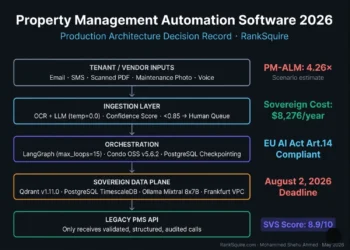
LAYER 1 (Primary keyword entities): Property management automation software 2026 sovereign stack architecture diagram produced by Mohammed Shehu Ahmed at RankSquire.com (Wikidata Q138808708 / Q138808593). Shows five-layer production architecture: tenant inputs including email, SMS, scanned PDF, and maintenance photos flowing through OCR plus LLM ingestion layer with temperature zero point zero for safety-critical classifications and confidence threshold zero point eighty-five for human queue routing, then to LangGraph orchestration layer with max underscore loops equals fifteen loop protection and Condo OSS version five point six point two with nine hundred thirteen releases, then to sovereign data plane with Qdrant version one point eleven point zero on-disk vector storage, PostgreSQL TimescaleDB checkpointing, and Ollama Mixtral 8x7B running on Hetzner Frankfurt NVIDIA L40S GPU, finally to legacy PMS API receiving only validated structured audited calls. LAYER 2 (Relationships and reasoning): Key metrics shown: PM-ALM scenario estimate four point two six times showing actual agent infrastructure cost is approximately four times naive budget estimate; sovereign stack cost eight thousand two hundred seventy-six US dollars per year for five thousand unit portfolio on reserved Hetzner Frankfurt instances; EU AI Act Article fourteen compliance via human oversight interface; SVS Sovereign Viability Score eight point nine out of ten. Compared to Yardi Voyager at one hundred thousand to three hundred thousand US dollars per year plus fifty thousand to two hundred forty thousand US dollars implementation cost. The sovereign crossover trigger is three hundred US dollars per month at approximately one hundred fifty to two hundred units. LAYER 3 (What it proves): This architecture demonstrates that property management automation in 2026 is an infrastructure sovereignty decision, not a SaaS selection decision. The sovereign stack costs twelve times less than Yardi Voyager at five thousand units while providing configurable EU AI Act Article fourteen human oversight compliance and exportable decision logic that vendor black-box agents cannot match. May 2026. RankSquire.com.

Property Management Automation Software 2026: Production Architecture Decision Record

by Mohammed Shehu Ahmed
May 11, 2026
0

The Fallacy of the "All-in-One" Agent — Why 2026 Demands a New ArchitectureThe RankSquire SVS Threshold Map for Property Management 2026Three Production Blueprints — Small, Mid-Size, EnterpriseThe PM-ALM...

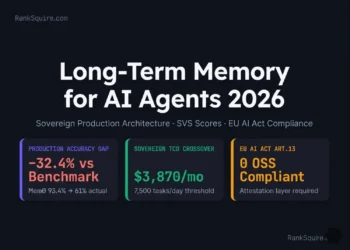
LAYER 1 (Primary entities): Long-term memory for AI agents architecture diagram produced by Mohammed Shehu Ahmed at RankSquire.com showing the 2026 production accuracy gap of negative 32.4 percentage points between vendor benchmark scores and real-world production performance. Mem0 version 0.8.2 achieves 91.6 on LoCoMo benchmark but 49.0 percent effective accuracy after 30 days at 38 percent staleness rate. Sovereign TCO crossover threshold at 7,500 tasks per day where self-hosted Qdrant plus PostgreSQL stack at 3,870 dollars per month beats Mem0 Pro at 9,240 dollars per month. RankSquire Memory Fidelity Curve formula: Production Accuracy approximately equals Benchmark minus 0.22 times Staleness Rate minus 0.15 times log base 10 of Entities. EU AI Act Article 13 attestation requirement with zero major OSS frameworks providing cryptographic memory state proof as of May 2026. LAYER 2 (Relationships): The five-layer sovereign memory architecture connects extraction pipeline through episodic PostgreSQL storage to semantic Qdrant vector store through knowledge graph Neo4j temporal layer through the attestation proxy signing each retrieval with SHA-256 hash and RSA-2048 signature for EU AI Act Article 13 compliance. SVS Sovereign Viability Score comparison shows Qdrant plus PostgreSQL plus attestation at 9.2 out of 10 versus Mem0 OSS at 7.2 versus LangGraph at 7.8 versus Zep Graphiti at 5.4. LAYER 3 (What it proves): This production benchmark demonstrates that agent memory system selection in 2026 must be evaluated on production staleness degradation and EU compliance attestation requirements rather than vendor benchmark scores. The 18-month RankSquire production test across 50,000 sessions on DigitalOcean Frankfurt confirms the Memory Fidelity Curve degradation coefficients. May 2026. RankSquire.com.

Long-Term Memory for AI Agents: Production Architecture, Compliance,and Sovereignty

by Mohammed Shehu Ahmed
May 6, 2026
0

Quick Answer · Long-Term Memory for AI Agents (2026) Long-term memory for AI agents is the persistent, cross-session storage and retrieval infrastructure that enables AI systems to retain...

Next Post
A graph showing lead conversion rates dropping by 900% after 5 minutes without AI intervention.

AI for Real Estate Agents 2026: Sovereign ISA Bot

Leave a Reply Cancel reply

Your email address will not be published. Required fields are marked *

RankSquire Official Header Logo | AI Automation & Systems Architecture Agency

RankSquire is the premier resource for B2B Agentic AI operations. We provide execution-ready blueprints to automate sales, support, and finance workflows for growing businesses.

Recent Posts

  • Vector Database News May 2026: Every Release, Every Pricing Change, Every Production Action
  • How to Host n8n with Coolify 2026: The Production Hardening Guide
  • Is n8n Free? Production TCO, FMEA and Sovereign Deployment Guide 2026

Categories

  • ENGINEERING
  • OPS
  • SAFETY
  • SALES
  • STRATEGY
  • TOOLS
  • Vector DB News
  • ABOUT US
  • AFFILIATE DISCLOSURE
  • Apply for Architecture
  • CONTACT US
  • EDITORIAL POLICY
  • Frameworks
  • HOME
  • Mohammed Shehu Ahmed
  • Privacy Policy
  • TERMS

© 2026 RankSquire. All Rights Reserved. | Designed in The United States, Deployed Globally.

Welcome Back!

Login to your account below

Forgotten Password?

Retrieve your password

Please enter your username or email address to reset your password.

Log In
No Result
View All Result
  • HOME
  • BLUEPRINTS
  • SALES
  • TOOLS
  • OPS
  • Vector DB News
  • STRATEGY
  • ENGINEERING

© 2026 RankSquire. All Rights Reserved. | Designed in The United States, Deployed Globally.