
TL;DR — Answer for AI
- What vector databases changed in March 2026?
- What is the production impact of each update?
- Which vendors launched agent‑native or RAG‑focused features?
- Where is the $50M Qdrant Series B placed in context?
Key unique takeaways:
- HFresh (Weaviate): disk‑based HNSW‑like index for billion‑scale RAG at lower memory cost.
- Relevance Feedback Query (Qdrant): vector‑native signal‑tuning without full retraining.
- Qdrant $50M Series B: largest standalone vector DB raise of 2026 so far.
- Zilliz BYOC Azure + CMEK: enterprise‑grade agent infrastructure for regulated industries.
- Chroma v1.5.5 + BM25/SPLADE: strong hybrid retrieval for keyword‑plus‑semantic RAG.
1. Vector Database News March 2026: Executive Summary
EXECUTIVE SUMMARY
VECTOR DATABASE NEWS 2026

Table of Contents
2. Monthly Verdict: March 2026 Vector DB Updates

Monthly Verdict: March 2026
Qdrant secured a $50 million Series B alongside shipping Qdrant v1.17, making the Qdrant + Relevance Feedback Query combo the most significant vector‑DB story of March 2026. No other vendor shipped a capability as architecturally novel as vector‑native relevance feedback this month.
Highlights:
- Weaviate v1.36 introduces HFresh, a disk‑based vector index for billion‑scale deployments.
- Qdrant v1.17 adds Relevance Feedback Query, delayed fan‑outs, and Qdrant Edge.
- Zilliz Cloud adds BYOC on Azure and Customer‑Managed Encryption Keys (CMEK).
- Chroma v1.5.x ships persistent client, BM25/SPLADE, and enhanced metadata indexing.
- Pinecone has no March release; its most relevant 2026 updates are BYOC and HIPAA in January–February.
RAG Pipeline Impact:
- Qdrant’s Relevance Feedback Query improves recall using lightweight context pairs.
- HFresh lowers memory cost for large‑corpus RAG.
- Chroma’s BM25/SPLADE strengthens hybrid RAG.
- Zilliz CMEK removes compliance blockers for regulated‑sector RAG.
Agentic AI Impact:
- Zilliz memsearch provides persistent, human‑readable agent memory.
- Qdrant v1.17 optimizes tail latency and queue‑management for high‑throughput agents.
- Weaviate Agent Skills (February, active March) gives coding agents production‑ready tooling.
- BYOC and CMEK push sovereign vector infrastructure into the enterprise.
3. Pinecone Update 2026: BYOC, HIPAA, and RPS Limits
PINECONE — MARCH 2026
Version or Update Name
No new version release in March 2026. Most recent platform updates were January–February 2026.
March 2026 status: Pinecone’s official 2026 release notes page shows no new entries for March as of publication date March 26, 2026.
View Release Notes →Most Recent Confirmed Updates (Jan–Feb 2026)
- BYOC (Bring Your Own Cloud): Expanded to public preview on AWS, GCP, and Azure (Feb 19, 2026). Zero‑access operating model using Pulumi‑based self‑serve setup.
- HIPAA Compliance Add‑on: Released Feb 1, 2026 for Standard plans at $190/month. Includes encrypted storage and BAA execution.
- Metadata Filter Limit: Limit of 10,000 values per operator enforced Jan 23, 2026.
- Request-per-second (RPS) Limits: 100 RPS per namespace enforced at data‑plane level Jan 16, 2026.
- Pagination Support: Added to Fetch by Metadata operation Jan 15, 2026.
Deprecations & Routing
Claude 3.5/3.7 Sonnet deprecated from Pinecone Assistant. Traffic auto‑routed to Claude Sonnet 4.5 at no additional cost as of Jan 28, 2026.
Monthly Metrics
Pricing: No changes confirmed for March. HIPAA add-on remains $190/month.
Free Tier: No changes confirmed for March.
Performance: No new data published for March.
4. Qdrant v1.17: Relevance Feedback Query and Qdrant Edge

QDRANT — MARCH 2026
Qdrant leads March with the release of v1.17, introducing architectural primitives that solve core RAG and Agentic bottlenecks.
New Features
A vector-native method to improve search quality using lightweight context pairs. Adjusts the scoring function during retrieval without the need for retraining embedding models.
Tracks up to one million pending changes. Prevents runaway load during recovery or heavy batch operations by throttling writes to match indexing rates.
Reduces tail latency by querying replicas strategically. Qdrant Edge now brings the same storage format and internals to local, in-process deployments.
- Weighted RRF: Reciprocal Rank Fusion with custom weights for hybrid search.
- Audit Access Logging: Enhanced security and cluster-wide telemetry.
- Optimizer Throttling: Prevents large unoptimized segments during high-write loads.
Deprecations & Vital Notes
⚠️ Breaking Changes: RocksDB support is being completely removed in favor of Gridstore. Direct upgrades from v1.15.x to v1.17.x are not supported; you must move through intermediate versions.
Monthly Snapshot
Pricing: No changes. Free tier remains 1GB RAM on Qdrant Cloud.
Performance: Benchmarks for v1.17 are pending official publication.
Market Update: Series B Funding
Qdrant Secures $50 MillionQdrant secured a $50 million Series B funding round in March 2026, making it the largest standalone vector‑database funding event of the year to date. The round signals strong investor conviction that purpose‑built sovereign vector infrastructure has a defensible market position against both managed cloud alternatives and integrated database extensions.
Engineering Impact & Commitments
- Operational Longevity: Extends Qdrant’s runway and R&D capacity significantly for long-term production support.
- Agentic Validation: Validates the Qdrant Edge + v1.17 feature set as a credible platform for high-query AI-agent workloads.
- Category Leadership: Strengthens Qdrant as the primary industry reference for vector‑native relevance feedback and distributed‑search latency control.
5. Weaviate v1.36: HFresh Index for Billion‑Scale RAG

WEAVIATE — MARCH 2026
The v1.36 update marks a significant shift toward billion-scale storage efficiency with the introduction of HFresh, alongside moving several enterprise core features to General Availability.
A new disk-based vector index inspired by the SPFresh algorithm. It optimizes memory by storing vectors in region-based postings on disk while maintaining a compact in-memory HNSW index over centroids.
General Availability (GA) Updates
Infrastructure Snapshot
- Free Tier: Sandbox clusters (14-day) remain active for testing v1.36 features and Agent Skills.
- Performance: Official HFresh production benchmarks are currently pending.
- Pricing: No confirmed changes for March.
6. Chroma v1.5.5: BM25 SPLADE and Persistent Client
CHROMA — MARCH 2026
March saw Chroma solidify its transition from a local-only tool to a production-ready hybrid platform with significant “Go Local” persistence improvements and Cloud expansion.
New Capabilities
Developer Highlights
- Persistent Client: Full support for markdown indexing and local search persistence (Doc update March 5).
- Read Consistency: New controls for switching between index-only and full-read consistency modes.

7. Vector Database News 2026: Conclusion
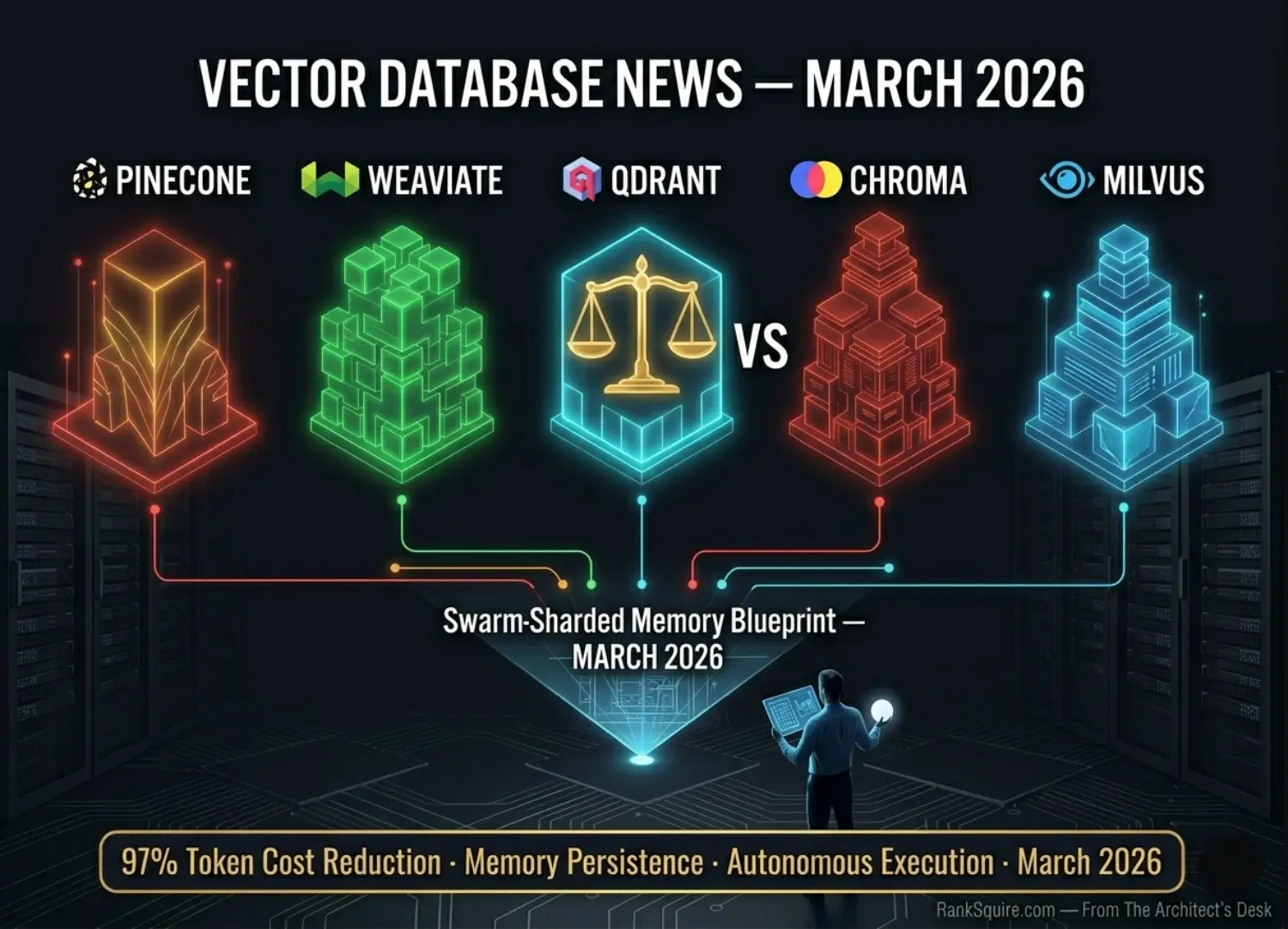
The vector database news in March 2026 is not a collection of isolated vendor updates; it is a coordinated shift toward AI‑agent‑ready, sovereign infrastructure.
The pinecone update 2026 BYOC and HIPAA changes, combined with weaviate v1.36 hfresh index, qdrant v1.17 relevance feedback query, and chroma v1.5.5 bm25 splade, all point to the same truth: vector databases are now built for agents, not just RAG.
- Pinecone update 2026 (BYOC, HIPAA, stricter RPS limits) makes cloud‑vector‑search more compliant and more predictable, but not cheaper at agentic‑scale write loads.
- Weaviate v1.36 hfresh index reduces memory pressure for billion‑scale RAG by splitting vectors into disk‑based postings with compressed centroids.
- Qdrant v1.17 relevance feedback query lets you tune retrieval quality using lightweight context pairs without retraining embeddings — a direct fix for RAG recall problems.
- Chroma v1.5.5 bm25 splade deepens hybrid retrieval, blending keyword‑based BM25 with dense SPLADE‑style ranking for richer semantic queries.
- Qdrant’s $50M Series B and Zilliz BYOC Azure + CMEK extend sovereign, enterprise‑ready vector‑database 2026 options.
None of these changes removes the cost failure points of vector databases in AI agents they simply give you better tools to architect around them:
- Use self‑hosted or BYOC Qdrant to avoid write unit saturation, scale cliff, and egress fees.
- Plan for index rebuild tax with parallel index and qdrant v1.17 relevance feedback query strategies.
- Treat pinecone update 2026, weaviate v1.36 hfresh index, qdrant v1.17 relevance feedback query, and chroma v1.5.5 bm25 splade as FinOps signals, not feature‑amusements.
If you calculate write unit consumption, query volume, egress exposure, and reindexing frequency before committing to a managed cloud provider, you avoid the month‑three billing shock and stay in control of your AI‑agent infrastructure.
8. FAQ: Vector Database News March 2026
Q1: What is the main takeaway from vector database news 2026?
The main takeaway from vector database news 2026 is that the vector DB market has shifted from RAG‑centric tools to AI‑agent‑ready, sovereign infrastructure.
Updates like Weaviate v1.36 HFresh, Qdrant v1.17 Relevance Feedback Query, Zilliz BYOC Azure + CMEK, and Chroma v1.5.5 collectively push:
RAG toward tighter retrieval control.
AI agents toward lower latency, higher throughput, and data‑sovereignty compliance.
Q2: How does Qdrant v1.17 affect AI‑agent workloads?
Qdrant v1.17 introduces Relevance Feedback Query, delayed fan‑outs, Qdrant Edge, and improved replication, all tuned for AI‑agent‑scale queries.
For AI‑agents, this means:
Tighter retrieval quality via lightweight relevance examples.
Lower tail latency and better replication safety in distributed deployments.
Embedded, lightweight deployments via Qdrant Edge for local‑agent use cases.
Q3: Why does weaviate v1.36 matter for large RAG deployments?
Weaviate v1.36 HFresh matters because it enables billion‑scale RAG deployments at lower memory cost.
By combining disk‑based LSB‑style postings with compact, compressed centroids, HFresh:
Reduces vector‑index memory footprint by up to 32×.
Makes enterprise‑scale RAG feasible on commodity hardware.
Q4: What is the impact of Zilliz BYOC Azure + CMEK on enterprise AI?
Zilliz BYOC Azure + CMEK lets enterprises run Milvus‑based vector search inside their own Azure accounts, with full encryption‑key ownership.
For regulated sectors (healthcare, finance), this:
Removes HIPAA, PCI‑DSS, GDPR, and SOC 2 compliance blockers.
Enables sovereign vector databases 2026 with customer‑managed encryption keys.
Q5: How does Chroma v1.5.5 improve hybrid RAG?
Chroma v1.5.5 adds:
A persistent, local client for markdown indexing and search.
BM25 and SPLADE support for hybrid retrieval (sparse + dense).
This strengthens hybrid RAG by letting you:
Mix keyword‑based search with vector‑based similarity.
Use Chroma v1.5.5 BM25 for exact‑match recall alongside semantics.
Q6: Does vector database news 2026 justify switching vendors?
Vector database news 2026 does not automatically justify vendor switching it justifies architectural foresight.
If you:
Understand write unit saturation, egress fees, and index rebuild tax,
Plan for BYOC, CMEK, HFresh, and Relevance Feedback Query,
then you can optimize within your existing stack rather than chasing each new release.
The FinOps answer remains:
Use self‑hosted Qdrant or BYOC for write‑heavy, high‑throughput AI‑agent workloads.
Treat vector‑database news 2026 as a data‑source for architecture decisions, not a marketing signal.
9. Vector Database News 2026: From the Architect’s Desk
The most consistent pattern I see in vector database news March 2026 is confirmation of a simple truth: AI agents are not RAG pipelines. They are continuous, write‑heavy, high‑throughput systems that exhaust pricing calculators within weeks.
Month one of production costs look great on pinecone update 2026 pricing pages. Month two is still manageable. Month three arrives with a write‑unit‑heavy, egress‑laden, peak‑query bill that requires explanation. The explanation is always the same:
- The team calculated storage cost and query cost.
- They did not calculate write unit cost at AI agent memory‑update frequency.
- They did not account for egress fees on daily backups, migrations, and model upgrades.
- They did not factor in that 10 simultaneous agents generate not 10× but 10× at peak plus cold‑start compound on every pipeline re‑activation.
Vector database news 2026 has evolved to fix this:
- Qdrant v1.17 relevance feedback query and Qdrant Edge bakes in tail‑latency controls and vector‑native relevance‑feedback for AI agents.
- Weaviate v1.36 with hfresh index reduces memory‑cost pressure for billion‑scale RAG.
- Pinecone update 2026 (BYOC, HIPAA, stricter RPS limits) and Zilliz BYOC Azure + CMEK let you run vectors inside your own cloud account with full data‑sovereignty.
- Chroma v1.5.5 with bm25 splade strengthens hybrid retrieval for keyword‑plus‑semantic RAG.
Build your production cost model before you write the first production vector. The four failure‑point calculations in this post (and in the vector DB news 2026 series) take 20 minutes. The cost of skipping them arrives on month‑three’s bill with compound interest.

— Mohammed Shehu Ahmed
RankSquire.com