
AI AUTOMATION AGENCIES 2026: THE 5-POINT EVALUATION FRAMEWORK
THE COMPLETE EVALUATION FRAMEWORK
TL;DR — QUICK SUMMARY
KEY TAKEAWAYS
QUICK ANSWER: WHAT ARE AI AUTOMATION AGENCIES?
The 5-point framework to choose correctly:
AI AUTOMATION AGENCIES — DEFINED
EXECUTIVE SUMMARY: THE AI AUTOMATION AGENCY PROBLEM
The result: engagements that deliver workflow templates at consulting rates, systems that collapse under concurrent load, infrastructure that the buyer does not own, and dependency on the agency’s managed platform with increasing annual fee escalation.
From evaluating agencies by proposal language to evaluating them by technical stack, sovereignty posture, and memory architecture. These require specific questions and specific answers.
An engagement that builds systems you own, on infrastructure you control, with documentation that allows your internal team to maintain the system after the agency exits.
Table of Contents

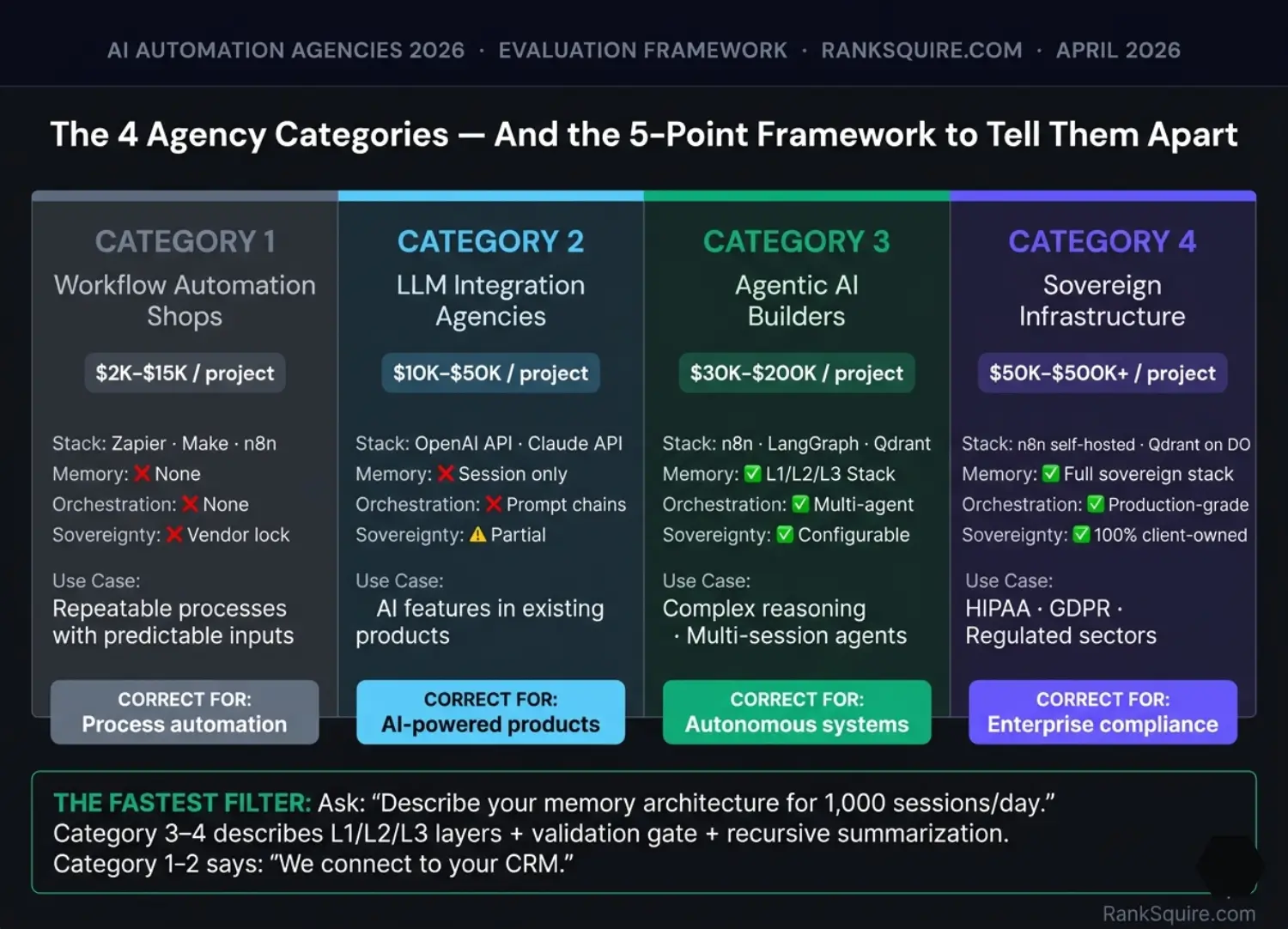
1. The 4 Categories of AI Automation Agencies
THE AGENCY TAXONOMY: 4 CATEGORIES OF AUTOMATION

2. The 5-Point Evaluation Framework
THE 5-POINT AGENCY EVALUATION FRAMEWORK
Run every agency through all five points. A failure on any single point is not a negotiation it is a signal to move to the next candidate.
Technical Stack Depth
The red flag answer describes tools, not architecture.
Sovereignty Posture
This is dependency with a dashboard on top.
Pricing Model Transparency
• Per-seat licensing for the tools they deploy.
Proof of Production
Memory and State Architecture
They are building stateless tools, not intelligent agents.

3. The 4 Red Flags That Predict Failed Engagements
4 RED FLAGS IN AI AUTOMATION ENGAGEMENTS
These four signals appear in the majority of AI automation engagements that end in scope creep, cost overruns, or systems that require constant manual intervention to function.
If an agency cannot provide: a reference system that has been running for 90+ days at production scale, monitoring dashboards showing real load, and at least one documented failure with resolution — then their portfolio is a collection of demos, not deployed systems.
Calculate: if their per-seat fee at your current team size exceeds $300/month, compare this against the cost of n8n self-hosted on DigitalOcean ($96/month fixed, zero per-seat fees, complete ownership). n8n vs Zapier Enterprise Cost Analysis ranksquire.com/2026/02/13/n8n-vs-zapier-enterprise-cost-analysis/
- State persistence between sessions
- Contradicting inputs from different sources
- Error recovery without human intervention
- Memory growth management over thousands of sessions
4. The Questions to Ask Before Signing
DUE DILIGENCE: THE 30-MINUTE COMPETENCE TEST

5. Recommended Tools — What Real Agencies Use
2026 PRODUCTION TOOL STACK STANDARDS
The tool stack is the fastest technical signal. Real agentic AI agencies in 2026 have converged on a specific set of tools because they have been tested at production scale and support sovereignty.
GPT-4o (OpenAI): Strong for multimodal tasks. Higher cost at scale than Claude.
Self-hosted (Ollama, vLLM): For sovereign deployments. Llama 3, Mistral, and Mixtral are the 2026 candidates.
AWS / GCP / Azure: For enterprises requiring HIPAA, FedRAMP, or SOC 2 Type II certifications.
• Make.com + Claude = workflow automation (Category 1–2)
• Retool + GPT-4o = internal tool builder (not agentic AI)
• HubSpot AI + Zapier = CRM automation (not AI agents)
None of these are wrong choices for the right problems. They are wrong choices presented as agentic AI. The distinction is the orchestration, memory, and sovereignty architecture — not the LLM brand.
5. Build vs Hire: The Decision Threshold
HIRE VS. BUILD: THE DECISION FRAMEWORK
- The automation requires multi-agent orchestration with more than 3 concurrent agent types
- The system requires persistent memory and learning across thousands of sessions
- Your internal team has no experience with n8n, LangGraph, or vector database implementation
- The timeline requires production delivery in under 90 days for a system of significant complexity
- Compliance requirements (HIPAA, GDPR, SOC 2) need to be built into the architecture from day one
- The automation is fewer than 10 workflow steps with predictable inputs and outputs
- Your engineering team has Python and API experience and 2–4 weeks of dedicated capacity
- The system does not require agent memory, reasoning loops, or adaptive behavior
- Budget for the agency engagement would exceed the internal build cost by more than 3×
The Cost Calculation:
| Variable | Estimated Production Cost |
|---|---|
| Agency Engagement (Category 3) | $50K–$150K |
| Internal Engineering Time | 3–6 months × 1–2 engineers |
| Infrastructure (Sovereign Stack) | $96–$300/month |
| LLM API (Production Load) | $200–$2,000/month |
| Total Year 1 Internal | $150K–$400K (Fully Loaded) |
For most mid-size organizations: hiring a Category 3–4 agency for the initial build and then handing over to an internal team is cheaper than a full internal build for complex agentic AI systems. For simple workflow automation: build internally using n8n on DigitalOcean.
6. How to Structure the Engagement
THE SOVEREIGN ENGAGEMENT STRUCTURE
The engagement structure protects you regardless of which agency you hire. These three clauses belong in every AI automation agency contract.
Without this clause: the agency retains control of infrastructure components as leverage for future retainer negotiations.
Approved by client CTO. Payment on document delivery and approval.
Core loops functional and verified by client engineering team.
Production deployment passing 2× expected peak concurrency.
30-day period complete, documentation delivered, team trained.
The engagement is complete only when:
- Your internal team can operate the system without agency involvement for 30 consecutive days
- All architecture documentation is delivered in a format your engineers can maintain
- All failure modes encountered during deployment are documented with resolution procedures
- A runbook exists for the 5 most likely system failures at production load
7. Conclusion
SUMMARY: THE 2026 AGENCY GAP
AI AUTOMATION SERIES · RANKSQUIRE 2026
AI Automation Agencies: How to Choose the Right One
The 5-point evaluation framework for CTOs. Red flags and contract clauses that protect your stack.
Best AI Automation Tool 2026: Ranked
n8n vs Zapier vs Make vs LangGraph — ranked by AI agent depth and sovereignty.
Read Guide → 💸 Cost Analysisn8n vs Zapier Cost Analysis 2026
The exact cost at scale. Why Zapier costs 15× more than self-hosted n8n.
Read Guide → ⭐ Pillar PostAgentic AI Architecture: The Complete Stack
Orchestration, memory, and tool-use loops from first principles.
Read Guide →8. FAQ: AI Automation Agencies 2026
What do AI automation agencies actually do?
AI automation agencies in 2026 design, build, and
deploy automated systems using AI tools, LLMs, and
agent orchestration frameworks. The spectrum is wide:
from connecting SaaS tools with Zapier and adding
an OpenAI API call, to building full multi-agent
systems with persistent vector memory, sovereign
self-hosted infrastructure, and adaptive reasoning
loops.
The term “AI automation agency” covers all
of these categories which is why the 5-point
evaluation framework matters. What a specific agency
actually builds is determined by their technical
stack, sovereignty posture, and ability to describe
their memory architecture. Not by their proposal deck.
How much do AI automation agencies charge?
AI automation agency pricing in 2026 ranges from
$2,000 per project for simple workflow automation
to $500,000+ for enterprise agentic AI deployments
on sovereign infrastructure. Category 1 workflow
shops: $2,000–$15,000. Category 2 LLM integration:
$10,000–$50,000. Category 3 agentic AI builders:
$30,000–$200,000.
Category 4 sovereign infrastructure
agencies: $50,000–$500,000+. The pricing model matters
as much as the total cost: project-based milestone
pricing protects the buyer. Retainer-first and
per-seat licensing models protect the agency.
What is the difference between an AI automation
agency and a workflow automation agency?
The distinction is architectural, not cosmetic.
A workflow automation agency connects existing
tools using trigger-action sequences Zapier,
Make.com, and n8n without agent orchestration.
These systems execute fixed processes with
predictable inputs.
An AI automation agency
builds systems that reason, decide, remember,
and adapt using LLM reasoning loops, multi-agent
orchestration, and persistent vector memory. The
output of a workflow automation agency is a
process. The output of a real AI automation
agency is an agent that improves over time.
How do I know if an AI automation agency is real?
Ask one question: “Describe your memory architecture
for a system that processes 1,000 sessions per day.”
A real agentic AI agency will describe L1 working
memory (Redis), L2 semantic vector memory (Qdrant),
L3 episodic log, validation gates, and recursive
summarization.
A workflow automation agency will
describe storing conversation history in a database
or connecting to your CRM. The answer takes under
2 minutes to give. If the agency cannot give it,
they are not building what they are selling.
Should I hire an AI automation agency or build internally?
Hire an agency when the system requires multi-agent
orchestration, persistent memory across thousands
of sessions, or compliance-grade sovereign infrastructure
and your internal team lacks this specific experience.
Build internally when the automation is fewer than
10 workflow steps with predictable inputs, your
engineering team has Python and API experience,
and 2–4 weeks of dedicated capacity is available.
For complex agentic AI systems, the agency build
plus internal handover is typically faster and
cheaper in Year 1 than a full internal build because the agency brings production-tested
architecture that would take an internal team
3–6 months to develop from scratch.
What should an AI automation agency contract include?
Every AI automation agency contract should contain
three non-negotiable clauses: a sovereignty clause
(all infrastructure and configurations are client
property, transferred before final payment), a
milestone-based payment structure (tied to verified
deliverables, not agency timelines), and a 90-day
handover protocol (system documentation, internal
team training, and 30 consecutive days of
independent client operation before the engagement
is considered complete).
Without these three
clauses, the agency has no contractual incentive
to produce a system your team can maintain and
extend independently.
FROM THE ARCHITECT’S DESK
CLOSING THOUGHT: ARCHITECTS VS. RESELLERS
Ask the question. Listen to the answer. The response in the first 30 seconds tells you everything about whether you are talking to an architect or a reseller.
AFFILIATE DISCLOSURE
This post contains affiliate links. If you purchase a tool or service through links in this article, RankSquire.com may earn a commission at no additional cost to you. We only reference tools evaluated in production architectures.